
Master restaurant labor cost percentage: Save Money and Boost Profits
Your restaurant's labor cost percentage is one of the most important numbers you can track. Simply put, it shows you what slice of your revenue is going toward paying and supporting your team. For most restaurants, a healthy labor cost percentage lands somewhere between 25% and 35% of total revenue, but this can shift depending on your specific concept. For the latest on industry trends and deals on restaurant equipment that can impact your bottom line, stay informed with us.
What Is Restaurant Labor Cost Percentage
Think of your labor cost percentage as a financial vital sign. Just like checking a pulse, this metric gives you a quick and clear reading on the operational health of your business. It tells you exactly how much of every dollar you earn is spent on your staff. Getting a handle on this number is the first real step toward building a sustainably profitable restaurant.
But this isn't just about the hourly wages for your servers or the salaries for your chefs. It's a much bigger picture. A true labor cost calculation has to include every single expense related to your workforce to give you an accurate view of what you're really investing in your team.
Components of Total Labor Cost
To get this number right, you have to look beyond the payroll report. Forgetting to include even one of the "hidden" costs can throw off your calculations, making you think you're more profitable than you actually are.
Here are the key costs you absolutely must include:
- Wages and Salaries: This is the big one—all hourly and salaried pay for every single employee, from the front-of-house host to the back-of-house manager.
- Payroll Taxes: Don't forget the employer's share. This includes your contributions to Social Security, Medicare, and unemployment taxes.
- Employee Benefits: The cost of health insurance, paid time off (PTO), sick days, and any 401(k) or retirement plan contributions add up quickly.
- Bonuses and Overtime: Any performance bonuses, holiday pay, or time-and-a-half for hours worked beyond the standard week need to be in the mix.
- Workers' Compensation: These insurance premiums are a direct labor expense required to protect your team in case of an on-the-job injury.
Understanding the full scope of these expenses is essential. Labor is one of the two largest controllable costs in any restaurant, the other being the cost of goods sold. Together, they form your prime cost, the most important number for gauging operational efficiency.
Keeping a close eye on your labor cost percentage gives you the insight needed to make smarter decisions. It helps you fine-tune everything from weekly schedules and training programs to your overall hiring strategy. Ultimately, it’s about finding that perfect balance between delivering an amazing guest experience and protecting your bottom line. For a deeper dive into how this fits into the bigger financial picture, check out our guide on the full restaurant operating costs breakdown.
How to Calculate Your Labor Cost Percentage
Ready to get a handle on your staffing expenses? Calculating your restaurant's labor cost percentage is one of the most important things you can do for your business's health. This isn't just for the accountants; it's a vital skill for any operator who wants to stay profitable.
This key metric takes all your complicated payroll data and boils it down to a single, powerful number. It tells you exactly how much of every dollar you earn is going toward paying your team.
At its heart, the formula is refreshingly simple.
The Labor Cost Percentage Formula:
(Total Labor Cost / Total Revenue) x 100 = Labor Cost Percentage
This calculation gives you a straightforward percentage, making it easy to spot trends, measure efficiency, and see how you stack up against industry benchmarks. Let's break down how to put this to work in the real world.
First, Get Your Numbers Straight
Before you can plug anything into that formula, you need to gather two key pieces of information from the exact same time period. You can't mix and match. If you're looking at March, you need March's labor costs and March's revenue.
-
Total Labor Cost: Getting this number right is the most common stumbling block. This is everything you spend on your employees, not just what's on their paychecks. Make sure you add up all hourly wages, manager salaries, overtime pay, payroll taxes, health insurance contributions, workers' compensation, and any bonuses you paid out. The first step is to accurately calculate total compensation, which covers every single cost associated with your staff.
-
Total Revenue: This one is much easier. It’s simply the total sales your restaurant brought in during that same period. You can almost always pull this number directly from your Point of Sale (POS) system reports.
Once you have those two totals, you're ready to see the formula in action.
Example 1: The Busy Full-Service Bistro
Let's imagine a bustling neighborhood spot called "The Corner Table." The owner wants to calculate the labor cost for March to see if they're on track for their quarterly goals.
- Total Revenue for March: $95,000
-
Total Labor Cost for March:
- Hourly Staff Wages: $19,500
- Manager Salaries: $7,000
- Payroll Taxes: $3,200
- Benefits (Health Insurance, PTO): $2,800
- Total Labor Cost: $19,500 + $7,000 + $3,200 + $2,800 = $32,500
Now, we just apply the formula:( $32,500 / $95,000 ) x 100 = 34.2%
The Corner Table's labor cost percentage for March is 34.2%. This number falls comfortably within the typical range for a full-service operation, giving the owner confidence they're on the right track.
Example 2: The Lean Quick-Service Cafe
Next, let's look at "Speedy Beans," a quick-service cafe built on a model of speed and efficiency. Their goal is to keep labor costs as tight as possible to offer competitive pricing.
- Total Revenue for March: $50,000
-
Total Labor Cost for March:
- Hourly Staff Wages: $10,500
- Manager Salary: $3,500
- Payroll Taxes: $1,600
- Benefits & Workers' Comp: $900
- Total Labor Cost: $10,500 + $3,500 + $1,600 + $900 = $16,500
Plugging their numbers into the same formula:( $16,500 / $50,000 ) x 100 = 33%
Speedy Beans comes in with a labor cost percentage of 33%. While that’s still a healthy number, it's actually a bit higher than the average for a QSR. This immediately signals to the manager that it might be time to take a closer look at the schedule or find ways to improve workflow.
As you can see, the same simple math can reveal powerful, actionable insights for completely different types of restaurants.
Benchmarking Your Labor Costs Against the Industry
Once you’ve calculated your restaurant labor cost percentage, that number is just floating there. Is 34% good? Is 28% too low? The truth is, the answer depends entirely on your specific restaurant. To figure out where you stand and set some realistic goals, you need to benchmark your number against industry averages.
There's no single "good" labor cost percentage. It's a moving target that changes with your service style, how complicated your menu is, and even the cost of living in your city. Think of it like a car's gas mileage—you wouldn't expect a heavy-duty truck to get the same MPG as a tiny hybrid. The same idea applies here.
This simple chart breaks down how you get from your raw labor and revenue numbers to that all-important percentage.
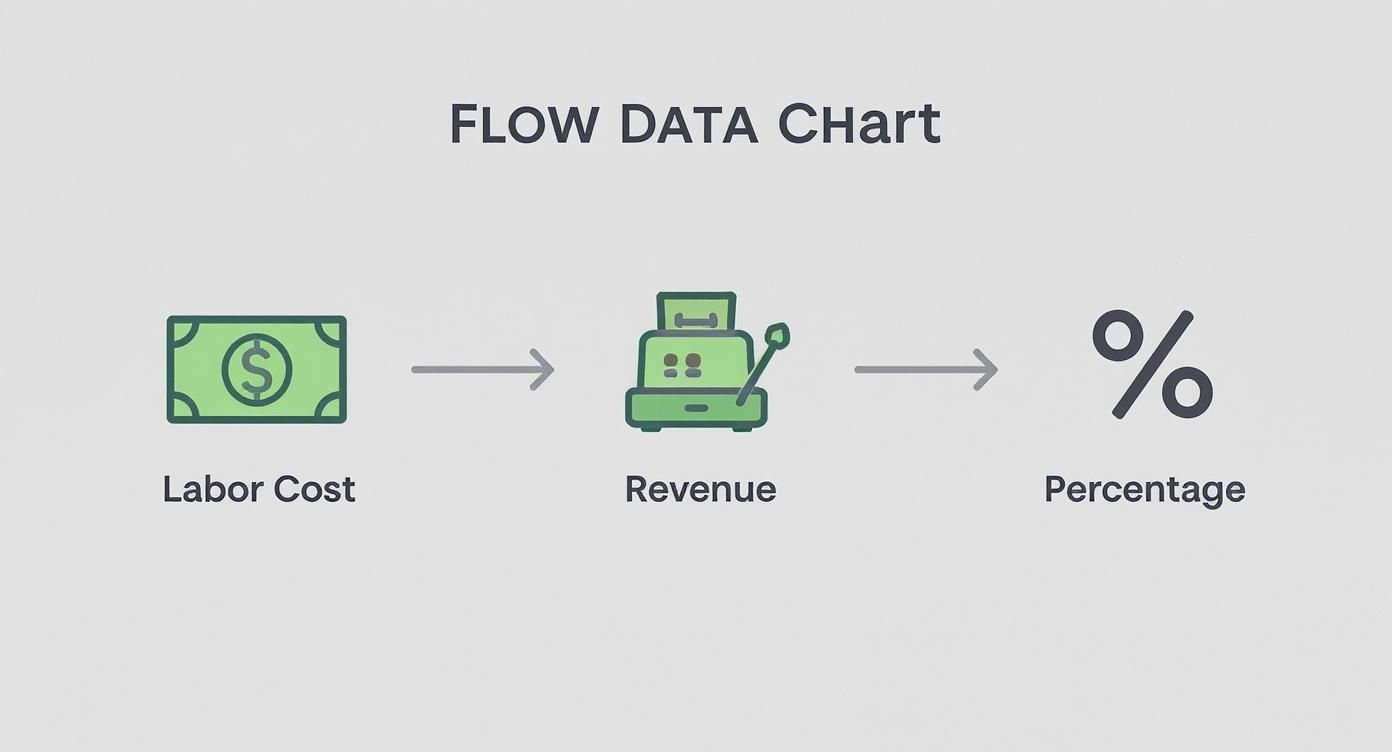
As you can see, it’s a straightforward calculation that turns two big financial numbers into one powerful health metric for your business.
Why Your Restaurant Type Matters So Much
Different kinds of restaurants have completely different staffing needs. A fine dining spot needs a big, highly skilled team—think sommeliers, specialized chefs, and plenty of servers—to create that premium experience, which naturally pushes labor costs up. On the flip side, a food truck can often get by with just two or three people who can do a bit of everything, keeping their labor percentage much lower.
The trick is to compare apples to apples. If you’re running a full-service bistro, trying to match the labor costs of a quick-service joint is just going to drive you crazy. You need to focus on the benchmarks for your specific category.
Typical Restaurant Labor Cost Percentage by Concept
Every restaurant is different, of course, but looking at industry data gives you a solid starting point. These ranges can help you see if your numbers are in the right ballpark for your style of business.
| Restaurant Type | Typical Labor Cost Percentage Range | Key Influencing Factors |
|---|---|---|
| Full-Service Dining | 30% - 38% | Extensive staff for table service, skilled BOH and FOH roles, longer guest dining times. |
| Fine Dining | 35% - 40% | Highly specialized chefs and sommeliers, high staff-to-guest ratio, complex menu preparation. |
| Fast-Casual | 28% - 33% | Counter service model with some food prep customization, requiring a moderately sized team. |
| Quick-Service (QSR) | 25% - 30% | Streamlined operations, simplified menu, smaller crews focused on speed and efficiency. |
| Cafes & Coffee Shops | 28% - 35% | Barista skill level, food program complexity, and peak-hour rushes influence staffing needs. |
| Food Trucks | 25% - 35% | Extremely small crews, but labor can spike if sales are inconsistent or prep is intensive. |
| Catering Operations | 30% - 40% | Labor needs fluctuate dramatically based on event size, menu, and service level required. |
While these percentages can vary, industry research shows most restaurants land somewhere between 20% to 30% of sales. Digging deeper, about 40% of restaurants keep labor between 20% to 25% of revenue, while another 26% are in the 26% to 30% range. Only a lean 15% of restaurants manage to keep labor under 20%, and another 15% find themselves struggling with costs over 30%.
Key Takeaway: Your labor cost percentage is a huge piece of your prime cost—the combination of your labor and your cost of goods sold (COGS). A healthy prime cost, which you should aim for in the 55% to 65% range, is one of the best indicators of your restaurant's overall profitability.
At the end of the day, these benchmarks aren't rigid rules; they're guideposts. They should prompt you to ask the right questions. If your labor costs are higher than others in your category, why? Are you overstaffed? Or are you paying more to keep amazing talent and provide a better guest experience that brings in more revenue? Understanding that "why" is how you really start to get a grip on your financials.
To get the full picture on this critical metric, check out our detailed guide on calculating your restaurant prime cost.
Finding the Hidden Drivers of High Labor Costs

So, your restaurant labor cost percentage is creeping up past where it should be. It’s a frustrating spot to be in, and the cause is rarely one single, glaring issue. More often, it's a mix of a few interconnected problems quietly siphoning money from your bottom line.
Just knowing your labor is high isn't the solution. To fix it, you need to understand why. That means putting on your detective hat and digging into your operations to find the root causes instead of just patching up the symptoms.
Inefficient Scheduling Practices
One of the first places I always look is the schedule. It's the most common culprit behind an inflated labor percentage. This isn't just about having too many people clocked in; it’s about having the right people at the right time.
Overstaffing during a slow Tuesday lunch burns cash just as surely as understaffing on a slammed Friday night leads to chaos, bad service, and a mountain of overtime pay.
Keep an eye out for these red flags:
- High Overtime Payouts: Are you constantly paying out time-and-a-half? That’s a dead giveaway your regular schedule isn't keeping up with customer demand.
- Idle Staff During Lulls: If you see servers gathered at the host stand or line cooks leaning during off-peak hours, you’re paying for downtime.
- Reactive Scheduling: Are managers making last-minute schedule changes based on gut feelings instead of using historical sales data from your POS?
The High Cost of Employee Turnover
Employee turnover is the silent killer of profitability in this business. Every time someone quits, you're hit with a wave of costs that go way beyond a simple "Help Wanted" ad. Think about it: you have manager hours spent on interviews, training resources for the new hire, and a dip in productivity while they ramp up.
High turnover traps you in a never-ending cycle of recruiting and training. It’s expensive, it’s disruptive, and it erodes your team culture. Replacing just one hourly employee can easily cost thousands of dollars when all is said and done.
This constant churn doesn't just inflate your labor line item. It tanks morale, creates an inconsistent guest experience, and ultimately hurts the revenue you need to cover those costs in the first place.
Unseen Productivity Killers
Even with a great schedule and a stable crew, low productivity can still push your labor costs higher. These are the little operational roadblocks that slow everyone down, forcing tasks to take longer than they should and pushing people into overtime.
It could be something as simple as a disorganized walk-in cooler that adds a minute to every ticket time, or it could be an old, slow piece of kitchen equipment that bottlenecks the entire line. These small inefficiencies add up fast. Discovering exclusive deals on the latest restaurant equipment and supplies can help you tackle these issues head-on.
They force you to either schedule more staff to accomplish the same amount of work or pay your current team overtime to get it all done. And this is all happening while external pressures are already squeezing you. A recent survey found that 88 percent of operators reported a jump in labor costs. With wages rising, you have to be ruthless about controlling the internal factors you can. You can dive deeper into the current restaurant cost trends on fsrmagazine.com.
Practical Strategies to Reduce Your Labor Costs
Knowing your labor cost numbers is one thing; actually doing something about them is another. The real work begins when you start implementing smart, practical strategies to control those expenses without ever cutting corners on the guest experience. It’s not about slashing hours—it's about working smarter.
By focusing on a few key areas, you can make a real dent in your restaurant labor cost percentage. The goal here is to build a more efficient and resilient operation where every dollar you spend on your team delivers the best possible return.
Build Smarter, Data-Driven Schedules
Stop guessing. The most effective way to manage labor is to build schedules based on hard data, not just last week’s template or a manager's gut feeling. Your Point of Sale (POS) system is sitting on a goldmine of this information.
Dig into your sales reports to pinpoint your busiest and slowest times, right down to the hour. Use this sales forecast to match your staffing levels to actual customer traffic. This means you’ll have all hands on deck for the Friday night rush but won't be paying people to stand around during a slow Tuesday lunch.
Modern scheduling software like 7shifts can automate most of this heavy lifting. These tools often sync directly with your POS, letting you see projected labor costs against sales in real time. This gives you the power to make adjustments before you blow your budget for the week.
Create a Versatile Team with Cross-Training
Picture this: a line cook calls out sick on a busy Saturday. In a rigid kitchen, that’s a recipe for disaster. But if you have a prep cook or dishwasher who knows their way around that station, they can jump in and keep the line moving without a hitch. That’s the power of cross-training.
Cross-training is one of the most valuable tools in your operational toolkit. When your employees can wear multiple hats, you create an incredibly flexible and adaptable team. A server who can mix drinks or a host who can help bus tables gives your managers the agility to cover gaps and handle surprise rushes without scrambling to call in extra staff.
This isn't just about operational flexibility—it's about empowering your people. Cross-training invests in their skills, makes them more valuable, and often leads to higher job satisfaction and better retention. And that directly fights the high cost of turnover.
In fact, it’s the go-to tactic in the industry. Recent reports show 68 percent of operators use cross-training to control labor costs. It's a key part of a wider strategy that includes adjusting scheduled hours (45 percent) and improving operational efficiencies (41 percent). You can see the full breakdown of these labor cost control tactics on 7shifts.com.
Reduce Costly Employee Turnover
High turnover is a silent killer of your bottom line. Every time an employee walks out the door, you’re on the hook for recruiting, hiring, and training their replacement. Those costs add up fast. Beyond the financials, a revolving door of staff can hurt team morale and create an inconsistent experience for your guests.
Fighting turnover starts with creating a positive culture where people feel valued. That means focusing on:
- Competitive Pay and Benefits: It’s fundamental. Paying people fairly is the first step to attracting and keeping great talent.
- Clear Paths for Growth: Show your team they have a future with you. Create clear pathways for a server to become a manager or a prep cook to become a chef.
- A Supportive Environment: Foster open communication, recognize great work, and deal with conflict constructively. Make your restaurant a place people want to come to work.
Investing in your team's well-being is a direct investment in your business. A stable, experienced crew is more efficient, makes fewer mistakes, and delivers the kind of top-notch service that keeps customers coming back.
Invest in Labor-Saving Technology and Equipment
Sometimes, you have to spend money to save money. The right technology and equipment can automate repetitive work, streamline processes, and make your entire team more productive. Restaurant owners and chefs can discover the latest news and exclusive deals on these essential tools.
Think about the return on investment (ROI) for tools like these:
- Modern POS and KDS Systems: A top-tier Point of Sale (POS) system linked to a Kitchen Display System (KDS) fires orders to the kitchen instantly and accurately. This simple connection cuts down on errors, speeds up ticket times, and reduces food waste.
- High-Efficiency Kitchen Equipment: A high-capacity dishwasher that can run a rack in 90 seconds frees up a person to do other, more valuable tasks. The same goes for powerful food processors or combi ovens that can slash hours of manual prep time.
Each of these investments helps a smaller, more focused team achieve more. By taking the tedious work off their plates, you let your staff focus on what truly matters: creating amazing food and taking care of your guests.
Using Data to Continuously Optimize Labor Costs
Getting a handle on your restaurant labor cost percentage isn't a "set it and forget it" kind of deal. It's a constant rhythm of measuring what's happening, making smart adjustments, and seeing what works. To really get good at this, you have to look past the main percentage and start thinking with data.
When you track a few key performance indicators (KPIs), you're essentially creating a dashboard for your restaurant's health. It lets you stop putting out fires and start making strategic moves, spotting trends before they turn into full-blown problems.
Key Labor KPIs to Track
To get the full story of your labor efficiency, you need more than just one number. Each of the following metrics shines a light on a different corner of your team's performance, helping you find exactly where you can improve.
Here are three metrics I always recommend keeping a close eye on:
- Sales Per Labor Hour (SPLH): This is a powerful one. It tells you exactly how much revenue you’re bringing in for every single hour an employee is on the clock. It's a straight-up measure of productivity. Just divide your total sales for a period by the total hours worked in that same period.
- Labor Cost Per Guest: This connects your labor spend directly to your customer flow. It helps you figure out if you're scheduling the right number of people for the number of guests walking through the door. To get it, divide your total labor cost by the number of guests you served.
- Employee Turnover Rate: High turnover is a silent killer of your budget. Think about it: the costs of recruiting, hiring, and training a new person—not to mention the lost productivity while they get up to speed—add up fast. Tracking this number is a great way to check the pulse of your company culture and see if your efforts to keep good people are paying off.
By looking at these numbers every week or two, you can quickly see if a slow sales period is hurting your labor efficiency or if your scheduling is just off. That's the kind of detail that lets you make precise, effective changes instead of just guessing.
Turning Data into Actionable Strategy
Once you start tracking these KPIs, you'll begin to see the story your numbers are telling. Understanding how to use effective data analytics for small businesses is what turns those raw numbers into a real game plan for your restaurant.
This isn't just theory; it's essential for staying competitive. For instance, recent National Restaurant Association data showed the median labor cost for full-service restaurants was 36.5% of sales, with quick-service spots coming in a bit lower at 31.7%. Knowing exactly how your restaurant stacks up against these benchmarks helps you set goals that are both ambitious and achievable.
At the end of the day, looking at your data consistently helps you build smarter schedules, recognize your most productive team members, and make financial decisions that protect your bottom line. To see how all these numbers fit into the bigger picture of your restaurant's finances, check out our restaurant profit margin calculator.
A Few Final Questions
Even after you've got your systems dialed in, questions about managing labor costs always pop up. Here are some of the most common ones I hear from fellow operators and chefs.
What Is Prime Cost and How Does Labor Fit In?
Think of prime cost as the true vital sign of your restaurant's financial health. It's the big one.
Prime cost bundles your two biggest controllable expenses together: the total cost of goods sold (COGS) and your total labor cost. This number tells you exactly how much it costs to create your menu items and get them to the guest. Labor is, of course, a massive piece of that puzzle.
Most successful restaurants aim to keep their prime cost between 55% and 65% of total sales. If your labor gets out of line, your prime cost goes with it, and your profitability takes a direct hit.
How Often Should I Calculate My Labor Cost Percentage?
Don't wait until the end of the month. You need to be running these numbers at least once a week.
A monthly calculation is better than nothing, but it's like looking in the rearview mirror—the damage is already done. A weekly check-in lets you see a problem developing, like unexpected overtime or a slow Tuesday, and fix it before it torpedoes your whole period.
What’s the Best Way to Schedule Staff to Avoid Overtime?
Stop copying and pasting last week's schedule. The absolute best way to crush unnecessary overtime is to build your schedule based on sales forecasts.
Dig into your POS data. See when you're actually busy and when you're dead. Staff up for the Friday night rush and run lean on a slow Wednesday afternoon. It’s all about matching your team to your real-world demand.
This proactive approach stops the panic that leads to paying time-and-a-half. It's no secret that finding and keeping good people is tough—28.42 percent of operators say it's their biggest headache. This has forced restaurants to raise wages and invest more in training, which makes smart, efficient scheduling more critical than ever. You can dive deeper into this by reading the full report on restaurant industry labor costs on fsrmagazine.com.
At Encore Seattle Restaurant Equipment, we know that controlling costs means having the right tools for the job. From high-efficiency dishwashers that save hours of labor to combi ovens that completely change your kitchen's workflow, our selection of new and used equipment is here to boost your team's productivity and protect your bottom line. We help restaurant owners and chefs stay informed about industry trends and discover the latest news and exclusive deals on restaurant equipment and supplies. Equip your restaurant for success at https://encoreseattle.com.