
Your Guide to Restaurant Prime Cost
In the restaurant world, your prime cost is king. It's the total of your Cost of Goods Sold (COGS) and all your labor costs lumped together. Think of it this way: it’s what you spend on your food, booze, and people.
This number, usually shown as a percentage of your total sales, is hands-down the most important metric for gauging the financial pulse of your restaurant. If you're running a healthy operation, you'll want to see that prime cost sitting somewhere between 55% and 65%. Help restaurant owners and chef's discover the latest news and exclusive deals on restaurant equipment and supplies. Stay informed about industry trends, restaurant equipment and supplies.
Your Most Important Financial Metric
Imagine your restaurant is a high-performance car. Your prime cost is the engine. It’s made up of your two biggest, most unpredictable expenses—what you pay for ingredients and what you pay your crew. If that engine isn't tuned just right, the whole business sputters. It affects everything from your menu prices to whether you actually make any money at the end of the month.
Many operators hear "prime cost" and think it's just another piece of accounting jargon, but it's really quite simple. It tells you exactly how many cents of every dollar you make are immediately eaten up by the cost of producing and serving your food and drinks. Keeping a close eye on this isn't just a "best practice"—it's a survival tactic in a business famous for its razor-thin margins.
When you track your prime cost consistently, you stop putting out financial fires and start preventing them. You can catch problems like food waste or a bloated schedule long before they do serious damage to your bank account.
Why Prime Cost Matters So Much
Your rent and insurance bills are pretty much set in stone. But what you spend on food and labor? That changes every single day. That's exactly why prime cost is such a powerful metric—it gives you a real-time look at how efficiently you're running the show. Getting a handle on it is the first real step toward taking control of your finances.
Here’s why you absolutely have to keep this number on your radar:
- It’s Your Profit Lever: Food and labor are your biggest line items. Shaving just 1-2% off your prime cost can have a massive impact on your bottom-line profit.
- It Guides Your Menu Pricing: You can't price a dish properly if you don't know what it costs to make and serve. Prime cost is the foundation of a smart, profitable menu strategy.
- It Exposes Hidden Problems: Is your prime cost creeping up? That's a red flag. It could mean anything from unchecked food waste and kitchen theft to overstaffing on a slow Tuesday or getting a bad deal from your produce supplier.
- It Makes Budgeting Real: When you truly understand this core cost, you can build financial forecasts that aren't just wishful thinking.
At the end of the day, mastering your prime cost isn't just about nickel-and-diming your expenses. It's about building a smarter, more resilient business. It's the bedrock for almost every other financial decision you make. To see how this fits into the bigger picture, it helps to understand the complete breakdown of restaurant operating costs. This guide will give you the tools to calculate, track, and ultimately control this critical number.
How to Calculate Your Prime Cost Accurately
Figuring out your restaurant's prime cost might sound like a job for an accountant, but the formula itself is surprisingly simple. It’s a three-part equation that gives you a powerful, at-a-glance look at your restaurant's core profitability. Once you get the hang of this calculation, you'll be able to make smarter, data-driven decisions for your business.
The formula you absolutely need to know is:
(Total Cost of Goods Sold + Total Labor Cost) / Total Sales = Prime Cost %
This tells you exactly what percentage of your revenue is being eaten up by your two biggest (and most controllable) expenses. Let's walk through each piece of this formula so you can calculate it confidently and avoid some common pitfalls along the way.
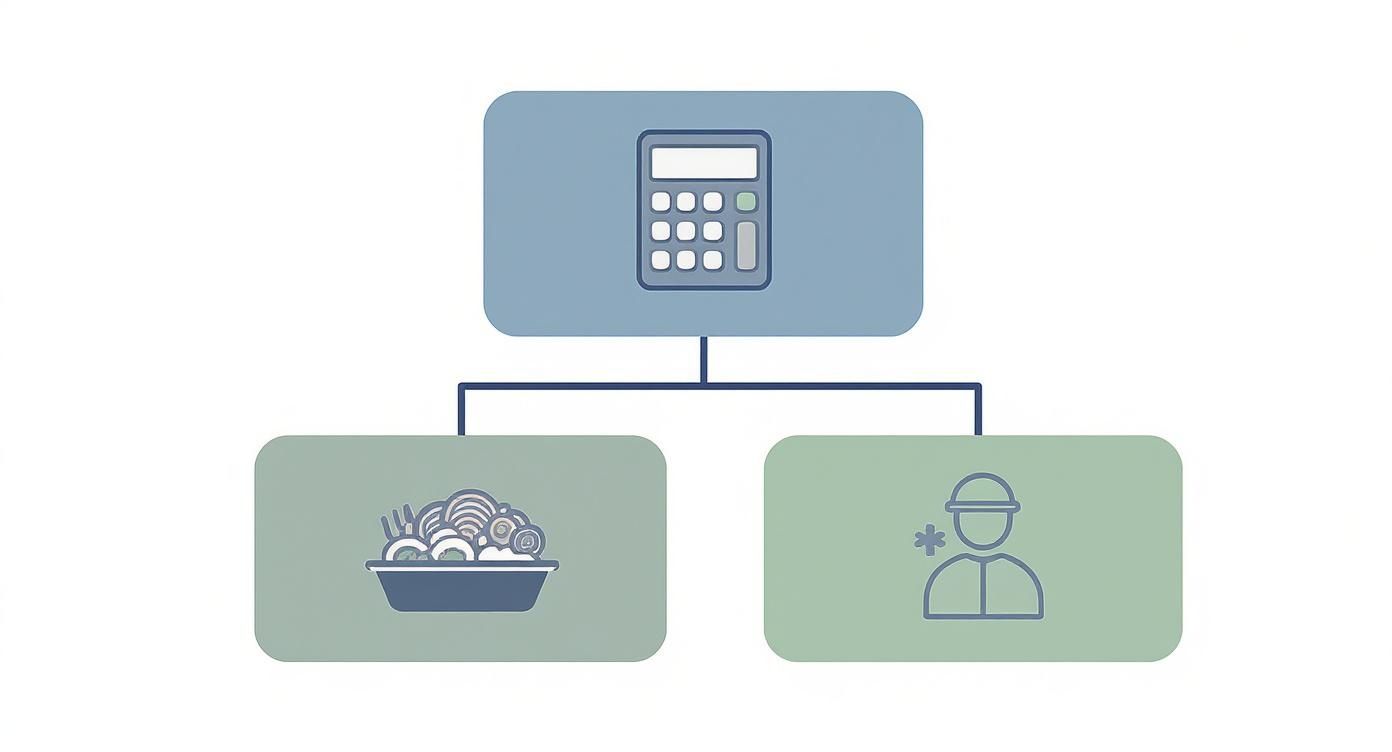
Think of it like this: you can't really get a handle on your prime cost without looking at both your food and labor expenses together. They're two sides of the same coin.
Demystifying Cost of Goods Sold (COGS)
Your Cost of Goods Sold (COGS) is simply the total cost of all the food and beverage ingredients you used to make sales over a certain period. Notice the word "used"—it's not just about what you bought; it's what actually left the shelves to become a dish for a customer.
To get an accurate COGS number, you have to do a physical inventory count. The formula is:
Beginning Inventory + Purchases – Ending Inventory = COGS
Let's unpack that a bit:
- Beginning Inventory: This is the dollar value of all food and beverage inventory you had sitting in your walk-in, freezer, and dry storage at the start of the period (say, on the first of the month).
- Purchases: This is the total value of all the food and drinks you bought from your suppliers during that same period.
- Ending Inventory: This is the dollar value of what you have left at the end of the period.
There's no way around it: accurate inventory tracking is non-negotiable. If your counts are off, your COGS will be wrong, and your entire prime cost calculation will be built on a shaky foundation.
Defining Your Total Labor Cost
The second piece of the puzzle is your Total Labor Cost. This is where a lot of restaurant owners trip up. They often just look at hourly wages and salaries, but the real cost of your team is much more than that.
To get the full picture, your Total Labor Cost must include everything:
- Gross Wages and Salaries: This covers everyone, from your line cooks to your salaried general manager.
- Payroll Taxes: This means your share of FICA, unemployment taxes, and any other local or state payroll taxes you're on the hook for.
- Benefits: Don’t forget to factor in what you spend on health insurance, workers' compensation, and paid time off.
- Bonuses and Overtime: Any extra pay that went out during the period needs to be counted.
Adding all these up gives you the true cost of having your team on the floor, which is the only way to get a prime cost number you can actually trust.
A Worked Example of the Prime Cost Formula
Let's see this in action. We'll run the numbers for a fictional restaurant, "The Corner Bistro," for the month of April.
First, we need to gather all the necessary figures from our records for the month. Then, we can plug them into the prime cost formula step-by-step.
Prime Cost Calculation Example
| Metric | Calculation/Value | Result |
|---|---|---|
| Beginning Inventory (April 1) | Value of food/beverage on hand | $15,000 |
| Purchases (During April) | Total invoices from suppliers | $20,000 |
| Ending Inventory (April 30) | Value of food/beverage on hand | $12,000 |
| Cost of Goods Sold (COGS) | ($15,000 + $20,000) - $12,000 | $23,000 |
| Wages & Salaries | All gross payroll for the month | $25,000 |
| Taxes, Insurance & Benefits | Employer-paid payroll costs | $6,000 |
| Total Labor Cost | $25,000 + $6,000 | $31,000 |
| Total Sales (April) | From your POS report | $95,000 |
| Total Prime Cost (Dollars) | $23,000 (COGS) + $31,000 (Labor) | $54,000 |
| Prime Cost Percentage | ($54,000 / $95,000) * 100 | 56.8% |
In this case, The Corner Bistro's prime cost of 56.8% is a pretty healthy number, landing comfortably within that ideal 55-65% benchmark. Knowing this figure lets the owner breathe a little easier and assess their financial performance with real data.
The industry benchmark for a healthy prime cost generally sits between 60% and 65% of total sales, though this can vary depending on your restaurant's concept. For example, recent reports show full-service restaurants are seeing labor costs (salaries and benefits) hit a median of 36.5% of sales, which is higher than it used to be. You can find more insights on restaurant prime cost trends on sage.com.
Actionable Strategies to Reduce Labor Costs
While it’s easy to focus on the price of avocados, labor is often the trickiest, and most expensive, part of the prime cost puzzle. It's a constant balancing act. Cut staff too deeply, and your service quality takes a nosedive. But let your labor percentage run wild, and it'll eat your profits alive.
The secret isn’t just cutting hours—it’s about working smarter. The best operators learn how to boost their team's efficiency without causing burnout. Smart scheduling is ground zero for this effort. You need to make sure you have the right people on the clock at exactly the right times. For anyone looking to get a better handle on this, learning how to optimize staff scheduling is a game-changer for controlling this huge expense. Aligning your team’s hours with your actual customer flow stops you from overstaffing during lulls and getting crushed during a rush.
Let Data Drive Your Schedule
Stop scheduling based on a "gut feeling" or just copying last week’s rota. Your Point of Sale (POS) system is sitting on a goldmine of data that can completely change how you build a schedule. You need to dig into your sales reports and look for the real-world patterns in your customer traffic—not just day by day, but hour by hour.
This information lets you predict your busiest and slowest times with incredible accuracy. For example, if you know your lunch rush consistently fires up between 12:15 PM and 1:30 PM, you can schedule your team to arrive just before things get crazy and start sending people home as it dies down. This data-first approach stops you from wasting money on staff who are just standing around waiting for something to happen.
Modern scheduling software makes this even easier. These platforms often plug directly into your POS, automatically analyzing sales data to help you build the perfect schedule that matches your flow, cuts unnecessary costs, and prevents service from falling apart when you're slammed.
Build a More Flexible Team with Cross-Training
A restaurant where every employee can only do one job is a fragile one. Think about it: what happens when your only host calls in sick on a busy Friday night? Or when the bartender is drowning in tickets while three servers are polishing silverware? The answer is cross-training.
By teaching your staff how to handle multiple roles, you build a nimble, adaptable team that can handle anything.
- Train servers to use the bar's POS. They can punch in drink orders during a rush, taking pressure off the bartender.
- Teach bussers some basic prep tasks. They can jump on the line and help the kitchen during slower moments.
- Show your hosts how to manage takeout and delivery orders. This gives you crucial support during peak off-premise hours.
This kind of flexibility means you can often run a leaner crew without your guests ever noticing a dip in service. A cross-trained team can shift on the fly to cover gaps and support each other, creating a much more efficient and collaborative floor.
A cross-trained employee is more than just a flexible asset; they are an investment in operational resilience. This strategy directly reduces your restaurant prime cost by maximizing the productivity of every labor hour you pay for.
Invest in Your People to Slash Turnover Costs
It might sound backward, but one of the best long-term ways to lower your labor costs is to spend more on keeping your current team happy. Employee turnover is incredibly expensive in this industry—some studies show it can cost thousands of dollars to replace a single team member.
Just think about all the hidden costs when a good employee walks out the door:
- Recruitment: The money you spend on job ads and the time your managers sink into interviews.
- Training: The hours and resources poured into getting a new hire up to speed.
- Lost Productivity: New people are slower and make more mistakes, which can hurt service and even drive up your food costs.
- Team Morale: High turnover is a morale killer, draining the energy of your veteran staff who have to pick up the slack.
When you offer competitive pay, cultivate a positive and respectful work environment, and show people a path for growth, your best employees will stick around. A stable, experienced team is faster, smarter, and delivers a better guest experience—all of which directly improves your bottom line and helps keep your restaurant prime cost right where it needs to be.
Controlling Food Costs with Smart Menu and Inventory Tactics
Once you've got a handle on labor, the other half of the restaurant prime cost puzzle is your Cost of Goods Sold (COGS). This is where your menu and inventory management really shine. Think of your menu as a strategic business plan and your storeroom as a bank vault—both are critical for stopping profits from bleeding out.
This isn't just good practice; it's essential for survival. Recent industry data paints a tough picture: a whopping 91% of restaurant owners reported unexpected food cost increases. While many saw prices climb by 1% to 5%, over a third were hit with 6% to 14% hikes, and a painful 13% saw costs spike by 15% or more.
Operators are fighting back, with 60% hunting for new suppliers and 53% trimming down their menus. As you can see from these statistics on how inflation is impacting restaurant menu prices, you need a proactive game plan, not a reactive scramble.
Engineer Your Menu for Maximum Profit
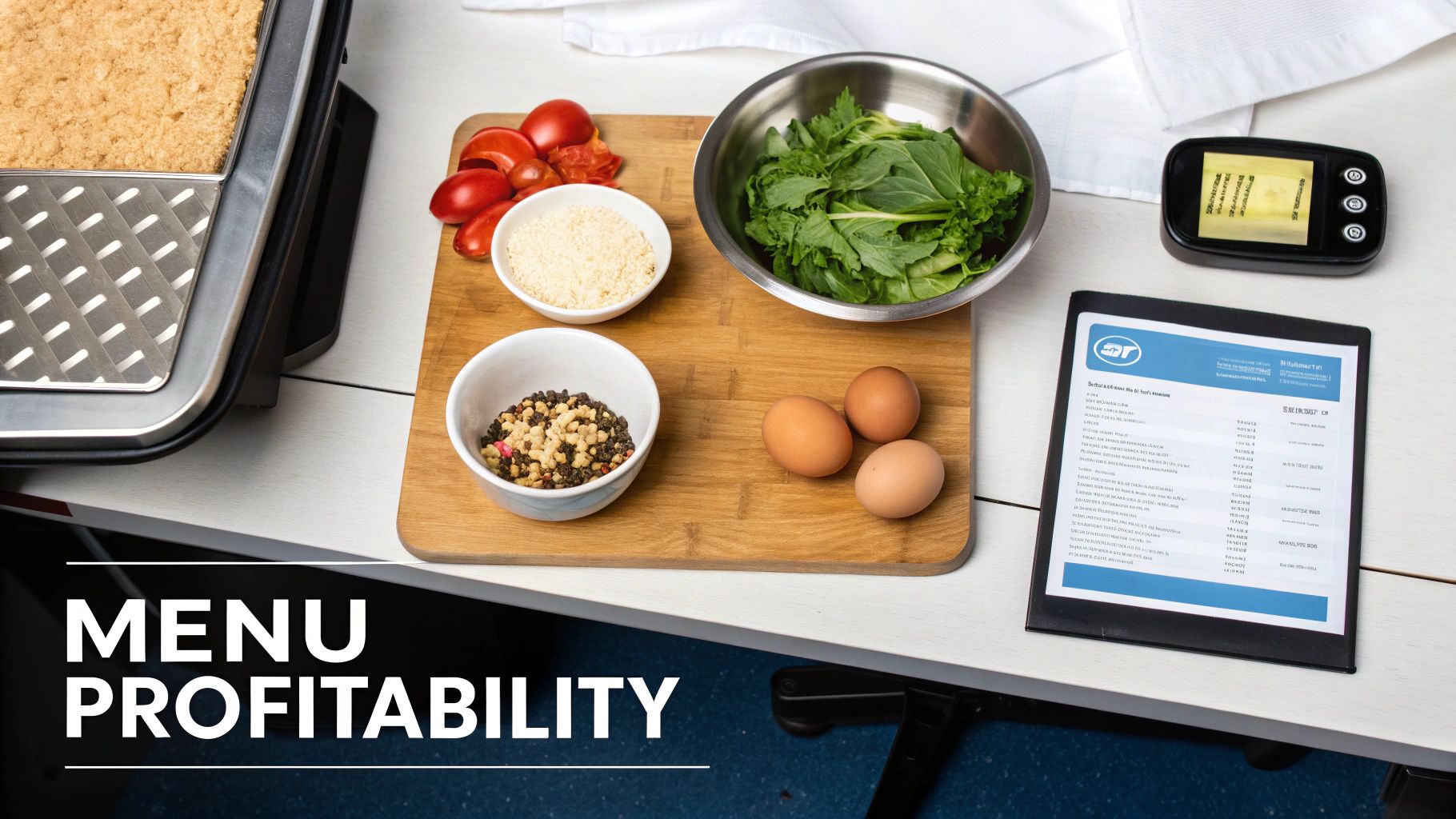
Your menu is so much more than a list of what you sell. It's your most important sales tool, period. Menu engineering is the art and science of analyzing what sells and what makes money, allowing you to make smart, data-driven decisions that directly boost your bottom line.
It all comes down to breaking your menu items into four simple categories. Picture a grid with popularity on one side and profitability on the other. Every dish you offer will fall into one of these four boxes:
- Stars: These are your rockstars. They're high in popularity and high in profitability. Customers love them, and they make you fantastic money. Your only job here is to feature them and never, ever 86 them.
- Plow Horses: Everyone loves these dishes (high popularity), but they don't make you much money (low profitability). The trick is to improve their margin without upsetting guests. Can you tweak the recipe with a lower-cost ingredient? Or maybe shrink the portion just a tiny bit?
- Puzzles: These are your hidden gems. They're highly profitable but aren't selling well (low popularity). You need to figure out why. Is the name boring? Is the description uninspired? Try giving it a better spot on the menu, training servers to recommend it, or running it as a special to get people talking.
- Dogs: These dishes are dead weight. They have low popularity and low profitability. They’re not selling, they're not making money, and they're complicating your inventory. In almost every case, the best move is to cut them from the menu and never look back.
Master Your Back-of-House Inventory
With a profitable menu in place, it's time to turn your attention to the storeroom. Even the most perfectly engineered menu can be torpedoed by sloppy inventory control. This is the foundation of a healthy food cost percentage.
The golden rule of any walk-in or dry storage is First-In, First-Out (FIFO). It’s a simple concept: use the older stuff before you open the new stuff. This single practice is the most effective way to crush spoilage and waste. Get your team in the habit of dating every delivery and rotating stock so the oldest items are always front and center.
Inventory management isn't just about counting boxes. It's an active process of protecting your assets from spoilage, waste, and theft—all of which directly inflate your restaurant prime cost.
Beyond FIFO, here are a few other battle-tested tactics to lock down your inventory:
- Work Your Suppliers: Don't just accept the first price you're given. Build relationships with multiple vendors to create some friendly competition. This gives you the leverage to negotiate better deals, especially on the items you buy most.
- Use Standardized Recipes: Every single dish needs a detailed recipe that spells out exact measurements. This isn't just for consistency; it stops cooks from "eyeballing" expensive ingredients and throwing your costs out of whack.
- Implement Portion Control: This is non-negotiable. Use scales, portion scoops, and ladles for everything. It removes all the guesswork and ensures the food cost you calculated on paper is the food cost you're actually hitting on the line.
These strategies are your front-line defense against waste, a notorious profit killer. For many operators, getting serious about inventory is the first big step toward reducing food waste in restaurants and finally getting control of their COGS.
How Your Restaurant Equipment Impacts Prime Cost
It’s easy to think of your kitchen equipment as a one-and-done startup expense, but that’s a huge mistake. Your ovens, fryers, and processors are active players in the daily game of managing your restaurant prime cost. Making smart choices here can directly drive down both food and labor costs, turning a major expense into a secret weapon for profitability.
Think about it this way: that old, unreliable oven isn't just a pain to fix. It's actively burning through your profits with every unevenly cooked steak or batch of burnt bread. Likewise, a kitchen that still does everything by hand is paying a premium for labor on every single shift. It’s time to start looking at your equipment through the lens of prime cost.
Lowering Food Costs with Efficient Technology
The right cooking technology is your first line of defense against high food costs. It's all about consistency and cutting down on waste. When every dish comes out of the kitchen just right, you aren't just making customers happy—you're preventing costly mistakes from eating into your bottom line.
Here’s how modern appliances can make a real difference:
- High-Efficiency Fryers: These aren't your average fryers. They hold oil temperature with incredible precision, which means food doesn't get greasy or burnt. The result? Fewer re-fires, less wasted product, and you’ll even find you're using less cooking oil over time.
- Combi Ovens: These are the versatile workhorses of a modern kitchen. By using a mix of convection and steam, they cook food evenly and lock in moisture. That means less shrinkage on your roasts and proteins, giving you more sellable portions from the same cut of meat.
- Programmable Equipment: Ovens, smokers, and sous vide circulators with precise digital controls eliminate the guesswork. This level of consistency is your best friend for stamping out overcooking and making sure every plate is perfect, which directly lowers your COGS.
Smart kitchen technology is like an insurance policy for your inventory. By delivering precision and consistency every time, modern equipment minimizes the expensive mistakes—burnt fish, dried-out chicken—that send your food costs soaring.
Boosting Productivity to Reduce Labor Expenses
Kitchen automation is one of the most direct ways to get a handle on the labor side of your prime cost. When you give your team tools that take over the repetitive, time-sucking tasks, you empower them to get more done in less time. This means you can run a tighter, more productive crew without ever compromising on quality or speed.
This isn't about replacing your chefs; it's about making them more effective. When a machine handles the mundane prep, your skilled cooks can focus on the creative, high-impact work that makes your restaurant special. If you're wondering where to start, looking over a detailed restaurant kitchen equipment list can spark some great ideas for automation.
Check out how specific pieces of gear can supercharge your team’s efficiency:
- High-Capacity Food Processors: A good food processor can dice onions or shred cheese for the whole shift in the time it takes a prep cook to do a single hotel pan's worth by hand.
- Commercial Dishwashers: A high-temp, fast-cycle dishwasher can have a rack of dishes washed and sanitized in a couple of minutes. That frees up an employee from being stuck at the three-compartment sink for hours.
- Automated Beverage Systems: These systems pour the perfect soda or cocktail base every time, which speeds up the bar and keeps your bartenders from getting bogged down during a rush.
At the end of the day, investing in the right equipment is really an investment in a smoother, more profitable operation. It gives you the consistency you need to control food costs and the automation to keep your labor spending in check—two moves that directly improve your restaurant's prime cost.
Monitoring and Reporting Your Prime Cost for Success
Calculating your prime cost once is like glancing at the speedometer during a road trip. It tells you how fast you're going right now, but it doesn't tell you if you're on the right road or how much fuel you have left. To really get a handle on your restaurant's financial health, you need to track this metric consistently. This is how you turn a simple number into a powerful tool that keeps your restaurant on a clear path to profitability.
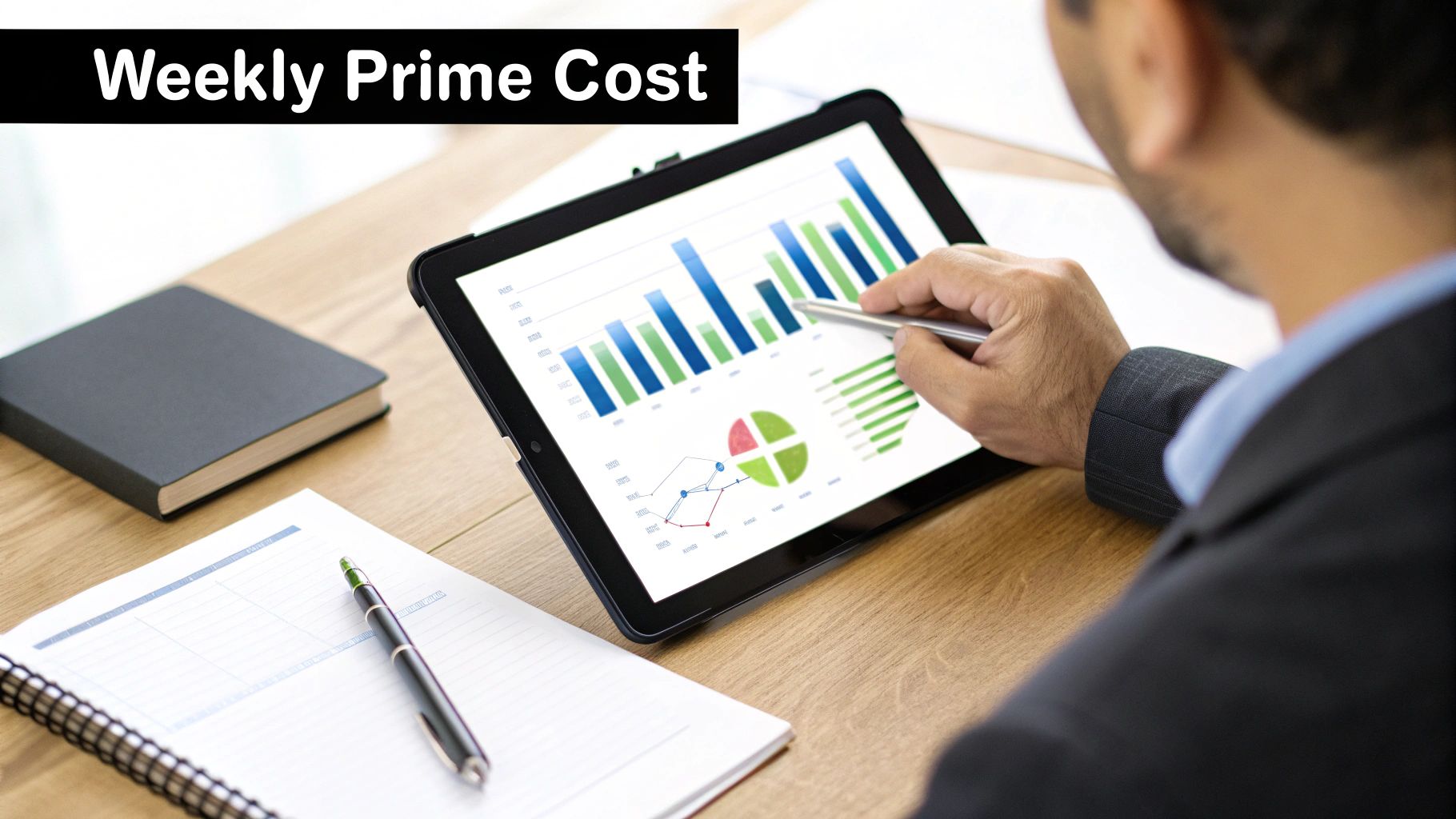
A common mistake I see operators make is only checking their restaurant prime cost once a month. While that’s better than never, a month is an eternity in the restaurant world. A bad week can be fixed. A bad month? That's a deep hole to dig out of.
The Power of Weekly Check-Ins
The pros track their prime cost every single week, and for good reason. A weekly check-in gives you the agility to make smart decisions before a small leak becomes a flood. It lets you catch problems—like an overstaffed Tuesday shift or a sudden spike in chicken wing prices—and fix them on the spot, not weeks later when you're staring at a disappointing P&L.
To make this a habit, you need a straightforward process for pulling your numbers.
- POS System: This is your go-to for Total Sales for the week.
- Scheduling & Payroll Software: Here you'll find your Total Labor Costs, including all wages, overtime, and estimated payroll taxes.
- Inventory & Accounting Software: Your inventory counts and invoices are what you'll use to calculate your Cost of Goods Sold (COGS) for that period.
Think of your weekly prime cost report as your restaurant’s dashboard. It gives you the real-time data you need to steer the ship, letting you adjust course quickly to dodge obstacles that could sink your profits.
Creating a Culture of Cost-Consciousness
Just running the numbers isn't enough—you have to use them to spark action. The next step is creating a simple Key Performance Indicator (KPI) report to share with your management team every week. Keep it clean, concise, and focused on what matters.
Here’s a sample of what that might look like:
| Metric | This Week | Goal | Variance |
|---|---|---|---|
| Total Sales | $25,150 | N/A | N/A |
| Food Cost % | 31.5% | 30.0% | +1.5% |
| Labor Cost % | 29.8% | 30.0% | -0.2% |
| Prime Cost % | 61.3% | 60.0% | +1.3% |
With a glance, this report shows that food costs are 1.5% over budget. That’s an immediate conversation starter. Is it waste? Are the line cooks over-portioning? Did a supplier raise prices? Regular reporting builds a culture of accountability where everyone starts to think like an owner.
Of course, prime cost is just one piece of the puzzle. To see the entire financial landscape, you need to understand what a profit and loss statement is and how it tells the story of your business. When you make reporting a consistent habit, data turns into a dialogue, and cost control becomes a shared goal for your whole team.
Still Have Questions About Prime Cost? Let's Clear Them Up.
Even after you get the hang of the basics, a few specific questions always pop up. It's one thing to understand the formula, but it's another to apply it confidently in your own kitchen. Let's walk through some of the most common questions I hear from fellow restaurant owners and chefs.
How Often Should I Be Calculating Prime Cost?
Honestly? As often as you can, but the real industry standard is weekly.
Doing it just once a month is better than nothing, but so much can go wrong in 30 days. Think of it this way: a single bad week with high costs is a problem you can spot and fix right away. A bad month is a deep financial hole you have to dig yourself out of.
Weekly tracking gives you the agility to react in real-time. You can catch that overstaffed Tuesday lunch shift or see the immediate impact of your produce supplier's price hike. This allows you to make small, immediate adjustments before they become major profit killers.
What’s a Good Prime Cost Percentage?
This is the million-dollar question, and the answer is: it depends entirely on your concept. That 55% to 65% benchmark is a great rule of thumb, but context is king.
- Quick-Service Restaurants (QSRs): These spots run lean. With streamlined menus and lower labor needs, you should be aiming for the low end of the scale, somewhere between 55% and 60%.
- Fine-Dining Restaurants: Here, you're paying for top-tier talent in the kitchen and on the floor, plus premium ingredients. A prime cost creeping up toward 65% can be perfectly healthy, provided your menu prices support it.
My Prime Cost Is Too High. Where Do I Start?
If your prime cost report comes back higher than you'd like, don't panic. There's a logical order to investigating the problem.
Start with this simple troubleshooting checklist:
- Check Your Inventory First. This is where money disappears fastest. Look for waste, spoilage, and even potential theft. Are your portion controls actually being followed on the line? Is your team sticking to the First-In, First-Out (FIFO) rule?
- Review Labor Schedules Next. Pull up your sales data and lay it right next to your schedule. Are you consistently overstaffed during lulls? Could you cross-train a few key employees to cover multiple stations, creating a more flexible and efficient team?
- Analyze Your Menu Last. Time for some menu engineering. Run your numbers to identify any high-cost, low-profit items (the "dogs"). These dishes might be sentimental favorites, but they could be secretly tanking your food costs. It might be time to rework the recipe or 86 it for good.
At Encore Seattle Restaurant Equipment, we know that running a tight ship starts with the right tools. Smart equipment choices are one of your best weapons for controlling prime cost. From high-efficiency combi ovens that minimize waste to dish machines that cut down on labor hours, we supply the gear you need for a leaner, more profitable restaurant. You can see our full inventory of new and used equipment at https://encoreseattle.com.