
The Ultimate Guide to a Restaurant Prep Table Setup
A prep table for a restaurant is more than just a place to chop vegetables—it's the heart of your kitchen's operation. This is where ingredients get organized, dishes come together, and the pace for your entire service is set. Getting this choice right from the start has a massive impact on your kitchen's flow, speed, and safety. Stay informed about the latest industry trends and exclusive deals to ensure your kitchen is always ahead of the curve.
Finding the Right Prep Table for Your Kitchen
Think of your prep table as the command center for every dish that leaves your kitchen. This isn't just about finding something that fits in a corner; it's a decision that will define your team's workflow and your ability to meet food safety standards day in and day out. It’s a foundational piece of equipment that can either create efficiency or cause bottlenecks.
As you get your kitchen set up, a good guide to sourcing restaurant equipment can give you a solid overview of all the tools you'll need. This kind of foundational knowledge helps you make smart, informed decisions on every piece of equipment, not just your tables. Keeping up with the latest restaurant equipment and supplies news ensures you're investing in the best tools for the job.
Aligning Equipment with Your Culinary Vision
Before you even start browsing online catalogs, stop and look at your menu. Seriously. The food you serve is the single biggest factor determining what kind of prep table you need. A bustling sandwich shop has completely different needs than a fine-dining spot focused on delicate, artistic plating.
The global demand for this kind of specialized gear really drives this point home. The market for food prep tables was valued at a huge USD 1.18 billion in 2023 and is expected to climb to USD 1.62 billion by 2029. This isn't just a random statistic; it shows how essential the right equipment has become for restaurants trying to keep up. You can dig into more of this data on the food prep tables market on Arizton.com.
This growth is all about kitchens hunting for tools that perfectly match their specific operational needs. A smart purchase is an investment in your team's productivity, not just a place to put a cutting board. Following industry trends helps you discover innovations that can streamline your operations.
Key Takeaway: Your menu dictates your equipment needs. Don't start shopping for a prep table until you have a crystal-clear understanding of the tasks it will need to support every single day.
Think about what your staff will actually be doing on it:
- High-Volume Assembly: Are you cranking out hundreds of sandwiches or salads during a crazy lunch rush? You absolutely need a refrigerated sandwich/salad prep table with cold wells right at hand.
- Dough Work: Is pizza or fresh bread your thing? A pizza prep table is a must-have, with its wide, deep surface and a raised rail to keep all your toppings organized and chilled.
- General Preparation: Do you just need a flexible, all-purpose spot for chopping produce, portioning proteins, or plating? A simple, tough-as-nails stainless steel work table is often the most practical and budget-friendly option.
At the end of the day, the right prep table restaurant owners choose is one that feels like a natural part of the kitchen's rhythm, not something the team has to constantly work around.
Navigating Prep Table Types and Materials
Picking the right prep table for your restaurant is about so much more than just finding something that fits in a corner. The table you choose needs to support your menu, and its materials will dictate how long it lasts and how easy it is to keep clean. Get it wrong, and you're looking at a bottleneck in your workflow, potential food safety headaches, and the unexpected cost of replacing it way too soon.
The first question to ask is: what are we making? A high-volume deli needs a completely different setup than a pizzeria that needs room to sling dough. Each style of prep table is built for a specific job, and figuring out which one matches yours is the first step to a smoother-running kitchen.
Matching the Table to Your Menu
The big decision usually comes down to a specialized refrigerated unit versus a basic, all-purpose worktop. For a sandwich shop, where speed and organization are everything, a dedicated sandwich prep table isn't a luxury—it's a necessity.
The market backs this up. The global sandwich prep table market was valued at USD 1.2 billion and is expected to climb over USD 1.7 billion by 2032, all because quick-service spots need that efficiency.
Let's look at the main players:
- Sandwich and Salad Prep Tables: These are built for speed. They have refrigerated wells right up top to keep ingredients like lettuce, tomatoes, and cheese chilled and within arm's reach. The cutting board is usually on the narrower side, giving you just enough room to build an order without hogging space.
- Pizza Prep Tables: If you're a pizza joint, this is your workhorse. They feature extra-deep work surfaces, often 18 inches or more, giving your crew plenty of space to stretch and top pies. The refrigerated rail is often raised, which makes it much easier to grab toppings without leaning over the dough.
- Worktop Tables: Don't sleep on the simple stainless steel worktop. It's the most versatile player in the kitchen, perfect for everything from chopping veggies and butchering meat to plating finished dishes. If your kitchen has varied prep needs or you already have solid reach-in refrigeration, this is often the most practical and budget-friendly choice.
This quick summary shows the core things you'll be weighing.
At the end of the day, you're balancing size, durability, and the features that will make your team’s life easier.
Understanding Stainless Steel Grades
Once you've landed on the type of table, the next big thing is the material. In any commercial kitchen, the answer is stainless steel, but you need to know that not all stainless steel is created equal. The "grade" tells you what it's made of, which directly impacts how durable it is and how well it fights off rust.
The two grades you'll see most often are 304 and 430.
My Two Cents: Don't cut corners here. Always, always invest in 304-grade stainless steel for any surface that touches food. Its ability to resist rust is a non-negotiable for food safety and making sure your equipment lasts.
A 304-grade stainless steel top is the industry gold standard for a reason. It has more nickel in it, making it incredibly resistant to rust and corrosion, even from acidic things like tomato sauce or vinaigrette. For your main work surface, this is what you want.
On the other hand, 430-grade stainless steel is the more budget-friendly option. It's still tough, but it's more likely to show signs of corrosion over time. You'll often find it used for parts that don't directly touch food, like the legs, body, or an undershelf. Good manufacturers mix these grades to give you a solid table without breaking the bank.
Here’s a quick comparison to help you weigh your options.
Prep Table Material and Type Comparison
This table breaks down the key differences between common prep table types and stainless steel grades, helping you find the right fit for your restaurant's needs and budget.
| Feature | Sandwich/Salad Prep Table | Pizza Prep Table | 304 Stainless Steel | 430 Stainless Steel |
|---|---|---|---|---|
| Primary Use | Fast assembly of cold items | Dough prep and topping | Food-contact surfaces | Structural parts, non-food areas |
| Work Surface | Narrow cutting board (8-12") | Deep workspace (18"+) | Highest corrosion resistance | Good durability, moderate corrosion resistance |
| Refrigeration | Pan wells for cold ingredients | Raised rails for easy topping access | N/A | N/A |
| Cost | Mid-to-high range | Mid-to-high range | Higher initial cost | Lower initial cost |
| Best For | Delis, QSRs, cafes | Pizzerias, bakeries | Tabletops, sinks | Legs, undershelves, body panels |
Ultimately, choosing the right combination of table type and material grade comes down to matching the equipment to your menu and investing where it counts—on the surfaces that handle your food.
Essential Features That Boost Efficiency
Beyond the basics, a few simple features can make a huge difference in how well your kitchen runs. A backsplash is a great example. It's a small detail that stops food and liquids from hitting the wall, which makes closing down for the night that much faster.
An undershelf is another must-have for smart storage. It’s the perfect spot to stash bulk ingredients, extra pans, or small appliances, keeping them handy but off your main work surface. To see more ways you can set up your workspace, our guide on commercial kitchen tables has some great ideas. These little things are what turn a piece of metal into a workstation that actually helps your team.
Making Your Prep Table Fit Your Kitchen's Flow
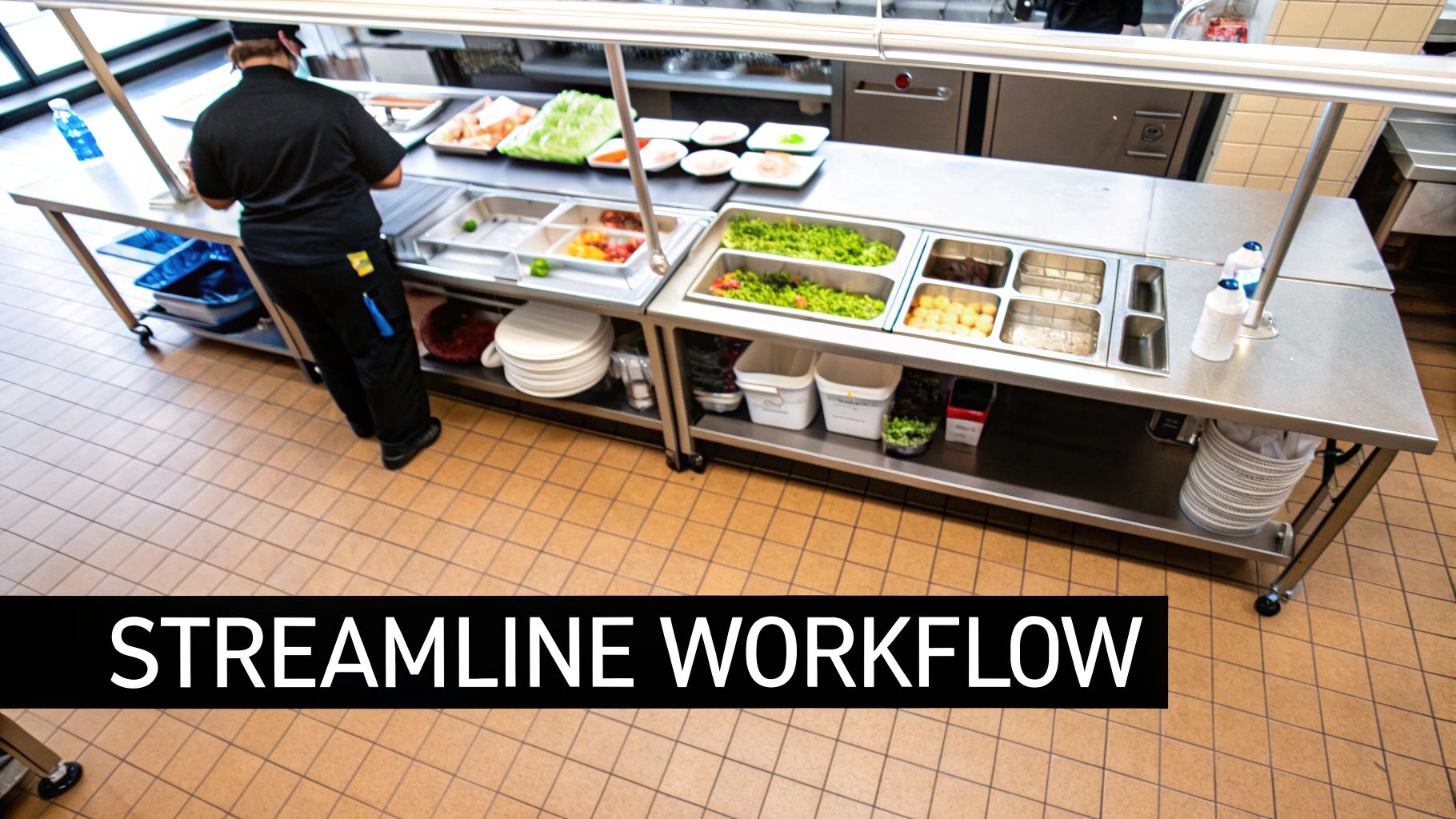
Even the best prep table in a restaurant kitchen is just a clunky obstacle if you drop it into the wrong spot. The right table should feel like a natural extension of your kitchen’s rhythm, not something your staff has to constantly work around. It’s about more than just staying organized; it’s about engineering a workflow that shaves precious seconds off every task and gets food out to your customers faster.
Before you even think about buying, take a long, hard look at your current kitchen layout. The mission is to find and eliminate those little bottlenecks that drive cooks crazy during a busy service. This means thinking beyond the table itself and seeing how it fits into your entire operation.
Measure Twice, Buy Once
That old carpenter’s saying is gospel in a commercial kitchen, where every single inch is valuable real estate. Grabbing a tape measure is the obvious first move, but it’s about more than just length and width. You have to account for the kitchen in motion.
When you're mapping out the space, think about these crucial details:
- Pathways: Can two people pass each other without doing an awkward shuffle? You need clear lanes for staff to move safely, especially when they're carrying hot pans or full bus tubs. A good rule of thumb is to keep walkways at least 36-48 inches wide.
- Door Swings: This one gets overlooked all the time. Make sure you account for the full swing of every door nearby—refrigerators, ovens, and the entry to the kitchen itself. There's nothing worse than realizing your new table blocks half the walk-in.
- Breathing Room: Refrigerated prep tables have compressors that generate heat. They need space to breathe. A rear-breathing unit pushed flush against a wall will overheat and die an early death. Always leave a few inches of clearance.
Getting this wrong turns an exciting new piece of equipment into a massive headache.
The Modern Kitchen Work Triangle
You've probably heard of the classic "kitchen work triangle"—the path between the stove, sink, and fridge. In a commercial kitchen, that concept needs an upgrade. Think of your prep station as the central hub of a work diamond. The goal is a fluid, intuitive path for your team.
A chef should be able to move effortlessly from storage (the walk-in), to the prep table, over to the cooking line, and finally to the plating area. Every step should feel logical. Where you place your prep table is what makes this flow possible.
A salad station, for example, needs to be a short trip from both the cooler and the service window. A table for butchering or heavy veg prep? That's better off near the sinks and dish pit for easier cleanup.
A well-placed prep table is the heart of an assembly line. Ingredients move from storage to prep to the line in a logical sequence, which cuts down on traffic jams and boosts speed.
Nailing these fundamentals is the key to a kitchen that helps you, not hinders you. To really dig into designing an efficient space, check out these concepts of commercial kitchen design and layout, which offer great insights for any kitchen.
Match the Table to Your Kitchen's Reality
There’s no magic, one-size-fits-all prep table. The right choice is dictated entirely by your menu, your volume, and the physical constraints of your space.
Let’s look at two totally different kitchens.
Scenario 1: The Cramped Food Truck
Here, space is everything. You need one piece of equipment to do the job of three. A compact, multi-functional refrigerated prep table is a lifesaver. Look for one with refrigerated drawers below, a small work surface up top, and an undershelf for dry goods. And casters are a must—you need to be able to move it for cleaning and service. It’s all about getting the most function out of the smallest footprint.
Scenario 2: The High-Volume Catering Kitchen
In this world, it's all about volume and dedicated zones. You’ll likely have several prep stations: one for butchering proteins, another for chopping vegetables, and a separate one for pastry. Large, simple worktop tables give your teams the space they need. The layout is designed to keep raw and cooked foods separate and allow multiple cooks to work at full speed without tripping over each other.
In both examples, the prep table restaurant setup is chosen specifically to support the kitchen's main purpose. By analyzing how your team actually works, you can find a table that makes them faster and more efficient.
Mastering Installation and Maintenance
https://www.youtube.com/embed/bPTpqTZMCHw
Your new prep table has arrived. It's easy to see it as just another piece of stainless steel, but how you handle it from this moment on will determine if it becomes the reliable heart of your line or a constant headache.
Getting the installation and maintenance right from day one is everything. It’s the difference between a unit that runs smoothly for years and one that dies an early, expensive death. Skip these steps, and you’re setting yourself up for wobbly cutting surfaces, failing refrigeration, and a surprise visit from the health inspector you weren't ready for.
A Smooth and Safe Installation Checklist
Before you even think about loading it with ingredients, take a moment to set it up properly. I’ve seen too many kitchens rush this part and pay for it later. A few minutes of careful setup prevents a world of operational pain.
Here’s what you need to nail for a perfect installation:
- Find a Level Footing: Almost every commercial kitchen floor is sloped for drainage. That means your table will rock unless you adjust it. Grab a level and tweak the bullet feet on each leg until that work surface is rock-solid. You can't have chefs doing knife work on an unstable table—it's a serious safety risk.
- Check Electrical Connections: For any refrigerated unit, make sure the outlet can handle its voltage and amperage. Never use a regular extension cord for commercial equipment. It's a fire hazard and can kill your compressor. The plug needs to be secure and the cord should have a clear, straight path—no kinks or pinches.
- Give It Room to Breathe: The compressor on your refrigerated table needs to vent heat. If you shove it flush against a wall, it will overheat, run constantly, and burn out fast. The manual will give you specifics, but a good rule of thumb is to leave at least 3-4 inches of breathing room around the back and sides.
- Confirm Refrigeration Settings: Once it's plugged in, let it run empty for a couple of hours to get down to the right temperature. Don't just trust the display; stick a reliable thermometer inside to verify it’s holding steady at or below 40°F. Only then should you start loading it with food.
A Quick Tip from the Trenches: Don't toss the user manual in the trash. It has the exact specs for your model's electrical needs, clearance, and maintenance schedule. Stick it in a folder in the office where you can actually find it.
Your Essential Maintenance Schedule
Think of routine maintenance as cheap insurance. A simple, consistent schedule is what separates a prep table that lasts a decade from one that gives you problems in its second year. This is how you prevent most equipment failures and stay ready for health inspections 24/7.
Breaking the work down into daily, weekly, and monthly tasks makes it completely manageable.
Daily Cleaning and Upkeep
Make these tasks a non-negotiable part of your nightly closing routine.
- Wipe Down All Surfaces: Use a food-safe sanitizer on the entire unit—the top, backsplash, and exterior. A pro tip is to wipe with a soft cloth in the direction of the steel's grain to avoid ugly streaks.
- Clean the Cutting Board: Pull the cutting board off, then wash, sanitize, and rinse it. Let it air dry completely overnight to stop bacteria from growing.
- Empty and Clean Food Pans: On refrigerated tables, all ingredient pans on the rail need to come out. Get them washed, sanitized, and dried before putting them away.
Weekly Checks
Find a few minutes during a slow period each week to dig a little deeper.
- Inspect Door Gaskets: Check the rubber seals around the doors and drawers. Are they cracked, torn, or getting hard? A bad gasket leaks cold air, which makes the compressor work overtime and jacks up your electricity bill.
- Check and Tighten Hardware: Kitchens are high-vibration environments. Screws and bolts will loosen over time. Give the legs and any other fixtures a quick check to make sure everything is tight.
Monthly and Quarterly Tasks
These bigger jobs are the key to your equipment’s long-term health.
- Clean the Condenser Coil (Monthly): This is the single most important maintenance task for any refrigerated equipment. The coils get clogged with dust, grease, and flour, which chokes the system and stops it from cooling efficiently. Unplug the unit, then use a stiff brush and a vacuum to gently clean off all that gunk. If you're a pizzeria or bakery with a lot of flour in the air, you need to do this every single month.
- Calibrate Thermometers (Quarterly): You need to know that the temperature display is telling you the truth. Test it by sticking the probe in an ice-water bath—it should read 32°F. If it's off, follow the manual's instructions to recalibrate it.
Digging Into Refrigeration and Energy Costs
When your prep table has a refrigeration unit, what’s going on under the hood is just as important as the stainless steel on top. This is where your long-term operating costs are hiding in plain sight. The heart of the unit—the compressor—and its hunger for electricity can quietly inflate your utility bills, chipping away at your bottom line month after month.
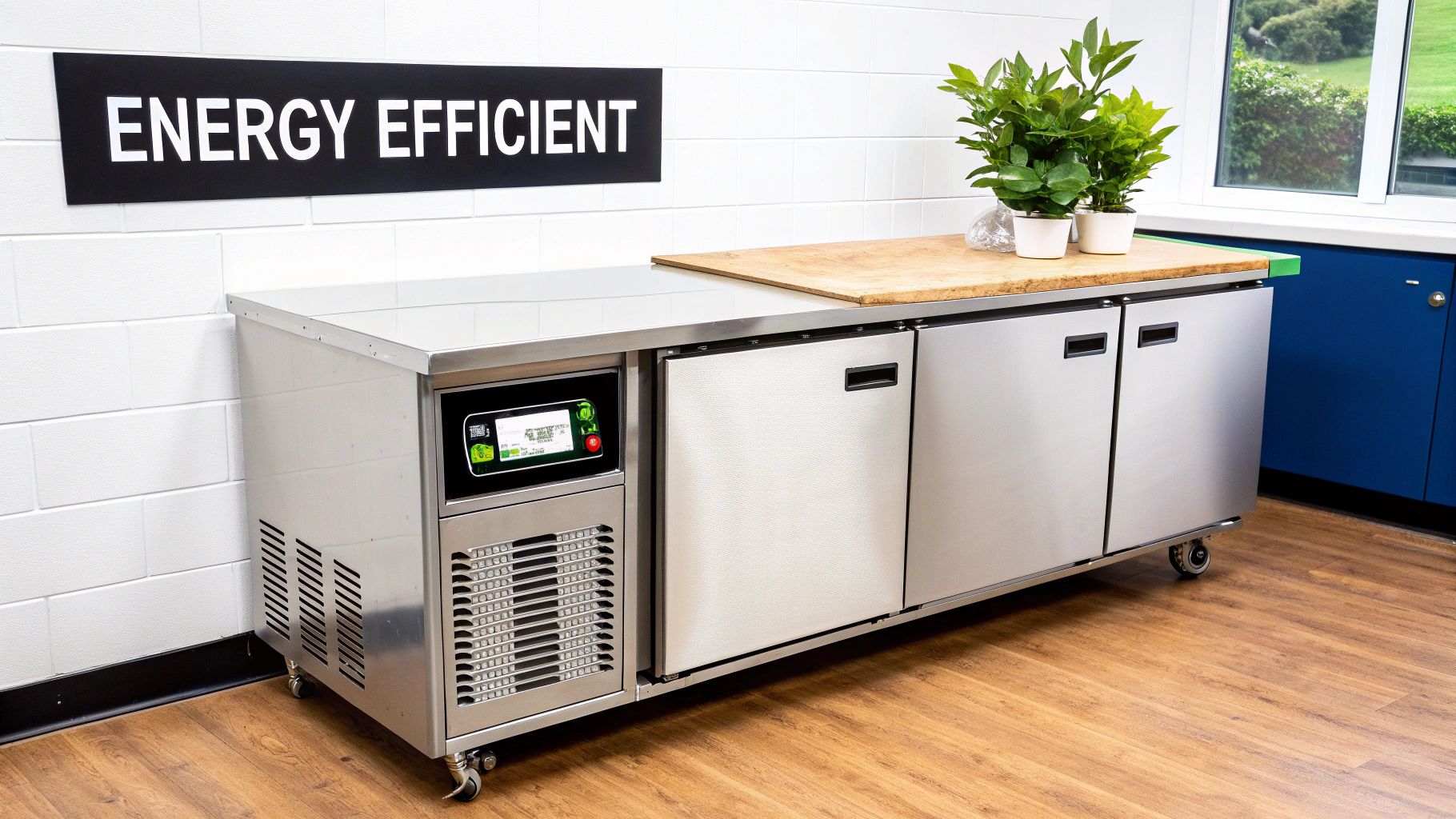
You don't need to be a mechanic to grasp this stuff; it's just smart financial planning. Making the right call here protects both your food and your profits. And remember, when looking at a significant investment like this, it’s always worth exploring restaurant equipment financing to manage the upfront hit to your cash flow.
Front-Breathing vs. Rear-Breathing: A Critical Kitchen Layout Decision
One of the first practical details you’ll run into is how the refrigeration unit "breathes." This seemingly small detail dictates exactly where you can—and can't—place the table in your kitchen.
-
Front-Breathing Models: These units pull in and push out air right from the front, usually behind a grille. In a tight kitchen, they are an absolute lifesaver. You can shove the back and sides flush against a wall or another piece of equipment without worrying about suffocating the compressor.
-
Rear-Breathing Models: These are the old-school standard, venting hot air from the back. They’re often a bit cheaper, but they demand at least a few inches of clear space behind them for proper airflow. Jamming one against a wall is a classic rookie mistake—it's a surefire way to get an overworked, inefficient system that's heading for an early grave.
Choosing the right type for your layout isn't a small thing. It directly impacts performance and prevents headaches and costly repair calls down the line.
Why Paying More for Energy Efficiency Actually Saves You Money
Energy is one of the biggest, most relentless expenses in any commercial kitchen. An energy-efficient prep table isn’t just a "green" choice; it's a cold, hard financial strategy that pays you back every single month.
Keep an eye out for the ENERGY STAR label. That little blue sticker means the unit has been independently proven to be more efficient than standard models—often by 15-20%. Yes, the sticker price might be a bit higher, but they pay for themselves over time with lower utility bills.
From the Field: An ENERGY STAR certified commercial refrigerator can save a restaurant around $170 a year. That might not sound like a fortune, but over the 10-year lifespan of the equipment, that's real money going straight back into your business.
This push for efficiency is a huge industry trend. The global refrigerated prep tables market was valued at USD 7.67 billion and is projected to hit USD 10.30 billion by 2031. That growth isn't just about more restaurants; it’s driven by the demand for smarter, more efficient tech and tougher food safety regulations. Staying informed on these industry trends helps you make smarter, more profitable investments.
Smart Refrigerants: Good for the Planet, Better for Your Wallet
Beyond pure energy consumption, today’s prep tables offer much more environmentally friendly refrigerant options. Older equipment often used HFCs (hydrofluorocarbons) like R-134a, which we now know are pretty rough on the atmosphere.
The industry is now shifting to natural refrigerants like R-290 (a highly purified propane). These gases have a tiny environmental footprint and, as a bonus, are often more energy-efficient. It’s a true win-win for your conscience and your operating budget. For a closer look at specific models and what they offer, you can learn more about refrigerated prep tables in our article. Choosing a unit with modern refrigerants is a forward-thinking move that keeps your kitchen aligned with where the industry is heading.
Your Prep Table Questions, Answered
When you're outfitting a commercial kitchen, the questions start piling up fast. For a workhorse piece of equipment like a prep table, getting the details right from the start can save you a world of headaches later on. Let's tackle some of the most common questions I hear from chefs and restaurant owners.
Think of this as the stuff you'd ask a seasoned pro before you spend your hard-earned cash. Getting these answers straight can be the difference between a smooth-running line and a daily source of frustration.
What's the Real Difference Between a Sandwich and a Pizza Prep Table?
They look almost the same, but they’re built for completely different workflows. It all boils down to two things: how deep the cutting board is and how the ingredient rail is set up.
- Sandwich/Salad Tables: These have a much narrower cutting board, usually around 8 to 12 inches deep. It’s the perfect size for building sandwiches or tossing salads without eating up precious floor space. The ingredient pans in the refrigerated rail sit pretty much flush with the countertop, making it a breeze to grab, scoop, and spread.
- Pizza Tables: Making pizzas is a whole different beast—it demands space. Pizza tables come with an extra-deep cutting board, often 18 to 24 inches, giving you plenty of room to stretch dough and load it up with toppings. The refrigerated rail is also raised and angled toward the cook, so you can easily grab handfuls of cheese and pepperoni without awkwardly leaning over your masterpiece.
Grabbing the wrong one is an instant bottleneck. Ever tried stretching a 16-inch pizza on a 10-inch board? It’s not just messy; it’s a total drag on your ticket times.
How Often Should I Clean My Refrigerated Prep Table Coil?
This is, without a doubt, the most critical maintenance job for any refrigerated unit. Ignoring it is like throwing money away. As a solid rule of thumb for an average kitchen, get in there and clean the condenser coil every 90 days.
But—and this is a big but—your kitchen's environment changes everything.
If you’re running a pizzeria with flour floating in the air or a kitchen with a lot of grease from the fryers, you need to be cleaning that coil every single month. A clogged coil forces the compressor to work overtime, which burns through electricity and drastically shortens the lifespan of your unit.
A few minutes with a stiff-bristled brush can literally save you from a thousand-dollar repair bill.
Should I Buy a New or Used Prep Table?
Ah, the classic dilemma. It really comes down to weighing your upfront budget against your long-term risk tolerance. There's no single right answer, just the right answer for your specific situation.
Buying a new prep table for your restaurant gives you some serious advantages:
- A Full Warranty: This is your safety net. If the compressor dies six months in, you’re covered. No surprise repair bills.
- Peak Efficiency: Modern units, especially the ones with an ENERGY STAR rating, are designed to sip electricity, saving you money on your utility bills from day one.
- Total Peace of Mind: You know its entire history because there isn't one. No hidden gremlins or worn-out parts to worry about.
On the flip side, a used prep table can slash your initial investment, which is a massive help when you're just starting out. The catch? You're inheriting all its potential problems. The refrigeration system could be on its last legs, and there's no warranty to bail you out. If you go the used route, stick with a reputable dealer who inspects and stands behind their equipment. And always, always check the door gaskets and listen to the compressor run before you hand over any money. Discovering exclusive deals on both new and used equipment can make this decision even easier.
Why Is NSF Certification So Important?
You'll see that little NSF logo on just about every piece of commercial kitchen gear, and it's far more than just a sticker. NSF (National Sanitation Foundation) certification is your guarantee that the equipment is built to strict public health and safety standards.
It means the materials are food-safe and non-toxic, and more importantly, the unit is designed to be easily and completely cleaned. There are no hidden cracks or crevices where bacteria can thrive. When the health inspector walks in, you can bet they’ll be looking for that NSF mark on your equipment.
Trying to save a few bucks on a non-certified table is a bad gamble. It puts you at risk of failing a health inspection, which could lead to fines or even a temporary shutdown. Making sure your prep table and all restaurant equipment is NSF-certified isn't just a good idea—it's non-negotiable for running a safe, compliant kitchen.
Ready to find a prep table that will anchor your kitchen line and boost your efficiency? Encore Seattle Restaurant Equipment has a huge selection of new and used prep tables to fit any menu and budget. Let us help you find the perfect match for your space and discover the latest deals on top-quality restaurant equipment and supplies.