

The Essential Guide to a Pocket Digital Thermometer
In any professional kitchen, the pocket digital thermometer is a non-negotiable tool. It’s your secret weapon for nailing that perfect medium-rare steak and, more importantly, your first line of defense against foodborne illness. For chefs and restaurant owners, this little device is the key to both food safety and consistent quality. We're here to help you stay informed about the latest industry trends and find exclusive deals on the restaurant equipment and supplies that matter most.
Your Key to Consistent Food Safety and Quality
Picture this: a busy dinner service, the grill is fired up, and a line cook is about to send out a beautiful piece of fish. With a quick check from a pocket thermometer, they know in seconds that it's cooked through perfectly—safe, flaky, and delicious. That single moment of certainty is what separates a great kitchen from a good one.
This is where a pocket digital thermometer shines. It’s not just a gadget; it's a fundamental part of your kitchen's integrity.
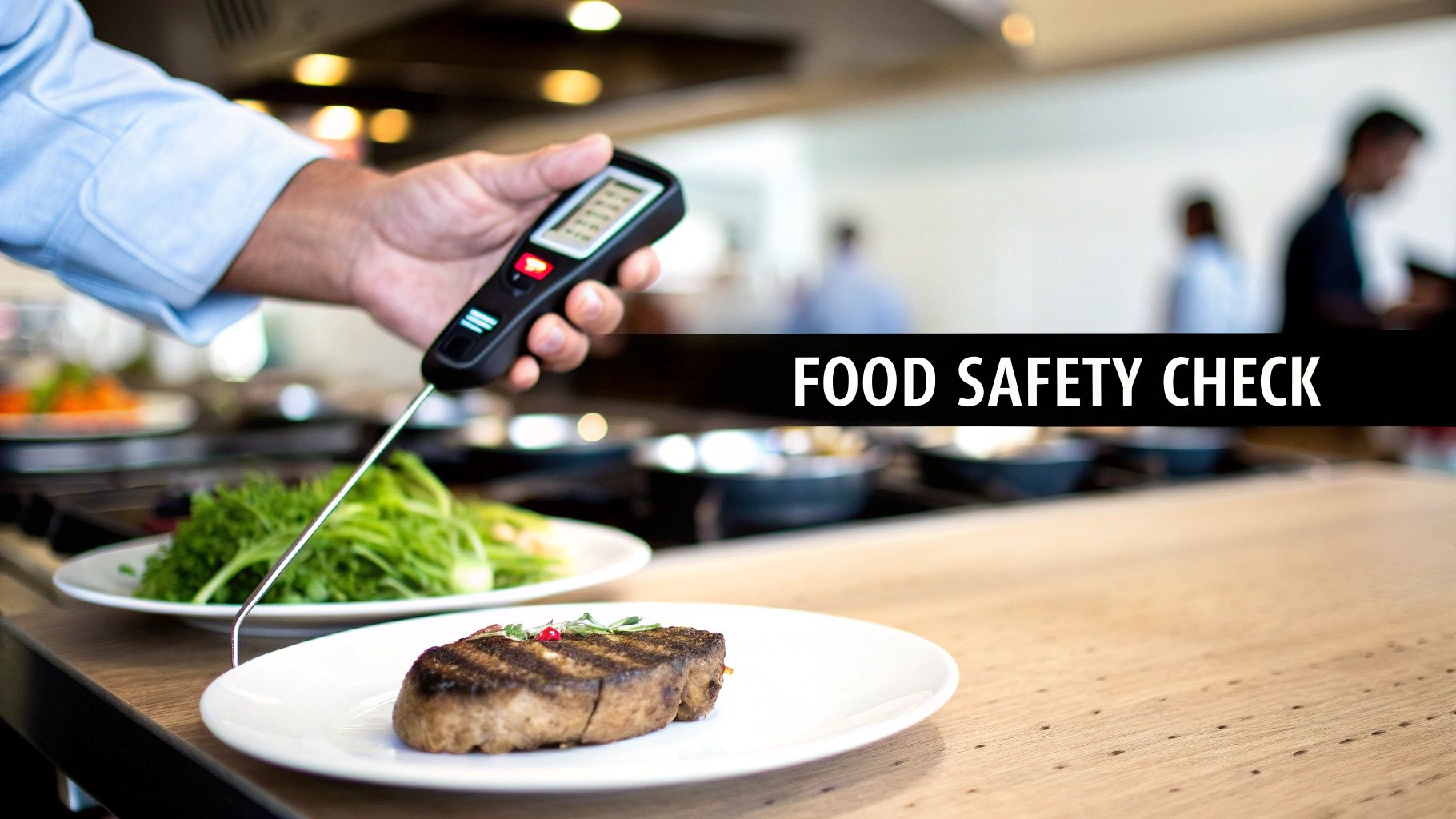
Think of this guide as your complete playbook for mastering this essential tool. We'll move beyond just "checking the temp" and turn it into a precise, repeatable process. This is how you nail your Hazard Analysis Critical Control Point (HACCP) standards and protect the reputation you've worked so hard to build. Every temperature reading is a direct promise to your guests: their meal is not only fantastic but also completely safe.
Why Every Kitchen Needs a Reliable Thermometer
In the heat of service, there’s zero room for guesswork. An off-temperature piece of chicken isn't just a quality issue; it's a major safety risk that could lead to a failed health inspection or, worse, a sick customer. A reliable digital thermometer gives you the hard data you need to operate with confidence.
Here’s why you can’t run a professional kitchen without one:
- HACCP Compliance: Digital thermometers are the backbone of any food safety plan. They’re essential for monitoring critical control points like cooking, holding, and cooling temperatures.
- Preventing Foodborne Illness: The only way to be sure you've killed off harmful bacteria like Salmonella and E. coli is to verify that food has reached its minimum safe internal temperature.
- Ensuring Food Quality: Consistency keeps customers coming back. A thermometer guarantees that every medium-rare steak is actually medium-rare, every single time.
- Protecting Your Reputation: A single food safety slip-up can do lasting damage to your business. Consistent temperature monitoring is one of the smartest, cheapest insurance policies you can have.
The trust of your customers is the foundation of your entire operation. A pocket digital thermometer is a small investment that delivers massive returns in building and maintaining that trust, one plate at a time.
From Farm to Fork
Temperature control is a huge piece of the puzzle, right alongside practices like preventing cross-contamination in your kitchen. It's a journey that starts long before ingredients even land on your prep table.
To get the full picture of how temperature integrity is maintained throughout the entire supply chain, check out our guide on what is cold chain management: https://encoreseattle.com/blogs/seattle-restaurant-equipment/what-is-cold-chain-management. Understanding the whole process reinforces just how critical that final temperature check is in your kitchen.
Decoding Thermometer Specs That Actually Matter
Technical jargon on a product box can be a real headache. But when it comes to thermometers, understanding a few key specs is the difference between buying a reliable kitchen partner and a frustrating gadget. Think of it less like a science test and more like reading the stats on a race car—you just need to know which numbers translate to speed and safety on the track, or in this case, on your line.
Let's break down what truly matters in a professional pocket digital thermometer. These are the features that directly impact your kitchen's efficiency, the quality of your food, and your ability to nail food safety standards without breaking a sweat.
Accuracy: Your Non-Negotiable Safety Net
If you only look at one spec, make it this one. Accuracy is typically shown as a plus-or-minus value, like ±1°F or ±0.7°F. This tiny number tells you the margin of error the thermometer is guaranteed to stay within.
Think about cooking chicken, which has to hit 165°F to be safe. If your thermometer is only accurate to ±2°F, a reading of 164°F could mean the chicken is actually at 162°F—firmly in the danger zone. A tighter margin of error, like ±0.7°F, gives you a much more reliable safety buffer.
This precision is what stands between a perfectly cooked, safe-to-serve protein and a critical food safety violation. For your peace of mind and HACCP compliance, always go for the most accurate thermometer you can find.
Response Time: Finding Speed During the Rush
Response time is simply how fast the thermometer gives you a stable, accurate reading after you stick it in the food. In a hectic kitchen, waiting 15 or 20 seconds for a temperature is an eternity. It slows down your line, creates bottlenecks, and adds a ton of stress during a busy service.
The best digital thermometers give you a final reading in just 2-3 seconds. That kind of speed allows your grill cook to temp multiple steaks in the time it would take a clunky, old-school model to read just one. It’s not just about convenience; it's about keeping the rhythm and momentum going when every second counts.
It’s no surprise that pros are moving to faster, more reliable tools. Mercury-free thermometers, especially the digital models chefs love, made up 65% of global revenue in 2022. The market is expected to grow at an 8.7% CAGR to reach USD 3.14 billion by 2032, driven by kitchens that demand instant, trustworthy readings. You can learn more about this industry trend at Grand View Research.
Probe Types: The Right Tool for the Job
Not all probes are built the same. The two you’ll see most often in pocket digital thermometers are thermistors and thermocouples, and they each have their strengths.
-
Thermistor Probes: Think of these as the durable workhorses of the kitchen. They are very accurate but can be a bit slower on the uptake. They’re perfect for thicker cuts of meat, roasts, and checking temps in liquids like soups and sauces, where the probe will be sitting for a few seconds anyway.
-
Thermocouple Probes: These are built for pure speed. They have an incredibly fine tip that measures temperature at a very precise point. This makes them ideal for thin foods like fish fillets and burger patties, or for delicate items like pastries. Their near-instant readings are a game-changer for line cooks who need to temp, flip, and move on.
Key Pocket Digital Thermometer Features at a Glance
To make things even clearer, here’s a quick rundown of the most important specs and what they mean for your day-to-day operations.
| Feature | What It Means | Why It Matters for Your Kitchen |
|---|---|---|
| Accuracy | The margin of error in its readings (e.g., ±0.7°F). | Guarantees food safety by ensuring internal temperatures are met. Crucial for HACCP and health inspections. |
| Response Time | How quickly it displays a stable temperature (e.g., 2-3 seconds). | Speeds up the cooking line, prevents bottlenecks, and improves workflow during busy service periods. |
| Probe Type | The sensor technology used (Thermistor vs. Thermocouple). | Determines the best use case—thermocouples for speed and thin items, thermistors for durability and thick cuts. |
| IP67 Rating | The device is waterproof and can be submerged in water. | Survives accidental drops into sinks, spills, and frequent, thorough washing without breaking. |
| Backlit Display | The screen lights up for easy reading. | Essential for accurately reading temps in dim environments like walk-in coolers or poorly lit storage areas. |
| NSF Certified | Meets public health standards for safety and cleanability. | Assures health inspectors that your tools are food-safe and easy to sanitize, preventing cross-contamination. |
Choosing a thermometer with the right combination of these features will set your team up for success, making food safety checks faster, easier, and more reliable.
Essential Features for a Professional Kitchen
Beyond the core specs, a few other features make a huge difference in the daily grind of a commercial kitchen.
A thermometer's features should solve real-world kitchen problems. A backlit display prevents a cook from fumbling in a dim walk-in, and a waterproof rating means a simple mistake doesn't result in a broken tool.
When you're shopping, keep an eye out for these game-changing features:
-
Waterproof Rating (IP67): An IP67 rating means the device can be fully submerged in water without dying. This is a must-have in a kitchen where splashes, spills, and constant washing are part of the job. It’s the difference between a quick rinse and a dead thermometer.
-
Backlit Display: A bright, easy-to-read screen is a lifesaver. It’s perfect for taking readings in poorly lit areas like walk-in coolers, dark storage rooms, or even under the shadow of a hot salamander.
-
NSF Certification: This seal of approval means the thermometer is designed and built to be easily cleaned and safe for foodservice. It's a key detail that health inspectors look for and a sign of a truly professional-grade tool.
Choosing the Right Tool for the Task
In a professional kitchen, thinking a single thermometer can do it all is a recipe for trouble. You wouldn't use a cleaver for delicate pastry work, and the same logic applies here. Giving your team the right pocket digital thermometer for their specific station is like handing a carpenter a full toolkit instead of just a hammer—it elevates their precision, speed, and the quality of everything they produce.
Imagine the chaos at your grill station on a packed Saturday night. Your line cook is juggling a dozen steaks. They need a thermometer that gives them a reading now, not in ten seconds. A model with a lightning-fast response time and a needle-thin probe is a game-changer, letting them temp a filet in under three seconds and move on. Anything slower becomes a disastrous bottleneck, backing up the entire line.
Now, picture your steam line, where chefs are holding soups and sauces. It's hot, humid, and things get messy. A super-fast probe isn't the priority here; what you really need is a rugged, waterproof model. It has to survive being dropped in hot water, blasted with steam, and washed constantly. In this environment, durability is king.
Matching the Thermometer to the Station
To really dial in your kitchen’s workflow and food safety, you have to match the thermometer’s features to the job at hand. This isn't about buying the most expensive model; it's about being strategic. When every team member has the right tool, quality and safety just naturally fall into place.
Here’s a practical look at who needs what:
- The Grill Cook: Go with a thermocouple thermometer that reads in 2-3 seconds. The tiny probe slides into a thin piece of fish or a steak without leaving a gaping hole, giving instant feedback for that perfect medium-rare.
- The Prep Cook: A solid, all-around thermistor thermometer is your best bet. It’s ideal for checking big roasts before they hit the oven or making sure tubs of ingredients in the walk-in are holding at a safe temp.
- The Pastry Chef: This is where precision is everything. For tempering chocolate or hitting the exact stage for a sugar syrup, you need a thermometer with an accuracy of at least ±0.7°F. A model with a wide temperature range is a must, and a clip-on probe can be a lifesaver for hands-free monitoring.
- The Fry Station Attendant: Safety first. A thermometer with a long probe is non-negotiable for checking deep-fryer oil without getting burned. It also needs to be tough and easy to wipe down in a greasy environment.
Beyond the Probe: The Power of Infrared
Sometimes, you can't or shouldn't poke what you're temping. This is where an infrared (IR) thermometer comes in. An IR model reads surface temperature in a split second, making it perfect for jobs where a probe is just impractical or would cause cross-contamination.
Think about it: an infrared thermometer lets a chef instantly check if a griddle is hot enough to sear scallops or if a pizza stone is ready to go—all without making contact. It’s the ultimate tool for speed and preventing bacteria from hopping from one surface to another.
This tech is becoming a huge part of modern food safety. In fact, infrared digital thermometers—many of them pocket-sized—held a massive 48% market share in 2024. For fast-paced spots like bars, sandwich shops, and caterers, getting instant, non-contact readings is crucial for keeping food out of the 40°F to 140°F "danger zone." And as the technology gets better, we're seeing more smart models with Bluetooth for automatic temperature logging—a massive help for proving HACCP compliance during a health inspection. You can dig deeper into these developments in the digital thermometer market.
Ultimately, when you stop looking for one magic thermometer and start arming each station with the right pocket digital thermometer for the job, you’re not just buying tools. You’re empowering your team to work smarter, hold a higher standard, and protect the people you serve.
Mastering Calibration for Flawless HACCP Compliance
An uncalibrated pocket digital thermometer isn't much better than guessing. In a professional kitchen, where food safety and quality ride on precision, that's a risk you just can't take. Calibration isn't a suggestion—it's a critical, routine task that underpins your entire HACCP plan and protects every customer you serve.
Think of it like tuning a guitar before a big show. An out-of-tune instrument can ruin the whole performance, just like an inaccurate thermometer can compromise a dish and put your reputation on the line. Mastering this simple process ensures every temperature reading you take is dead-on, reliable, and ready for a health inspector's audit.
This flowchart maps out how to pick the right tool for the job, whether you're searing steaks or checking surface temps.
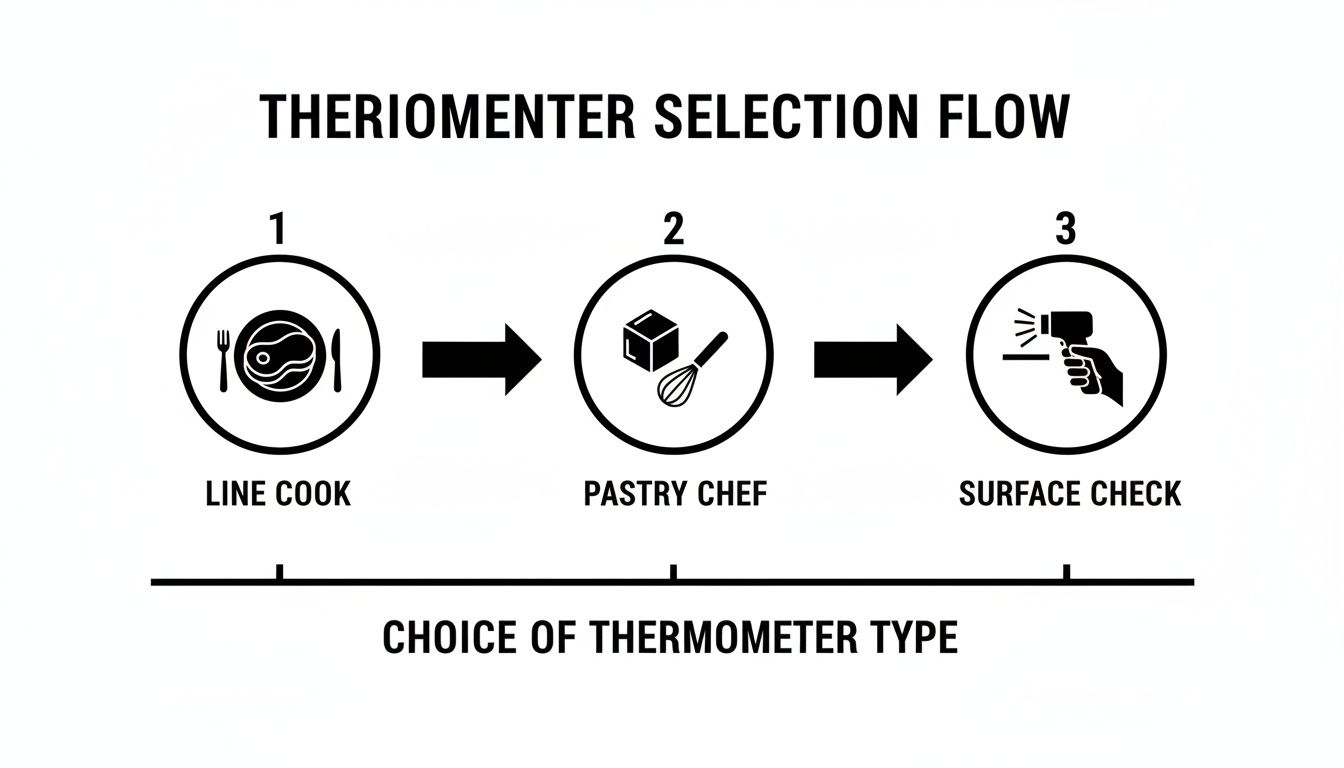
As you can see, matching the right thermometer to the task is the first step. After all, you can't get an accurate reading if you're using the wrong tool to begin with.
Calibration vs. Validation: What's the Difference?
Before we get into the "how," let's clear something up. People often throw around the words "calibration" and "validation" like they’re the same thing, but they’re not.
Validation is simply checking if your thermometer is accurate. Calibration is the act of adjusting an inaccurate thermometer to make it read correctly again.
You validate your thermometer every time you test it. If the reading is off, then you need to calibrate it. The good news is that high-quality digital thermometers rarely need to be adjusted, but regular validation confirms they're still doing their job properly.
The Ice-Point Method: Your Go-To Kitchen Test
The most reliable and foolproof way to test a thermometer's accuracy in any kitchen is the ice-point method. A properly made ice bath has a stable, known temperature of 32°F (0°C), making it the perfect benchmark.
But be warned: just throwing some ice in a cup of water won’t work. A sloppy setup can be off by several degrees, defeating the whole purpose.
How to Make a Proper Ice Bath:
- Pack a container with ice. A tall, insulated cup or a small pitcher is perfect for this. Fill it all the way to the top.
- Add just enough cold water. Slowly pour in water to fill the gaps between the ice cubes, stopping about a half-inch from the top. Let it sit for a minute for the temperature to stabilize.
- Stir and insert the probe. Give the ice slurry a gentle stir and submerge the thermometer probe at least two inches deep in the center. Make sure the tip isn't touching the sides or bottom.
- Check the reading. After about 30 seconds, the thermometer should read 32°F (0°C).
Don't forget to check your thermometer's stated accuracy (e.g., ±1°F). If your device reads between 31°F and 33°F, it's within tolerance and you don't need to adjust it.
The Boiling-Point Method for Higher Temps
While the ice bath is your best bet for daily checks, you can also test your thermometer’s accuracy at the other end of the scale using boiling water. This method is a bit trickier because the boiling point of water isn't always the same—it changes with your elevation.
Water boils at 212°F (100°C) only at sea level. If you're in a high-altitude city like Denver, it boils closer to 202°F (94°C). Before you start, look up the exact boiling point for your location using an online calculator.
Once you know your target temperature, bring a pot of water to a strong, rolling boil. Submerge the probe in the center, away from the sides, and wait for the reading to stabilize. If it matches your local boiling point (within its accuracy spec), you're good to go. For most kitchens, the ice-point test is just more practical and reliable.
For more on temperature management, you might find our guide on how to calibrate an oven thermometer useful, as it covers similar principles for other essential equipment.
Document Everything to Stay Compliant
The final—and most important—step is to write it down. Keep a simple logbook with your thermometers. Every time you validate a device, just jot down the date, the thermometer's ID number, the result, and your initials.
This log isn't just paperwork; it’s your proof of due diligence. When a health inspector walks in, showing them a consistent record of calibration checks proves you're serious about food safety and is a key part of a rock-solid HACCP plan.
Proper Cleaning and Storage Best Practices
An accurate thermometer is a food safety powerhouse, but only if it's kept clean. If you're not careful, that same essential tool can become a major source of cross-contamination, spreading bacteria from raw chicken to a ready-to-eat salad with one quick temperature check.
Proper cleaning and storage aren't just tedious chores; they're non-negotiable safety protocols.
Think of your thermometer's probe like you would a chef's knife. You’d never dream of dicing raw chicken and then slicing tomatoes for a salad with the same unwashed blade. The exact same principle applies here. A strict cleaning routine and smart storage habits protect your customers, help your equipment last longer, and build a real culture of safety in your kitchen.
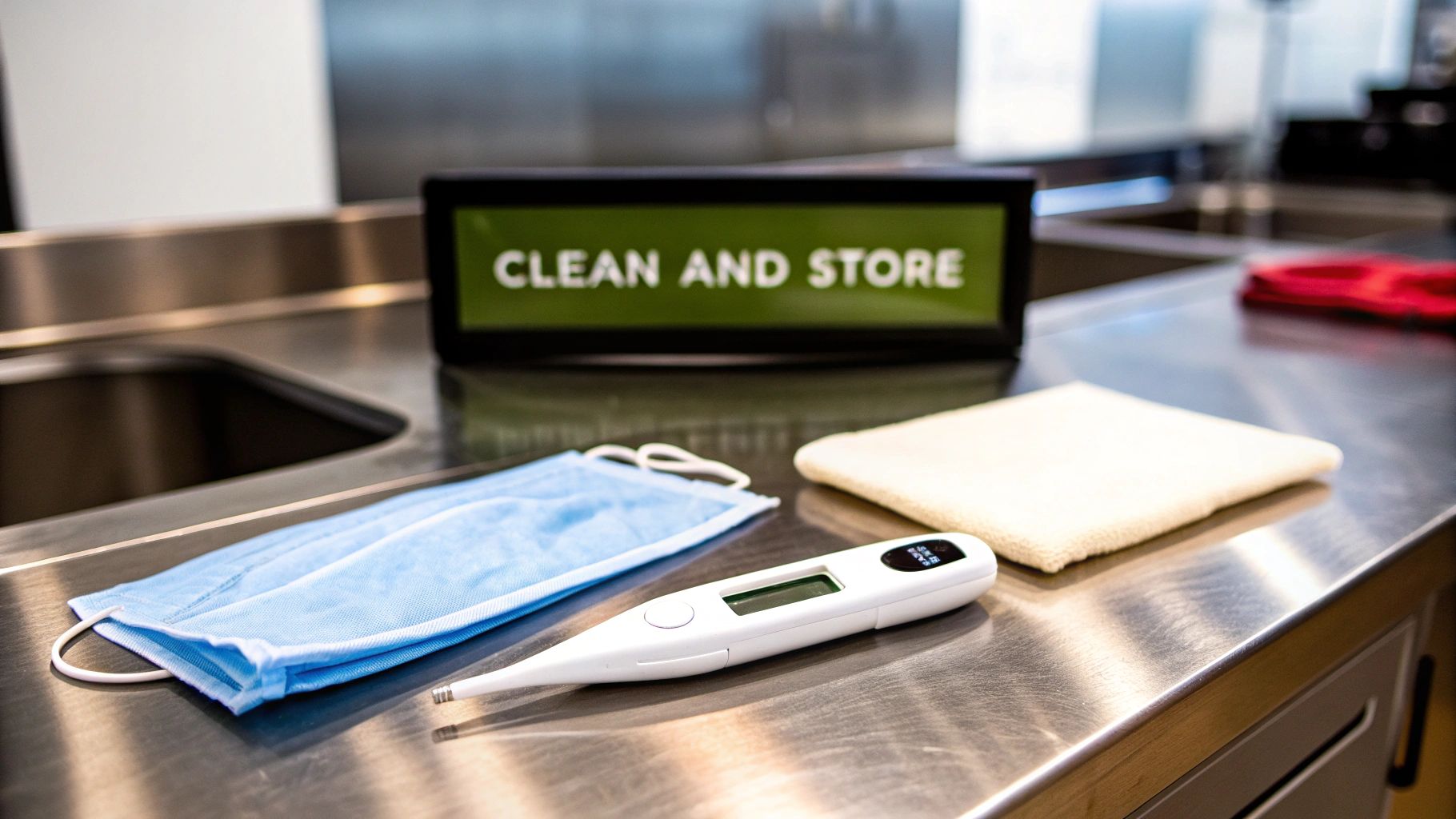
The Clean and Sanitize Procedure
Cleaning your pocket digital thermometer is more than a quick swipe on your apron. It’s a critical two-step process that has to be done every single time, especially when you're moving between different foods.
First, you clean the probe. This is all about removing the physical stuff—food particles, grease, and grime. A simple wipe with a clean cloth and some warm, soapy water gets this job done. But cleaning alone won’t get rid of the invisible threats.
Next, you sanitize. This is the step that actually kills the microscopic pathogens. Using a fresh alcohol wipe or a food-safe sanitizing solution is absolutely essential to make the probe safe for the next temp check.
Here’s a simple, rock-solid cleaning process:
- Wipe Clean: Right after you use it, wipe the probe with a clean paper towel to get rid of any obvious food residue.
- Wash Thoroughly: Use warm, soapy water to give the probe a good wash. If your thermometer is waterproof (look for that IP rating), you can wash the whole thing.
- Sanitize: Grab a food-safe sanitizer. An alcohol pad is perfect because it works fast, kills germs, and evaporates cleanly.
- Air Dry: Let the probe air dry completely before you put it away. Wiping it with a towel could just re-contaminate it.
This whole routine takes less than a minute, but it's one of the most important things your team can do to keep food safe.
Smart Storage Protects Your Investment
How you store your thermometer is just as important as how you clean it. Tossing it into a jumbled utility drawer is a surefire way to damage it, and a broken thermometer is a risk you just can’t take.
A thermometer stored properly is always ready for duty. Smart storage isn't just about keeping it safe; it's about ensuring it's accurate and reliable the moment you need it.
Always, always use the protective sleeve or probe cover it came with. That little piece of plastic is what shields the sensitive tip from drops or bumps that could wreck its calibration or break it completely.
Store it in a designated, clean spot. Keep it away from intense heat sources like the grill or oven, which can fry the electronics inside. For a deeper dive into best practices, you can find excellent templates for SOPs for Equipment Maintenance in Food Service. Following these simple habits will protect your investment and ensure your thermometer is ready to go for years.
Building a Food Safety Culture Through Team Training
Let's be honest: the best pocket digital thermometer in the world is useless if your team doesn't know how to use it properly. Buying top-notch equipment is a great first step, but it's the training that truly protects your customers and your reputation. This is how you shift temperature checks from just another task on a checklist to a core part of your kitchen's commitment to safety.
Good training closes the gap between simply having a tool and actually mastering it. Everyone on your team, from the prep cook who just started last week to your most experienced sous chef, needs to understand not just how to take a temperature, but why it's so critically important. That "why" is the bedrock of a real food safety culture.
Core Training Points for Every Team Member
To get everyone on the same page, your staff needs to master a few essential skills. Nailing these practices ensures every single temperature reading is accurate, consistent, and helps keep your entire kitchen safe.
Make sure your training checklist covers these non-negotiables:
- Proper Probe Insertion: Show your team exactly where to insert the probe—the thickest part of the food, well away from bone or gristle. For soups and sauces, they need to stir first to get a true reading of the whole batch, not just a hot or cold spot.
- Understanding the "Why": Don't just tell them to cook chicken to 165°F. Explain that 165°F is the magic number that kills dangerous bacteria like Salmonella. When you connect the action to the outcome, you create a sense of ownership.
- Consistent Logging: Stress the importance of writing down every temperature in your logbook. This isn't just about busywork for the health inspector; it's your proof that you're doing things right.
A well-trained team is your best defense against food safety failures. When everyone understands their role in preventing illness, accuracy and diligence become second nature, turning your thermometer into a cornerstone of your operation's success.
From Protocol to Culture
For any foodservice business, investing in reliable thermometers is an active step toward slashing the risk of foodborne illness. Improper temperature control is a major factor in the 48 million cases of foodborne illness that occur in the U.S. each year. Undercooked meats and improper cooling are some of the biggest offenders. A simple thermometer helps you maintain the cold chain and guarantees every burger is cooked to a safe temperature, which is good for business and for public health. You can find more data on the growing importance of this tech in the digital thermometer market analysis.
But turning protocol into culture takes more than a one-and-done training day. It needs constant reinforcement from the top down.
Make temperature checks a visible, everyday habit. When chefs and managers are seen consistently using their thermometers, it sends a powerful message: we take accuracy seriously here.
By weaving these practices into your daily operations, you empower every team member to be an active guardian of your food safety program. For a deeper dive into building these habits, check out our guide on effective restaurant food safety training. This level of commitment is what transforms a simple tool into an ironclad promise of quality and safety to every person who walks through your doors.
Common Questions from the Kitchen
Even with great training, questions are bound to pop up during the chaos of a busy service. When it comes to temperature, you need fast, correct answers to keep the line moving and the food safe. Here are some of the most common questions we hear from chefs and their teams.
We’ve pulled together some straightforward answers to help you troubleshoot common snags, brush up on best practices, and really get the most out of this crucial kitchen tool.
How Often Should I Calibrate My Thermometer?
Here’s the rule of thumb for any professional kitchen: validate the accuracy of your thermometers every single day. The easiest way is with a properly made ice bath right before service starts. It’s a quick check that tells you if the tool is still on the money.
You only need to do a full calibration—that is, actually adjusting the thermometer—if it's reading outside of its stated accuracy, like being off by more than ±1°F. A quality digital thermometer shouldn’t need frequent calibration, but if it gets dropped or banged around, it can get knocked out of whack. Think of that daily check as your insurance policy.
Can I Use One Thermometer for Everything?
In a word: no. While it might seem faster to use one thermometer for every task, it’s a major cross-contamination risk. You can't temp a raw chicken breast and then stick the same probe into a ready-to-eat salad without a full clean and sanitize in between.
The best practice is to have separate, color-coded thermometers for different food groups. Think one for raw meats, another for cooked foods, and a third for produce. This simple system is a powerful way to strengthen your HACCP plan and prevent cross-contamination.
This isn't just about safety; it's about building a clear, visual system that your team can follow instinctively, even when you're in the weeds.
What Should I Do If I Drop My Thermometer?
It happens. If your thermometer takes a tumble, the very first thing you need to do is check its accuracy. A hard knock can easily damage the internal sensor, even if there’s no visible damage.
Grab your ice bath and do a quick validation check. If it’s reading correctly, you’re good to go. If the reading is off, try to recalibrate it. If it won't recalibrate or the display is cracked, it’s time to retire it. An inaccurate thermometer is a bigger liability than a broken one.
Ready to stock your kitchen with reliable, accurate thermometers and other essential supplies? At Encore Seattle Restaurant Equipment, we provide top-tier new and used equipment to help you maintain the highest standards of food safety and quality. Explore our extensive selection and find the perfect tools for your team today.