
Best Commercial Refrigeration: The Practical Guide for Restaurants
When you're outfitting a kitchen, picking the best commercial refrigeration isn't just about finding a "cold box." You're choosing the reliable heart of your entire operation, a critical piece of equipment that directly impacts industry trends and your bottom line. The right unit is a careful balance of energy efficiency, pinpoint temperature control, and the exact capacity your menu and workflow demand. It’s a direct investment in food safety and the long-term success of your business. Stay informed with us to discover exclusive deals and the latest news on restaurant equipment and supplies.
Your Kitchen’s Heartbeat: Choosing the Right Refrigeration
Of all the equipment decisions you'll make for your restaurant, choosing the right commercial refrigeration is arguably one of the most critical. This goes way beyond simply keeping food cold. It's a foundational investment in your kitchen's core, directly affecting food safety, how smoothly your team works, and, of course, your bottom line.
Get it wrong, and you're looking at spoiled inventory, a bottleneck during service, and utility bills that make you wince. An underperforming unit is a constant headache.
But get it right? The perfect system becomes a silent, hardworking partner. It stands guard over thousands of dollars in inventory, keeps the health inspector happy, and helps your crew fly through even the most chaotic dinner rush. A well-chosen refrigerator or freezer is really a cornerstone of quality control, and finding exclusive deals on the right equipment makes the investment even smarter.
Why This Decision Matters So Much
Think of your refrigeration as the foundation of your entire menu. The quality of every single dish that leaves your kitchen starts with the absolute freshness of its ingredients. Proper refrigeration is what guarantees that.
- Food safety is non-negotiable: Holding precise, consistent temperatures is what stops harmful bacteria in its tracks. This protects your customers and, by extension, your hard-earned reputation.
- Inventory loss gets slashed: Spoilage is cash straight out of your pocket. Reliable cooling preserves the quality and shelf life of your most expensive items—meat, fresh fish, delicate produce—which directly pads your profit margin.
- Your kitchen workflow actually flows: When units are placed strategically and sized correctly, your staff isn't wasting time hunting for ingredients. That means faster prep, smoother service, and a less stressful kitchen.
Think of this guide as your trusted partner for navigating this essential purchase. We’re going to break down everything you need to know, from the different types of units and how to plan capacity to understanding long-term energy costs and what to look for in a warranty. We'll help you stay informed about the latest news and industry trends in restaurant equipment and supplies.
This isn't just about comparing spec sheets. Our goal is to arm you with the knowledge to match the right equipment to your unique concept—whether you're running a busy cafe in the Pacific Northwest or a remote kitchen in Alaska. By the time you're done reading, you'll be able to choose a refrigeration system that works as hard as you do.
Decoding the Different Types of Commercial Coolers
Walking into the world of commercial refrigeration can feel like you're learning a new language. But it's simpler than it looks. Each unit is a specialized tool designed for a specific job in the fast-paced ecosystem of a professional kitchen. Choosing the best commercial refrigeration isn’t about finding one perfect box; it’s about assembling the right team of cooling workhorses to support your entire operation.
Think of it like setting up a mechanic's garage. You wouldn't use a massive engine hoist for a small spark plug, right? Same principle here. You don't want a massive walk-in for ingredients your line cooks need every five minutes. The first step to an efficient kitchen is understanding the distinct role each type of cooler plays. Get this right, and you’ll build a seamless workflow that keeps your team moving and your food safe. Keeping up with industry trends will also help you discover exclusive deals on the latest restaurant equipment and supplies.
The Everyday Pantry: Reach-In Refrigerators and Freezers
The reach-in is the unsung hero of almost every commercial kitchen. It's the chef's personal pantry, parked right on the line for quick access to daily essentials like prepped veggies, sauces, and proteins. These units are built tough for the chaos of service, with powerful compressors that can handle the door being opened constantly and still snap back to a safe temperature.
Its entire purpose is to keep ingredients for the current shift within arm's reach. A well-placed reach-in means your cooks aren't running to the back for a tub of chopped onions, saving precious seconds that make a huge difference during the dinner rush. You can find them in one, two, or three-door models to fit just about any space.
The Bulk Storage Vault: Walk-In Coolers and Freezers
If the reach-in is the pantry, the walk-in cooler is the restaurant's bank vault. This is where you securely store the motherlode—cases of produce, whole primals of beef, and pallets of frozen goods. It’s the main hub for receiving deliveries and the reserve you pull from to restock the smaller, line-side units.
Walk-ins are designed for holding large volumes at a super-stable temperature, not for constant traffic. How you organize your walk-in is everything. Good organization directly impacts your inventory counts, cuts down on food waste, and makes sure you never 86 an item mid-service.
This quick decision tree can help you weigh your options between food safety, workflow, and cost.
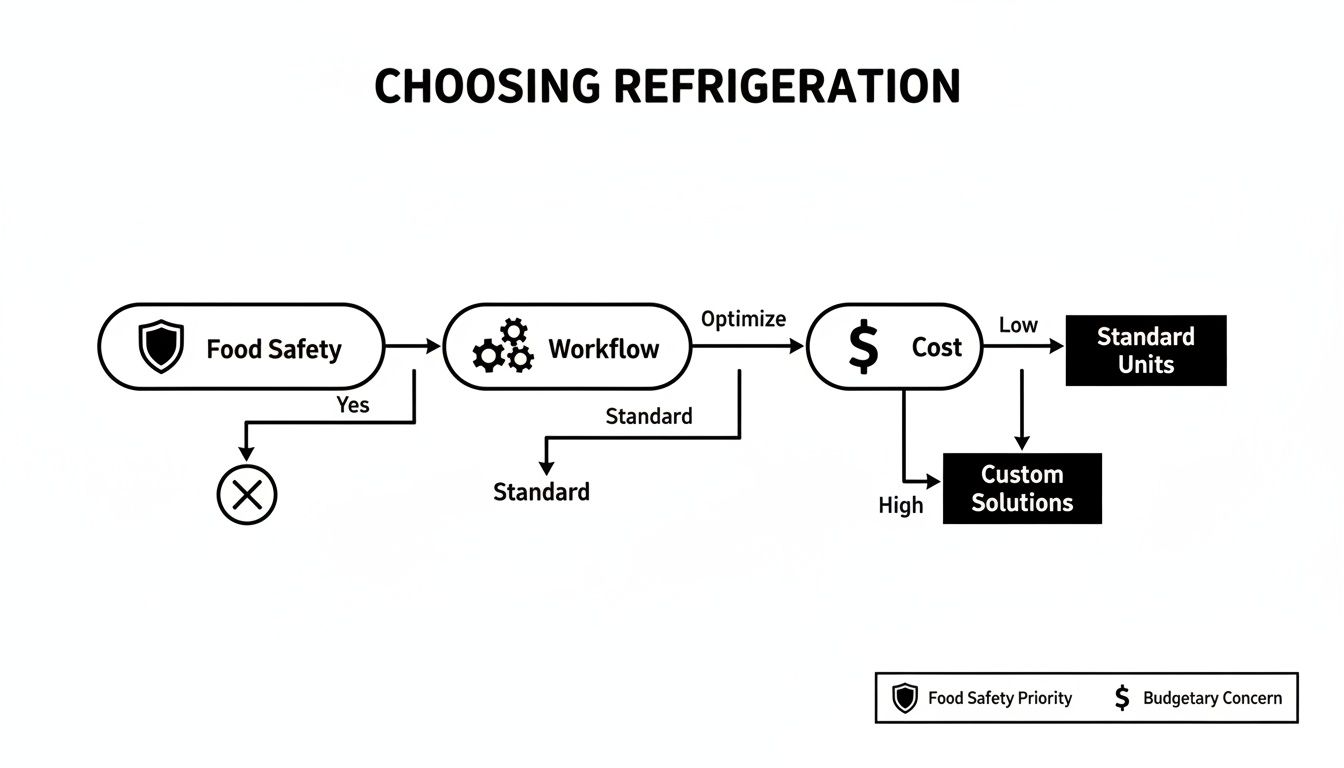
As the chart shows, every choice you make, from a huge walk-in to a tiny undercounter unit, is a strategic move that affects your whole kitchen.
Comparing Commercial Refrigeration Units
To make things even clearer, here's a quick reference chart to help you match the right type of refrigeration unit to your restaurant's specific needs.
| Unit Type | Best For | Typical Capacity Range | Ideal Environment |
|---|---|---|---|
| Reach-In Refrigerator | Storing daily-use ingredients right on the cooking line | 20-70 cubic feet | High-traffic prep and cooking areas |
| Walk-In Cooler | Bulk storage of inventory and receiving large food deliveries | 100+ cubic feet | Back-of-house, near the receiving door |
| Undercounter Unit | Keeping essential items at a specific workstation (e.g., salad) | 2-12 cubic feet | Underneath prep tables or service counters |
| Refrigerated Prep Table | High-volume assembly of sandwiches, salads, or pizzas | 6-30 cubic feet | Dedicated prep stations for specific menu items |
| Bar Cooler | Chilling and storing beverages for fast bar service | 5-20 cubic feet | Front-of-house, behind the bar |
| Display Merchandiser | Showcasing grab-and-go items to customers | 10-50 cubic feet | Customer-facing areas, near checkout points |
This table is a great starting point, but always think about your unique menu and kitchen layout when making a final decision.
Specialized Units for Peak Efficiency
Beyond the main storage units, a whole category of specialized coolers act as focused, high-performance workstations. These are the pieces of equipment that turn a standard kitchen into a finely tuned machine.
-
Undercounter Refrigerators: These little guys are the ultimate space-savers. Tucked neatly under a prep table, they become mini-toolkits, keeping ingredients for a specific station—like garnishes for the expo line or desserts for the pastry station—right where they're needed most.
-
Refrigerated Prep Tables: These are an absolute game-changer for sandwich shops, pizzerias, and build-your-own-bowl concepts. They combine a refrigerated base for backup ingredients with a top rail of cold pans, creating a self-contained assembly line that makes service incredibly fast.
-
Bar and Back Bar Coolers: Built specifically for the front-of-house, these units keep bottles and cans perfectly chilled and within a bartender's easy reach. Models with glass doors also double as merchandisers, showing off your craft beer or wine selection.
-
Display Refrigerators and Merchandisers: Think of these as your silent salespeople. Placed where customers can see them, glass door merchandisers are perfect for encouraging impulse buys of bottled drinks, pre-made sandwiches, and desserts. They can really help bump up your average ticket size.
At the end of the day, when you thoughtfully combine these different types of commercial coolers, you’re building more than just cold storage. You’re creating an intelligent workflow that minimizes how much your staff has to run around, speeds up service, and protects the quality of every single plate that leaves your kitchen.
Finding the Perfect Fit: Sizing and Capacity
Picking out a new refrigerator for your kitchen isn't just about finding one that fits in an empty corner. It's a critical decision that gets to the heart of your entire operation—how you cook, what you serve, and how smoothly your kitchen runs day in and day out.
Think about it: a farm-to-table spot with daily produce drops has wildly different needs than a pizzeria that buys mozzarella by the pallet. The first needs quick, easy access to fresh ingredients, while the other is all about bulk storage. That's why simply looking at the cubic feet a manufacturer lists on a spec sheet will never give you the full picture.
More Than Just Cubic Feet
To really nail this, you have to get a feel for the rhythm of your kitchen. How fast are you turning over inventory? Is your menu a sprawling affair with dozens of fresh components, or are you focused on a few core items you need to stock up on? Figuring this out is the first real step.
It’s a bit like packing for a trip. You don’t just grab the biggest suitcase you can find; you think about how long you’ll be gone, the weather, and what you’ll be doing. The same logic applies here. You need to consider your delivery schedules, your busiest nights, and even where you see your business heading in a few years.
A classic rookie mistake is buying a unit that's too small. It forces the compressor to work itself to death, leading to an early breakdown. But going too big is just as bad—it’s a waste of valuable floor space and will bloat your energy bills for no good reason.
Let’s break down how to get this right by looking at your needs from two different angles: what you actually need to store and the physical space you have to work with.
Calculating Your True Capacity Needs
Before you even start browsing models, take a hard look at your daily operations. This isn't about specs yet; it's about your reality.
- How fast do you use ingredients? If fresh fish comes in every morning, you don't need a ton of long-term storage. You need accessible, ready-to-go space.
- How complex is your menu? A ton of different ingredients means you'll need more organized, compartmentalized storage to keep things separate and avoid cross-contamination. A simple menu might just need big, open shelves.
- What does a slammed Saturday night look like? Your refrigeration has to handle your peak prep volume without being stuffed to the gills. Over-packing chokes off airflow and creates dangerous temperature inconsistencies.
- How often do your suppliers show up? If your main delivery is only once a week, your storage needs will be way bigger than a place that gets daily or bi-daily drop-offs.
For a deeper dive into this process, check out our complete guide on how to choose the right commercial refrigerator size.
Measuring Your Physical Kitchen Space
Okay, once you've got a handle on the internal volume you need, it's time to break out the tape measure. This is a step people often rush, and it can lead to some massive headaches on delivery day.
First, measure the spot where the unit will actually live. Don't forget to add the manufacturer's required clearance on the sides and back for proper ventilation. A refrigerator has to breathe to get rid of heat, and if it can't, the compressor will burn itself out.
Next—and this is just as important—measure the entire path from your loading dock to that final spot. That means every doorway, every hallway, and every tight corner. It doesn't matter how perfect that walk-in cooler is if you can't get it through the kitchen door. A few careful measurements now can save you from a huge, costly problem later.
3. Temperature Control: Your First Line of Defense for Food Safety
Think of your commercial refrigerator as more than just a cold box. It’s the silent, round-the-clock guardian of your inventory—and your reputation. The single most important job it has is maintaining a precise, unwavering temperature.
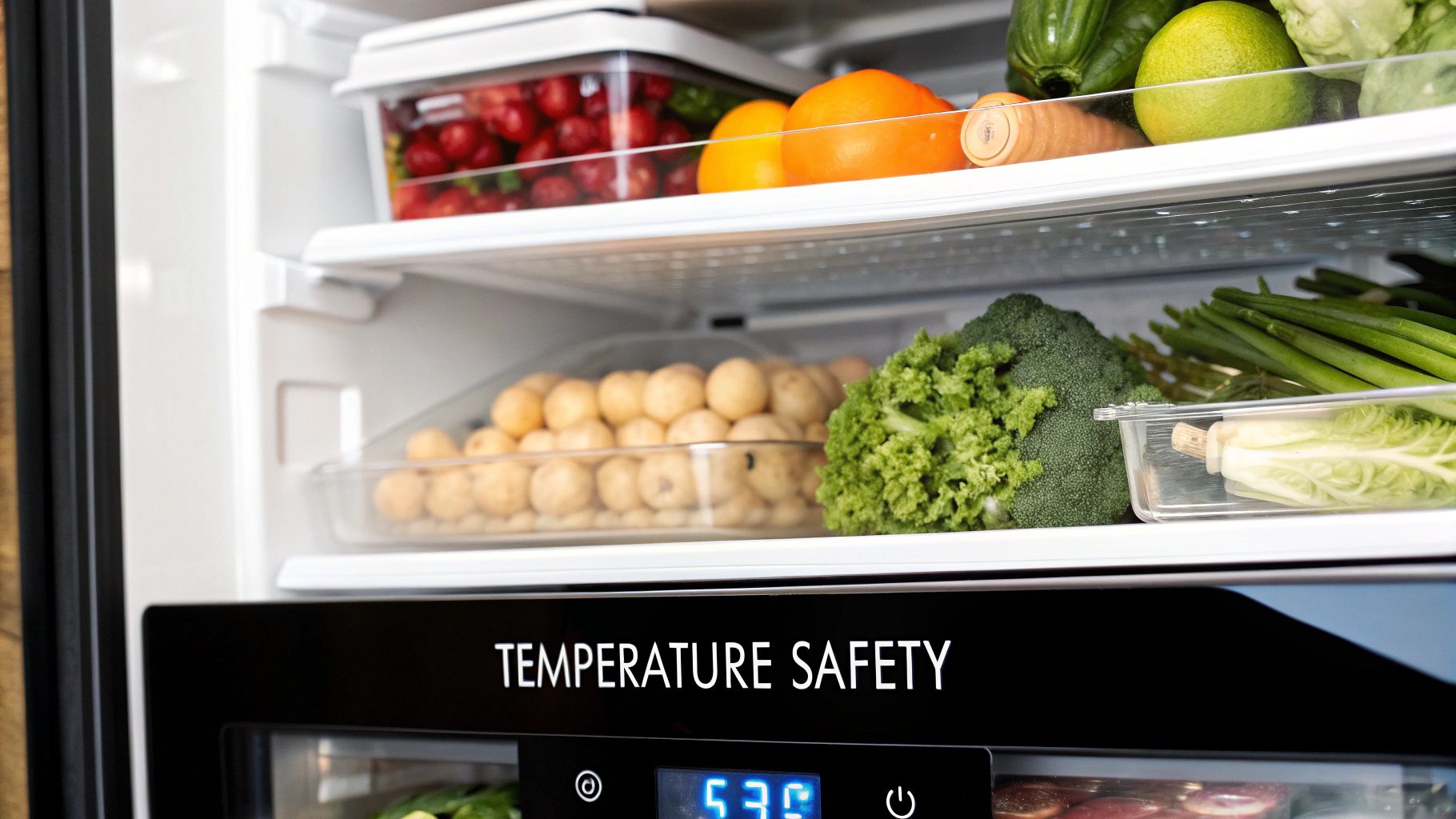
When temperatures creep up, you're not just risking spoiled food and wasted money. You're rolling out the welcome mat for dangerous bacteria. This is why every single person in your kitchen needs to understand the "temperature danger zone."
Staying Out of the Danger Zone
Food safety professionals have a name for the temperature range where bacteria thrive: the danger zone. It spans from 40°F to 140°F. Inside this range, bacteria can double in as little as 20 minutes.
Keeping perishable food in this zone for too long is a recipe for foodborne illness, which can have devastating consequences for your customers and your business.
A top-tier commercial refrigeration unit is engineered specifically to keep your products safely below that 40°F threshold, day in and day out. It's not just a nice feature; it’s a non-negotiable for passing health inspections and running a responsible kitchen.
This focus on temperature is a core piece of the puzzle. It’s part of a bigger concept we call cold chain management, which you can learn more about here: https://encoreseattle.com/blogs/seattle-restaurant-equipment/what-is-cold-chain-management
Features That Protect Your Investment
Modern refrigerators come packed with technology designed to make your life easier and your food safer. These aren’t just flashy extras; they’re essential tools for protecting your bottom line.
- Digital Thermostats: Forget the guesswork of old analog dials. Digital controls give you pinpoint accuracy, letting you set and monitor temperatures down to a single degree.
- Temperature Alarms: What happens if a door is left slightly ajar overnight? An audible alarm can mean the difference between a quick fix and thousands of dollars of inventory in the trash. It’s an insurance policy you can’t afford to skip.
- Humidity Control: It's not always just about the cold. Certain produce, like leafy greens, needs specific humidity levels to maintain its texture and freshness. Advanced units let you fine-tune the environment to extend shelf life.
Once you start seeing your refrigerator as a critical food safety tool, your entire approach changes. It's not just holding product; it's actively preserving quality, protecting patrons, and upholding the standards you've set for your business.
Of course, the best equipment in the world can't make up for human error. That's why pairing your unit with a well-trained team is so important. Making sure your staff has proper food handler certificate training reinforces these critical best practices and creates a truly airtight defense against food safety risks.
Understanding the True Cost of Your Refrigeration
The price tag on a new refrigerator is just the down payment. The real, ongoing cost doesn’t show up on the initial invoice—it arrives every single month on your utility bill. To choose the best commercial refrigeration for your kitchen, you have to stop thinking of it as a one-time purchase and start seeing it for what it is: a long-term financial commitment.
An old, inefficient unit is like a gas-guzzling truck. It might have been cheap to buy, but the cost to keep it running will bleed your budget dry over time. The true cost of ownership is a simple formula: the purchase price plus the energy it burns through every day for the next decade.
What an ENERGY STAR Rating Really Means for Your Wallet
When you see that little blue ENERGY STAR sticker, don't just glance past it. That label is a promise of savings. These certified units are engineered to be 15-30% more efficient than their standard counterparts, a difference you’ll see directly in your bottom line.
This isn't just marketing fluff; it's about smarter design and better parts. Think of an ENERGY STAR model as a professional athlete, built for peak performance without wasting a single drop of energy. A standard model is more like a weekend warrior—it gets the job done, but it’s nowhere near as efficient.
Investing in an energy-efficient model is one of the smartest financial moves a restaurant owner can make. The monthly savings don't just offset the higher initial price; over the unit's lifetime, they can add up to thousands of dollars in pure profit.
This is especially critical in our industry. In U.S. supermarkets, refrigeration systems are notorious energy hogs, responsible for around 40% of total energy use. This has led to a major push for advanced tech that can slash those costs by 30-50%, a game-changing saving for any business. You can read more about this market shift from the analysts at Future Market Insights.
The Technology Behind the Savings
So, how do these units actually save you money? It comes down to a few key engineering upgrades that work together to lighten the machine's workload. A less-stressed refrigerator is a more efficient one.
Better technology means the unit doesn't have to work nearly as hard to stay cold, and that’s where the real savings kick in. Let's look at the two components that make the biggest difference.
Key Components for Energy Savings:
- High-Efficiency Compressors: The compressor is the heart of your refrigerator. Modern, variable-speed compressors are smart; they can ramp up or power down based on real-time cooling needs. Older compressors are just "on" or "off"—a much clunkier and less efficient way to operate.
- Superior Insulation: Think of this like the difference between a cheap fleece and a high-end winter coat. Advanced insulation, like high-density polyurethane foam, is far better at keeping the cold in and the heat out. This means the compressor doesn't have to cycle on as often, which dramatically cuts energy consumption.
These aren't just minor tweaks; they're fundamental to lowering your operating costs. You can dive deeper into the specifics in our detailed post about energy-efficient commercial refrigerators.
Calculating Your Long-Term Return on Investment
Let's run some real-world numbers. Say you're looking at two similar reach-in refrigerators. One is a standard model for $2,500, and the other is an ENERGY STAR model for $3,200. That initial $700 price difference might make you lean toward the cheaper option.
But hang on. If the efficient model saves you just $30 a month on electricity (and that's a conservative estimate), you're pocketing an extra $360 every year. In less than two years, you've completely paid off that initial $700 difference.
For the next 8-10 years of that unit's life, the $360 you save annually goes straight back into your business. Over a decade, that’s a $3,600 return on a $700 investment. Now that’s a smart play.
Installation and Maintenance: Protecting Your Investment for the Long Haul
Buying a top-notch commercial refrigerator is a huge step, but the real test of its value begins after it arrives at your door. Think of it this way: proper installation and consistent maintenance are the two things that will keep that unit humming along for years, making it a reliable workhorse instead of a constant source of stress.
Your refrigerator is like a high-performance engine; it has to breathe to get rid of heat. If you choke its airflow, the compressor—the heart of the whole system—is forced to work overtime. That leads to sky-high energy bills, poor performance, and eventually, a total burnout. Getting the setup right from day one is absolutely critical.

Your Pre-Installation Checklist
Before that delivery truck even pulls up, a few quick checks can save you from a world of installation headaches. Running through this simple list will make sure your new equipment gets set up fast and right, ready to go to work without any drama.
- Give It Room to Breathe: Check the manufacturer's spec sheet for clearance requirements. Most units need at least 3-4 inches of open space around the back and sides to vent heat properly.
- Check Your Power: A standard wall outlet isn't going to cut it. Commercial refrigerators are power-hungry and almost always require their own dedicated circuit to avoid constantly tripping breakers.
- Find a Level Playing Field: Your unit needs to sit perfectly flat. If the floor is slanted, the doors won't seal properly, forcing the compressor to run non-stop and creating a mess of condensation.
Proper setup isn't just about finding a spot for it; it's about giving the machine what it needs to run efficiently from the second you plug it in. A few minutes of prep now will save you hours of troubleshooting later.
And for anyone on your team handling the technical side, getting the electrical components right is non-negotiable. Understanding how to wire everything safely is key, and resources on Mastering Contactor Installation can be a lifesaver.
A Proactive Maintenance Schedule
Once your unit is up and running, a little proactive care is what separates a long-lasting machine from a lemon. A simple, regular maintenance routine can prevent up to 75% of those frantic, middle-of-a-rush emergency service calls. The easiest way to make this happen is to build these tasks right into your kitchen's existing cleaning schedule.
Daily Tasks (5 Minutes or Less)
- Wipe It Down: Clean up spills inside and out to keep things hygienic and prevent sticky buildup.
- Check for Blockages: Make sure inventory isn't pushed up against the interior air vents. Good circulation is key!
Weekly Tasks (About 10-15 Minutes)
- Inspect the Gaskets: Feel around the door seals for any cracks or tears. Try the dollar bill test: if you can close the door on a bill and pull it out easily, your seal is weak and it’s time for a replacement.
- Clear the Area: Sweep and mop the floor around the unit. You don’t want dust bunnies and kitchen debris getting sucked into the works.
Monthly Tasks (20-30 Minutes)
- Clean the Condenser Coils: This is the big one. Dust and grease act like an insulator on these coils, making the compressor work way harder than it needs to. Use a stiff brush and a vacuum to get them clean.
- Wipe the Fan Blades: Gently clean the condenser fan blades so they can move air effectively.
- Check the Drain Lines: Make sure the drain lines are clear of any gunk. A clog can cause water to back up and pool inside the unit.
Your Top Commercial Refrigeration Questions, Answered
Even after you've done your research, a few nagging questions always seem to pop up right before you pull the trigger. That’s completely normal. Let's tackle some of the most common ones we hear from restaurant owners so you can make your final choice with total confidence.
New vs. Used Refrigeration: Which Is Smarter?
This is probably the biggest fork in the road for most buyers. On one hand, a brand-new unit gives you the best of today's energy-saving tech and the security of a full manufacturer's warranty. It's a solid, reliable investment that’s built to last, but it definitely comes with a bigger price tag upfront.
On the other hand, a quality piece of used equipment can save you a serious amount of cash right out of the gate—a huge plus if you're just starting out or working with a tight budget. The trick is buying from a reputable dealer. You need someone who has meticulously inspected, serviced, and certified the unit. A good seller will even stand behind their work with a limited warranty, giving you a crucial safety net. As your source for restaurant equipment and supplies, we can help you find exclusive deals on both new and used models.
How Often Does a Commercial Refrigerator Need to Be Serviced?
Think of maintenance as the cheapest insurance policy you can buy. For a long and happy life, your refrigeration equipment needs professional service at least twice a year. A pro will do the deep-dive stuff: deep cleaning the coils, checking refrigerant levels, and inspecting the whole electrical system to spot trouble before it turns into a disaster.
But that's only half the battle. Your kitchen crew needs to be doing weekly checks, too. Simple things like wiping down door gaskets and making sure air vents aren't blocked by boxes are non-negotiable. This one-two punch of professional tune-ups and daily vigilance is the absolute best way to keep your unit humming and avoid that dreaded phone call about a walk-in failing mid-service.
Think of it this way: bi-annual professional servicing is like a major tune-up for your car, while weekly staff checks are like making sure the tires have air. You need both to keep things running smoothly and reliably.
What Are the Biggest Mistakes People Make When Buying?
We see the same few costly mistakes trip people up time and time again. If you can sidestep these common pitfalls, you’ll save yourself a world of headaches and money.
- Focusing only on the sticker price. The single biggest mistake is buying a "cheap" unit without considering its energy bill. An inefficient refrigerator might save you a few hundred dollars today, but it can cost you thousands more in electricity over its lifetime.
- Getting the size wrong. This is a close second. A fridge that’s too small will be constantly running just to keep up, leading to premature burnout. One that's too big is just a waste of electricity and precious kitchen real estate.
- Ignoring ventilation needs. Every refrigeration unit has to breathe—it needs space to push out heat. We’ve seen people buy the perfect unit, only to realize it won't fit with the required clearance. Measure your space, then check the spec sheet for ventilation requirements before you buy. It’s one of the fastest ways to kill a brand-new compressor.
Ready to find the perfect refrigeration solution for your kitchen? The experts at Encore Seattle Restaurant Equipment are here to help you navigate every option, from premium new units to certified used equipment, all at unbeatable prices. Explore our extensive inventory and get a quote today.