
A Practical Guide to the Best Commercial Fridges
When you're trying to pick the best commercial fridge, you're really making a decision that impacts food safety, your energy bills, and how smoothly your kitchen runs. The big players are usually reach-in refrigerators for everyday prep, undercounter models to save space, and massive walk-in coolers for your bulk inventory. But the "best" one? That comes down to what your operation actually needs.
Let's walk through how to make that call. Stay informed about industry trends and discover the latest news and exclusive deals on restaurant equipment and supplies right here.
Your Commercial Fridge: The Unsung Hero of the Kitchen
Think about it—choosing a commercial refrigerator isn't just about buying a big, cold box. It's a fundamental investment in your restaurant's reputation and, frankly, its profitability. A fridge that can't hold its temperature or guzzles electricity hits you right in the wallet, leading to spoiled food, sky-high utility bills, and maybe even a visit from the health inspector.
But when you get it right, that fridge becomes the silent, hardworking heart of your kitchen. It keeps everything flowing, letting your staff grab fresh ingredients without missing a beat during a chaotic service. A poorly sized or placed unit creates logjams, slows down ticket times, and just plain frustrates your team. The right restaurant equipment is truly a cornerstone of a well-run operation.
Matching Your Fridge to Your Business Goals
Every kitchen is different. A bustling restaurant cranking out hundreds of covers a night needs heavy-duty, high-capacity units that can take a beating and still hold temp. On the other hand, a cozy little café might just need a compact, energy-sipping model that tucks neatly under a counter. The "best" fridge is always the one that fits your menu, your volume, and your kitchen's unique layout.
To make the right choice, you have to look past the upfront cost and think about long-term value. Here’s what really matters:
- Profitability: An ENERGY STAR-rated model can literally save you hundreds, if not thousands, of dollars a year in electricity.
- Food Safety: Rock-solid temperature control is non-negotiable. It's how you prevent foodborne illness and protect thousands of dollars in inventory.
- Workflow Efficiency: A well-placed unit with the right kind of shelving means less running around for your staff and faster service for your customers.
The right commercial fridge doesn't just store food—it actively supports your business by safeguarding inventory, controlling operational costs, and empowering your team to work at peak efficiency.
Here’s a quick breakdown of how your goals might steer your decision.
| Your Main Goal | What to Look For in a Fridge | A Real-World Example |
|---|---|---|
| Maximize Profitability | ENERGY STAR Certification | Slashing monthly utility bills in a large, busy kitchen. |
| Guarantee Food Safety | Rapid Temperature Recovery | Keeping food safe when doors are flying open during the dinner rush. |
| Streamline Kitchen Flow | Smart Footprint & Easy Access | Placing undercounter units at each prep station to keep ingredients handy. |
Comparing Commercial Fridge Types for Modern Kitchens
Choosing the right commercial fridge is about more than just stainless steel and specs; it’s about understanding how a unit will fit into your kitchen’s day-to-day grind. The first step is getting to know the core types. It’s a lot like how a homeowner needs to understand different systems to discover the secret to buying the best central air conditioner. Each model is engineered for a very specific job, whether that’s high-frequency access during a dinner rush or long-term bulk storage.
This decision is more critical than ever. The global commercial refrigeration market, valued at $29.6 billion in 2023, is on track to hit an incredible $56.2 billion by 2035. That’s a compound annual growth rate of 5.6%, fueled by a growing appetite for frozen and chilled foods and the explosion of foodservice businesses worldwide. By staying informed about industry trends like this, chefs and restaurant owners can make smarter investments.
To cut through the noise, we've put together this visual guide. It's a straightforward way to see which fridge type makes the most sense based on your kitchen's volume, what you'll use it for, and the space you're working with.
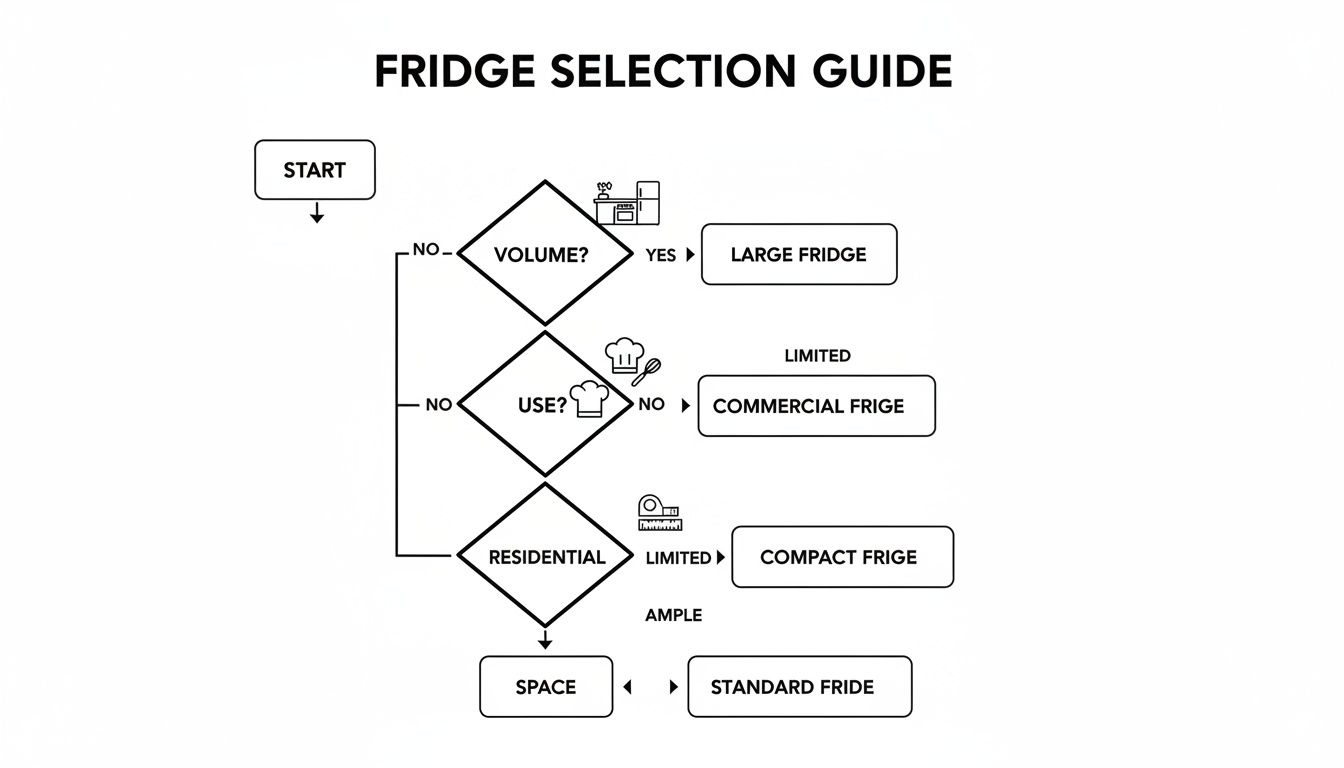
As you can see, your operational needs should be what drives this decision. Are you storing bulk inventory, needing ingredients right on the line, or just trying to maximize a tight space? Let's break down which units solve which problems.
Reach-In Refrigerators: The Daily Workhorse
Think of reach-in refrigerators as the backbone of most professional kitchens. These upright units, usually with one, two, or three doors, are all about easy access to ingredients you need throughout service.
Their biggest advantage is that they strike a great balance between serious storage capacity and a reasonable footprint. A standard two-door reach-in, for instance, can hold dozens of food pans, keeping everything from prepped veggies to house-made sauces right where your cooks can grab them. That kind of immediate access is a game-changer during a chaotic service.
The flip side is that their vertical design and swinging doors can create headaches in smaller kitchens. You have to account for that door swing—make sure it doesn't block a walkway or create a safety hazard when your team is moving fast.
Undercounter and Worktop Models: The Space Savers
When every single square inch of your kitchen is prime real estate, undercounter and worktop refrigerators are your best friends. These compact units are designed to slide right under standard countertops, turning what would be dead space into productive cold storage.
Their real purpose is to create efficient, decentralized workstations. Picture a garde manger station where a chef has every topping, green, and dressing chilled right under their cutting board. That setup cuts out all the wasted steps back and forth to a main cooler, which directly translates to faster ticket times.
Placing ingredients exactly where they are needed is the key. Undercounter units minimize staff movement, shrink ticket times, and just make for a smoother, more organized kitchen.
Of course, they aren't built for bulk storage. Their smaller capacity means they are best for holding what you need for a single shift, so they rely on being restocked regularly from your larger refrigerators.
Prep Tables: Built for High-Speed Assembly
Refrigerated prep tables—whether for sandwiches, salads, or pizzas—are highly specialized machines engineered for one thing: speed. They combine a refrigerated base for backup ingredients with a top section that holds an array of food pans right at the cook's fingertips.
The payoff is pure efficiency on the line. A cook building a pizza has the sauce, cheese, and every topping perfectly chilled and laid out in front of them, with backup inventory just below. There's no faster way to assemble high-volume menu items.
That specialization is also their main drawback. A pizza prep table isn't nearly as flexible as a standard reach-in. They're a perfect investment for repetitive, high-volume tasks but don't offer much for general-purpose storage.
Walk-In Coolers: For Maximum Capacity
For any operation that moves a serious amount of product, a walk-in cooler is the ultimate storage solution. We're not just talking about a fridge; we're talking about a refrigerated room that can hold entire pallets of produce, cases of meat, and stacks of dairy.
A walk-in gives you the power to buy in bulk, which can lead to major cost savings from your suppliers. It also acts as a crucial buffer, ensuring you're stocked up for a massive weekend rush or a big catering event without the fear of running out of a key ingredient. The sheer volume they offer is simply unmatched.
The trade-offs, of course, are space and money. Walk-ins demand a significant footprint and a much larger upfront investment. They really only make sense for high-volume restaurants, large-scale catering operations, and institutions that have both the physical space and the inventory needs to justify it.
Comparing Key Specifications for Peak Performance
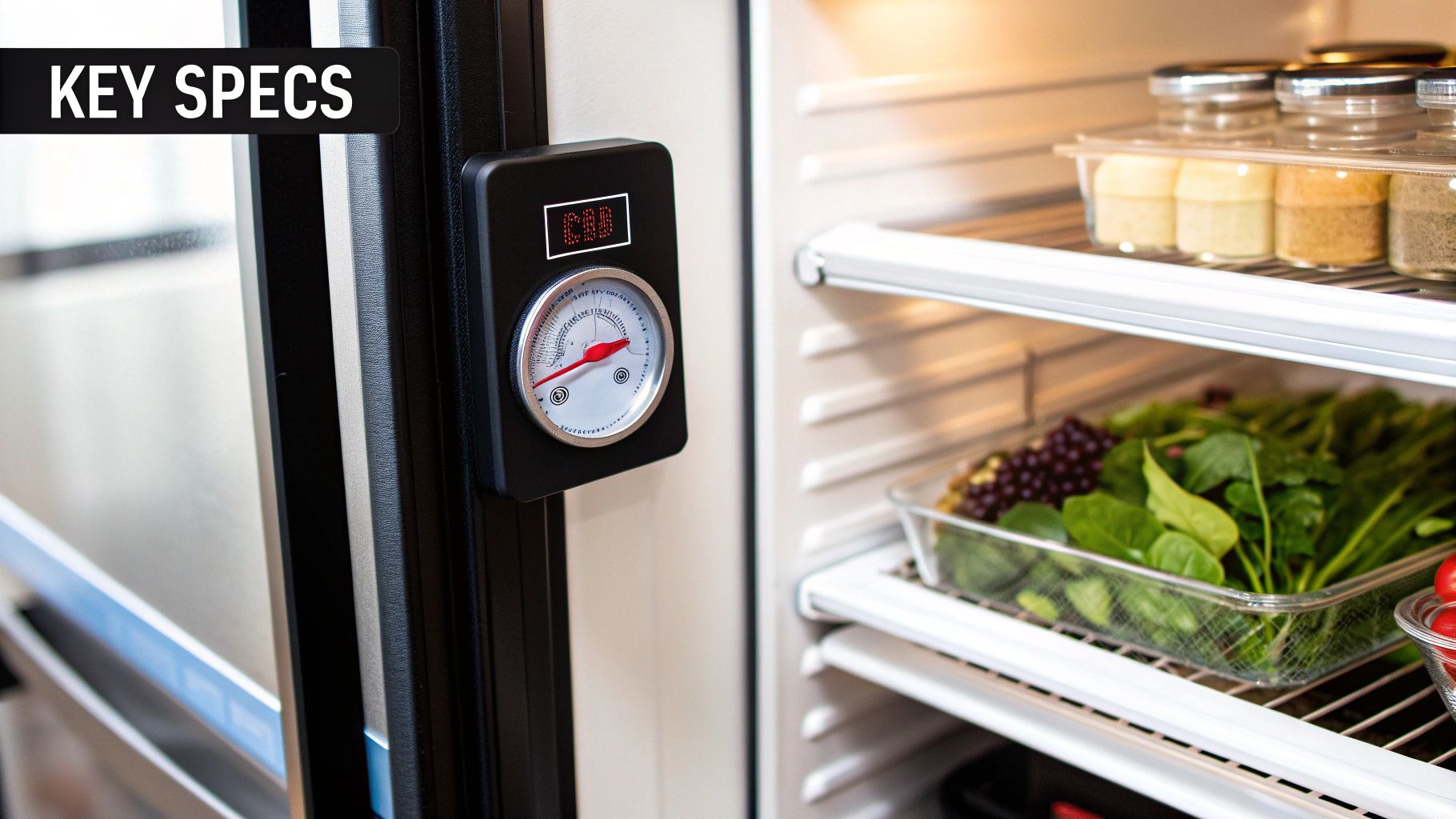
Once you've zeroed in on the type of commercial fridge your kitchen needs, it's time to get into the nitty-gritty: the technical specs. This is where a good unit is separated from a great one. These details will directly impact everything from your daily workflow, food safety standards, and your monthly utility bill. Making sense of them is how you find a refrigerator that performs under pressure when you need it most.
This isn't just about buying an appliance; it's a strategic investment. The commercial refrigeration market hit USD 85.6 billion in 2024 and is on track to reach USD 161 billion by 2034. That explosive growth shows just how critical this equipment is. When you consider that refrigeration can make up 40% of a supermarket's total energy use, it’s no surprise that manufacturers are pushing hard to innovate with highly efficient models.
Capacity: Cubic Feet vs. Usable Space
The first spec everyone looks at is capacity, usually listed in cubic feet. But that number can be deceiving. It often reflects the total internal volume, not the actual, practical storage space you can actually use day-to-day.
The real metric to care about is usable space. This is what’s left after you account for the evaporator coil's location, the shelving layout, and any interior ducting. A poorly designed unit might have awkward corners or bulky components that get in the way, making it impossible to slide in a standard food pan and wasting precious real estate.
Expert Insight: Don't just trust the spec sheet. If you can, check out a unit in person. If not, study detailed interior photos to see how the shelving and components will work with the pans and containers you use most.
Compressor Location: Top-Mount vs. Bottom-Mount
The compressor is the heart of your refrigerator, and where it’s placed has a huge impact on maintenance, efficiency, and even the air quality in your kitchen. There are two main designs to consider.
-
Top-Mount Compressors: These are fantastic for kitchens with lots of airborne flour, dust, or debris on the floor—think bakeries and pizzerias. Because the compressor is up high, it avoids sucking in all that gunk, keeping its coils cleaner for longer. The trade-off is that the heat it generates rises, which can warm up the area near the ceiling, and it can be a bit harder to reach for maintenance.
-
Bottom-Mount Compressors: This is the more common setup for a reason. Placing the compressor at the bottom makes it far easier for technicians to clean and service, which can lower your repair bills. It also pulls in cooler air from near the floor, helping it run more efficiently. The main downside is that it's right in the line of fire for grease and dust, so you have to be diligent about cleaning the coils to prevent clogs.
For most restaurants, a bottom-mount unit offers the best blend of efficiency and easy servicing, as long as you commit to a regular cleaning schedule.
Commercial Fridge Feature Comparison for Foodservice Operations
The technical specs of a commercial fridge can feel overwhelming, but they all serve a purpose. This table breaks down the key features across different fridge types to help you see the trade-offs at a glance, connecting each specification to real-world kitchen needs like workflow, energy costs, and maintenance.
| Feature | Reach-In Fridge | Undercounter Fridge | Prep Table | Walk-In Cooler |
|---|---|---|---|---|
| Typical Capacity | 20-70 cubic ft. | 2-15 cubic ft. | 5-20 cubic ft. | 100-1000+ cubic ft. |
| Footprint | Moderate vertical | Small, fits under counters | Long and narrow | Very large, room-sized |
| Compressor | Top or bottom mount | Typically rear or side | Bottom or side mount | Remote or self-contained |
| Workflow Impact | Central storage | Point-of-use access | Integrated prep surface | Bulk, long-term storage |
| Energy Use | Moderate | Low to moderate | Moderate | High (but efficient per ft³) |
| Best For | General storage | Bar, grill, specific stations | Sandwich, pizza, salad lines | High-volume kitchens |
Ultimately, choosing the right fridge means matching these technical features to the specific demands of your menu and kitchen layout. A small cafe has very different needs than a high-volume catering operation, and the right specs make all the difference.
Energy Efficiency: Decoding the Savings
In any commercial kitchen, energy is a huge operating expense. An energy-efficient refrigerator isn't just a green choice; it's a direct boost to your bottom line. The most reliable sign of efficiency is the ENERGY STAR certification.
An ENERGY STAR certified commercial fridge can be 15-30% more efficient than a standard model. That translates into hundreds, sometimes thousands, of dollars saved over the life of the unit. These models get there with better insulation, high-efficiency compressors, and smarter temperature controllers. As you evaluate your options, this certification should be a non-negotiable. Dive deeper into how choosing energy-efficient commercial refrigerators can make a real dent in your expenses.
Temperature Recovery Times: The Food Safety Metric
One of the most critical specs—and one that's often overlooked—is temperature recovery time. This is a measure of how quickly the fridge can get back down to a safe temperature after the doors have been opened, which happens constantly during a busy service.
A unit with a weak compressor or flimsy insulation will struggle to recover, leaving your food in the temperature "danger zone" (40°F to 140°F) for too long. This doesn't just hurt food quality; it's a major food safety risk. High-performance refrigerators are built with powerful compressors and robust circulation fans designed specifically to fight this, ensuring temperatures snap back to safe levels almost instantly.
Customization: Shelving and Door Options
At the end of the day, the best commercial fridge is one that works with your inventory, not against it. Look for models that offer adjustable or customizable shelving. Being able to rearrange shelves lets you fit everything from tall stockpots to shallow sheet pans without wasting an inch of vertical space.
Door options also play a big role in efficiency:
- Solid Doors: These offer the best insulation, which means better energy efficiency. They are perfect for back-of-house storage where you already know what's inside.
- Glass Doors: A must-have for front-of-house displays or busy prep lines where staff need to see what they're grabbing before opening the door. This cuts down on how long the door stays open, helping maintain a stable temperature.
By carefully weighing these key specs, you shift from simply buying a fridge to choosing a high-performance tool that's perfectly suited to your kitchen’s unique demands.
How to Size Your Fridge for Maximum Kitchen Efficiency
Picking the right commercial fridge isn't just about making sure it fits through the door—it's about making it work for your kitchen's rhythm. Get one that's too small, and you're constantly fighting to restock and missing out on bulk purchase savings. But go too big, and you're just paying to cool empty space and sacrificing precious floor real estate.
Think of it this way: the right size is a strategic asset. It smooths out everything from inventory control to how fast a plate gets to the pass. It’s the difference between a kitchen that flows and one that’s always in a state of chaos.

Assessing Your True Capacity Needs
Before you even look at a spec sheet, you need to get real about what your kitchen actually needs. The answer lies in three things: your menu, your customers, and your suppliers.
- Menu Complexity: Are you running a simple cafe menu or a fine-dining operation with dozens of fresh components? A kitchen that relies heavily on fresh produce, proteins, and from-scratch sauces needs a lot more cold storage than one with a more streamlined ingredient list.
- Daily Customer Volume: Think about your busiest shift on your busiest day. A high-volume restaurant churns through inventory at an incredible rate and needs enough stock on hand to prevent that dreaded "86" mid-service.
- Delivery Frequency: If your suppliers are dropping off fresh goods every day, you can get by with less on-site capacity. But if you're only getting deliveries a couple of times a week, you'll need enough space to hold several days of perishable inventory.
Beyond Dimensions: Measuring for Workflow and Ventilation
Okay, now it's time to break out the tape measure. But we're looking at more than just the unit's footprint. We need to think about how this beast will actually live and breathe in your space.
First up, measure every single doorway, hallway, and tight corner on the path from the delivery truck to its final spot. The best commercial fridges are useless if they get stuck in the corridor. Next, check the door swing. You have to make sure it won’t block a high-traffic lane or create a safety hazard for your crew when it's open.
The most overlooked step? Planning for ventilation. These units throw off a lot of heat. You absolutely must leave enough clearance—usually 2-3 inches on all sides—for the compressor to breathe. If you don't, the fridge will work itself to death, run inefficiently, and fail years before it should.
Planning for Future Growth and Layout Optimization
It’s tempting to buy for the business you have today, but you should really be buying for the business you want to have in a year or two. That small coffee shop might be fine now, but what happens when you add a full lunch menu? Sizing up just a little bit now can save you a massive headache and expense down the road.
Also, think about where you place your cold storage. A smart layout can shave precious seconds off every order. For a busy line, putting undercounter fridges at each station means cooks aren't constantly running back and forth to a central walk-in. It’s about keeping everything within arm's reach to build dishes faster and get tickets out the door.
For a more detailed breakdown, take a look at our complete guide on selecting a commercial refrigerator size.
New vs. Used Fridges: A Critical Financial Decision for Your Kitchen
Deciding between a new commercial refrigerator and a quality used model is one of the biggest financial calls a restaurant owner has to make. It’s the classic tug-of-war: save big now or invest in long-term peace of mind? The right choice really comes down to your budget, your stomach for risk, and your overall business plan. This isn't just about the sticker price; it's about the total cost of owning that machine for years to come.
This decision is more relevant than ever. The U.S. commercial refrigeration market, which keeps our foodservice businesses running, was valued at USD 12.63 billion in 2024. Experts project it will soar to USD 25.02 billion by 2033, thanks to a thriving food industry and a serious push for energy-efficient equipment. You can read more about the trends shaping the commercial refrigeration market to see where things are headed.
The Case for Buying Brand New
There’s a certain confidence that comes with buying new, and for good reason. The single biggest perk is the manufacturer's warranty. It usually covers parts and labor for one to three years, shielding you from surprise repair costs right after you’ve made a huge investment. For a new business watching every penny, that kind of security is priceless.
On top of that, new refrigerators come packed with the latest energy-saving tech. An ENERGY STAR certified unit might have a higher upfront cost, but it can easily save you hundreds of dollars a year on your utility bills. Before you know it, that efficiency pays for the price difference. You're also getting a spotless unit with its entire operational lifespan ahead of it, with no hidden history or wear and tear.
The Smart Money on Certified Used Fridges
When capital is tight, the appeal of used equipment is hard to ignore. A certified used commercial fridge from a trusted dealer can slash your initial cost by 30-70% compared to buying new. That’s a significant chunk of cash you can redirect toward other vital parts of your business, like marketing, inventory, or hiring another cook.
The trick, however, is to buy from a reputable supplier who puts their equipment through its paces—inspecting, servicing, and certifying every piece. A good dealer will be upfront about a unit's history and often provide a limited warranty, which takes a lot of the usual risk out of buying used. If you're considering this route, check out our in-depth guide on what to look for when buying used restaurant equipment.
When purchasing used, you are buying the dealer as much as the equipment. A reputable seller who stands behind their products transforms a potentially risky purchase into a smart, cost-effective investment for your kitchen.
Before you pull the trigger on any pre-owned fridge, you need to do your homework and give it a thorough inspection. Pay close attention to these key areas:
- Door Seals: Are the gaskets still flexible? A tight seal is crucial for keeping the cold in and your energy bill down.
- Compressor: Fire it up and listen. Any strange noises, vibrations, or signs of oil leaks are major red flags.
- Interior Condition: Check for rust, cracks, or missing shelves. Anything that compromises food safety or functionality is a deal-breaker.
- Temperature Consistency: If you can, ask to see the unit running. Make sure it can hold a steady, safe temperature without struggling.
At the end of the day, there’s no universally "right" answer in the new vs. used debate. A new fridge delivers reliability and top-tier efficiency, while a used model offers immediate, substantial savings. The best choice is the one that lines up perfectly with your restaurant's financial reality and operational needs.
Finding the Right Partner for Your Commercial Refrigeration Needs
Picking out the best commercial fridges for your kitchen is a big deal, but who you buy them from matters just as much. The right equipment partner isn't just selling you a stainless steel box; they're an advisor who's genuinely invested in your kitchen's success. We want to help restaurant owners and chefs discover the latest news and exclusive deals on restaurant equipment and supplies. A good partner gets that a restaurant's needs go way beyond the initial sale, covering everything from seeing the equipment firsthand to flexible logistics and support down the road.
A truly great partner offers real, tangible benefits that make your life easier. This often starts with having a massive showroom and warehouse full of stock, so you can actually get your hands on both new and certified used models. Seeing a unit in person lets you judge its real-world capacity, build quality, and how it feels to use—things a spec sheet just can't tell you.
The Advantage of Local Know-How and Flexibility
When you work with a local specialist like Encore Seattle, you get advantages that are built around you. Instead of dealing with a faceless online store hundreds of miles away, you get a team that knows the ins and outs of operating in the Pacific Northwest. That relationship translates into immediate, practical benefits.
- See It Before You Buy It: Come down to our Seattle showroom to touch, open, and measure the units yourself. Make sure it fits your pans, your space, and your workflow—no surprises.
- Smart Freight & Pickup: We offer free freight anywhere in Washington, which cuts a huge and often unpredictable cost from your budget. Plus, our flexible pickup options mean you can grab your equipment when it works for you.
- Real-World Advice: Our sales team can walk you through the nitty-gritty differences between models. We’ll explain what compressor placement or temperature recovery times actually mean for your specific operation.
A great equipment partner is more than a supplier; they are a resource. Their expertise ensures you not only buy the right fridge but also understand how to maximize its value for years to come.
Solutions That Fit Your Kitchen
Every foodservice business, whether it's a bustling pizza place or a quiet neighborhood bar, has its own financial situation. A true partner gets this and offers solutions that work with your budget and goals. This is where tailored financing really makes a difference, putting essential equipment within reach without a massive cash outlay. By offering these options, we help restaurants of all sizes get the quality gear they need to succeed.
Choosing the right partner is a critical step for any major kitchen investment. For a deeper dive into vetting professionals, this guide on how to choose a kitchen remodeling contractor offers some great principles. The core idea is the same: find experts who understand your vision. At the end of the day, your refrigeration partner should be someone committed to helping your business thrive.
Commercial Fridge FAQs
Even with all the specs and models laid out, you're bound to have some practical questions when it comes time to choose, install, and maintain your commercial fridges. Let's tackle some of the most common questions we hear from chefs and restaurant owners. Getting these details right from the start can save you some serious headaches later on.
After all, the initial purchase is just one part of the equation. Knowing how to properly care for your investment is what keeps your kitchen humming and your food safe.
How Often Should a Commercial Fridge Be Professionally Serviced?
Think of it like a car's oil change. For most commercial fridges, an annual professional service check is the bare minimum to keep things running smoothly. This is a pretty standard rule of thumb for most major kitchen equipment.
However, if your fridge is in a really tough spot—say, right next to a hot cookline or in a kitchen that never stops—bumping that up to twice a year is a smart move. During a professional tune-up, a technician will handle the critical stuff you can't easily do yourself.
- Refrigerant Level Checks: They'll make sure the system has the right amount of refrigerant to cool efficiently without overworking the compressor.
- Coil Inspections and Cleaning: Technicians have the proper tools to give the condenser and evaporator coils a deep clean that goes beyond a simple wipe-down.
- Door Seal and Hinge Examination: They'll check for tiny gaps or worn-out seals that let cold air escape and drive up your energy bill.
- Thermostat Calibration: This ensures the temperature on the display is the actual temperature inside, keeping your food safe.
Staying on top of this doesn't just add years to the life of your unit; it keeps it running at peak efficiency, which you'll definitely notice on your utility bills.
What’s the Most Common Cause of Commercial Fridge Failure?
Hands down, the number one killer of commercial refrigerators is a dirty condenser coil. Kitchens are full of grease, dust, and flour—all of which get pulled into the fridge's ventilation system.
That gunk builds up on the condenser coil and acts like a thick blanket, trapping heat inside. The compressor then has to work overtime just to keep the unit cool, leading to overheating, sky-high energy use, and eventually, total system failure.
I can't stress this enough: routine coil cleaning is the simplest, most effective thing you can do. A few minutes with a brush each month can literally prevent thousands of dollars in emergency repairs and spoiled inventory.
Can I Use a Residential Fridge in a Commercial Kitchen?
Please don't. It might seem like a way to save a few bucks upfront, but using a residential fridge in a professional kitchen is a massive mistake that will cost you dearly.
Home refrigerators simply aren't built for the job. Their compressors can't keep up with the high ambient heat and constant door openings of a busy service, putting you at huge risk for food spoilage and health code violations. They also aren't built to withstand the constant wear and tear, meaning they'll break down fast. On top of all that, putting a residential unit in a commercial space instantly voids its warranty.
Finding the right equipment and a partner you can trust is key to your success. At Encore Seattle Restaurant Equipment, we're here to offer expert guidance and a huge selection of new and certified used units to match your kitchen's needs. Come see what we have in stock and let us help you find the perfect refrigeration solution at https://encoreseattle.com.