

The Ultimate Guide to Undercounter Refrigerator Sizes
In a commercial kitchen, every inch counts. When it comes to undercounter refrigerators, you’re generally looking at units ranging from 24 to 72 inches wide. They're designed to stand about 34 to 36 inches tall, letting them slide right under a standard-height work counter.
Inside, the storage capacity can be anything from a tight 2 cubic feet to a surprisingly roomy 20 cubic feet, all depending on the specific model you pick.
Your Quick Guide to Undercounter Refrigerator Sizes
Picking the right undercounter refrigerator isn't just about filling a space—it's about making your kitchen work smarter. Think of it like finding the perfect puzzle piece for your prep line. Get it right, and everything flows seamlessly. Get it wrong, and you've just created a bottleneck that will drive your chefs crazy during a busy service.
This guide is your cheat sheet for matching a unit to what you actually need, whether you're setting up a high-volume restaurant, a cozy café, or a super-efficient food truck. Stay informed about the latest industry trends to make the best choice.
Understanding the standard dimensions is the first step. The right size directly impacts your kitchen’s productivity, helps you nail food safety compliance, and ultimately protects your bottom line. A fridge that's too small means overstuffed shelves and poor airflow, which is a recipe for spoiled ingredients. One that’s too big is just a waste of precious floor space and electricity.
To help you get a quick visual, here’s a breakdown of the common sizes you'll encounter.
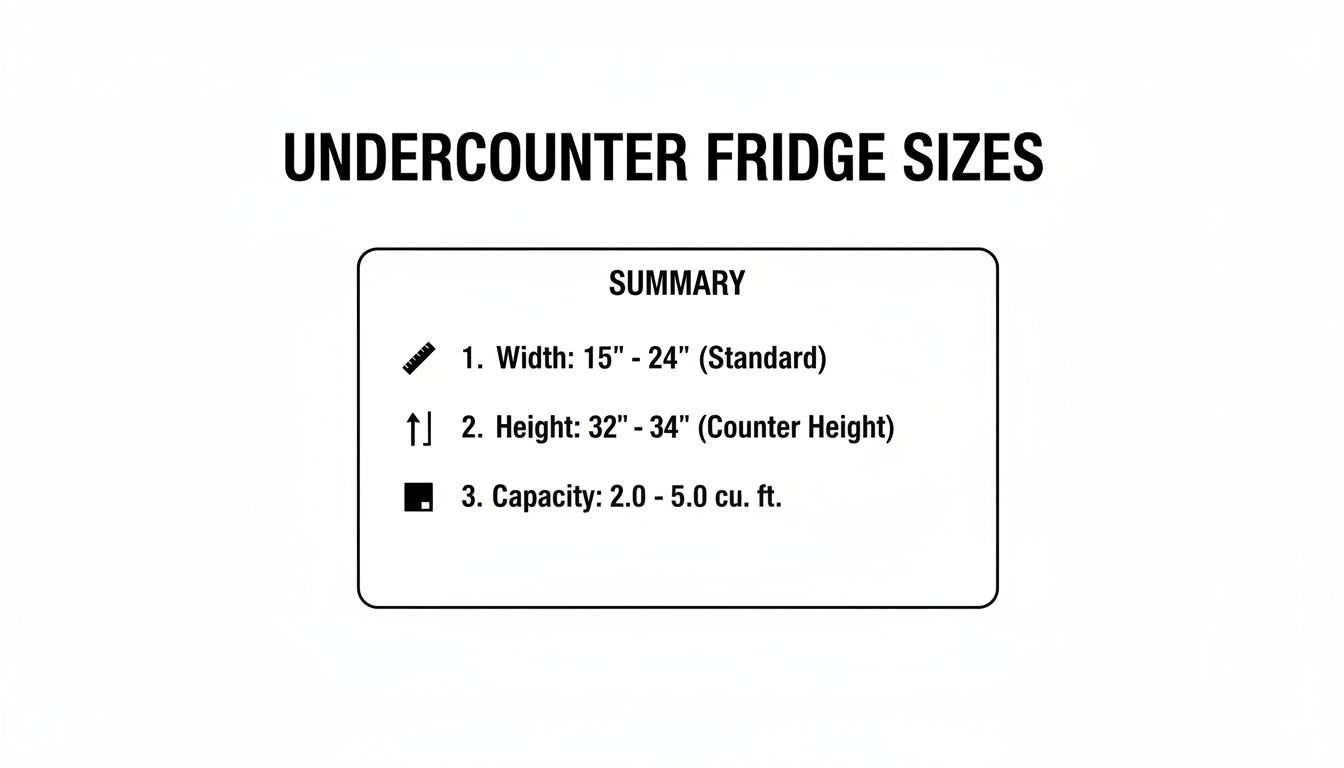
This image nails the three key things to keep in mind: width, height, and capacity. These are the metrics that will tell you if a unit is a good fit for your kitchen's layout and your menu's demands.
Key Dimensions to Consider
When you start shopping, you’ll notice that undercounter refrigerators fall into a few standard size categories. Each one is built for a different role in a professional kitchen, from a small bar station to a main prep line that’s constantly in use.
To make things easier, I've put together a table that connects the typical sizes with where they work best. Think of this as your starting point for discovering exclusive deals on the restaurant equipment and supplies you need.
Standard Undercounter Refrigerator Dimensions and Applications
| Size Category | Typical Width (Inches) | Typical Capacity (Cu. Ft.) | Best For |
|---|---|---|---|
| Compact Single-Door | 24" - 30" | 5 - 8 | Bar backup, small cafés, or dedicated stations for specific ingredients. |
| Standard Two-Door | 36" - 54" | 9 - 15 | Most restaurant prep lines, sandwich shops, and busy kitchens needing flexibility. |
| Large Three-Door | 60" - 72" | 16 - 20+ | High-volume operations, large catering kitchens, and pizzerias with extensive topping needs. |
This table gives you a solid framework for matching a unit's footprint to its real-world application, helping you avoid buying more—or less—than you actually need.
The real trick is to balance the physical footprint with the usable internal capacity. A perfectly sized unit should feel like a natural extension of your counter, giving chefs instant access to ingredients without getting in their way.
Once you have these basic measurements in mind, you can confidently start looking at models that will genuinely support your team. From here, we can dig into the specifics of measuring your space and matching capacity to your menu.
Cracking the Code on Commercial Refrigerator Dimensions
Ever look at a spec sheet for an undercounter refrigerator and feel like you’re trying to decipher a secret code? All those numbers and technical terms can be a lot to take in. Let’s translate that information into practical knowledge you can actually use in your kitchen. My goal here is to help you read any spec sheet and know exactly how that unit will impact your day-to-day operations. We're going beyond just the numbers to get to the "why" behind them.
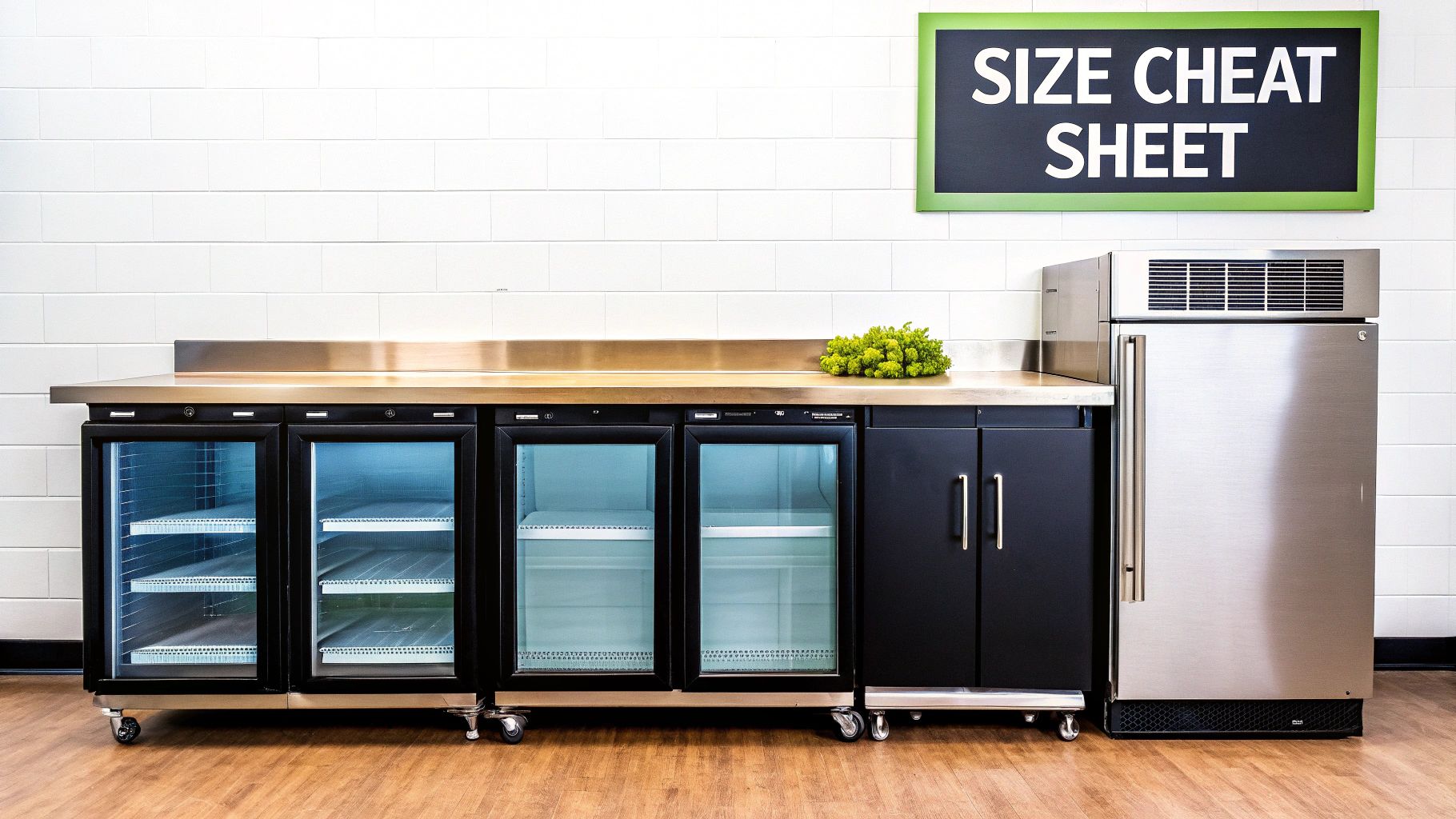
Here’s a simple way to think about it: a refrigerator's exterior dimensions are like its parking spot. They tell you if the unit will physically fit under your counter. The interior capacity, measured in cubic feet, is the cargo space—it’s all about how much product you can actually stuff inside. Getting this distinction right is the first step to maximizing your storage without creating a cramped, inefficient kitchen.
Why Standard Sizes Are a Kitchen's Best Friend
There's a reason most commercial kitchen counters are a standard height, usually hovering between 34 and 36 inches. Undercounter refrigerators are specifically built to slide right into that space, creating a clean, seamless line and a more efficient workflow. That height isn't random; it's all about ergonomics. It allows your team to grab ingredients and prep without constant, awkward bending or reaching.
You'll also find many of these units are designed with ADA (Americans with Disabilities Act) compliance in mind. An ADA-compliant counter has a maximum height of 34 inches, so refrigerators designed to fit are accessible to every member of your team. This fosters a more inclusive and legally sound workplace from the ground up.
When you choose a standard-sized unit, you're not just buying a piece of equipment; you're investing in a proven system designed for professional kitchen efficiency, safety, and accessibility.
This standardization is a lifesaver when it comes to kitchen design and equipment replacement. It means a new unit from a different manufacturer will almost certainly fit into the same slot as your old one, saving you from the headache and expense of custom modifications down the road.
What the Market Trends Tell Us
The growing popularity of these compact, powerful units isn't by chance—it reflects a major shift in how modern food service operates. The global undercounter refrigerator market has exploded, hitting USD 3.42 billion and is projected to climb to USD 6.27 billion by 2033. This massive growth is driven by the hospitality sector, where restaurants, cafes, and bars are all fighting for efficiency.
This trend points to a critical need in today's kitchens: having more ingredients right where the action is. By placing cold storage directly under prep stations, chefs don't have to waste precious seconds walking back and forth to a walk-in. Staying informed about industry trends like this helps restaurant owners make smarter investments.
Connecting Dimensions to Your Daily Workflow
Let's bring this down to a practical level. A small, 24-inch wide single-door unit could be the perfect fit for a café’s milk and creamer station. On the other hand, a sprawling 72-inch three-door model is non-negotiable for a busy pizzeria's topping line. The dimensions you choose should directly support your menu and the pace of your service.
When you're looking at that spec sheet, here's what to focus on:
- Width: This tells you how much horizontal counter space the unit eats up. It's the most important number for fitting it into an existing prep line.
- Depth: This ensures the unit will sit flush with your other equipment and cabinetry, not stick out into walkways and create a safety hazard. Most standard depths are around 30-32 inches.
- Height: This confirms it will actually slide under your counter, especially after you account for casters or legs. Always measure your counter height before you buy.
Once you’ve got these fundamentals down, you can stop looking for a fridge that just "fits." You can start choosing a unit that truly enhances your kitchen’s layout and makes your team's job easier. To continue building your knowledge, you can also check out our guide on general commercial refrigerator size considerations.
How to Measure Your Space for a Perfect Fit
There’s nothing worse than the delivery truck showing up with your brand-new undercounter refrigerator, only for the crew to tell you it won’t fit. It’s a costly, frustrating, and totally avoidable mistake. Getting the right fit isn't just about sliding the unit into a hole; it's about making sure it can work efficiently for years.
Think of it like this: a refrigerator's compressor is its engine. If you suffocate it in a space that’s too tight, it can’t breathe. It will overheat, work overtime just to stay cool, and burn out way too soon. A few careful measurements are all it takes to protect your investment.
The Three Core Measurements
First things first, grab a tape measure. You need to know the exact dimensions of the opening where the refrigerator will live. A pro tip is to measure each dimension in three different spots (e.g., top, middle, and bottom for height) and use the smallest measurement. That way, you're covered if the space isn't perfectly square.
- Width: Measure the horizontal space from one side of the opening to the other. This is the first number you'll use to narrow down your options.
- Height: Measure vertically from the floor right up to the underside of the countertop. Be sure to account for any lip or trim on the counter that might hang down and steal a fraction of an inch.
- Depth: Measure from the back wall to the front edge of the cabinets or other equipment. This is crucial for making sure the unit sits flush and doesn't stick out, creating a trip hazard in a busy kitchen.
When you're trying to integrate an undercounter unit seamlessly, the same precision used for planning built-in cabinets is a must. Nail these three numbers, and you've laid the foundation for a perfect installation.
Giving Your Refrigerator Breathing Room
This is the step that trips up so many people. You can’t just buy a fridge that has the exact same dimensions as your opening. It needs clearance—what we call "breathing room"—so the condenser coils can dissipate heat properly.
A solid rule of thumb in the industry is to leave at least 1-2 inches of clearance around the back and sides of the unit. If you don't, you're setting yourself up for an overheating compressor, higher energy bills, and a much shorter lifespan for your equipment.
But remember, not all refrigerators are created equal. The most important detail to check on the spec sheet is the ventilation type. A standard, rear-breathing model pushes hot air out the back and absolutely requires that clearance to survive.
The Front-Breathing Advantage in Tight Spaces
For operations where every single inch counts—think food trucks, cramped bar areas, or a tight prep line—a front-breathing model is a lifesaver. These units are designed to pull in cool air and push out hot air through a grille on the front.
This clever design means they can be installed completely flush against walls and sandwiched between other equipment without any side or rear clearance. They are the go-to choice for a true, zero-clearance, built-in look. They might cost a bit more upfront, but the space you save often makes it well worth it. If you're exploring other compact cooling options, our guide to counter top refrigeration is a great next step.
Final Checks Before You Buy
Before you hit that "confirm order" button, run through one last mental checklist to catch any potential installation headaches.
- Check for Obstacles: Look inside the opening. Are there any plumbing lines, electrical outlets, or conduits on the back wall that could get in the way?
- Map the Delivery Path: It's not just about the final spot. Measure every doorway, hallway, and tight corner on the path from your loading dock to the kitchen. Make sure the unit can actually get there.
- Confirm Electrical Needs: Double-check the unit's spec sheet. Does it need a standard 120V outlet, or something more powerful? Is there a dedicated circuit ready for it? Ensure your electrical setup can handle the load.
Matching Refrigerator Capacity to Your Menu
Figuring out the right undercounter refrigerator size is about more than just finding a unit that slots into your available floor space. The real trick is matching its internal capacity—what we measure in cubic feet (cu. ft.)—to the daily grind of your menu and service volume.
Capacity isn't just a number on a spec sheet. It's a direct measure of how well that piece of equipment can support your kitchen when the ticket machine is spitting out orders non-stop.
Think of it this way: a refrigerator's external dimensions are its footprint, but its cubic footage is its horsepower. A high-volume sandwich shop needs a unit that can hold multiple food pans for lightning-fast access, whereas a craft cocktail bar needs just the right height for chilling tall bottles and even a small keg. The key is to get granular and analyze exactly what you store and how fast you burn through it.

Take a hard look at your menu and pinpoint your highest-turnover ingredients. When you align your storage directly with your operational needs, you're setting your team up to work smarter, not harder. No more frantic restocking or hunting for that last container of prepped veg during a rush.
Connecting Cubic Feet to Kitchen Output
Let's make this practical and connect undercounter refrigerator sizes to real-world kitchens. A small bakery that just needs to chill butter, eggs, and cream can get by beautifully with a compact 5 cu. ft. model tucked neatly under a prep table. It provides just enough cold storage without wasting energy or precious space.
On the other hand, a bustling coffee shop serving breakfast sandwiches and pre-made salads needs a lot more muscle. A model in the 10+ cu. ft. range is a better fit, offering plenty of room for milk cartons, yogurt, produce, and grab-and-go items, all organized for speed. For operations that lean heavily on prepped ingredients, you might even find that exploring different kinds of refrigerated prep tables offers a more streamlined solution.
The smartest way to choose a capacity is to think about function, not just footprint. Don't just ask, "Will this unit fit in the corner?" Instead, ask yourself, "What will this unit do for my workflow?"
It’s no surprise that the 5-10 cubic feet range is a major player in the undercounter market. This popular size hits a sweet spot for full-service restaurants and kitchen designers who need a good amount of space for meats, vegetables, and drinks. It offers substantial storage without being too bulky for the tight layouts often found in food trucks or pop-up concepts.
To give you a better idea of what capacity might be right for you, here’s a quick guide matching cubic feet to common food service operations.
Capacity Guide for Different Food Service Operations
| Capacity Range (Cu. Ft.) | Ideal For | Common Items Stored |
|---|---|---|
| 2 - 5 cu. ft. | Small cafes, bars (garnish/beverage), bakeries | Butter, cream, milk, cocktail garnishes, pre-portioned sauces |
| 5 - 10 cu. ft. | Mid-size restaurants, coffee shops, delis | Meats, cheeses, produce, pre-made sandwiches, grab-and-go items |
| 10 - 15 cu. ft. | High-volume kitchens, institutional settings, caterers | Bulk produce, large containers of dressings, backup ingredients |
Ultimately, this is a starting point. Your specific menu and workflow will always be the best guide.
Total vs. Usable Space
Here’s a crucial detail that often gets overlooked: the difference between a refrigerator's advertised total capacity and its actual usable space. The number on the box represents the total empty volume inside, but that’s not the whole story.
Several real-world factors chip away at the amount of product you can realistically store:
- Shelving: Adjustable shelves are fantastic for customizing your layout, but each shelf eats up vertical space. The more shelves you add, the less room you have for bulky items.
- Compressor Hump: Take a look inside most models and you'll find a "hump" at the bottom that houses the compressor components. This creates an uneven floor that you have to work around.
- Door Storage: Those little bins on the door are great for organization, but they often can't handle heavy or oversized items and may not stay as consistently cold as the main cabinet.
- Airflow Gaps: This is a big one. You have to leave space around your ingredients for cold air to circulate properly. Over-packing a refrigerator is the fastest way to create warm spots and serious food safety risks.
So, how do you estimate what you can actually fit? A good rule of thumb is to subtract about 20-30% from the total advertised cubic feet. This more realistic number gives you a much better idea of what the unit can truly hold during a busy service, helping you choose an undercounter refrigerator size that won't let you down.
More Than Just a Box: Features That Define Your Refrigerator's Real-World Size
The spec sheet gives you the external dimensions and cubic footage—the numbers that tell you if a unit will physically fit and its maximum theoretical capacity. But the real functional size? That comes down to its features. How you get into that cold space, whether it's through doors or drawers, has a massive impact on your kitchen's rhythm during the dinner rush.
Choosing the right setup is like picking the right knife for the job. A solid door is your insulated, all-purpose workhorse. A glass door is a front-of-house sales specialist. Getting this choice right means picking a unit that actually helps your team, not just one that slides under the counter.
The Great Debate: Doors vs. Drawers
When you're looking at undercounter refrigerator sizes, one of the first forks in the road is doors versus drawers. There’s no single "best" answer here; the right choice is completely tied to how and where you plan to use the unit.
A standard swing-door model is a versatile classic. It’s perfect for general storage where you need to see everything at a glance. Pop the door open, and you've got a full view of multiple shelves, making it simple to grab bulky items like big containers of sauce or prepped vegetable bins.
Drawers, on the other hand, are all about speed and organization on a frantic cook line. Think of them as refrigerated filing cabinets for your mise en place. Instead of opening a door, crouching down, and digging around, a chef can pull out a drawer for immediate, top-down access to neatly arranged food pans. This can shave precious seconds off plating a dish or building a sandwich.
Solid Doors vs. Glass Doors
The type of door you pick fundamentally changes the refrigerator's job description. It's a clear choice between back-of-house utility and front-of-house salesmanship.
- Solid Doors: These are the champs for most back-of-house prep areas. Their superior insulation does a much better job of holding a consistent temperature, which is critical in a hot kitchen. That makes them more energy-efficient and the safer bet for storing sensitive ingredients like meat and dairy.
- Glass Doors: A must-have for any front-facing spot like a bar, café, or grab-and-go counter. A glass door instantly turns your fridge into a display case, letting customers see bottled drinks, desserts, or craft beers. This visual marketing can directly boost sales, but just know they're a little less efficient due to the glass.
Think about the unit's main purpose. If it's holding raw ingredients for the kitchen line, a solid door is the only practical choice. If it's for serving drinks to customers at the bar, a glass door is a non-negotiable sales tool.
Don't Underestimate Adjustable Shelving
Beyond the door style, the interior layout is the final piece of the puzzle. The flexibility of the shelving is what dictates what you can actually store, no matter what the cubic footage number says.
Most commercial undercounter units come with heavy-duty, adjustable shelves, usually coated to fight off rust and corrosion. In a commercial kitchen, that adjustability isn't a luxury—it's essential. You have to be able to reconfigure the interior to handle changing menus and seasonal ingredients.
One week you might need to drop a shelf to fit tall bottles of house-made dressing; the next, you might need to raise it to stack shallow prep pans. A unit with fixed shelves is a one-trick pony that will quickly limit your kitchen's potential. Always look for models that give you total control over the internal layout. It's the only way to make sure every cubic foot you paid for is actually usable space.
Getting Your Installation Right: The Final Piece of the Puzzle
You've measured your space and picked the perfect size—great. But getting that new undercounter refrigerator to work flawlessly and legally in your kitchen is the final, and most important, step. Think of this as your pre-flight check before you commit. A proper installation isn't just about plugging it in; it’s about setting your new equipment up for a long, efficient life.
The absolute first thing to look for is NSF certification. That NSF seal is more than just a sticker; it’s your guarantee that the unit is built to strict public health standards for everything from material safety to cleanability. Health inspectors live and breathe these standards. Seeing that mark means you pass; not seeing it can mean a failed inspection and a major headache. For any serious food business, it's non-negotiable.
Nuts, Bolts, and Practical Details
Beyond the official certification, you need to sort out the practical side of things. Getting these details right from the start will make your life so much easier when it comes to daily operations and maintenance.
- Power Up Correctly: Always check the manufacturer's spec sheet. Most commercial undercounter units need their own dedicated 120V circuit. The compressor needs a lot of juice to kick on, and trying to share a circuit with a microwave or blender is just asking for a tripped breaker in the middle of a rush.
- To Roll or To Stand Still?: You'll usually get a choice between casters (wheels) or legs. I almost always recommend casters. They make it a breeze to roll the unit out for deep cleaning, which is essential for getting into those hard-to-reach spots. Legs are sturdy, but they turn a simple cleaning job into a major project.
- Let the Pros Handle It: It might look like a simple plug-and-play setup, but a professional installation ensures everything is done by the book. They'll make sure the electrical supply is correct and that you've left enough breathing room for the condenser. Little mistakes here can void your warranty or cause the unit to fail years before it should.
A smooth, compliant installation comes down to careful planning, from taking precise measurements to ensuring the right electrical hookups are ready. For a deeper dive into what this involves, it’s worth reading up on professional refrigerator installation to make sure all your bases are covered.
Think of installation as the foundation for your refrigerator's entire lifespan. A correctly installed, NSF-certified unit doesn't just pass inspections. It runs more efficiently, saves you money on energy bills, and will serve you reliably for years to come. That’s a real return on your investment.
By locking down these logistical and compliance details before you buy, you’re not just making sure your new fridge fits the space. You’re ensuring it becomes a seamless, legal, and hardworking part of your kitchen from day one.
Quick Answers to Common Questions About Undercounter Refrigerator Sizes
Even after you've done your homework, a few specific questions always seem to pop up when you're about to pull the trigger on a new undercounter unit. Let's tackle the most common ones I hear from kitchen operators to make sure you're making the right call.
Getting these details sorted out ensures your new fridge won't just fit the space, but will also work efficiently and legally from the moment it's installed.
What Is the Standard Height of an Undercounter Refrigerator?
You'll find that most commercial undercounter refrigerators stand between 34 and 36 inches tall. This isn't an accident—it's designed to let them slide perfectly under standard-height commercial counters, putting everything right where you need it for a smooth workflow.
This height is also key for accessibility. ADA-compliant counters can't be taller than 34 inches, so many models are built to fit under them, making your kitchen accessible for every member of your team. Just be sure to grab a tape measure and check your counter's exact height before you buy.
How Much Breathing Room Does an Undercounter Fridge Need?
Good ventilation is non-negotiable if you want your refrigerator to last. For a typical rear-breathing model, you absolutely have to leave space for the compressor to shed heat.
The industry rule of thumb is to leave at least 1-2 inches of clearance around the back and sides. If you don't, you're essentially choking the compressor, which leads to overheating, higher energy bills, and a much shorter lifespan for your equipment.
If you're really tight on space, look for a front-breathing model. These are a game-changer. They're designed to pull air in and push it out through a grille on the front, meaning you can install them completely flush against walls or other equipment with zero clearance needed.
Are Commercial Undercounter Refrigerators Louder Than the One in My House?
In a word, yes. A commercial undercounter refrigerator is going to be noticeably louder than your home fridge. The reason is all about power and performance.
These units are built like workhorses, with bigger, tougher compressors designed to chill ingredients fast and hold that temperature steady, even with doors opening and closing constantly during a dinner rush. You'll hear the hum and the cycle of the fan and compressor kicking on. That's just the sound of a heavy-duty machine doing its job in a demanding kitchen.
Ready to find the perfect fit for your kitchen? At Encore Seattle Restaurant Equipment, we offer a wide selection of undercounter refrigerators to match any size and need. Discover exclusive deals and expert advice by visiting us at https://encoreseattle.com.