
A Guide to Under Counter Refrigerator Sizes for Your Commercial Kitchen
When outfitting a commercial kitchen, knowing the standard dimensions of your equipment is half the battle. For undercounter refrigerators, you’ll find that most are designed with a 24-inch depth to align perfectly with standard countertops. From there, widths typically come in at 24, 36, and 48 inches, while heights generally fall between 33 and 36 inches to slide right under the work surface.
This consistency is key—it’s what allows for that clean, seamless look that defines an efficient, professional kitchen line. Staying informed about industry standards ensures you make the best equipment choices for your operation.
An Overview of Standard Undercounter Refrigerator Sizes
For any chef or restaurant owner who has managed a busy service, you know that every inch of kitchen real estate counts. Undercounter refrigerators are absolute workhorses for creating efficient prep stations, but picking the right one always comes back to the numbers. Understanding these standard dimensions is the bedrock of good kitchen design, impacting everything from workflow to how easily your staff can move around.
This quick visual guide breaks down the typical dimensional ranges you'll encounter when shopping for the latest undercounter refrigeration.
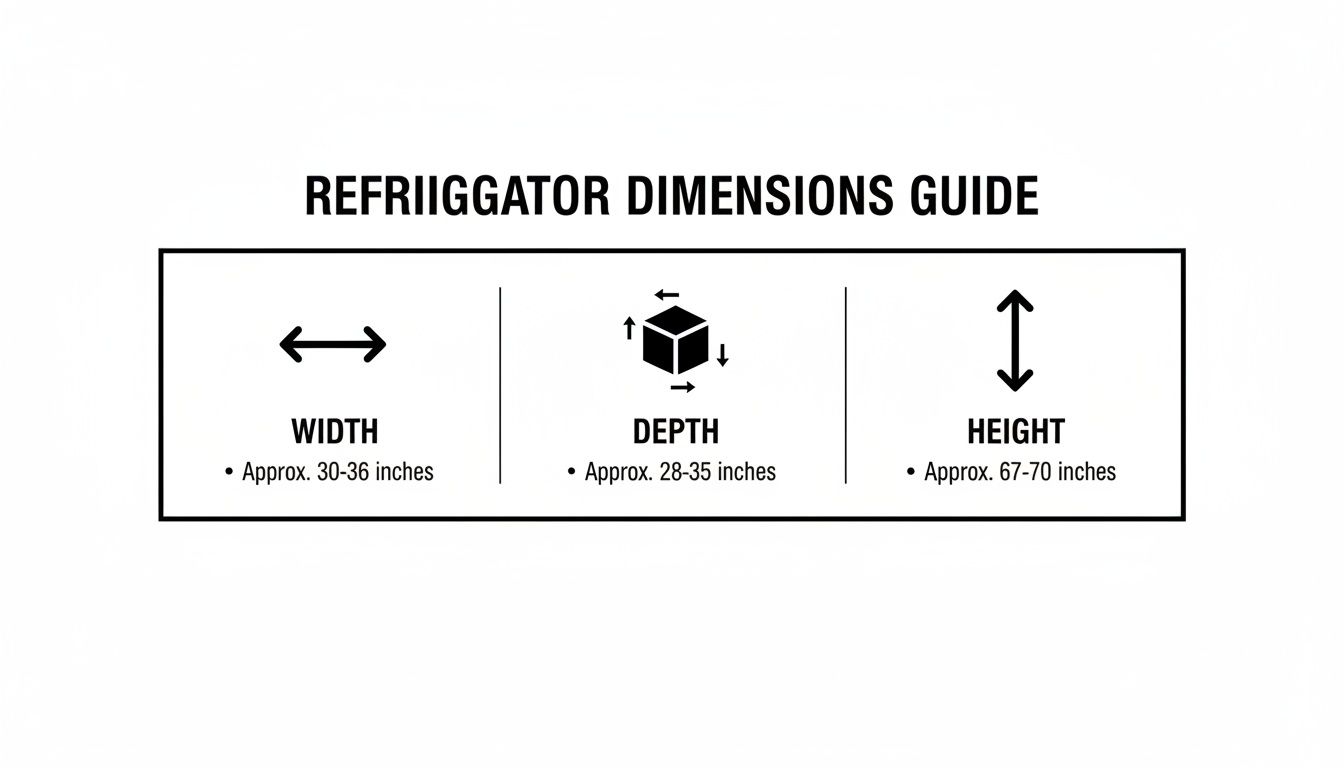
As you can see, the predictable depth and height make installation straightforward. It's the variation in width that gives you the flexibility to match the unit to your specific storage needs and the space you have available, a key industry trend in kitchen optimization.
Standard Commercial Undercounter Refrigerator Sizes
To make things even easier, here’s a quick-reference table that lays out the most common sizes you'll find on the market. These are the go-to configurations for a reason—they're designed to fit the demands of most commercial kitchens. Keep an eye out for exclusive deals on these popular models.
| Configuration | Typical Width (Inches) | Typical Depth (Inches) | Typical Height (Inches) | Common Capacity (Cu. Ft.) |
|---|---|---|---|---|
| Single-Door | 24 - 32 | 24 - 32 | 34 - 36 | 6 - 8 |
| Two-Door | 36 - 60 | 24 - 32 | 34 - 36 | 9 - 16 |
| Three-Door | 60 - 72 | 24 - 32 | 34 - 36 | 17 - 22 |
| Drawer Models | 24 - 72 | 24 - 32 | 34 - 36 | 6 - 22 |
This table should give you a solid baseline for what to expect, whether you're looking for a compact single-door unit for a small prep area or a large three-door model for a high-volume line.
The Foundation of Kitchen Layouts
There's a reason these dimensions are so consistent—it’s all about modularity. Commercial kitchens are built like a puzzle, and manufacturers design undercounter units to fit perfectly into the bigger picture. With a standard 24-inch depth and common widths like 24, 36, and 48 inches, you can line up different pieces of restaurant equipment and supplies without wasting precious space.
This standardization makes planning much easier. Whether you're spec'ing out a new build or swapping an old unit, you can accurately map out your linear footage and know exactly where your utility hookups need to be.
Of course, getting the basic measurements right is just the starting point. You also need to think about how that unit fits into your kitchen's overall operation. For more on that, take a look at our guide on choosing the perfect commercial refrigerator size. Once you master the fundamentals of sizing, you're well on your way to building a smarter, more efficient kitchen.
Understanding Key Dimensions: Width, Depth, and Height
When you're outfitting a commercial kitchen, picking the right undercounter refrigerator isn't just about finding one that slides into an empty space. You have to get the dimensions right. Every inch of width, depth, and height affects your kitchen's workflow, layout, and even safety. Getting these details dialed in from the start ensures your new restaurant equipment becomes a seamless part of your operation, not a daily obstacle.
These three measurements define everything from storage capacity to the unit's physical footprint. A small miscalculation can lead to a blocked walkway, a clumsy prep line, or a fridge that just plain won't fit.
Breaking Down Undercounter Refrigerator Widths
Width is usually the first thing kitchen designers and chefs look at. It’s what determines how the unit fits into the prep line and how much you can store. Luckily, commercial undercounter fridges are built to standard widths, which simplifies planning a modular kitchen layout—a key industry trend.
You’ll typically find widths falling into these common categories:
- 24 Inches: This is your go-to for tight spots. Think satellite prep stations, small bars, or any point-of-service area where you only need a handful of refrigerated items within arm's reach.
- 36 to 48 Inches: These are the workhorses in most kitchens. They strike a great balance between footprint and capacity, making them perfect for busy salad or sandwich stations. A single 48-inch unit can often do the job of two smaller fridges, which is a smart way to consolidate.
- 60 to 72 Inches: These big units are built for high-volume kitchens. They offer maximum undercounter storage and are usually found along the main cook line, keeping bulk ingredients right where the action is.
The trick is to match the width to the station's purpose. A 72-inch model is a game-changer for a pizza prep line holding dozens of topping pans, whereas a compact 24-inch fridge is all a bartender needs for garnishes and mixers.
Choosing the Right Unit Depth and Height
Don't overlook depth and height—they're just as critical for a smooth installation. These dimensions dictate whether the unit will sit flush with your counters and if it meets important accessibility standards.
Depth Considerations
The standard depth for a commercial unit usually falls between 24 to 32 inches. This is designed to align perfectly with most commercial countertops, giving you a clean, flush look. You may also see "bar-depth" or "shallow-depth" models designed for tight bar spaces or to leave more room in walkways.
Key Takeaway
Pay close attention to the spec sheet. Does the listed depth include the handle and the ventilation coils on the back? An extra inch or two can throw off your entire plan in a crowded kitchen. Measure your space precisely and compare it to the unit's total footprint, not just the cabinet dimensions.
Height and Accessibility
Most undercounter refrigerators have a standard worktop height of 34 to 36 inches. This allows them to slide neatly under existing prep tables and counters, creating a comfortable, ergonomic work surface for your staff.
It's also important to consider accessibility. Many manufacturers produce ADA-compliant models, which have a finished height of 34 inches or less. This ensures the unit is accessible to employees who use wheelchairs, which is crucial for building an inclusive and legally compliant workplace.
Calculating Your Kitchen's Capacity Needs
Choosing an undercounter refrigerator based on its exterior dimensions is only half the battle. What really impacts your day-to-day operations is the unit's internal capacity. It’s one thing to see a number on a spec sheet, but it’s another to visualize how that translates to food pans, bottles, and prepped ingredients during a chaotic dinner service.
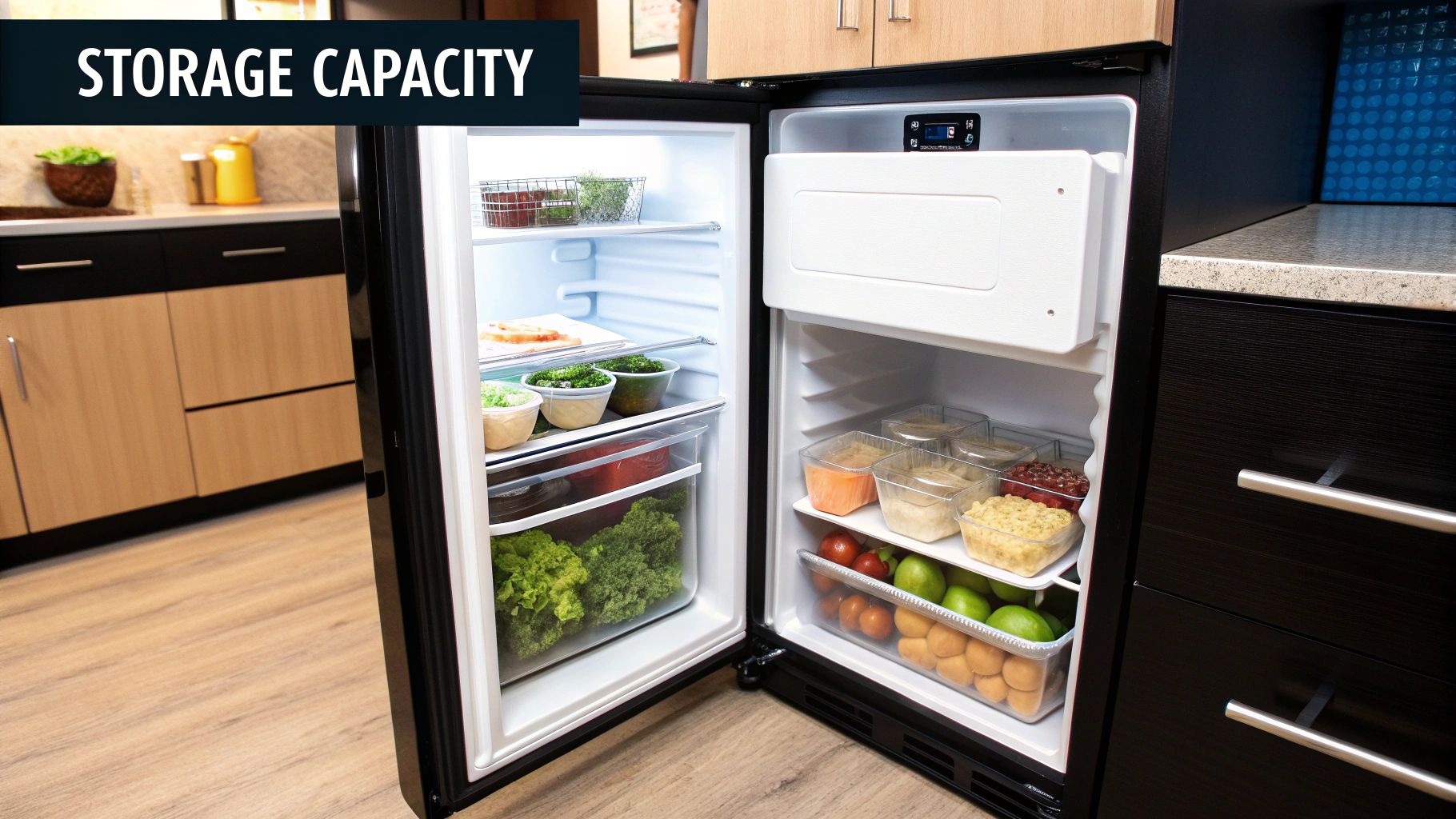
The real goal here is to find that perfect balance between the physical footprint of the fridge and its actual, usable volume. Nail that, and you'll avoid overstocking perishables or, even worse, running out of a key ingredient mid-shift. Stay informed on the latest models to find the perfect capacity for your needs.
From Cubic Feet to Food Pans
A common mistake is thinking all cubic feet are created equal. They're not. The internal layout—whether it's shelves or drawers—completely changes how you can use that space. For example, a 7 cu. ft. model with a door is great for miscellaneous bottles and bulk containers. That same 7 cu. ft. in a drawer model, however, is perfectly optimized for holding neat rows of sixth-size food pans at a sandwich station.
Let's put this into practical terms:
- A smaller 6-7 cu. ft. unit can typically hold about 50–70 standard hotel pans (or gastronorm containers), making it a solid choice for a small café's prep line.
- Stepping up to a larger 12-13 cu. ft. unit can essentially double that capacity. For a busy bar or a main kitchen line, this can slash restocking cycles by 40–60%.
That difference is huge. Picking the right capacity means your chefs have what they need, right where they need it, streamlining the whole workflow.
Expert Insight
Drawers are unbeatable for organization and speed when you need immediate access to portioned ingredients. Doors, on the other hand, offer more flexibility for storing items of various shapes and sizes. Before you decide, think hard about the station's primary function and look for exclusive deals on the style that fits your menu.
Evaluating Your Menu and Service Volume
The complexity of your menu is a huge factor in determining your capacity needs. A restaurant with a sprawling, diverse menu is going to need a lot more refrigerated storage than a specialized food truck. In the same way, a high-volume spot needs bigger units to keep up with faster ingredient turnover and cut down on trips to the walk-in.
Commercial undercounter units typically range from 3.5 cubic feet for a small beverage cooler all the way up to 15 cubic feet for a big two-drawer worktop model. You'll often see cafés and food trucks sticking with smaller 3–7 cu. ft. units to save space, while full-service restaurants usually lean toward the 6–10 cu. ft. range to handle their back-of-house prep volume.
To get a precise calculation and see how different sizes will actually fit into your layout, it's worth looking into kitchen design software. These tools let you map out your space and ensure the unit you choose not only fits physically but also meets your operational demands.
Mastering Installation and Ventilation Clearances
Choosing the right size undercounter unit is half the battle; the other half is getting the installation right. This isn't just about making it fit. Proper placement and ventilation are non-negotiable for keeping your equipment running efficiently, and frankly, for keeping your warranty valid. I've seen too many kitchens where a poorly installed unit overheats, struggles to cool, and eventually fails—turning a key piece of restaurant equipment into a major headache.
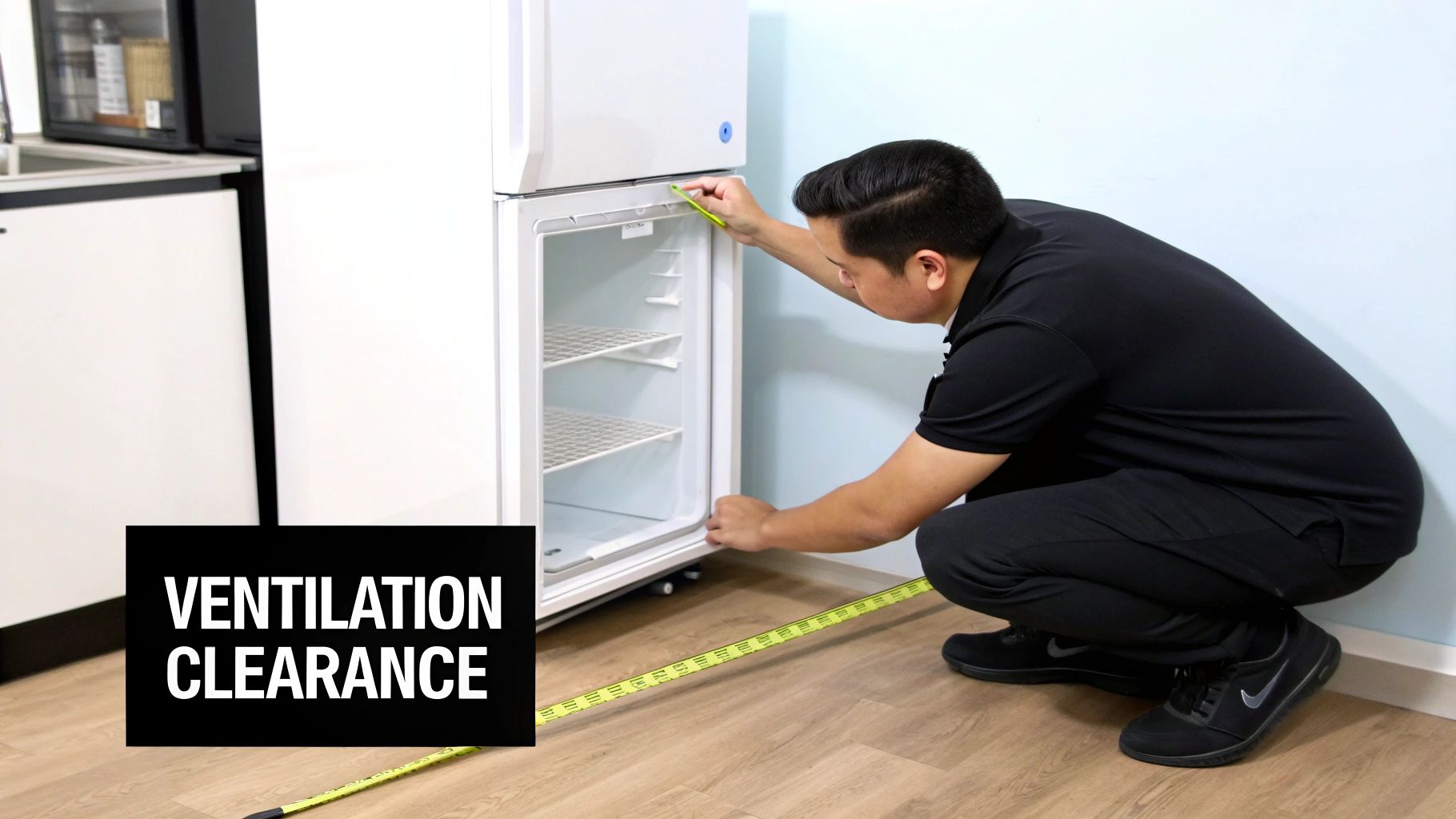
The single most common mistake? Starving the unit of air. A refrigerator's condenser needs to breathe to dissipate heat. If it can't, the compressor works overtime, burns more energy, and wears out far too soon. It’s a completely avoidable problem that knowledgeable restaurant owners can prevent.
Understanding Ventilation Types
You need to know where your unit breathes from to know how much space to give it. Commercial undercounter refrigerators generally fall into one of three design camps, and each one has its own rules for installation.
- Front-Breathing Models: These are the most flexible. They pull air in and push it out through a grille on the front of the unit, which means you can build them in flush with your cabinetry. They require minimal to no clearance on the sides or back, making them a true "built-in" solution.
- Rear-Breathing Models: These units need room to breathe behind them. They pull air from the back, so you have to leave a good amount of space for heat to escape. As a rule of thumb, plan for at least 3-6 inches of clearance between the unit and the wall.
- Side-Breathing Models: Though less common, you'll still run into these. They have vents on one or both sides and require clearance there. Always check the spec sheet, as the exact space can vary from 1 to 4 inches per side.
When you're mapping out your kitchen, remember that fitting in the fridge is part of the bigger picture of kitchen renovation planning and custom cabinet considerations.
Crucial Tip
Don't ever guess on clearance. The manufacturer's spec sheet is your bible here—follow it to the letter. Ignoring those measurements can easily void your warranty and leave you on the hook for repairs. Remember, proper airflow is a cornerstone of a safe kitchen; for more on this, check out our guide on commercial kitchen ventilation requirements.
How to Measure Your Installation Space
A few minutes with a tape measure now will save you a world of pain on installation day. And I mean really measure—don't just get one quick reading of the opening.
- Measure in Multiple Spots: Get the width and height at the front of the opening and then again at the back. Walls and floors are almost never perfectly square.
- Account for Utilities: Know exactly where your outlets, water lines, and drains are. Make sure the fridge's plug and connections won't get jammed up, preventing it from sliding all the way back.
- Check for Uneven Floors: Put a level on the floor. Most units have adjustable feet to handle minor slopes, but if you have a serious slant, you may need to get the floor leveled first.
- Factor in Door Swing: This one’s easy to forget. Make sure there's enough clearance for the door to swing fully open without smacking into other equipment or blocking a busy walkway.
Matching Refrigerator Size to Your Kitchen Workflow
Choosing the right undercounter refrigerator is about much more than just finding a unit that fits the available space. The smartest equipment decisions are tied directly to how your kitchen actually works. When you align a refrigerator’s size and features with your daily workflow, you can see a real impact on efficiency, service speed, and even staff morale.
Think of it this way: a well-placed, correctly sized refrigerator is a strategic tool for any chef. It puts critical ingredients exactly where they’re needed, cutting down on time-wasting trips to the walk-in and keeping the prep line humming. This is where you start building a truly efficient kitchen—with smart choices on restaurant equipment and supplies that support your team when things get busy.
Sizing for Specific Kitchen Stations
Every station in a commercial kitchen has a different job to do, and your refrigeration should reflect that. A one-size-fits-all approach is a recipe for inefficiency. Instead, take a hard look at the tasks performed at each spot to figure out the best undercounter unit for the job.
A fast-paced sandwich or salad line, for example, lives and dies by organization and immediate access to ingredients.
-
High-Volume Sandwich Station: A 48-inch drawer model is often the gold standard here. The drawers are built to hold rows of food pans, keeping toppings, meats, and spreads perfectly organized and right at hand. This means a cook can build orders one after another without taking a single step away from the station.
-
Busy Bar Area: For a bar, a slim 24-inch glass door cooler is usually the perfect fit. It gives bartenders a quick visual on garnishes, juices, and bottled mixers, helping them assemble drinks faster. The glass door also makes it easy to see when something is running low during a rush.
-
Grill or Sauté Station: A 36-inch solid door refrigerator is a workhorse on the hot line. It offers flexible storage for raw proteins, sauces, and prepped vegetables. More importantly, the solid door provides superior insulation in a high-heat environment, keeping food safe and cool right where the action is.
Tailoring Size to Business Type
The best undercounter refrigerator size also depends heavily on your business model. What works for a large, full-service restaurant is totally different from the needs of a small cafe or a food truck where every square inch counts. Discovering exclusive deals tailored to your business type can lead to significant savings.
Operational Insight
The ultimate goal is to create self-sufficient workstations. When a chef has everything they need for their station stored directly under their prep surface, you get rid of bottlenecks and wasted movement. This simple idea is fundamental to a productive kitchen layout.
Full-Service Restaurants
These kitchens often need a mix of different undercounter sizes. A long prep line might be anchored by a large 72-inch three-door unit for holding bulk items, while smaller, specialized drawer models are placed at individual stations. This layered approach creates a storage strategy that can support a diverse and complex menu.
Cafes and Coffee Shops
In a cafe, refrigeration is usually smaller and more focused. A 24-inch glass door model is perfect for keeping milk, creamers, and dairy alternatives right next to the espresso machine. A separate 36-inch unit might be used for grab-and-go items like sandwiches and pastries, creating a clear, intuitive workflow for everyone.
Food Trucks
Space is the ultimate luxury in a food truck, so "compact and efficient" are the magic words. A 24-inch or 36-inch single-door model is often the biggest unit that can be squeezed in. Operators have to be smart about it, choosing a size that provides just enough cold storage without eating up the floor space needed for cooking and serving customers.
Market Trends and Specialized Sizes
The commercial refrigeration world is always in motion. Savvy restaurant owners and chefs stay informed about industry trends to make smart investments. What worked in a kitchen five years ago might be a hindrance today. Kitchen designs are getting smarter, food service trends are shifting, and everyone is trying to squeeze more efficiency out of their operation.
Think about it: urban kitchens are shrinking, so we need equipment that makes the most of every inch. At the same time, energy costs are a huge factor, pushing efficiency from a "nice-to-have" to a "must-have." These aren't just abstract ideas; they're real-world pressures shaping the latest news in refrigeration design.
How Global Demands Are Shaping New Designs
The worldwide market for this equipment is huge—some estimates put the commercial side at around $11.40 billion in 2024. But what's really interesting is how different parts of the world demand different things. In North America and Europe, you see a lot of standardized, modular units. The classic 24-inch by 33-inch model is a workhorse, driven by strict food safety codes and the needs of large restaurant chains. For a deeper dive into these numbers, this commercial refrigeration market report has some great insights.
But then you look at a place like the Asia-Pacific region, where urbanization and a booming street-food scene are changing the game. This has pushed manufacturers to get creative with narrower and shallower models. It's not uncommon to see compact 18 to 20-inch wide units popping up to fit into incredibly tight spaces.
A Forward-Thinking Investment
Across the board, one of the biggest shifts is the focus on total cost of ownership, not just the sticker price. Energy-efficient models, especially those with an ENERGY STAR rating, are grabbing 20-30% of new sales. Smart operators know that saving on the monthly utility bill delivers a much better return over the life of the unit.
Specialized Sizes for Unique Kitchen Needs
Beyond the major trends, manufacturers are rolling out specialized units designed to solve very specific problems. These aren't your standard, off-the-shelf models; they're solutions for kitchens with funky layouts or very particular storage needs.
Here are a few common examples you'll find:
- Low-Profile Models: These units are built short, often 32 inches or less, making them perfect for sliding under custom-height counters or into ADA-compliant workstations.
- Extra-Deep Models: If you have the floor space to spare but are short on wall length, an extra-deep refrigerator can give you a significant boost in storage capacity.
- Modular and Flexible Units: Some newer designs are built like Legos. You can stack them or place them side-by-side, giving you the freedom to reconfigure your cold storage as your menu or business volume evolves.
Comparing Popular Undercounter Refrigerator Models
Let's be honest, spec sheets can be overwhelming. Translating all those numbers and technical terms into what a refrigerator will actually do for your kitchen is the real challenge for any chef. The best way to cut through the noise is to look at a few real-world examples side-by-side.
When you compare different under counter refrigerator sizes and layouts, you start to see how specific designs are built for specific jobs. This isn't just about theory; it's about matching a unit's dimensions, capacity, and power needs directly to your workflow. Getting this right is the key to a smart purchase, so be on the lookout for exclusive deals on the models that fit your needs.
Specification At a Glance
The table below breaks down three classic undercounter models you'll find in almost any commercial kitchen. Each one serves a very different purpose, and the small differences in their specs make a huge impact on day-to-day operations.
We'll look at a compact single-door unit perfect for a tight corner, a wider two-drawer worktop model built for the chaos of a busy prep line, and a glass-door cooler designed specifically for front-of-house bar service. If you want to dive deeper into a particular brand's lineup, reviews like this one on Atosa undercounter refrigerator models are a great resource.
Example Spec Sheet Comparison of Undercounter Models
This table lays out the typical specs for three distinct undercounter models. Use it as a quick reference to see how features vary based on the unit's intended job in the kitchen.
| Specification | Single Solid Door (24") | Two-Drawer Worktop (48") | Glass Door Bar Cooler (36") |
|---|---|---|---|
| Model Type | Standard Undercounter | Worktop Refrigerator | Back Bar Cooler |
| Exterior Width | 24.5 inches | 48.25 inches | 36 inches |
| Exterior Depth | 29.5 inches | 30 inches | 24.5 inches |
| Exterior Height | 35.75 inches (with casters) | 35.5 inches (with casters) | 35.25 inches (with legs) |
| Capacity | 6.5 cu. ft. | 13.4 cu. ft. | 7.4 cu. ft. |
| Configuration | 1 Solid Door, 2 Shelves | 2 Drawers (holds food pans) | 2 Glass Doors, 4 Shelves |
| Temp Range | 33°F to 38°F | 33°F to 38°F | 33°F to 40°F |
| Electrical Needs | 115V / 60Hz / 1-ph | 115V / 60Hz / 1-ph | 115V / 60Hz / 1-ph |
| Amperage | 2.5 Amps | 3.5 Amps | 2.1 Amps |
| Best For | Small prep stations, cafes | High-volume sandwich/salad lines | Bar service, grab-and-go |
Looking at the numbers this way, the practical differences become obvious.
Notice how the 48" worktop model doesn't just have double the width of the 24" unit—it has more than double the capacity (13.4 cu. ft. vs. 6.5 cu. ft.). This is a perfect example of how a larger footprint often brings even greater storage efficiency. You can also see the bar cooler is intentionally designed with a shallower depth, ensuring it fits neatly behind the bar without getting in the bartender's way. These are the kinds of details that make or break a kitchen's flow.
Common Questions About Undercounter Refrigerator Sizes
You’ve done the research, narrowed down your options, and are just about ready to pull the trigger. But a few nagging, practical questions can often be the last hurdle before finalizing an equipment purchase. It’s completely normal for restaurant owners to have these last-minute concerns about installation, daily use, and even regulations when you're looking at different under counter refrigerator sizes.
Getting these details right from the start is what separates a good investment from a future headache. Let's walk through some of the most common questions we hear from chefs and operators to make sure you're confident in your decision.
What Is the Standard Height for an Undercounter Refrigerator to Fit Under My Counter?
Generally speaking, you'll find that most commercial undercounter refrigerators are built to a height between 33 and 36 inches. This isn't an arbitrary number; it's designed specifically to slide neatly under a standard 36-inch commercial countertop, giving you that clean, built-in look.
That said, never assume. Always break out the tape measure and check your actual counter height before you buy. Look at the unit’s spec sheet and pay close attention to the height, remembering to factor in the casters or legs. It's a good rule of thumb to leave about an inch of wiggle room at the top—this makes installation far less of a struggle and helps with air circulation.
Do I Need Extra Space Around the Refrigerator for Ventilation?
Yes, absolutely. Giving your refrigerator room to breathe is non-negotiable if you want it to perform well and last. How much space you need, however, depends entirely on how the unit is designed to cool itself.
- Front-breathing units: These are the gold standard for tight, built-in spots. All the air intake and exhaust happens through a grille on the front, so they typically require little to no clearance on the sides or back.
- Rear-breathing or side-breathing models: These units need several inches of open air behind and beside them to push out hot air. Boxing them in is a recipe for disaster.
Important Reminder
The manufacturer's installation manual is your bible here. Always follow its specific clearance requirements. Ignoring them can cause the compressor to overheat, lead to poor cooling, spike your energy costs, and almost certainly void your warranty. Stay informed to protect your investment.
How Do I Know if I Need a Drawer or a Door Model?
The drawers vs. doors debate comes down to one thing: your kitchen's workflow. One isn't inherently better than the other; they're just different tools for different jobs.
Drawer models are the champions of the prep line. They’re designed to hold standard food pans (like 1/6 or 1/3 size pans) perfectly. This setup gives chefs instant, organized access to ingredients, which is exactly what you need for a fast-paced sandwich, salad, or pizza station.
On the other hand, door models are the all-rounders. With adjustable shelving, they offer the flexibility to store a mix of things—bulk containers, bottles, odd-shaped produce, you name it. To decide, just think about what you're storing and how your team needs to grab it during the heat of service.
Are There ADA-Compliant Undercounter Refrigerator Sizes Available?
Yes, and it's an important consideration for creating an accessible and legally compliant kitchen. Many top manufacturers produce ADA-compliant undercounter models designed for easy use by employees in wheelchairs.
According to the Americans with Disabilities Act (ADA), these units must fit under a countertop with a maximum height of 34 inches. Beyond just height, their controls have to be positioned within reach and be operable with one hand, without needing to tightly grasp or twist. When you're shopping, look for equipment explicitly labeled "ADA Compliant" to ensure it meets all the necessary standards for both physical and operational accessibility.
Ready to find the perfect undercounter refrigerator for your operation? Encore Seattle Restaurant Equipment offers a vast selection of sizes and configurations from top brands, all at unbeatable prices. Our expert team can help you navigate the specifications to ensure you get the right fit for your workflow and budget. Explore our inventory today and discover why professionals in the Pacific Northwest have trusted us since 1990.