
Stainless Kitchen Prep Table: Your Guide to Efficiency and Savings
Think of a commercial kitchen. What's the one piece of equipment that sees action from the moment you open until the final wipe-down? The humble stainless kitchen prep table. It's the operational core, the main stage for everything from dicing onions to meticulously plating a signature dish. This isn't just a table; it's the workstation that anchors your entire kitchen, and staying informed on the latest trends and deals can give you a competitive edge.
The Undeniable Hub of Your Commercial Kitchen
Picture your kitchen during a busy service without its central work surface. Chaos, right? A stainless prep table is far more than just a place to put things. It’s the command center for all things culinary, directly impacting your team's speed, efficiency, and, most importantly, sanitation. For any serious restaurant, this is one of the most fundamental investments you'll make, and smart owners are always looking for exclusive deals on essential supplies like this.
Choosing the right table isn't about filling a space. It's about boosting productivity, upholding food safety standards, and bringing a sense of calm to the controlled chaos of a professional kitchen. For chefs and owners, this is a decision that pays dividends every single day, especially when you're up-to-date on industry news and equipment innovations.
Why a Prep Table Is Your Kitchen’s Command Center
The right prep table is the heart of your operation, the physical point where raw ingredients begin their journey to becoming a finished plate. Its placement and design are the foundation of an intelligent, efficient workflow.
- Defines Workflow: It naturally creates zones for different tasks—chopping, mixing, assembling—and dictates how your staff moves through the kitchen.
- Enforces Sanitation: Stainless steel is non-porous. That means it’s incredibly easy to clean and sanitize, a non-negotiable feature for keeping food safe and health inspectors happy.
- Maximizes Space: Options like undershelves provide invaluable storage, keeping pans, tools, and bulk ingredients organized and right where you need them.
A well-chosen prep table isn't an expense; it's an investment in operational smoothness. It streamlines every action, from initial prep to final plating, reducing wasted movement and saving valuable time during peak service hours.
In the fast-paced world of foodservice, these tables are absolutely essential. It’s a core piece of equipment, just as vital as anything on a coffee shop equipment list. In fact, the thoughtful integration of prep tables is a cornerstone of effective commercial kitchen design and layout, creating a space that just works.
The demand speaks for itself. The global market for pizza prep tables alone—a specialized segment dominated by stainless steel—was valued at USD 0.4 billion in 2019 and is on track to hit USD 0.6 billion by 2030. This industry trend reflects how critical these workstations are to growing restaurants and catering businesses worldwide.
When you're outfitting a kitchen, it's easy to look at a row of stainless steel prep tables and think, "steel is steel." But that's one of the biggest misconceptions I see. The specific type of steel you choose—both its grade and its thickness—is the single most important decision you'll make. It's the difference between a workhorse that lasts for decades and a table that starts showing its age in a year.
Think of it like buying the right coat for the weather. You wouldn't wear a light windbreaker in a blizzard, and you shouldn't put a budget-grade table in the most demanding, high-moisture corner of your kitchen. The two grades you'll run into most often are 304 and 430.
Getting this right is fundamental to building a kitchen that runs smoothly, stays clean, and is set up for success from day one.
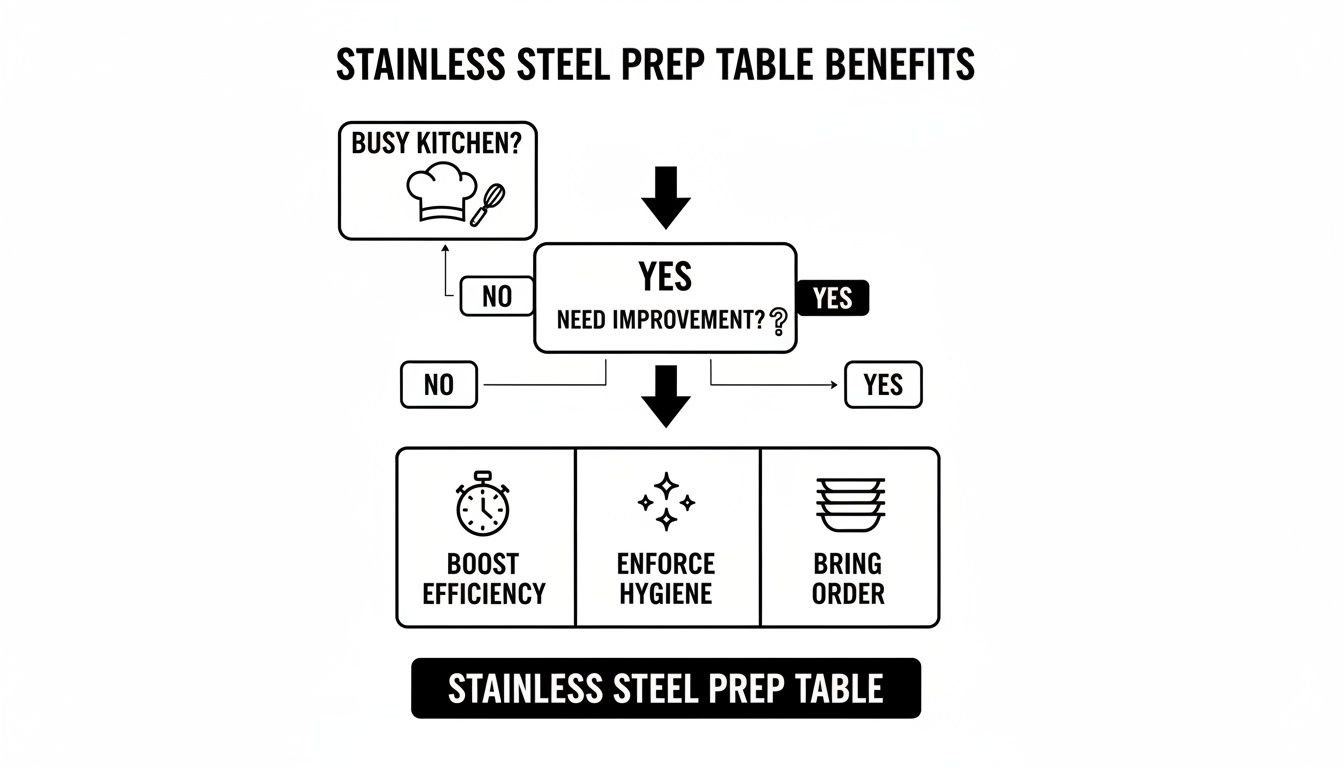
As you can see, a good prep table isn't just a surface—it's the command center for efficiency, hygiene, and organization in any serious commercial kitchen.
What's The Deal With Steel Grades: 304 vs 430?
Let's break down the two main players you'll see in the world of stainless steel.
304 grade stainless steel is, without a doubt, the king of the hill when it comes to fighting off rust and corrosion. It has more chromium and nickel in its makeup, which creates a tough-as-nails barrier against everything from acidic foods (think tomatoes and citrus) to the harsh sanitizers you use every day. It’s your heavy-duty, all-weather gear.
You'll want to invest in 304 grade for:
- Wet Zones: This is a non-negotiable for tables near dish pits, prep sinks, or any high-humidity area.
- Direct Food Prep: Its superior resistance makes it the safest and most durable surface for prepping ingredients directly.
- The Long Haul: If you need a table that can take a beating from constant use and aggressive cleaning, 304 grade is the only way to go.
Now, that doesn't mean the other option is bad. 430 grade stainless steel is a fantastic, more budget-friendly choice that's plenty durable for the right job. It has less nickel, so it is more likely to show corrosion over a long time in wet conditions, but it's a solid workhorse for less demanding spots.
Think of it as your dependable daily driver—perfectly fine for most situations, just not for off-roading in a swamp.
Go with 430 grade for:
- Dry Prep Areas: It’s perfect for baking stations, assembly lines, or general storage where moisture is minimal.
- Smart Savings: It gives you that clean, professional look and solid strength of stainless steel at a much friendlier price.
- Equipment Stands: It’s an ideal material for stands holding mixers, slicers, or other appliances where direct, prolonged contact with corrosive stuff is unlikely.
Here’s a quick-reference table to help you decide at a glance.
Comparing 304 vs 430 Stainless Steel
A quick comparison to help you choose the right stainless steel grade for your kitchen's specific needs and budget.
| Feature | 304 Grade Stainless Steel | 430 Grade Stainless Steel |
|---|---|---|
| Corrosion Resistance | Excellent. The best choice for wet environments and acidic foods. | Good. Suitable for dry areas but can rust with prolonged moisture. |
| Composition | Higher chromium and nickel content. | Lower nickel content, which makes it magnetic. |
| Best For | Prep near sinks, dish pits, direct food contact, heavy daily use. | Dry storage, baking prep, equipment stands, budget-focused needs. |
| Cost | Higher initial investment. | More economical and budget-friendly. |
| Longevity | Superior. A long-term investment that withstands harsh conditions. | Good. Very durable when used in the appropriate environment. |
Ultimately, choosing between grades is a strategic move. Spend the extra money on 304 grade for your wet line to prevent rust headaches down the road. Save a little by using 430 grade for your dry storage and assembly areas. It’s about putting the right tool in the right place.
It's All About The Gauge: The Secret to A Strong Table
Okay, so you’ve picked your steel grade. The next thing you need to look at is its gauge, which is simply a measure of its thickness. Now, this is where people get tripped up: with steel gauge, a lower number means thicker, stronger steel. It's a bit counterintuitive, but a 14-gauge table is an absolute beast compared to an 18-gauge one.
-
14-Gauge: This is your heavyweight champion. It’s incredibly thick and built to hold heavy equipment like a 60-quart mixer or a large commercial slicer without even thinking about bowing or flexing. If you’re doing intense, high-impact work, this is what you need.
-
16-Gauge: This is the versatile, all-around MVP. It hits that sweet spot between brute strength and cost-effectiveness, making it the most common choice for general prep tables. It can easily handle most chopping, mixing, and assembly tasks you throw at it.
-
18-Gauge: This is the lightest-duty and most economical option. You're not going to put a heavy grinder on it, but it’s perfect for lighter tasks, holding small wares, or as a landing spot for plated dishes coming off the line.
Just as the right prep table is the heart of your kitchen's workflow, smart storage is what keeps everything running smoothly around it. To build a truly efficient space, think about how your tables and storage work together. You can dive deeper into this in our guide to commercial stainless steel shelves.
How to Select the Perfect Table Size and Strength
Beyond the type of steel you choose, the physical size and sheer strength of your prep table are what will make or break its usefulness in your kitchen. A table that's too big or too small creates instant bottlenecks and daily frustration. Worse, one that can't handle the weight is a serious safety risk. Getting the dimensions and load capacity right from the start means your table will feel like a natural part of your kitchen's flow, not a constant obstacle.
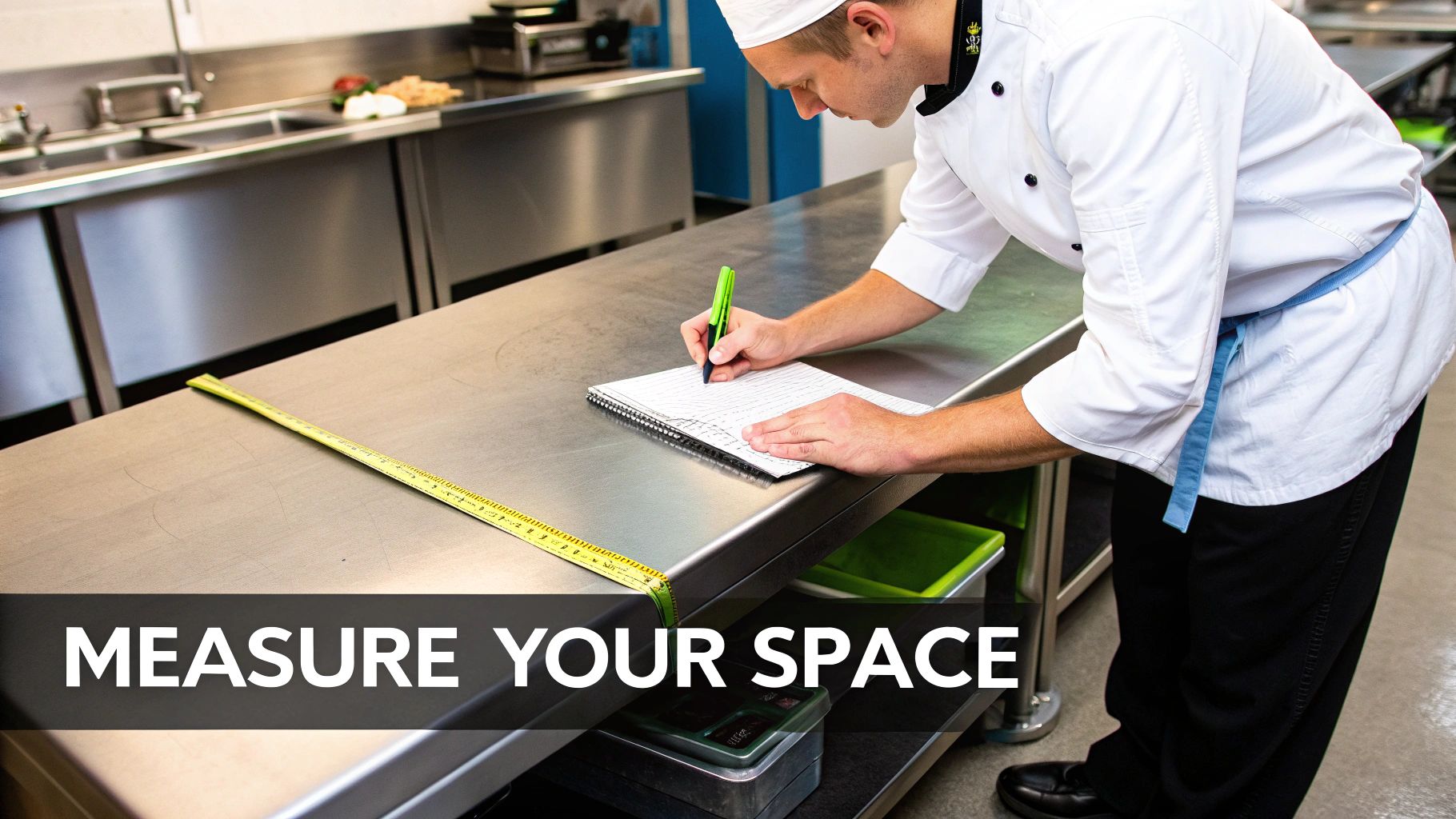
The best prep table doesn't just squeeze into an open spot; it actively improves how your kitchen operates. It should feel like it was custom-built for the space, supporting your team's every move without ever getting in the way.
Measuring for Workflow, Not Just for Space
Before you even think about grabbing a tape measure, think about movement. The classic rookie mistake is just measuring the empty square footage on the floor. A professional kitchen is all about motion—people moving, cart wheels turning, and doors swinging. Your table has to fit into that dance.
Here’s a better way to think about measuring your space:
- Create Clear Walkways: You need at least 36 inches of clearance around the table for people to move safely and efficiently. If it's a main traffic route in the kitchen, bump that up to 48 inches.
- Watch for Swinging Doors: Measure the full arc of every nearby oven, cooler, and cabinet door. Make sure they can open all the way without cornering a team member or smacking into your new table.
- Map Your Workflow: Think about the path from A to B. A table for dicing onions should probably live somewhere between the walk-in cooler and the sauté station to cut down on wasted steps.
Think of your kitchen layout like a road map. The prep table is a major intersection, and you need to make sure traffic can flow through smoothly, even during the dinner rush.
Calculating Surface Area and Load Capacity
Once you've figured out the footprint, it's time to think about what's happening on top of the table. A pastry station needs a wide-open runway for rolling out dough, which is a totally different requirement from a small, sturdy perch for a 100-pound meat grinder.
The job dictates the tabletop size. A compact 24” x 36” surface might be all you need for plating, but a station dedicated to breaking down cases of produce will be much more efficient with a larger 30” x 72” table.
The load capacity of a prep table isn't just a spec—it's a guarantee of safety and stability. This number comes from the thickness of the steel, the way the legs are built, and whether it has any cross-bracing.
Matching the table's strength to your equipment is non-negotiable. Its ability to hold a heavy stand mixer without wobbling or a stack of hotel pans without bowing comes down to its core construction. Thicker 14-gauge steel will always be stronger than 18-gauge, and features like reinforced leg gussets or undershelf cross-bracing add the rock-solid stability you need for heavy-duty gear. Always confirm the manufacturer's weight limit to make sure it can handle what you plan to throw at it.
Customizing Your Station for Maximum Efficiency
Think of a standard stainless kitchen prep table as a blank canvas. It's a solid, reliable foundation, but the real magic happens when you start customizing it. Adding smart, functional features is what separates a good kitchen from a great one—it’s how you build a truly high-performance workstation. These aren't just bells and whistles; they're strategic upgrades that will completely change your organization, boost productivity, and streamline every single task your team handles.
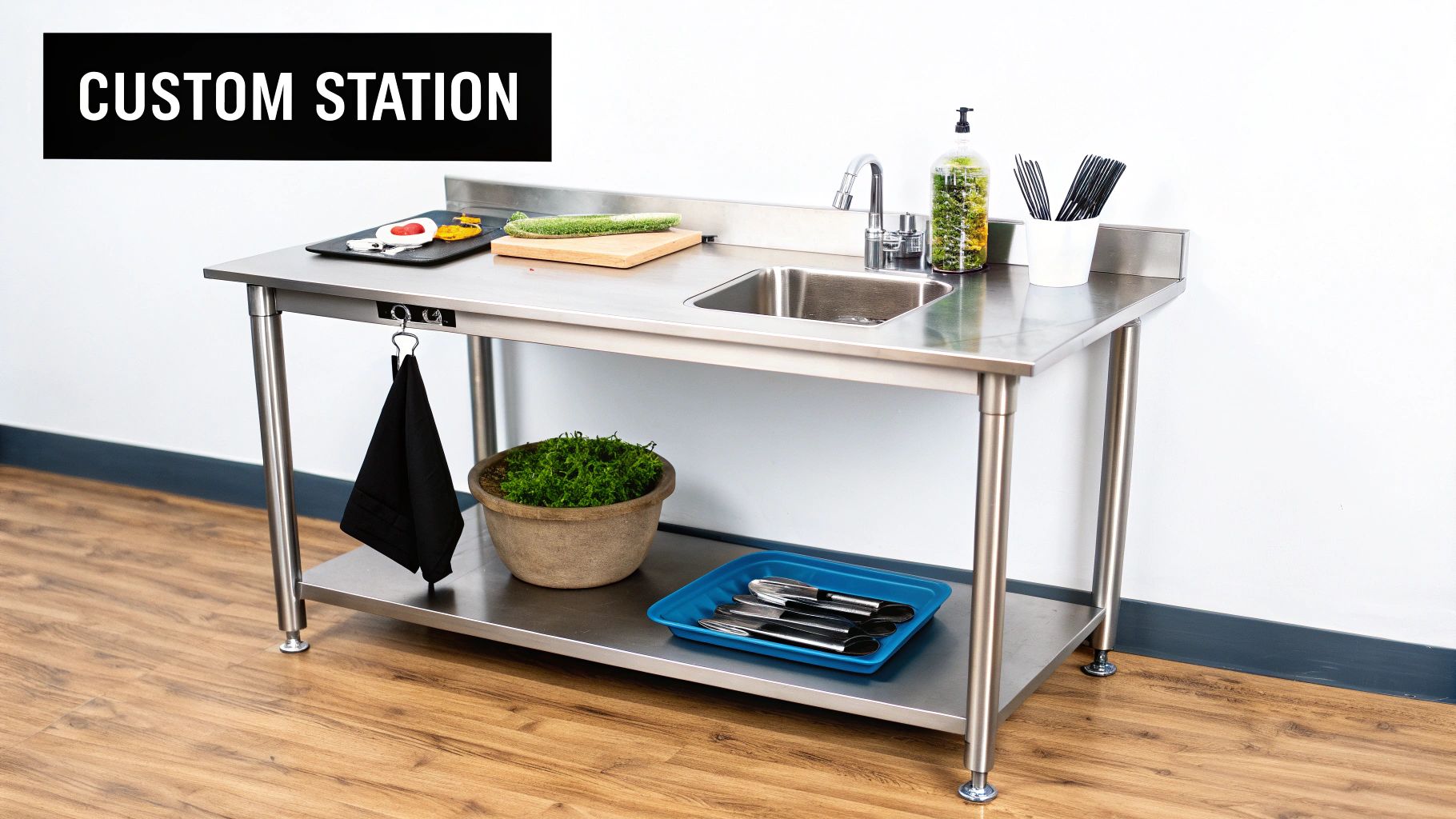
By thoughtfully picking features that match how your kitchen actually works, you can transform a simple surface into a specialized hub of efficiency. Let's dive into the key customizations that can turn a basic table into your kitchen's MVP.
Must-Have Features for Organization and Hygiene
Some features are so universally helpful they've pretty much become standard in any kitchen that runs like a well-oiled machine. They tackle the core challenges we all face: staying clean, getting organized, and making the most of every square inch.
A backsplash is one of the simplest, yet most effective, upgrades you can make. That little raised edge along the back of the table is a lifesaver, stopping ingredients, liquids, and all sorts of gunk from splashing onto the wall. This not only makes cleanup way faster but also protects your walls from moisture damage and stains, keeping the whole area more hygienic.
Another non-negotiable is an undershelf. This second level essentially doubles your storage capacity without eating up more floor space. It’s the perfect spot to stash frequently used items like mixing bowls, sheet pans, or bulk ingredients so they're always within arm's reach. Just think of all the steps your staff will save not having to walk back and forth to the main storage room.
Finally, adding drawers gives you secure, enclosed storage for all those smaller, essential tools. Knives, whisks, thermometers, and other utensils stay neatly organized and protected from the grease and grime of the kitchen. This keeps your main work surface clear and uncluttered, which is crucial for a focused and efficient prep flow.
Upgrades That Supercharge Your Workflow
Once you have the basics covered, you can get into customizations that solve specific operational headaches. This is where you can turn your prep station into a multi-functional powerhouse, adapting the table to your unique menu and service style.
Don't just see your prep table as a static piece of equipment. Think of it as a dynamic tool you can adapt to your kitchen's rhythm. The right features can eliminate entire steps from your processes, saving precious minutes during a busy service.
Casters are a perfect example of this. Putting wheels on your prep table introduces incredible flexibility. Suddenly, that table can be rolled out for deep cleaning, repositioned to create a temporary plating station during a rush, or even moved to a different area for catering prep. If your layout needs to change on the fly, casters are an absolute must.
Integrating a built-in sink is another game-changer. This creates a self-contained station for washing produce, thawing proteins under running water, or even just washing hands. It keeps sanitation tasks localized, cutting down on cross-contamination risks and saving your team from walking to a separate sink. That means a more focused workflow that also keeps the health inspector happy.
Let's look at how these features can be applied in the real world:
- High-Volume Chopping Station: Imagine a table with a built-in "chute" or an opening right over a waste bin. Your prep cooks can instantly sweep trimmings away, drastically speeding up vegetable prep.
- Mobile Plating Station: A table on casters with an over-shelf can be wheeled right up to the pass, giving you an organized, multi-level surface for final assembly and garnishing during the dinner rush.
- Dedicated Baking Area: For a pastry chef, a table with built-in drawers for tools and a marble top insert creates a specialized, efficient baking hub all in one place.
Take a hard look at your daily operations and identify the bottlenecks. Where are things slowing down? By choosing customizations that solve those specific problems, you'll get the greatest return on your investment and turn a standard table into a piece of equipment perfectly designed for your success.
Keeping it Clean: NSF Certification and Food Safety
In a professional kitchen, cleanliness isn't just a good idea—it's everything. Your stainless prep table is ground zero for food safety, which is why understanding certifications like NSF is so critical. It’s not just about passing inspections; it’s about protecting your customers and your reputation.
Think of the NSF (National Sanitation Foundation) seal as a promise. It tells you, your crew, and the health inspector that the table was designed from the ground up to be safe for a commercial food operation. It's been tested to meet tough public health standards, so you know it's built to prevent foodborne illness, not cause it.
What Does an NSF-Certified Table Actually Give You?
That little NSF mark isn't just for show. It means the table has specific design features that make it easy to clean and tough for bacteria to find a place to live. It’s hygiene built right into the engineering.
So, what are you getting?
- Smooth, Non-Porous Surfaces: The steel is completely smooth, with no microscopic pits or cracks where germs can hide from your cleaning cloth.
- Coved Corners: Instead of sharp 90-degree corners that trap gunk, all the joints are rounded. This simple change makes a world of difference when you're wiping things down.
- Sealed Edges: Every edge is rolled and sealed tight. There are no gaps for water, food bits, or other grime to sneak into and cause problems later.
These aren't just nice-to-haves. They're intentional design choices that make a real, practical difference in keeping your kitchen sanitary and ready for that surprise health inspection.
The Right Way to Clean for a Safe, Long-Lasting Surface
Keeping your table food-safe is a daily ritual. Doing it right not only ensures you’re meeting health codes but also protects the steel itself, making your investment last for years. The process is straightforward, but you can't cut corners.
First, get all the loose food and debris off the surface. Next, wash it down with a soft cloth, warm water, and a mild detergent. The most important step here is to rinse thoroughly with clean water—you don't want any soap residue left behind.
After rinsing, it's time to sanitize. Use a food-safe sanitizing solution, following the directions on the label precisely. Then, just let the table air-dry. That final air-drying step is what kills off any lingering microbes, leaving you with a perfectly safe surface ready for prep.
It’s no surprise that stainless steel is the standard. The global market for stainless steel kitchenware, including these workhorse tables, hit USD 23.5 billion in 2023 and is expected to climb to USD 35.7 billion by 2032. Why? Because pros know it’s one of the best materials for reducing cross-contamination risks. You can discover insights into the stainless steel kitchenware industry to see how this trend is shaping kitchens worldwide.
New vs. Used: Making the Smart Call on Your Prep Table
When it's time to pull the trigger on a stainless kitchen prep table, you'll face a classic fork in the road: do you go for brand new or pre-owned? This isn't just about what's cheaper today. It’s a strategic choice that pits upfront savings against long-term reliability and your own peace of mind. Both options can work out brilliantly, but savvy chefs and owners stay informed to find the best deals on both new and used equipment.
There’s no denying the appeal of a brand-new table. It shows up looking perfect—no dings, no scratches, no ghosts of kitchens past. Even better, it comes with a manufacturer's warranty. That piece of paper is your safety net, protecting your investment if something fails. For a lot of operators, that assurance alone is worth every penny of the higher price.
On the flip side, the money you can save with used equipment is hard to ignore, especially if you're just starting out or running on a tight budget. A second-hand stainless kitchen prep table can do its job just as well as a new one for a fraction of the cost. The catch? You have to become the inspector. Getting down on your hands and knees to check for stability, rust, and structural integrity isn't optional; it's essential.
The Case for Buying New
Choosing a brand-new prep table is really an investment in certainty. You get exactly what you pay for, with no hidden history or wear and tear to discover later. It's the most straightforward way to outfit your kitchen.
- Pristine Condition: Your table will be flawless. It's ready to meet the highest sanitation and aesthetic standards right out of the box.
- Manufacturer Warranty: This is the big one. A warranty covers you for defects in materials or craftsmanship, a luxury you almost never get with used gear.
- Latest and Greatest: New models might have subtle design improvements or better construction methods—staying on top of these industry trends can be a real advantage.
Ultimately, buying new is all about minimizing risk. You're guaranteeing a reliable, top-performing asset from day one, with the manufacturer standing behind it.
What to Look for in a Pre-Owned Table
The main reason to buy used is, of course, the price. The savings can be significant, freeing up cash for other critical parts of your business, like prime ingredients or a marketing push. But this path demands a bit more from you as a buyer. You're trading a lower price for the responsibility of vetting the equipment yourself.
When you're looking at a used stainless kitchen prep table, you need to give it a thorough once-over. Push on it—does it wobble? That could signal damaged legs or gussets. Look closely at the welds and corners for any signs of rust, which might point to lower-grade steel or a life of neglect. A few scratches are just signs of a well-used kitchen, but deep dents or a warped top can compromise the table's integrity. For a much deeper dive, check out our guide on buying used restaurant equipment.
A used table with a few cosmetic battle scars can be an absolute steal. One with structural problems is a liability waiting to happen. Your ability to tell the difference is what turns a used purchase into a smart one.
The Local Supplier Advantage
Whether you land on new or used, where you buy from makes a huge difference. Working with a local supplier like Encore Seattle Restaurant Equipment has some major perks over scrolling through anonymous online listings. Nothing beats being able to see and touch the equipment before you hand over your money.
Walking into a showroom lets you physically inspect a stainless kitchen prep table, feel its sturdiness, and confirm it's right for your space. You can also get real advice from people who actually understand the daily grind of a commercial kitchen and can inform you about the latest news and deals. Better yet, local suppliers often handle delivery and support, taking the headache out of getting a massive, heavy piece of equipment into your kitchen. Thinking about the logistics is key, so it's worth checking out some general tips on how to move heavy furniture safely and easily. This local support system is invaluable, making the whole process smoother and more reliable from start to finish.
A Few Common Questions We Hear
Even after you've done your homework, a few specific questions always seem to pop up right when you're about to make a decision. Let's tackle some of the most common ones we get from chefs and kitchen managers about stainless kitchen prep tables.
What's the Best All-Around Thickness (Gauge)?
For 90% of commercial kitchen tasks, 16-gauge stainless steel is the sweet spot. It's tough enough to handle the daily grind of chopping, mixing, and plating without flexing or denting easily. You get rock-solid performance without paying the premium for the super-heavy-duty 14-gauge stuff, making it the perfect workhorse for most restaurants.
Can I Set a Hot Pan Directly on the Table?
Absolutely. Go right ahead. Stainless steel is a champ when it comes to heat. You can pull a pan straight from the oven or off the range and set it down without a second thought. This is one of its biggest advantages over surfaces like butcher block or laminate that would be ruined instantly.
How Do I Deal with Scratches?
Scratches are going to happen—they're the battle scars of a productive kitchen. For those light, everyday scuffs, you can often minimize them with a non-abrasive pad (like a Scotch-Brite) and a good stainless steel polish. Just be sure to rub with the grain of the metal, not against it.
Deeper gouges are pretty much there to stay, but don't sweat it. A few marks of character don't compromise the table's safety or utility. The real focus should always be on keeping it clean and sanitized.
Should I Get an Undershelf or Cross-Bracing?
This really comes down to how you'll use the table. An undershelf is a massive win for storage, giving you a convenient place to stash Cambros, mixing bowls, or small appliances. It’s easily the most popular choice for maximizing a kitchen's footprint.
On the other hand, cross-bracing provides a completely open base. This gives you tons of legroom, making it the right call for prep stations where staff will be sitting on stools for long tasks like trimming vegetables or portioning dough.
Ready to find the perfect stainless steel workhorse for your kitchen? The experts at Encore Seattle Restaurant Equipment can guide you to the right table, whether new or used, and help you discover the latest deals and industry news to keep your operation ahead of the curve. Explore our extensive collection and build a more efficient kitchen today. Visit us at https://encoreseattle.com.