
Prep Table Commercial: A Guide to Choosing the Right prep table commercial
A commercial prep table is so much more than a stainless steel surface. It’s the command center of your kitchen—the exact spot where raw ingredients become finished dishes. This is where your kitchen’s efficiency is either made or broken. Getting the right table isn't just a purchase; it's a critical investment that shapes your workflow, food safety standards, and ultimately, your bottom line.
To stay ahead, savvy restaurant owners and chefs are always on the lookout for the latest industry trends and exclusive deals on essential equipment like this. Staying informed helps you make smarter purchasing decisions that boost your kitchen's performance.
Why Your Prep Table Is the Heart of Your Kitchen
Think of your prep table as the kitchen's air traffic control tower. It coordinates every single step of the culinary process, from chopping and mixing to plating. A well-placed, well-designed table allows your team to work together seamlessly, eliminating the kind of bottlenecks that slow down service.
It's the bridge between raw ingredient storage and the cooking line. When that bridge is strong, service is faster, orders are more accurate, and customers leave happier.
This central role is exactly why the market is growing. Valued at USD 1.18 billion in 2023, the global food prep tables market is on track to hit USD 1.62 billion by 2029. More and more operators are realizing just how vital these workstations are for efficiency and food safety. Keeping an eye on industry trends like this helps you understand the value of investing in quality restaurant equipment.
Aligning Equipment with Kitchen Design
A prep table can't do its job in isolation. Its true value is unlocked when it fits perfectly within your kitchen's overall layout. A poorly placed table is a recipe for disaster, creating traffic jams for staff and disrupting the natural flow from the walk-in fridge to the hot line.
To get the most out of your investment, it helps to think about how the table fits into modern commercial interior design principles. A strategic approach ensures every piece of equipment works together, creating a workspace that’s cohesive and highly productive.
A great prep table in a poorly designed kitchen is like having a race car stuck in city traffic. To unlock its full potential, you must consider its placement within the broader workflow of your entire operation, ensuring it serves as a bridge, not a barrier.
More Than a Surface—A Strategic Asset
When you look at it this way, the right commercial prep table is a strategic asset. It helps you uphold the highest food safety standards, empowers your team to work smarter, and directly contributes to your profitability. By seeing this purchase as the foundational hub of your kitchen—not just another piece of steel—you're set to make a decision that will pay dividends for years to come.
Before we dive deeper into the specific types, let's quickly summarize the key factors you'll need to consider.
Key Prep Table Considerations At A Glance
This table breaks down the most important factors to help you make a quick and informed decision.
| Factor | Why It Matters | Key Questions To Ask |
|---|---|---|
| Type | Determines function (e.g., cooling, heating, simple prep). Mismatching type to task kills efficiency. | Do I need refrigeration at the prep station? Is this for hot holding or just assembly? |
| Material | Impacts durability, ease of cleaning, and food safety compliance. | Is stainless steel the best fit for my environment? Does a polymer top make sense for my menu? |
| Size & Capacity | Dictates how much work can be done at once and how well it fits in your space. | How much surface area do my cooks need during peak hours? Will it fit without blocking a walkway? |
| Workflow | Placement can either create a seamless flow or a frustrating bottleneck. | Where does this table fit in the journey from storage to the service line? |
| Food Safety | Features like integrated sinks and NSF certification are crucial for compliance. | Is the material non-porous and easy to sanitize? Is it NSF-certified? |
Thinking through these points will put you on the right track to finding the perfect prep table for your operation.
Matching Your Prep Table to Your Menu
Picking the right prep table for your commercial kitchen isn’t about getting the flashiest model or the biggest one you can find. It's all about what you're putting on the plate. The ideal setup for a slammed sandwich shop would be a total nightmare in a pizzeria, and the other way around.
Think about it like this: you wouldn't bring a paring knife to a butchering contest. Forcing your team to work on the wrong kind of prep table is just as inefficient. They’ll have to create awkward workarounds, which kills speed, tanks morale, and opens the door for mistakes. The first step to a smoother, more profitable kitchen is making sure your equipment actually fits your menu.
The Right Tool for the Job
Every menu has its own rhythm and demands. A salad station needs a dozen fresh toppings, all chilled and ready to go. A pizza line needs a massive, durable surface for stretching dough. This is why specialized prep tables exist—they’re designed to solve these exact problems, turning what could be a chaotic assembly line into a clean, efficient flow.
You can see just how important this is by looking at market trends. The pizza prep table niche alone was valued at USD 1.75 billion and is expected to hit USD 4.92 billion by 2033. That kind of growth tells you just how critical task-specific gear is for any serious restaurant.
This decision tree breaks down how to think about your choice, balancing workflow needs with safety and your bottom line.
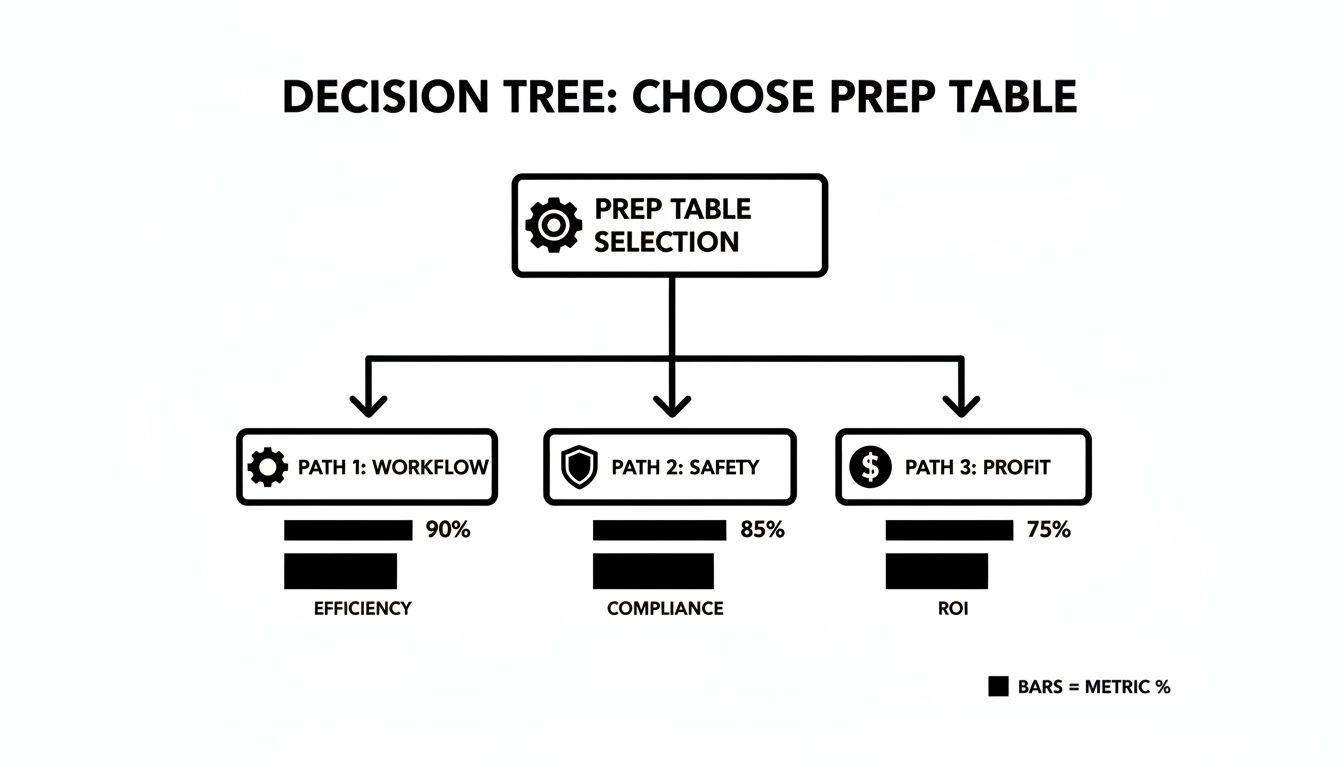
As you can see, the sweet spot is where operational speed meets food safety—that’s where profitability lives.
Sandwich and Salad Prep Tables
If you run a deli, café, or any quick-service spot cranking out sandwiches and salads, this is your workhorse. These units are built from the ground up for speed and handling a ton of different ingredients. The key feature is the refrigerated rail up top, designed to hold an army of food pans. Everything from crisp lettuce and sliced tomatoes to cured meats and cheeses stays perfectly chilled and right at your fingertips.
The cutting board is usually on the narrower side, somewhere between 8 and 12 inches deep. It’s just enough real estate to assemble orders without being a space hog. This design is all about economy of motion, letting your crew build complex orders without taking more than a step. If you need a hand narrowing down the options, take a look at our guide on choosing your next sandwich refrigerated prep table.
Pizza Prep Tables
Pizza prep tables are a different beast entirely. The first thing you'll notice is the massive, extra-deep cutting board—we’re talking 16 inches or wider. This gives your pizza makers all the room they need to stretch dough, slop on sauce, and load up toppings without making a mess.
A pizza prep table's raised ingredient rail is a game-changer. It elevates large pans of sauce, cheese, and popular toppings above the work surface, creating an ergonomic flow that keeps ingredients cold and prevents cross-contamination.
This setup keeps your high-volume ingredients organized and easy to grab while ensuring they stay safely chilled. The refrigeration system in these units is also beefier, built to keep large quantities of cheese and dairy cold even with the lids constantly opening and closing during a Friday night rush. For any pizzeria, it’s not a luxury; it’s essential.
Understanding Materials and Construction Quality
A prep table commercial unit might look simple enough from a distance, but its construction quality is the single biggest factor in how long it will last and whether it’s a smart investment. The materials used will touch everything from food safety compliance to how much time your staff spends scrubbing down surfaces at the end of a long shift. Getting this choice right means buying durability that pays you back for years.
Stainless steel is the king of the commercial kitchen, but you need to know that not all stainless steel is created equal. Understanding the different grades is crucial for judging a table's real value. It’s a lot like picking tires for a delivery van—you need the right type for the job it’s going to do, day in and day out.
Decoding Stainless Steel Grades
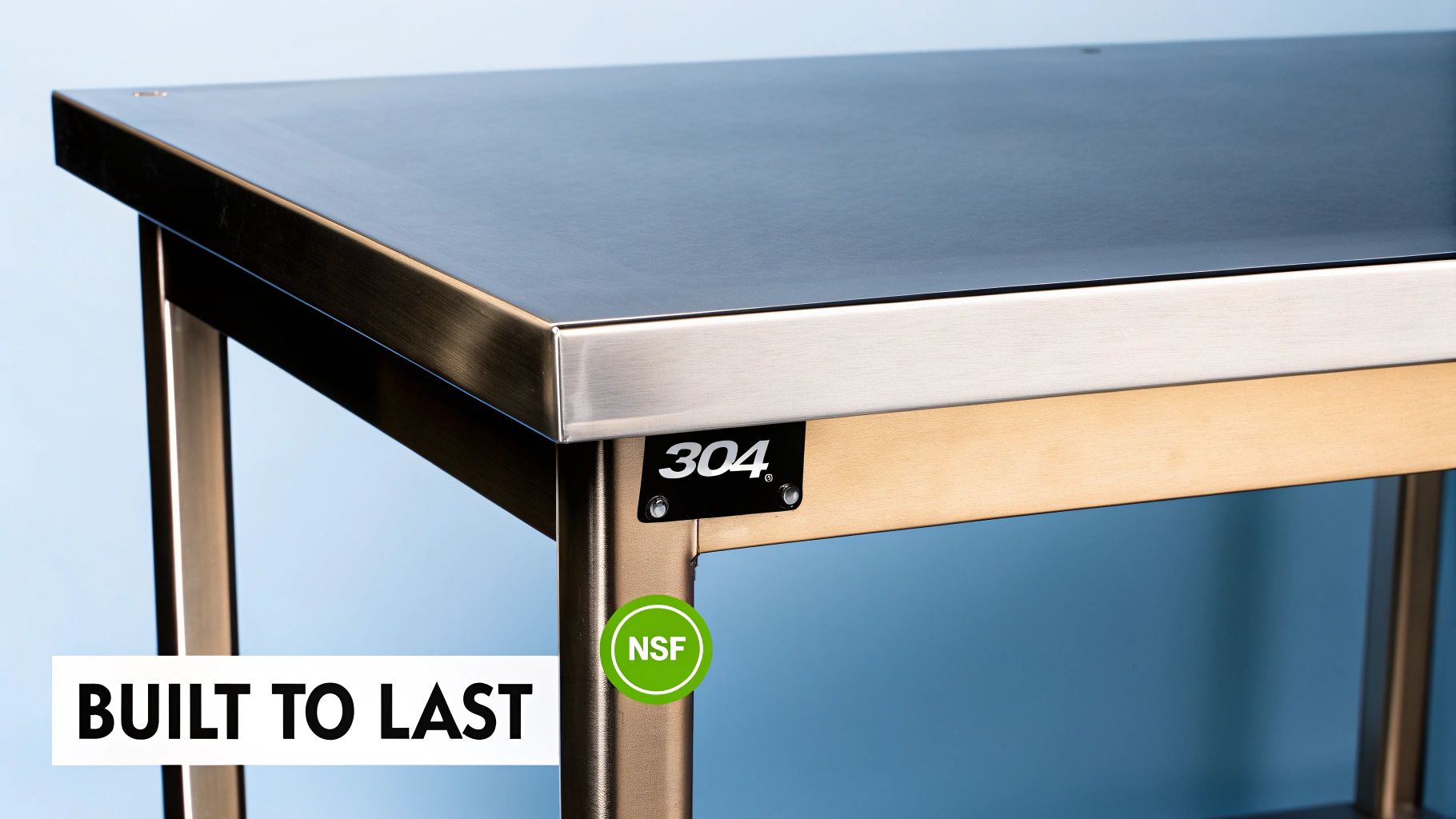
You'll mainly run into two grades: 304 and 430. Each one has a specific job to do, and seeing where a manufacturer uses them tells you a ton about their attention to detail and commitment to quality.
- 304 Grade Stainless Steel: This is the gold standard for work surfaces and any part of the table that directly touches food. It has more nickel, which gives it top-notch resistance to corrosion. That means it can handle acidic ingredients like tomato sauce or citrus juice without pitting or rusting.
- 430 Grade Stainless Steel: This is a more budget-friendly option and it’s perfectly fine for the table's sides, back, and legs. It's still durable, but it's more likely to corrode over time, which is why you want to keep it away from your main prep zones. A smart manufacturer will use 304 for the top and 430 for the body—it’s a sign of a well-designed, cost-effective piece of equipment.
When you're looking at a prep table, get up close and check out the small details. Look for welded, coved corners where the backsplash meets the work surface. These rounded edges eliminate the sharp 90-degree angles where gunk and bacteria love to hide, and that one small feature can literally save your team hours of cleaning time every week.
The Non-Negotiables of Build Quality
Beyond the type of metal, there are a few other absolute must-haves. NSF certification is non-negotiable. It's your guarantee that the table meets strict public health standards for safety and cleanability. The long-term performance of your prep table also hinges on proper installation, a standard that top commercial builders always adhere to.
This focus on durable, compliant gear isn't just a local trend; it's a global one. The refrigerated prep table market alone is estimated at a massive USD 7.67 billion, largely because of tough food-safety rules in established markets. This industry trend shows just how much experienced operators value equipment that meets health codes and works reliably. You can learn more about how to choose the right stainless steel prep table in our detailed guide.
Choosing the Right Size and Specifications
Getting the technical details right is the difference between a prep table that works for you and one that works against you. The right size and specs mean your table can handle the pressure of your busiest hours without creating a bottleneck in your line. Think of it like tailoring a suit—a perfect fit makes all the difference.
This goes way beyond just measuring the length and width. You have to consider how your team moves, how much product they need at their fingertips, and how the unit fits into your kitchen's overall ecosystem. A table that’s too small forces constant, frustrating restocks, while one that’s too big can completely derail a carefully planned workflow.
Sizing Your Table for Maximum Output
First thing's first: measure your available space. But don't stop there. The real trick is to figure out the ideal size based on your menu's actual demands.
For instance, a busy sandwich shop needs enough surface area to have multiple orders going at once. For them, a standard sandwich or salad table with a cutting board between 8 to 20 inches deep is usually perfect—just enough room to work without eating up valuable floor space.
A pizzeria, on the other hand, is a whole different ball game. They need a much deeper board, often 16 to 20 inches, to handle stretching out large pizza doughs. The length of your table, which can range from a compact 27 inches all the way up to 119 inches, should match your peak output. More length means more cooks can work side-by-side, which has a direct impact on your ticket times.
Understanding Refrigeration and Compressor Placement
For refrigerated prep tables, the compressor is the heart of the machine. Where it's located is a critical decision that depends entirely on your kitchen’s layout and ventilation. You have to think about the unit's "breathing"—how it pulls in and pushes out air—or you risk overheating and a very expensive repair bill.
You’ll typically see three main types of compressor placement:
- Front-Breathing: These units pull in and push out air from the front grate. They're a lifesaver in tight spots where you need to slide the table flush against a wall or between other pieces of equipment.
- Side-Breathing: As the name implies, these need clear space on at least one side for airflow. They work well when you have room next to the unit but not necessarily behind it.
- Rear-Breathing: This is the most common and often most affordable setup. The catch is that it must have several inches of clearance between the back of the table and the wall to function correctly.
Choosing the wrong compressor placement is a classic, costly mistake. A rear-breathing unit shoved up against a wall will work itself to death, drive up your energy bills, and eventually burn out. Always, always match the breathing style to your physical space.
Customizing Your Setup for Workflow
Beyond the big stuff like size and cooling, you need to think about how your team will actually access stored ingredients. The simple choice between doors and drawers can make a huge difference in your kitchen's speed and efficiency.
- Doors: These give you flexible, open-cavity storage. They’re perfect for bulky items like boxes of lettuce, large containers of sauce, or backup Lexans. Doors are generally the more budget-friendly option.
- Drawers: If you're all about organization, drawers are the way to go. They are fantastic for neatly arranging smaller pans of prepped ingredients, allowing cooks to see and grab exactly what they need without rummaging around. This is a massive time-saver during a chaotic rush.
Finally, give some thought to your cutting board. Most tables ship with a standard polyethylene board, which is fine. But you can often upgrade to a more durable composite material that’s easier on your knives, extending the life of both your tools and your workstation.
Getting the Most Out of Your Investment: Smart Placement and Maintenance
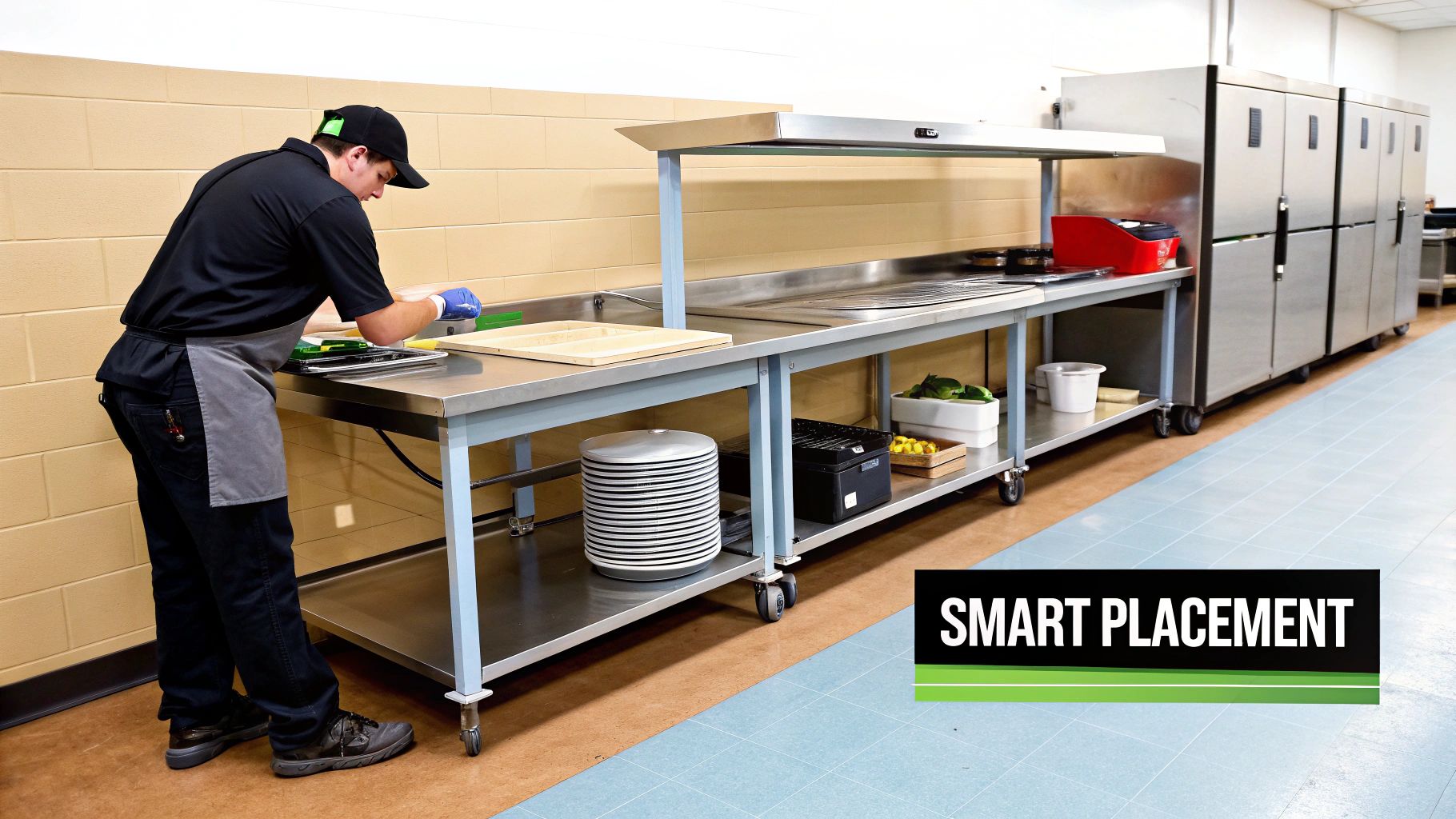
Think of a prep table commercial unit as more than just a piece of steel—it's a long-term investment in your kitchen's heartbeat. To really get your money's worth, two things matter most: where you put it and how you take care of it. The right spot can make your kitchen flow like a well-oiled machine, while the wrong one creates frustrating bottlenecks. And good maintenance? That's what keeps it running for years instead of costing you in surprise repair bills.
The whole point is to build a seamless path between your main work zones: storage, prep, and cooking. Your prep table sits right in the middle of that action. When it's positioned correctly, your team isn't wasting time and energy walking back and forth. They can grab ingredients from the walk-in, chop them on the table, and slide them right over to the range. This isn't just about faster service; it's about keeping your crew from burning out.
Smart Placement for a Smoother Workflow
Finding a home for your new prep table is more involved than just shoving it into an empty space. You have to consider how it plays with the rest of your kitchen's ecosystem. This is especially true for refrigerated models, which absolutely need to breathe. If you have a rear-breathing unit, pushing it right up against a wall will choke the condenser, causing it to overheat, work harder, and eventually fail.
Placement isn't just a matter of convenience; it’s crucial for the health of your equipment. For refrigerated prep tables, leaving at least 3-4 inches of clearance for airflow can cut your energy use by up to 10% and save your compressor from an early grave.
When you think through the kitchen's flow and the table's technical needs, you turn a simple workspace into the engine of your whole operation. If you're in the process of a new build-out or a major renovation, our guide on commercial kitchen design and layout can give you a much deeper dive into setting up a truly efficient workspace.
A Proactive Maintenance Schedule
The best way to avoid those dreaded middle-of-a-rush breakdowns is with a little proactive care. A simple, consistent maintenance routine not only prevents equipment failure but also keeps the health inspector happy.
Here’s a practical schedule you can stick to:
Daily Tasks:
- Sanitize All Surfaces: This is non-negotiable. At the end of every shift, the cutting board, steel surfaces, and handles need a thorough cleaning and sanitizing.
- Wipe Down Gaskets: Use a damp cloth to clean the door gaskets. Crumbs and gunk can build up, breaking the seal and letting cold air seep out.
- Clear Debris: Wipe up any food scraps inside and out to keep things smelling fresh and prevent bacteria from taking hold.
Weekly and Monthly Tasks:
- Inspect Gaskets for Damage: Once a week, give the door seals a good look-over for any cracks or tears. A bad gasket means your compressor is working overtime.
- Deep Clean the Interior: Once a month, take everything out and give the inside shelves and compartments a proper deep clean.
- Clean the Condenser Coils: Every 90 days, unplug the unit and use a vacuum or a soft brush to clear the dust and grease from the condenser coils. This is the single most important thing you can do to keep it cooling efficiently and avoid a costly service call.
Your Top Questions About Commercial Prep Tables, Answered
Jumping into the world of commercial kitchen equipment always sparks a few questions. Whether you're trying to pick the right model or figure out how to keep it running smoothly, getting good answers is crucial for making a smart investment. Here are some of the most common things we hear from chefs and restaurant owners about the prep tables that are the backbone of their kitchens.
We've put together some straightforward, practical answers to help you tackle real-world challenges and feel great about your equipment choices.
What’s the Real Difference Between a Sandwich Prep Table and a Pizza Prep Table?
At first glance, they look similar, but the main difference is in the workflow they're built for. Think of a sandwich prep table as a sprinter's starting block. It usually has a shallower cutting board, maybe 8-12 inches deep, designed for assembling sandwiches and salads quickly. The top rail is set up to hold a bunch of smaller food pans, giving you immediate access to a wide variety of meats, cheeses, and veggies for those custom orders.
A pizza prep table, on the other hand, is more like a marathoner's station. It’s all about endurance and space. You’ll see a much deeper cutting board, often 16 inches or more, which gives you plenty of room to stretch out a large pizza dough. The refrigerated rail is also raised higher to accommodate bigger, deeper pans for high-volume toppings like sauce and cheese, keeping everything perfectly chilled and right where the pizza maker needs it.
Should I Buy a New or Used Commercial Prep Table?
This is the classic "budget vs. risk" conversation. A brand-new prep table comes with the peace of mind of a manufacturer's warranty. That piece of paper is a lifesaver if the refrigeration system decides to take a dive, which can be a seriously expensive fix. Plus, a new unit is guaranteed to be up to snuff with current health codes right out of the box. Finding a reliable supplier with exclusive deals can make a new unit more affordable than you think.
Going with a used table can definitely save you some cash upfront, but you're rolling the dice on its history. It could have hidden wear and tear that leads to surprise repair bills. If you do decide to buy used, you absolutely must have a professional check out the compressor, thermostat, and door seals before you hand over any money. Honestly, for a critical piece of equipment like this, the reliability and warranty that come with a new unit often make it the better value in the long run.
A warranty on a new refrigerated prep table isn't just a piece of paper—it's your safety net. A compressor failure on a used unit can easily cost $800-$1,500 to repair, often wiping out any initial savings and causing significant downtime.
How Often Should I Be Cleaning My Refrigerated Prep Table Coils?
This is one of those small maintenance tasks that makes a huge difference. As a rule of thumb, you should clean the condenser coils at least every 90 days. But if your kitchen has a lot of grease, flour, or dust flying around—think pizzerias or bakeries—you really should be doing it monthly.
When those coils get clogged, the compressor has to work overtime just to keep things cool. That means higher energy bills, less efficient cooling, and a much shorter life for your unit. A few minutes of cleaning can save you from a costly emergency service call down the road and truly protect your investment.
What Does "NSF Certified" Actually Mean for a Prep Table?
Seeing that NSF seal means the equipment has passed a series of tough tests from an independent organization to ensure it meets public health and safety standards. For a prep table, this certification is a big deal.
It guarantees a few critical things:
- The table is built from materials that are non-toxic and resist corrosion, so they won't leach anything nasty into your food.
- The design makes it easy to clean thoroughly, with smooth surfaces and no tight corners or crevices where bacteria can build up and hide.
Most local health departments require all equipment that comes into contact with food to be NSF-certified, so it's not just a nice-to-have feature—it's a must.
Ready to find the perfect prep table that clicks with your menu, workflow, and budget? We can help you discover the latest news and exclusive deals on restaurant equipment and supplies. The experts at Encore Seattle Restaurant Equipment are here to help. Explore our extensive selection of new and used equipment with unbeatable pricing and expert guidance.
Discover Your Ideal Commercial Prep Table Today at encoreseattle.com