
Unlocking Profit with Menu Elements Restaurant Owners Must Master
When you boil it down, the essential menu elements restaurant owners need to get right are the item names, descriptions, prices, and overall layout. These pieces have to work in harmony, because together they have a massive impact on what your customers decide to order—and how much they spend. A great menu isn't just a list of food; it's one of the sharpest tools in your marketing kit, subtly guiding guests to your most profitable dishes and showcasing the latest industry trends.
Your Menu Is Your Most Powerful Sales Tool
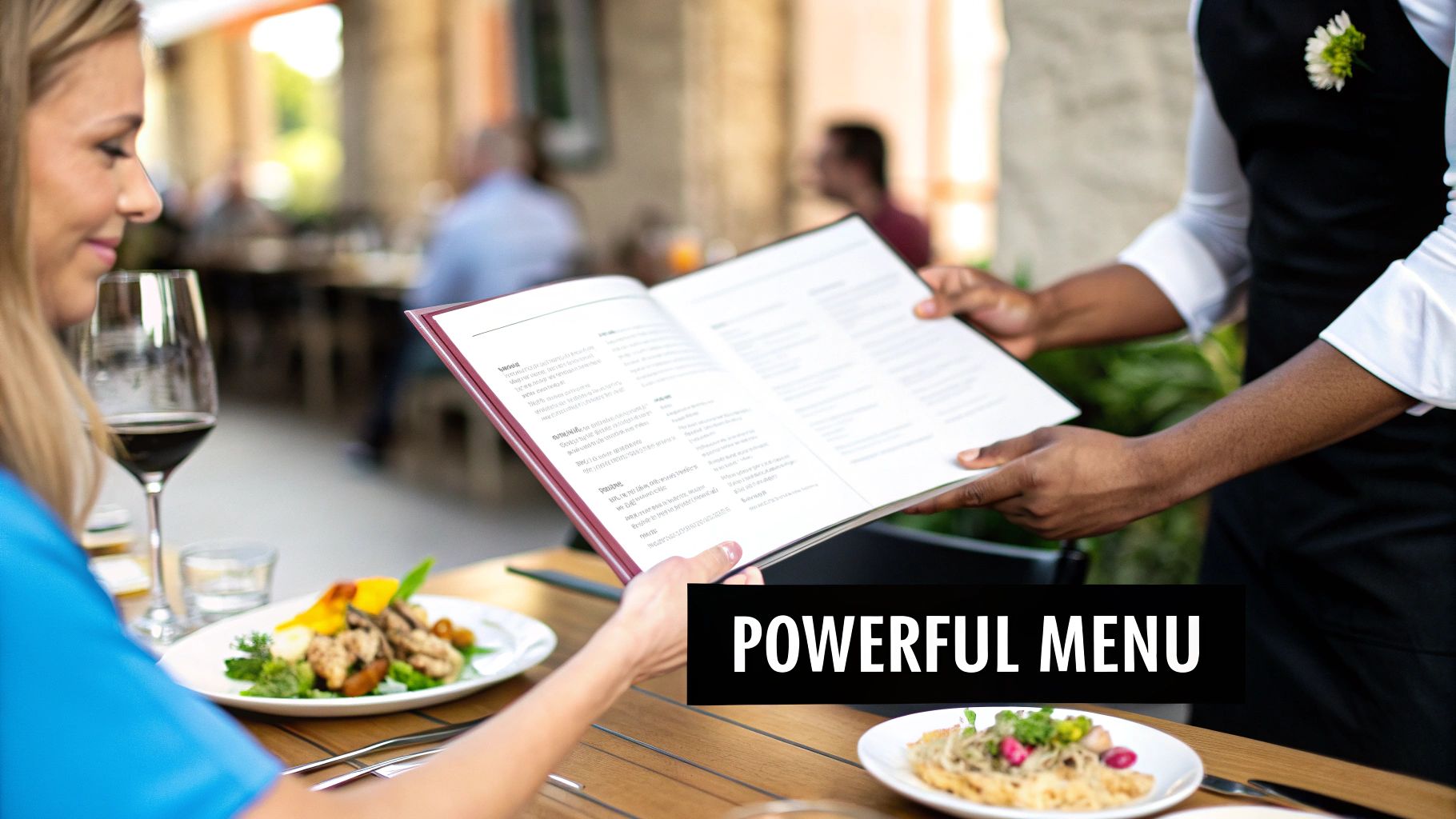
It's time for a mindset shift. Stop seeing your menu as a simple price list and start treating it as your number-one salesperson. Every single detail—from the font you choose to where you place a specific dish—tells your brand's story and directly influences your bottom line. Frankly, a strategically engineered menu, informed by the latest news and trends in restaurant equipment and supplies, is one of the most reliable ways to boost profits.
A strong menu goes beyond just listing what's available; it shapes the entire guest experience. When you understand the psychology behind menu design, you can nudge your average check size higher, make life easier for your kitchen team, and build a base of regulars who keep coming back. For some killer visual inspiration, check out these inspiring menu board design ideas that can really elevate a customer's first impression.
Setting the Stage for Success
In this guide, we’re going to break down the pillars of menu mastery. We’ll move past the basics and give you a clear, practical framework to turn your menu from a static document into a dynamic, profit-driving machine. You'll learn how to write descriptions that make mouths water and use pricing strategies that encourage guests to spend a little more, all while staying informed about key industry trends.
We'll dive into the topics every operator needs to master:
- Anatomy of a Menu: We'll dissect the core components—sections, item names, descriptions, and all the little details.
- Menu Engineering: This is all about using data to strategically place items for maximum profitability.
- Pricing Psychology: Learn the subtle tactics that guide customer choices without being pushy.
- Digital vs. Print: We'll explore the pros and cons of modern menu formats so you can choose what's right for you.
A well-crafted menu is a silent salesperson. It speaks to your customers, represents your brand, and quietly works to increase your profits with every order placed.
By mastering these elements, every time a guest sits down becomes a real opportunity. To explore more ways to improve your restaurant's financial performance, don't miss our detailed guide on how to increase restaurant revenue.
The Anatomy of a High-Performing Menu
Think of your menu as more than just a list of what's cooking in the kitchen. It’s your most valuable sales tool, a carefully crafted blueprint designed to guide a guest’s experience and, ultimately, boost your bottom line. Just like building a house, every element—from the foundation to the finishing touches—plays a critical role. Get these core components right, and you'll have a menu that truly works for you.
It all starts with a logical flow. A menu that’s a chaotic jumble of items is an instant source of frustration for a guest. You want to group your offerings into intuitive sections that feel like a natural journey, gently guiding them from their first sip to their last bite.
Guiding the Customer's Journey
The easiest way to create a smooth experience is to follow the classic dining sequence. This isn't just about being traditional; it's about meeting your customers' expectations and making it incredibly easy for them to order.
Most successful menus follow a simple, predictable path:
- Appetizers or Starters: The opening act. These dishes are designed to get the appetite going.
- Soups and Salads: A light transition or a satisfying meal on their own.
- Main Courses or Entrées: This is the heart of your menu, where your signature dishes really get to shine.
- Desserts: The grand finale, offering that perfect sweet note to end the meal.
- Beverages: You can keep this as one section or break it down into categories like cocktails, wine, beer, and non-alcoholic options.
By creating this clear path, you help diners avoid "analysis paralysis." That’s the feeling of being so overwhelmed by choice that they just default to something familiar and cheap. Logical categories make their decision easier and the whole experience feel more relaxed.
Crafting Listings That Sell Themselves
With your sections mapped out, it's time to focus on the details of each item listing. This is where the real psychology and salesmanship come into play.
H3: The Big Three: Name, Description, and Price
First up is the item name. "Chicken Breast" is functional, but it’s boring. "Tuscan-Herb Grilled Chicken Breast," on the other hand, immediately paints a picture and tells a story. It hints at a specific flavor profile and a level of care that helps justify the price.
Next, the description. This is your moment to sell the sizzle. Don't just list ingredients; describe them with sensory language that makes mouths water. "Roasted red peppers" becomes "Fire-roasted sweet red peppers." "Cream sauce" turns into "A rich, velvety parmesan cream sauce." It’s a small change, but research has shown that using vivid descriptions can increase an item's sales by as much as 27%.
Your menu description should be a short story that makes the reader hungry. It’s not just about what’s in the dish, but how it will make the customer feel.
Finally, let’s talk about how you display the price. Whatever you do, don't list your prices in a neat column down the right side of the page. That just encourages price shopping. Instead, nestle the price at the end of the item description, using the same font and style. Ditching the dollar sign (e.g., using 18 instead of $18.00) also helps de-emphasize the cost, keeping the focus on the delicious food itself.
A quick look at these core elements shows how each piece works together to create a compelling listing.
Core Menu Elements at a Glance
| Menu Element | Primary Function | Best Practice Example |
|---|---|---|
| Section | Organizes the menu for an intuitive ordering flow. | Appetizers, Main Courses, Desserts |
| Item Name | Captures attention and hints at the dish's character. | "Grandma's Classic Lasagna" vs. "Lasagna" |
| Description | Uses sensory language to create desire and appeal. | "Layers of fresh pasta, rich bolognese, and creamy béchamel..." |
| Pricing | De-emphasizes cost to focus attention on value. | "…baked to golden perfection. 21" |
| Modifier | Offers customization and increases check average. | "Add a side Caesar salad 5" |
| Icon/Label | Communicates dietary information quickly. | A chili icon for "Spicy" or "GF" for "Gluten-Free" |
Each of these components is a lever you can pull to subtly guide choices and enhance the overall dining experience.
H3: Using Modifiers and Visual Cues to Your Advantage
Beyond the basic text, a couple of other elements are non-negotiable for a modern menu.
First are modifiers. These are the little add-ons and customizations that let customers build their perfect meal while also giving you a chance to upsell. Think "Add grilled shrimp" to a salad or "Make it a combo with fries and a drink." They give your guests a sense of control and are an easy way to increase the average check size.
Second, icons and labels are powerful visual shortcuts. For guests with dietary restrictions, a small leaf icon (vegetarian), a "GF" (gluten-free), or a chili pepper (spicy) makes finding what they can eat a breeze. It saves them from having to ask a dozen questions and frees up your servers' time. These small visual aids are no longer a nice-to-have; they're essential for catering to today's diners.
Menu Engineering: The Science of Profitable Design
If the basic anatomy of a menu is the "what," then menu engineering is the "why" and "where." It’s the strategy behind turning a simple list of dishes into a powerful sales tool, subtly guiding your guests toward the items that benefit your bottom line the most.
Think of it this way: you wouldn't just randomly place equipment in your kitchen. You'd arrange it for maximum efficiency based on the latest industry trends. Your menu deserves that same strategic thinking. This isn't about fooling anyone; it's about applying proven psychology to make your most profitable dishes shine.
Understanding Menu Psychology and Layout
The first thing to realize is that people don't read menus like a book. When a guest picks up your menu, their eyes don't start at the top left and read line by line.
Instead, research shows our eyes tend to follow a predictable path, often called the "Golden Triangle." They typically dart first to the middle of the page, then up to the top right corner, and finally over to the top left. These three spots are your menu's prime real estate. Placing your high-margin, signature dishes here dramatically increases the odds they'll be ordered.
Your menu is a treasure map, and the Golden Triangle is where you mark the X. Don't waste this valuable space on low-profit items like a side salad or basic fries.
Another clever technique is price anchoring. This is where you place a particularly expensive item at the top of a category. A "$45 Chef's Special Ribeye" might not be your biggest seller, but it makes the "$28 Sirloin" right below it look like a fantastic deal. The anchor's job is less about selling itself and more about making everything else seem more reasonably priced.
At their core, menus are built from item names, descriptions, and prices. This is the foundation you'll build your strategy upon.
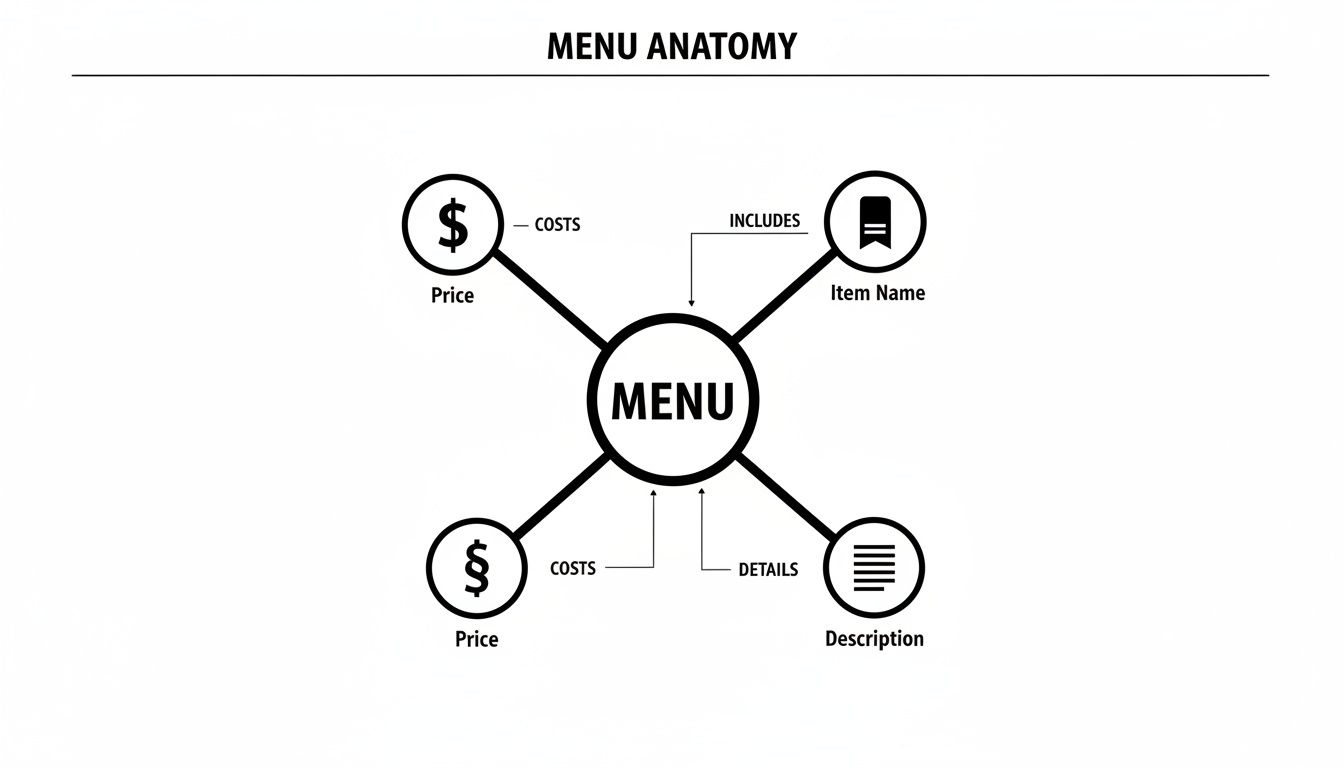
As you can see, each element has a distinct role, and when they work together, they present your food in the most appealing way possible.
The Profitability and Popularity Matrix
The real heart of menu engineering lies in analyzing every single dish on two simple metrics: popularity (how many you sell) and profitability (how much money you make on each one). Once you have that data, you can sort every item into one of four categories, which tells you exactly what to do next.
- Stars: (High Profitability, High Popularity) - These are your champions. Leave them alone! Highlight them in the Golden Triangle, give them mouth-watering descriptions, and maybe even a great photo.
- Plowhorses: (Low Profitability, High Popularity) - These are the crowd-pleasers that don't make you much cash. The goal here is to make them more profitable. Can you slightly increase the price? Or maybe reduce the portion size just a touch without anyone noticing?
- Puzzles: (High Profitability, Low Popularity) - You make great money on these, but nobody's ordering them. Your job is to figure out why. Try renaming the dish, writing a more vivid description, or training your servers to recommend it enthusiastically.
- Dogs: (Low Profitability, Low Popularity) - These items are dead weight. They're not popular, they don't make you money, and they complicate your inventory. In almost every case, the best move is to take them off the menu.
Small Design Tweaks That Make a Big Impact
Once you’ve sorted your dishes, you can use subtle design cues to nudge customers toward your Stars and Puzzles. You’d be surprised what a difference these small changes can make.
Something as simple as putting a box around an item makes it stand out and can significantly increase sales. Even a small icon, like a "Chef's Recommendation" star or a "House Favorite" leaf, draws the eye and signals that an item is special.
Another classic tool is charm pricing, which is just a fancy way of saying you end prices with .99 or .95. We all know that $14.99 is basically $15, but the psychological impact of seeing that "14" first is incredibly powerful. To get this right, you really need to know your numbers inside and out; you can learn more by exploring the food cost percentage calculation in depth.
Finally, try removing the dollar signs. Listing a price as 21 instead of $21.00 subtly de-emphasizes the cost. It helps keep the guest's mind focused on the dish and the experience, not the transaction.
How a Smaller Menu Makes You More Money
In the restaurant business, we're often tempted to believe that more choices equal more customers. But when it comes to your menu, the opposite is usually true. A huge, sprawling menu doesn't just overwhelm your guests; it can quietly bleed your restaurant dry by complicating your need for different restaurant equipment and supplies.
Think of it this way: a focused, well-curated menu isn't about limiting options. It's a strategic move that sharpens your kitchen's focus, smooths out service, and directly pads your bottom line. This isn't just a niche idea, either. The entire industry is catching on. Right now, 36% of operators are actively trimming their menus to fight rising costs and keep up with what customers actually want. As these restaurant industry statistics show, it's a massive trend for a reason.
The Hidden Costs of a Bloated Menu
Every single item you add to your menu brings a chain of hidden costs and complications with it. Each dish needs its own unique ingredients, its own prep station space, and its own slice of your cooks' attention. When your menu gets too big, that complexity snowballs and starts to cause some serious problems.
Here’s where it really hurts your operation:
- Sky-High Food Costs: A bigger menu means a bigger inventory. You’re forced to stock dozens of extra ingredients, many of which sit on the shelf, raising the risk of spoilage and killing your food cost percentages.
- Slower Ticket Times: Watch a line cook during a busy service. They get into a rhythm. When they have to constantly switch gears between 40 different, complex dishes, that rhythm is shattered. A focused menu builds muscle memory, letting your team fire out orders with speed and accuracy.
- Inconsistent Quality: Can your kitchen team perfectly execute 50 different dishes every single night? It’s highly unlikely. A smaller menu allows your chefs to truly master each plate, ensuring every guest gets the same fantastic experience.
A large menu forces your kitchen to be a jack of all trades but a master of none. A small menu turns them into specialists who execute flawlessly every time.
These operational headaches aren't just back-of-house problems. They spill over directly to the dining room. Slow service and uneven food quality are two of the fastest ways to ensure a customer never comes back.
A Better Experience for Your Guests
A tight, focused menu is also a gift to your customers. Ever watch a diner stare at a menu the size of a phone book, their eyes glazed over? That’s "analysis paralysis." They're so overwhelmed that they either take forever to order or just give up and point to something familiar and "safe"—which is rarely your high-margin star.
A curated menu, however, radiates confidence. It sends a clear message: "This is what we do best. We stand behind every single one of these dishes." It makes ordering easy and stress-free for your guests, which in turn leads to faster table turnover. And in this business, turning tables faster is pure profit.
Finding and Cutting the Underperformers
The secret to trimming your menu effectively is listening to your sales data. You have to know which dishes your customers are ordering again and again, and which ones are just gathering dust. This is where a core concept from menu engineering, the "Dogs," comes into play.
A "Dog" is an item that’s both unpopular and unprofitable. It’s dead weight. It complicates your inventory, takes up space on the menu, and slows down your kitchen, all without adding anything meaningful to your revenue. The only way to find them is to track your sales, item by item.
Once you’ve identified your "Dogs," the next step is simple, even if it feels difficult: get rid of them. It can be hard to cut a dish, especially if it's an old favorite of the chef or owner. But the numbers don’t lie. Cutting these underperforming items is the single most important step you can take toward a leaner, meaner, and far more profitable menu.
Embracing Global Fusion and Modern Menu Trends
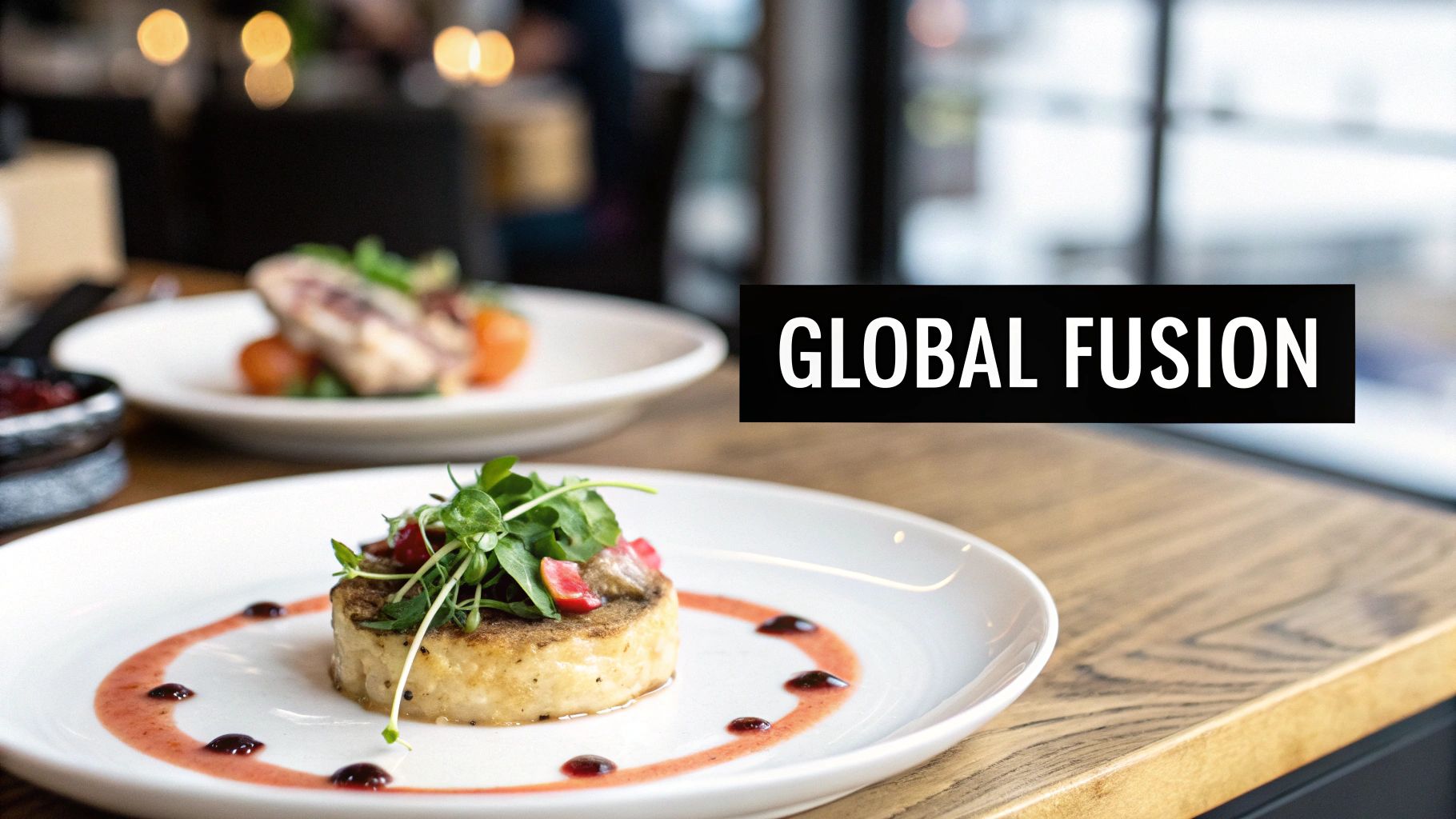
A menu that never changes is a menu that gets ignored. In the restaurant world, if you're standing still, you're falling behind. The trick is to keep things fresh and exciting without losing the soul of your restaurant. Right now, one of the biggest opportunities to do that is with global fusion.
Diners today have a more adventurous palate than ever before, and smart operators are leaning into it by mixing and matching flavors from different culinary traditions. This isn't about making food that's weird for the sake of being weird. It's about giving a familiar dish an unexpected, delicious twist. Think Korean-Mexican street tacos, a Filipino adobo-style fried chicken sandwich, or classic Italian pasta tossed in a bright, Japanese yuzu cream sauce. These are the kinds of dishes that get people talking and create a real buzz.
Tapping into Today's Most Powerful Trends
While global fusion is a big one, it’s not the only trend shaping what customers want to eat. Paying attention to these shifts shows your guests that you're in tune with what's happening and dedicated to giving them a great, modern experience. Keep an eye on industry news to discover the latest trends in restaurant supplies that can support these new directions.
These aren't just fleeting fads; they represent real changes in how people dine out:
- Elevated Plant-Based Options: The days of a sad, lonely veggie burger are over. Diners now expect creative, well-thought-out plant-based dishes that are just as good as their meat counterparts. We’re talking about things like smoked carrot "lox," savory mushroom carnitas, or a vibrant beet tartare.
- Hyper-Local Sourcing: Name-dropping local farms, ranches, and bakeries on your menu tells a powerful story. It screams freshness, shows you support your community, and gives your food a sense of place that people really connect with.
- Interactive Dining Experiences: This can be anything from tableside guacamole prep to a DIY taco kit or a flight of local craft beers. These touches create memorable moments that guests love to share online.
By thoughtfully weaving these menu elements, restaurant owners can build a brand story that feels both current and true to their roots.
Making Fusion Work for Your Bottom Line
Jumping on the global fusion trend isn't just a creative exercise; it's a savvy business decision. Cuisines blending Korean, Vietnamese, and Filipino flavors with familiar formats are popping up everywhere, and for good reason. They grab diners' attention without forcing you to completely overhaul your kitchen or inventory.
Operators are finding huge success by adding these exciting flavor profiles to comfort food classics—things like bulgogi pizzas, kimchi quesadillas, and adobo fried chicken. One Chicago restaurant group reported a 35% sales increase after making such a move. By introducing bold new flavors in a familiar package, you lower the risk for both you and your customer. You can explore more about how these menu trends actually perform and impact the bottom line.
Embracing a trend doesn't mean changing who you are. It means finding an authentic way to weave new ideas into your brand's existing story, making it more exciting and relevant to today's diner.
Ultimately, the goal is to make these trends feel like a natural part of your culinary identity, not just a gimmick you’re trying out for a month. When you nail that blend of the familiar and the unexpected, you create craveable dishes that don’t just bring in new faces—they turn them into regulars. This is how you keep your menu dynamic, profitable, and a step ahead of the competition.
Choosing Between Digital and Print Menus
Deciding between a classic paper menu and a modern digital one is a huge crossroads for any restaurant owner. You're essentially choosing between the familiar, tangible feel of a physical menu and the dynamic, data-driven world of QR codes and screens. There’s no universal "right" answer here; the best choice depends entirely on your restaurant's concept, your customers, and your operational goals.
A beautifully designed print menu offers a classic touch that can really set the tone for your brand's atmosphere. It’s a physical object that communicates a certain level of intention, especially in fine dining or concepts that lean into tradition. But that permanence is also its greatest weakness. Every time you change a price, 86 an item, or run a special, you're looking at a reprint—and that costs both time and money.
The Power and Flexibility of Digital Menus
Digital menus, usually accessed through a simple QR code scan, give you a level of agility that print just can't compete with. Imagine running out of a key ingredient mid-service. With a digital menu, you can instantly hide that dish, preventing guest disappointment and saving your servers from having those awkward "Sorry, we're out of that" conversations. That kind of real-time control is a game-changer for kitchen efficiency.
This flexibility translates directly to your bottom line. The whole industry is moving this way for a reason. In fact, the United States is leading the charge, accounting for 26% of global QR code menu usage. The results speak for themselves: digital menus can slash printing costs by up to 80% and enable real-time promotions that have been shown to boost the average check size by 15-20%. These promotions can be an excellent way to share exclusive deals on your offerings.
Advanced Features and Data Insights
Going digital isn't just about making quick updates. It opens up a whole new world of possibilities. Digital menus can connect directly with your online ordering and POS systems, creating a much smoother experience for both customers and staff. This is especially true as more restaurants adopt digital menu displays for in-house ordering.
Digital menus transform a static list into a live tool. You can collect invaluable data on what customers are looking at, what they’re ordering, and when, giving you the insights to make smarter business decisions.
Digital platforms also make your restaurant far more accessible. With a tap of a button, you can offer your menu in multiple languages, making tourists and a diverse local community feel right at home. This adaptability ensures every guest can order with confidence.
Finding the Right Fit for Your Restaurant
Ultimately, the choice isn't always a stark "either/or" situation. Many restaurants are finding success with a hybrid approach. A high-end steakhouse might keep its elegant, leather-bound menus for the table but use a digital menu for its massive, ever-changing wine list. On the flip side, a bustling fast-casual spot might go fully digital to maximize speed and turnover.
The key is to honestly weigh the classic appeal of print against the very real, profit-driving advantages that digital menus bring to the table.
Answering Your Biggest Menu Questions
After digging into the nuts and bolts of menu design and strategy, you're probably buzzing with questions. That's a good thing. It means you're ready to put these ideas into action. Let's tackle some of the most common questions I hear from restaurant owners.
How Often Should I Update My Menu?
For most places, a full-blown menu review and redesign every 6 to 12 months is a great rhythm to get into. This keeps you in sync with shifting food costs and what your customers are craving, but it won't feel like you're constantly reinventing the wheel.
Of course, if your concept is built around seasonality, you'll want to update your offerings four times a year. It's all about keeping things fresh and exciting.
This is where digital menus really shine. You can adjust prices on the fly, 86 a sold-out item instantly, or add a daily special without the hassle or cost of a new print run.
Should I Use Photos on My Menu?
This one comes down to your brand's personality. If you're running a fine-dining restaurant, photos are almost always a no-go. You want to maintain that elegant, minimalist vibe where the carefully crafted words do all the talking.
But for just about everyone else—casual spots, family restaurants, QSRs—a few strategically placed photos can work wonders. In fact, research shows a single, well-shot photo can boost an item's sales by up to 30%. The key is to use them selectively to spotlight your star dishes. Whatever you do, avoid cheap-looking or stock photos at all costs.
A great photo sells the dish before the guest even reads the description. A bad photo does the exact opposite, cheapening the perception of your entire menu.
What’s the Biggest Menu Design Mistake?
By far, the most common and damaging mistake is treating the menu like a simple price list. It’s your single most powerful marketing tool, not an inventory sheet! This mistake leads to cluttered layouts, prices lined up in a neat column that just encourages diners to shop by price, and descriptions that are totally uninspired.
A close second is failing to actually track how your menu items are performing. If you're not analyzing the data, you're flying blind. For a deeper look at getting your numbers under control, our guide on calculating your restaurant prime cost is a must-read. Ignoring this step means you're almost certainly keeping unprofitable "Dog" items on the menu that are quietly draining your profits.
Are QR Code Menus Still Relevant?
You bet they are. The pandemic may have pushed them into the spotlight, but they’ve stuck around for good reason. From an operational standpoint, they’re a huge win.
- No more printing costs. Ever.
- Instant updates. A dish sells out? Tap a button and it’s gone.
- Data collection. They give you valuable insight into what your customers are ordering.
- System integration. They link up perfectly with modern ordering and payment tech.
They save you money, make your operation smoother, and keep your guests happy. That’s a powerful combination.
At Encore Seattle Restaurant Equipment, we provide the high-quality kitchen tools and supplies you need to bring your perfect menu to life. From reliable cooking equipment to efficient prep stations, we help you discover the latest news and exclusive deals on restaurant equipment and supplies. Find everything you need to support your culinary vision by exploring our inventory at https://encoreseattle.com.