
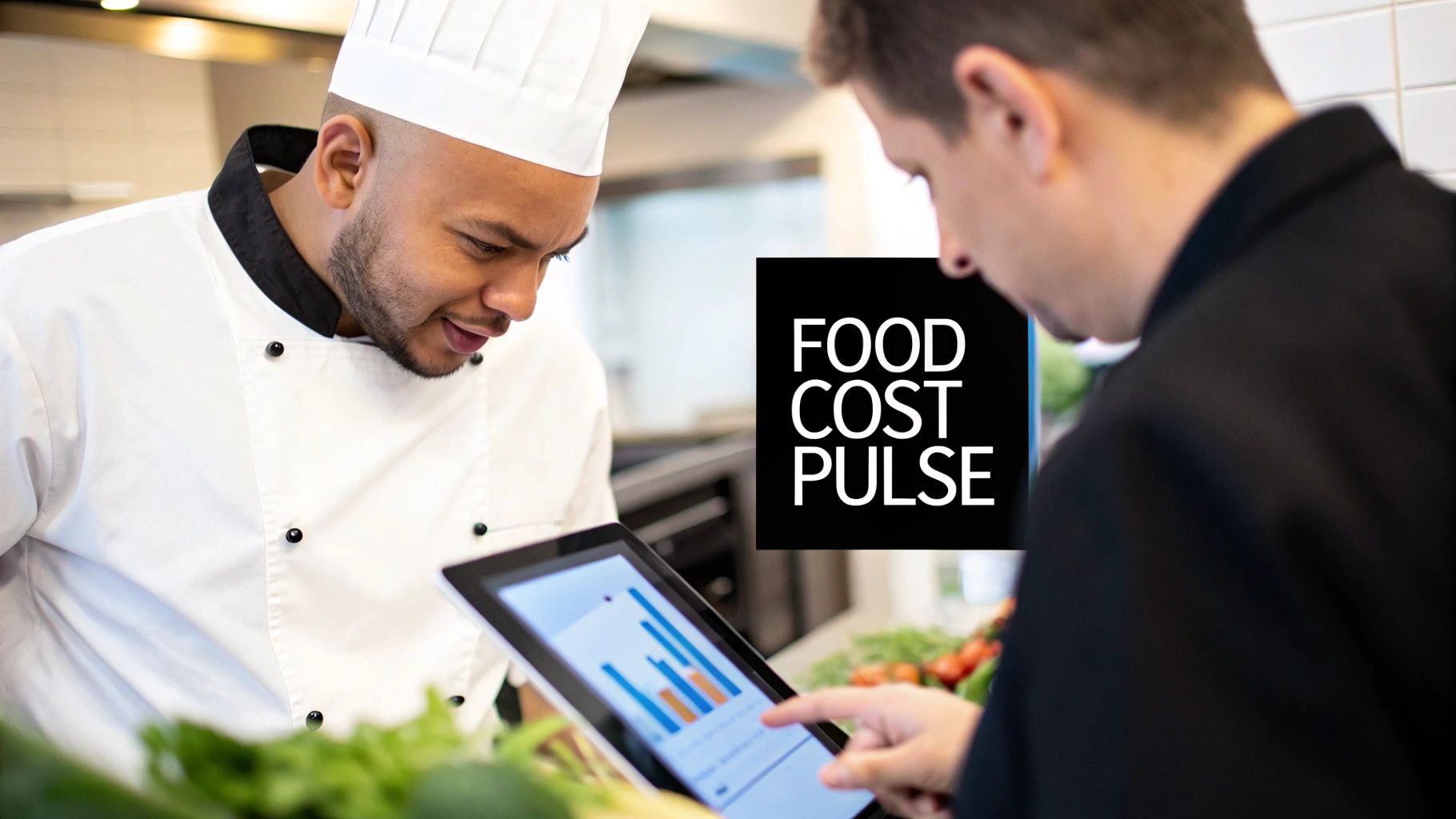
Mastering Food Cost Percentage Calculation to Boost Profits
At its core, the food cost percentage is a simple yet powerful number. It tells you exactly how much of your revenue is spent on the ingredients that go into the dishes you sell. If your food cost is 30%, that means for every dollar you bring in, 30 cents goes right back out to pay for food.
This isn't just a number for your accountant—it's a critical tool for menu pricing, cost control, and ultimately, staying profitable. Stay informed about the latest industry trends, restaurant equipment, and supplies to gain a competitive edge.
Why Food Cost Percentage Is Your Most Important Metric
Let's cut to the chase. Running a successful restaurant boils down to managing a few key numbers, and your food cost percentage is arguably the most important one. Think of it as the financial pulse of your kitchen. It's the metric that directly connects your menu to your bank account.
When you truly understand and track this figure, you can stop guessing and start making smart, data-driven decisions that actually protect your margins. It’s the bridge between the numbers on a spreadsheet and the real-world action happening on the line every single day.
What This Metric Reveals About Your Business
Keeping a close eye on your food cost percentage gives you a clear window into some of the most vital parts of your operation.
- Menu Profitability: It instantly flags which dishes are your money-makers and which ones are secretly costing you a fortune. This is the foundation of smart menu engineering.
- Pricing Strategy: This number is your starting point for setting menu prices that not only cover your costs but also hit the profit targets you need to thrive.
- Operational Efficiency: If your food cost starts creeping up, it’s a red flag. It could point to anything from sloppy portion control and vendor price increases to excess spoilage or even employee theft.
Think of your food cost percentage as an early warning system. A sudden spike can alert you to a waste or efficiency problem long before it snowballs into a major loss on your P&L statement.
A Global Perspective on Food Spending
While your restaurant's food cost is specific to your business, it’s interesting to see it in a broader context. A 2016 analysis found that U.S. households spend just 6.4% of their income on food—one of the lowest rates in the world. Compare that to Nigeria, where families dedicate a massive 56.4% of their income to food.
Understanding financial metrics is crucial for success. For more insights for the Food & Beverage industry, staying informed is key.
Of course, food cost is just one piece of the puzzle. To get the full financial picture, you'll also want to understand how it fits into your overall restaurant prime cost.
How to Calculate the Cost of a Single Menu Item
Before you can get a handle on your restaurant's overall financial health, you have to zoom in—all the way down to the individual plate. This process, often called plate costing or recipe costing, is the absolute foundation of a smart menu pricing strategy. It's the only real way to know which dishes are making you money and which are secretly eating away at your profits.
At its core, plate costing is about adding up the cost of every single component that goes into a dish. I’m not just talking about the steak or the fish. We're talking about every drop of olive oil, every pinch of salt, and that single sprig of parsley on top. It all adds up.
Deconstructing the Dish Cost
Let's walk through a practical example: a signature lasagna. To nail down its true cost, you have to break the recipe down piece by piece and figure out the exact cost for the amount used in one serving.
This means you can't just look at the invoice for a case of ground beef. You have to do a little math. For instance, if you buy a 10-pound case of ground beef for $40, your cost per pound is $4. If your lasagna recipe uses 8 ounces (that's half a pound) of beef, then the beef cost for that single portion is $2.
You'll need to do this for every single ingredient in the recipe:
- Pasta: The cost for the specific weight of noodles in one serving.
- Cheese: The cost per ounce for the mozzarella, ricotta, and parmesan.
- Sauce Ingredients: Tomatoes, onions, garlic, and even the few tablespoons of olive oil.
- Spices: Yes, you even need to account for that pinch of oregano. It might seem small, but it's not zero.
Getting this right requires a good system. A detailed spreadsheet is your best friend here. If you need some ideas on how to set one up, this guide to a solid inventory format for restaurant management is a great place to start.
The Final Calculation for Plate Cost
Once you’ve painstakingly costed out every component, from the protein down to the garnish, you simply add them all together. This gives you your Total Ingredient Cost, which is what many in the industry just call the "plate cost." It’s the raw cost to produce one serving of that dish.
Let's finish our lasagna example. After adding up the costs for the beef, pasta, various cheeses, sauce ingredients, and spices, your total plate cost comes to $4.20.
Now for the magic number. You can calculate the food cost percentage for that specific dish using a simple formula:
(Total Ingredient Cost / Menu Price) x 100 = Individual Item Food Cost Percentage
So, if you price that signature lasagna at $18.00 on your menu, the math is easy:
($4.20 / $18.00) x 100 = 23.3%
That 23.3% is a powerful piece of information. It tells you that your lasagna is a very profitable dish. By running these numbers for every single item on your menu, you gain an incredible amount of clarity, allowing you to make smarter decisions about what to promote, what to re-price, and maybe even what to 86 for good.
Calculating Your Restaurant's Overall Food Cost
While costing individual plates is crucial, you can't really steer the ship without looking at the whole map. This means calculating your overall food cost percentage for a specific period, like a week or, more commonly, a month. This single number is your most powerful tool for spotting hidden profit drains and getting an honest look at your kitchen's financial health.
The industry-standard formula might seem a bit complex at first glance, but it's pretty simple once you get the hang of its parts. It gives you a clear snapshot of what you're spending on inventory compared to what you're bringing in from sales.
The Standard Food Cost Formula
The formula you'll want to use is your total Cost of Goods Sold (CoGS) divided by your total food sales. The real work is in figuring out the CoGS, which accounts for the inventory you started with, everything you bought, and what was left at the end.
Here’s the full breakdown:
(Beginning Inventory + Purchases – Ending Inventory) / Total Food Sales = Food Cost Percentage
Let's walk through each piece of this puzzle. Getting each part right is non-negotiable for an accurate result.
Breaking Down the Equation
To trust the number this formula gives you, precision is key. A sloppy inventory count or a missed invoice will throw everything off, potentially masking a problem that's quietly costing you thousands.
- Beginning Inventory: This is the total dollar value of all food and beverage stock you have on hand at the start of the period. Think of it as your snapshot at midnight on the 1st of the month.
- Purchases: Simply add up the total dollar value of all the food and beverage inventory you bought during that period. Just tally up every supplier invoice.
- Ending Inventory: This is the dollar value of the stock you have left at the very end of the period—for instance, at midnight on the last day of the month.
The process really just follows the flow of your ingredients from purchase to plate.
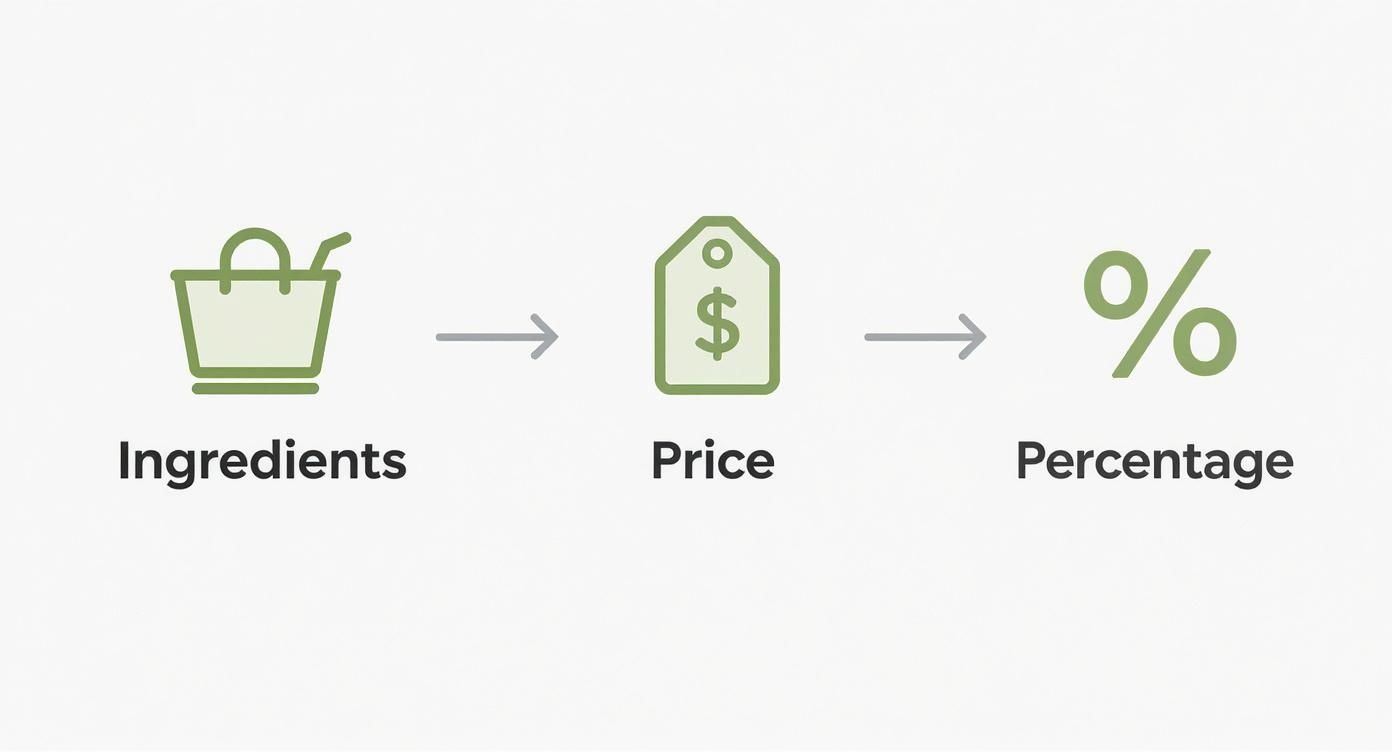
As this shows, it all starts with knowing what you're paying for your raw ingredients.
A Worked Example: Your Monthly Calculation
Let's put this into practice with a sample monthly calculation. This table shows you how the numbers plug into the formula to give you that final, all-important percentage.
Sample Monthly Food Cost Percentage Calculation
| Metric | Example Value | Description |
|---|---|---|
| Beginning Inventory | $15,000 | The value of all food stock on the first day of the month. |
| Purchases | $20,000 | The total cost of all food purchased during the month. |
| Ending Inventory | $16,000 | The value of all food stock remaining on the last day of the month. |
| Total Food Sales | $60,000 | The total revenue generated from food sales during the month. |
| Cost of Goods Sold (CoGS) | $19,000 | Calculated as: $15,000 (Beginning) + $20,000 (Purchases) - $16,000 (Ending). |
| Food Cost Percentage | 31.67% | Calculated as: $19,000 (CoGS) / $60,000 (Sales). |
In this scenario, the restaurant's food cost for the month is 31.67%. Now you have a concrete number to measure against your targets and past performance.
Uncovering Hidden Profit Leaks
This periodic calculation is where the real magic happens for management. When you compare your actual food cost (the number you just calculated) to your theoretical food cost (what your cost should have been based on menu prices and what you sold), a big difference is a major red flag. This gap can point to serious issues like over-portioning, unreported waste, or even employee theft.
Don't forget that global economic factors play a role, too. Food price indices, which track commodity costs, can swing wildly. For instance, the World Food Price Index hit a record high of 160.20 points in March 2022, a stark reminder of how outside forces can hammer your bottom line. These shifts in production and shipping costs hit your ingredient prices directly, making diligent cost tracking more critical than ever. You can explore more about these global food price trends to get a better feel for the market.
Staying on top of this overall number is essential. It takes you beyond just pricing dishes and puts you in active control of your kitchen's financial performance.
What Is a Good Food Cost Percentage?
So you’ve run the numbers, but what are they actually telling you? The honest answer is there's no single magic number that defines a "good" food cost percentage. The ideal target for your restaurant depends entirely on your concept, your service style, and the kind of ingredients you're working with.
Think about it: a fine-dining steakhouse that sources prime, dry-aged beef is going to have a fundamentally different cost structure than a high-volume pizzeria. One isn't necessarily better than the other. The real goal isn’t to chase some universal benchmark but to find the sweet spot where your specific business model thrives. Understanding this context is the first step in figuring out if your costs are healthy or if they’re flashing a warning sign.
Typical Food Cost Percentage by Restaurant Type
While your own historical numbers are the most important metric, it’s helpful to have a general idea of where you stand within the industry. This comparative look at average food cost percentages across different restaurant concepts can help you benchmark your performance.
| Restaurant Type | Average Food Cost Percentage Range |
|---|---|
| Quick Service (QSR) | 25% - 30% |
| Fast Casual | 28% - 32% |
| Casual Dining | 30% - 35% |
| Fine Dining | 32% - 40% |
Remember, these are just industry averages. A craft cocktail bar with a small, high-end food menu might have different targets than a family-style Italian restaurant. Use these figures as a starting point, not a strict rule.
The most powerful way to use your food cost percentage isn't to compare it to the restaurant down the street. It’s to compare it to yourself over time. If you see your own percentage creep up from 31% to 34% over a single quarter, that’s a clear signal to start digging into your purchasing, inventory, or kitchen practices.
A Bigger Picture on Food Costs
The struggle to manage food costs isn’t just a restaurant problem; it’s a global one. When you zoom out, the average cost of a healthy diet worldwide is estimated at $4.46 per person, per day. Animal-sourced foods are the priciest component at $1.00 of that daily total.
This global perspective is a powerful reminder that the price you pay for an ingredient is tied to massive, complex supply chains. It makes a strong case for why tracking every dollar in your own operation is so critical.
Actionable Strategies to Lower Your Food Costs
Knowing your food cost percentage is just the starting line. The real challenge—and where the money is made—is actively wrestling that number down. Smart operators know this isn't about switching to cheaper ingredients. It's about working smarter, killing waste, and being strategic with every single purchase.
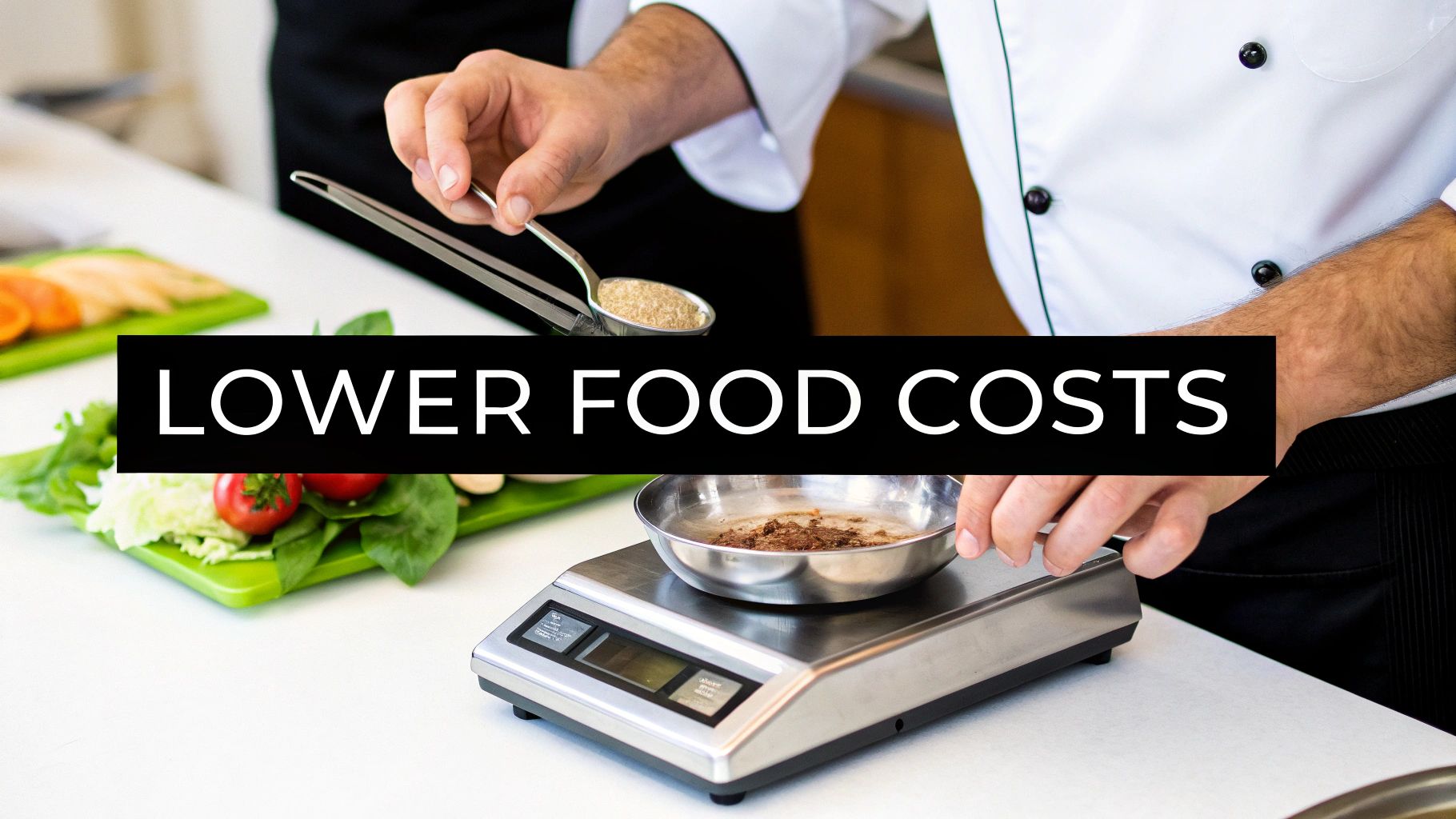
These are the strategies I've seen work time and again in real kitchens. The goal here is to turn a thin margin into a healthy one through consistent, deliberate action, all without your guests noticing anything but great food. Let us help you discover the latest news and exclusive deals on restaurant equipment and supplies.
Engineer Your Menu for Maximum Profit
Your menu is your single most powerful sales tool. Even tiny tweaks can have an outsized impact on your overall food cost. This is where menu engineering comes in—it’s the art of analyzing your dishes' profitability and popularity, then using that data to gently guide what your customers order.
The core idea is to highlight your "stars"—the dishes that are popular and have a low food cost. For example, simply moving a pasta dish with a 25% food cost into a more prominent spot on the menu can naturally boost its sales.
Give these proven menu engineering tactics a try:
- Use Visual Cues: The upper-right corner of the menu is prime real estate. It's where most people look first, so put your most profitable items there.
- Write Seductive Descriptions: Don't just list ingredients. Use words like "crispy," "house-made," and "hand-crafted" to make your high-margin dishes sound irresistible.
- Create a Decoy: Place a very expensive item at the top of a section. It makes everything else look like a bargain by comparison.
Master Portion Control and Waste Reduction
Inconsistent portioning is a silent profit killer. An extra ounce of steak here, a bigger handful of fries there... it adds up faster than you can imagine and throws your food cost calculations completely out of whack.
You need to implement strict portioning guidelines that your team can actually follow.
- Use portioned scoops for sides like rice or mashed potatoes.
- Get a few good digital scales for proteins. No more eyeballing.
- Pre-portion high-cost items like sauces and dressings during prep.
Don’t just set the standards; train on them constantly. Make portion control a part of your kitchen culture. It’s not about being cheap; it’s about delivering a consistent, high-quality product every single time.
On top of that, getting creative with waste reduction hits your bottom line directly. Look for ways to use every part of your ingredients. The carrot peels and onion ends from dinner prep? They can become the base for tomorrow's soup special. For more ideas on this, our guide on reducing food waste in restaurants is a great resource.
Strengthen Supplier Relationships and Procurement
Your relationship with suppliers should be a partnership, not an adversarial transaction. When you build strong, long-term connections, you often get access to better pricing, first dibs on quality products, and even more flexible payment terms.
But don’t get complacent. Implementing solid procurement cost reduction strategies is just as important as calculating your costs in the first place. You should be regularly checking prices from multiple vendors to make sure you’re getting a fair market rate.
Sometimes, a small shift in how you buy can make a huge difference. Think about buying whole chickens and having your team break them down instead of ordering pre-portioned breasts. Yes, it's more labor, but the savings on your plate cost can be significant. It's this combination of smart purchasing, menu strategy, and operational discipline that gives you true control over your restaurant's profitability.
Common Food Cost Questions Answered
Once you start digging into food cost, you’ll quickly realize that the real world of a bustling kitchen doesn't always fit into a neat formula. This is where theory hits the pavement. Knowing how to handle the messy, everyday scenarios is the difference between simply tracking numbers and actually managing your finances like a pro.
Let’s tackle some of the most common questions and tricky situations I see chefs and owners grapple with. Think of this as your field guide to keeping your food cost numbers clean, honest, and truly useful.
How Should I Handle Employee Meals and Comps?
This is probably the number one question I get. What do you do with food that leaves the kitchen but doesn't make you any money? We're talking employee meals, a free dessert for an unhappy guest, or that appetizer you gave away for a promotion.
If you don't account for these, they’ll get lumped into your regular food usage and bloat your food cost percentage. Suddenly, your kitchen looks way less efficient than it actually is.
The right way to handle this is to track these items at their cost, not their menu price, and keep them separate from your main Cost of Goods Sold (CoGS).
Here’s a simple system that works wonders:
- Employee Meals: Have a dedicated "Employee Meal" button in your POS programmed to a $0.00 price. This tracks what's being used without messing up your sales figures.
- Comped Dishes: Do the same thing with a "Comp" or "Promo" key. This makes sure the inventory depletion is recorded properly.
When you're ready to run your numbers for the week or month, just pull a report on these specific keys. Add up the total cost of those items and subtract that sum from your total CoGS before you calculate your final food cost percentage. This simple step gives you a much more accurate picture of your kitchen's actual performance.
Help! My Actual Food Cost Is Way Too High!
It’s a classic, stomach-dropping moment. You run the numbers on your recipes and sales mix (your theoretical cost), and you're sitting pretty at 28%. But then you do your inventory count, calculate your actual food cost, and it comes out to 34%. That 6% gap is a huge red flag—it's a profit leak, plain and simple.
Don't panic. Investigate. A big gap between your ideal and actual food cost is a signal to start digging into your daily operations. It’s almost never one big thing, but a bunch of small leaks adding up.
So, where do you start looking? Focus on the usual suspects first:
- Waste: Are you seeing a lot of spoilage in the walk-in? Are line cooks making errors that force them to re-fire dishes? Every mistake ends up in the trash can, and so does your money.
- Portion Control: Are your chefs eyeballing portions instead of using scales and measured scoops? A little extra on every plate adds up to a lot of lost profit by the end of the month.
- Theft: Nobody wants to think about it, but inventory shrinkage from theft is a real and costly problem.
- Receiving Errors: Did that case of beef you were invoiced for at 50 lbs actually weigh 50 lbs when it came off the delivery truck? You have to check.
At Encore Seattle Restaurant Equipment, we know that controlling costs is about more than just a spreadsheet—it's about having the right tools for the job. From high-precision digital scales that make portion control foolproof to efficient refrigeration that cuts down on spoilage, we stock the equipment that helps you protect your bottom line. Check out our huge selection of new and used kitchen gear at https://encoreseattle.com.