

Grease Trap Calculation: How to Size, Ensure Compliance, Prevent Backups
Getting the right size grease trap for your commercial kitchen isn't just a box to check—it's one of the most critical decisions you'll make for your operation. As a restaurant owner or chef, staying informed about industry trends and equipment is key. By figuring out exactly how much Fats, Oils, and Grease (FOG) your kitchen produces, you can choose a unit that prevents backups, avoids fines, and keeps you out of operational chaos.
Why You Can't Afford to Guess on Grease Trap Size
Let's be blunt: getting your grease trap calculation wrong is a recipe for disaster. This isn't just about following plumbing codes; it's about protecting your business from the inside out. An undersized unit is a ticking time bomb, guaranteed to cause messy sewer backups, force you to shut down unexpectedly, and rack up fines that can cripple your budget. You have to see this calculation as an investment in your restaurant's stability, not just another startup cost.
Picture a slammed Friday night. The kitchen is humming, orders are flying out, but your undersized grease trap just hit its limit. Next thing you know, your drains are backing up, a foul smell is wafting into the dining room, and you have no choice but to close your doors. This isn't a hypothetical problem—it's a costly reality for too many owners who cut corners on sizing.
The Real Costs of a Bad Calculation
The fallout from a poorly sized grease trap goes way beyond a simple plumbing headache. It hits your wallet and your reputation—hard.
Here's a look at what you're really risking with the wrong unit:
- Sky-High Plumbing Bills: Emergency calls for drain jetting and clog removal can easily run into hundreds, sometimes thousands, of dollars.
- Hefty Fines: Cities and towns are getting serious about FOG violations. Non-compliance can lead to steep, recurring penalties.
- Lost Sales: Shutting down during a dinner rush means lost revenue, spoiled food, and paying staff who can't work.
- Damaged Reputation: Nothing clears a restaurant faster than bad smells or a "closed for emergency" sign. That kind of negative experience is tough to bounce back from.
Ever since regulations like Seattle's FOG ordinance became common in the early 1990s, proper grease management has become a non-negotiable part of running a food business. In a recent survey of 500 US restaurants, 62% had to upgrade their traps after miscalculations led to backups. The average cost? A 20% loss in sales for every incident. You can learn more about the evolution of the grease trap market and why it's so important today.
Your Best Defense Against FOG Problems
To protect your operation, there are two reliable methods for calculating the right grease trap size. Each one gives you a solid way to match your kitchen's real-world output with the right piece of equipment.
The goal is straightforward: pick a trap that can handle your busiest moments without getting overwhelmed. It's a proactive step that stops FOG from ever reaching the city sewer system, which protects your pipes, your business, and the environment.
We'll walk through the two main approaches:
- Drainage Fixture Units (DFU): This method is based on the total potential flow rate from every sink, dishwasher, and drain connected to the trap.
- Meals Per Peak Hour: This is a volume-based calculation, perfect for high-traffic kitchens, that sizes the trap based on the maximum number of meals you serve.
Mastering one of these methods is your first and most effective defense against a FOG-related nightmare.
Sizing Your Grease Trap With The DFU Method
When it comes to sizing a grease trap, one of the most trusted methods in the plumbing world is the Drainage Fixture Unit (DFU) calculation. This isn't just guesswork; it's a systematic approach that sizes your interceptor based on the total potential wastewater every piece of equipment in your kitchen could produce.
Think of a Drainage Fixture Unit (DFU) as a simple score assigned to a sink, dishwasher, or floor drain. The higher the score, the more water it can dump into your plumbing system at once. It's a standardized way to measure the drainage load.
Tallying Up Your Kitchen's DFUs
First things first, you need to take an inventory. Walk through your kitchen and list every single fixture that will be connected to the grease trap. Once you have your list, you can assign a DFU value to each one and add them all up.
This gives you a clear, comprehensive picture of your kitchen's maximum potential wastewater output.
Common Kitchen Fixtures and Their DFU Values
To make this easier, here's a quick reference table based on the standards found in the Uniform Plumbing Code (UPC). It covers the most common fixtures you'll find in a commercial kitchen.
| Kitchen Fixture | Typical DFU Value | Notes |
|---|---|---|
| Three-Compartment Sink | 3 DFU | Each sink basin typically counts as 1 DFU. |
| Single Compartment Prep Sink | 2 DFU | Essential for prep work but adds to the load. |
| Commercial Dishwasher | 4 - 6 DFU | This varies quite a bit depending on the machine's size and discharge rate. |
| Hand Sink | 1 DFU | A small contributor, but every fixture counts. |
| Floor Drain / Floor Sink | 1 DFU | Catches everything from spills to equipment drainage. |
| Mop Sink | 3 DFU | Designed to handle large volumes of dirty water from cleaning. |
This table helps you quickly assign the right numbers to your equipment list, getting you one step closer to an accurate total.
Let's put this into practice with a real-world example: a small café. Their setup includes one three-compartment sink, a single prep sink, and a couple of floor drains.
- Three-Compartment Sink: 3 DFU
- Prep Sink: 2 DFU
- Floor Drain #1: 1 DFU
- Floor Drain #2: 1 DFU
Adding these up, the café's Total DFU is 7. This simple number is the foundation of the entire sizing calculation. It represents the combined drainage load all that equipment places on the system.
Converting DFU to Gallons Per Minute (GPM)
With your total DFU value in hand, the next step is translating it into a more practical metric: Gallons Per Minute (GPM). This is where the rubber meets the road. Plumbing codebooks have standard conversion charts that turn the potential load (DFU) into an actual flow rate (GPM).
The goal here is to account for peak flow. You’re not sizing for a slow Tuesday morning; you're planning for a chaotic Saturday night dinner rush. Imagine the dishwasher discharging, every sink draining, and someone mopping up a spill all at the same time. That's the moment your grease trap truly earns its keep.
For example, a modest kitchen might have a three-compartment sink (3 DFU), a prep sink (2 DFU), and a floor drain (1 DFU), for a total of 6 DFU. A quick look at a UPC conversion chart shows this translates to a peak flow of around 9-12 GPM. To handle that rush without a nasty backup, you’d be looking at a grease interceptor rated for at least 150-200 gallons.
This process really underscores why a correctly installed three-compartment sink is so crucial for both compliance and a smoothly running kitchen. For a deeper look, check out our guide on the specific rules for 3-compartment sinks to make sure your setup is up to snuff.
Getting this calculation wrong can have some pretty serious, and messy, consequences.
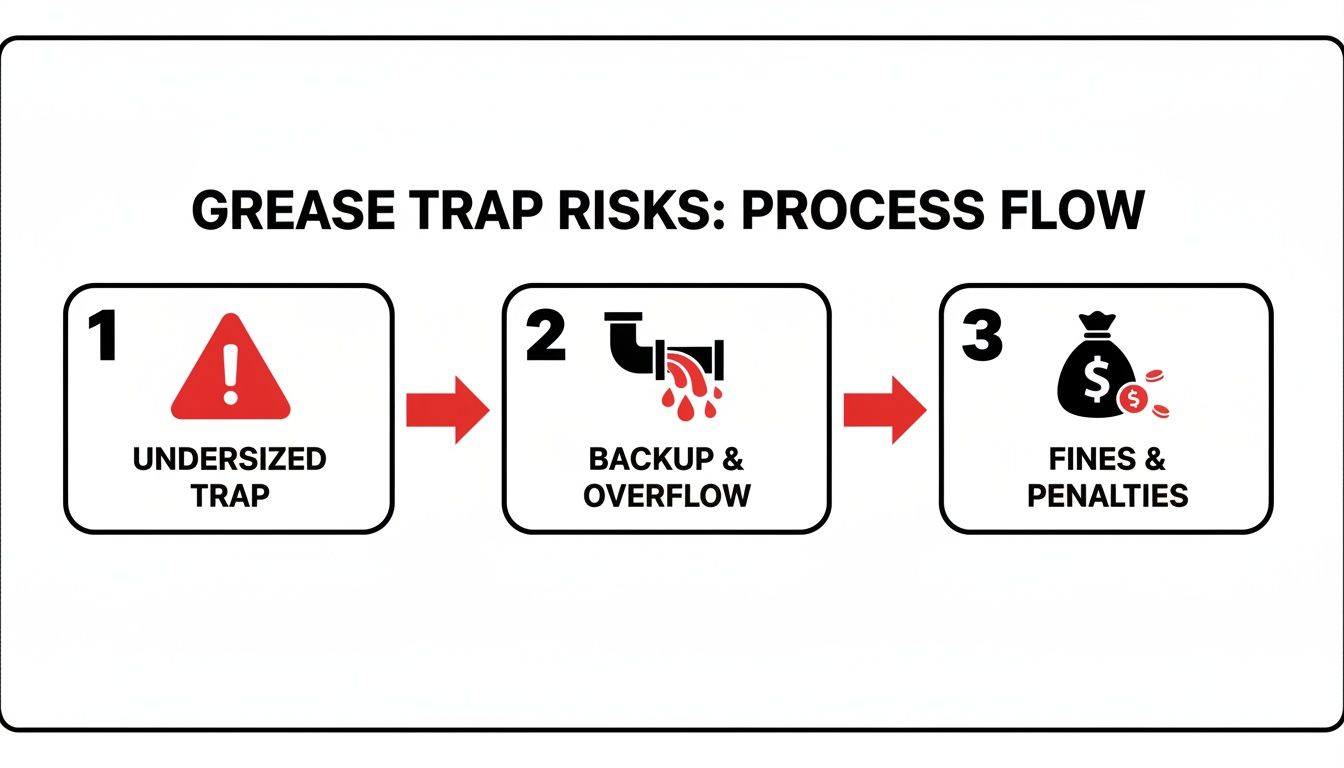
As you can see, an undersized trap is a direct path to backups, overflows, and the kind of expensive fines and shutdowns that can cripple a business.
Key Takeaway: Always, always choose a grease trap with a rated capacity that exceeds your calculated GPM. Think of that extra capacity as your insurance policy. It protects you from plumbing nightmares during your busiest hours and keeps your kitchen humming.
Sizing for High-Volume Kitchens: The Meals Per Peak Hour Method
While the Drainage Fixture Unit (DFU) method works well for many kitchens, it can fall short in high-volume settings. For a bustling restaurant, a large-scale catering company, or a ghost kitchen churning out hundreds of orders, the sheer volume of food produced can create far more grease and oil than the fixture count would ever suggest.
This is where the Meals Per Peak Hour calculation becomes the go-to tool.

Instead of just looking at the potential flow from your pipes, this volume-based approach focuses on what your kitchen is actually producing. It’s designed to make sure your grease trap can handle the intense demands of your busiest service, preventing a disastrous overflow when you can least afford it.
When to Use This Sizing Method
So, how do you know if you should use the Meals Per Peak Hour method? If your kitchen has a consistently intense peak service period, this calculation is almost certainly for you. We recommend it for businesses like these:
- High-Capacity Restaurants: Any dining room that regularly serves over 100 guests in a single hour.
- Large-Scale Catering Operations: Central kitchens preparing hundreds of meals for events.
- Busy Cafeterias: Places like hospitals, schools, or corporate campuses with very concentrated meal times.
- Ghost Kitchens & Food Halls: Multiple concepts operating out of one space create a massive collective output.
In these situations, the wastewater and FOG are directly tied to the number of plates leaving the kitchen—not just how many sinks you have.
Breaking Down the Formula
The formula itself is pretty straightforward, but you’ll need to have your operational data handy. At its core, you multiply your peak meal count by a few key factors to figure out the right grease trap capacity.
The calculation hinges on these components:
- Meals Served Per Peak Hour: This is the maximum number of meals your kitchen pushes out during its busiest hour of the day. Be honest with this number!
- Wastewater Per Meal Factor: An industry standard, typically set at 5 gallons, which represents the average wastewater generated for each meal prepared.
- Retention Time: The minimum time wastewater needs to sit in the interceptor so the FOG can separate. This is usually 2 hours for standard gravity interceptors.
- Grease Storage Factor: This is an extra multiplier to account for the space that FOG and solids will take up between pump-outs.
One of the cornerstone methods, which you can read more about at The Restaurant Warehouse, multiplies the meals served during the peak hour by 5 gallons of wastewater and then factors in a 2-hour retention time.
Imagine a popular pizza spot slinging 150 meals during its Friday night dinner rush. That’s 750 gallons of inflow per hour, which demands a 1,500-gallon interceptor to properly manage the FOG.
Putting It Into Practice: A Sizing Example
Let's walk through a real-world scenario. We have a 150-seat restaurant that gets absolutely slammed every Saturday night.
First, the manager dives into the sales data and confirms their busiest hour is 7:00 PM to 8:00 PM, when they serve an average of 120 meals.
Here’s how the calculation plays out:
- Calculate Peak Flow: 120 Meals x 5 Gallons/Meal = 600 Gallons Per Hour (GPH)
- Factor in Retention Time: 600 GPH x 2 Hours = 1,200 Gallons
The math is clear: this restaurant needs a grease interceptor with a minimum capacity of 1,200 gallons. This ensures that even during the most chaotic dinner service, the system has enough time and space to separate FOG from the wastewater and prevent a costly, messy backup.
Sizing your unit based on actual kitchen output provides a much more accurate safety margin than relying on fixture counts alone. It directly ties your equipment needs to your business's performance, ensuring the interceptor can keep up when your kitchen is firing on all cylinders.
Navigating Local Codes and Selecting The Right Unit
You’ve run the numbers and have a solid idea of what size grease trap your kitchen needs. It’s tempting to jump right on the internet and start shopping, but hold on. Even the most accurate calculation is worthless if it doesn't meet the rules set by your local health department or plumbing authority.
This is the step where so many new restaurant owners get tripped up. Before you spend a single dollar, your very first call should be to the local agency overseeing food service establishments. They have the final say, and their rules can completely change your game plan. Trust us, skipping this call is a costly and all-too-common mistake.
Why Your Local Codes Are The Final Authority
Think of local regulations less as guidelines and more as law. Municipalities often have their own specific requirements that can completely override standard industry formulas. If you don't comply, you could be looking at failed inspections, orders to rip out and replace brand-new equipment, and major delays in getting your doors open.
Here’s a glimpse of how local codes can dictate your choice:
- Mandated Formulas: Some jurisdictions might insist you use a specific sizing method, like the DFU formula, no matter what your actual kitchen output looks like.
- Minimum Retention Times: Your city might enforce a minimum amount of time wastewater has to sit in the trap to separate properly. A 2-hour retention time is a common standard that directly influences the size of the unit you’ll need.
- Approved Unit Types: Certain areas may have flat-out banned smaller, under-sink units for new builds, requiring larger in-ground interceptors for everyone.
Keep in mind that proper wastewater management involves more than just your grease trap. It’s all connected. To get the full picture, you'll also want to understand related regulations, like those for commercial kitchen floor drain requirements, which are part of the same system.
Choosing the Right Hardware for Your Kitchen
Once you’ve confirmed the local rules and have your calculated needs in hand, you can finally start looking at hardware. You'll generally find two main categories: smaller units that sit right at the source and large, centralized interceptors.
The right choice really boils down to the scale of your operation, the space you have to work with, your budget, and how much hands-on maintenance you're willing to do.
Under-Sink Hydromechanical Grease Interceptors
These are the compact units you often see tucked under a three-compartment sink. Officially known as hydromechanical grease interceptors (HGIs), they’re a go-to for smaller kitchens where space and budget are tight.
- Best For: Food trucks, cozy cafes, coffee shops, and kitchens with low FOG output.
- Pros: Much lower upfront cost, way easier to install in an existing building, and great for isolating a specific grease-heavy fixture.
- Cons: They need to be cleaned out frequently—think weekly or bi-weekly. Their limited flow rate also makes them a non-starter for busy, full-service restaurants.
These units use a clever system of baffles to separate grease and oils from water in a very small footprint.
Large In-Ground Gravity Interceptors
Just like the name says, gravity grease interceptors (GGIs) are massive tanks, often 500 gallons or bigger, buried outside your building. They work on a simple principle: FOG is lighter than water, so it floats to the top while solids sink, allowing cleaner water to flow out.
- Best For: High-volume restaurants, large-scale commercial kitchens, school cafeterias, and any business required by code to have a centralized system.
- Pros: They can handle a huge volume of wastewater from the entire kitchen at once and only need to be pumped out a few times a year, usually quarterly.
- Cons: The initial investment is significant, covering both the unit and the excavation work. You also need a good chunk of outdoor space for the installation.
Making the right choice here is a balancing act. For a new sandwich shop, a 20 GPM under-sink unit might be the perfect fit. But for a bustling 150-seat steakhouse, a 1,000-gallon in-ground interceptor isn't just a good idea—it's likely a non-negotiable requirement for both performance and compliance.
Installation and Maintenance Best Practices
Once you've done the math and picked out the right grease trap, the job is only half done. Now, the focus shifts to making sure it actually works as intended for years to come. A perfect installation and a rock-solid maintenance plan are the two things that will keep your FOG management system running smoothly and keep you on the right side of the health inspector.
Getting these next steps right is every bit as important as the initial sizing calculation. A poorly installed trap is a nightmare waiting to happen—think leaks, nasty smells, and instant non-compliance. This isn't a DIY weekend project; you need a pro.
Executing a Flawless Installation
Let me be blunt: the single most important thing you can do here is hire a licensed commercial plumber who knows your local codes inside and out. They're your guide through a minefield of regulations. A seasoned plumber will handle the critical details that prevent expensive, messy mistakes down the road.
There are a few non-negotiables they'll focus on:
- Perfect Leveling: The unit has to be perfectly level for gravity to do its job separating the grease. If it's even slightly off-kilter, it won't work efficiently.
- Proper Venting: Correct venting is crucial. It stops siphoning and keeps wastewater flowing smoothly. Without it, you can create a vacuum that messes up your whole drainage system.
- Accessibility for Cleaning: This one seems obvious, but you'd be surprised. Whether it's a small under-sink unit or a huge in-ground interceptor, you need clear, easy access for cleaning. Don't let a contractor box it in to make things look tidy—you'll regret it on the first maintenance day.
These details ensure everything from your three-compartment sinks to your floor drains works correctly. Staying informed about industry standards for all your restaurant equipment and supplies is key to a successful kitchen build-out.
Building a Proactive Maintenance Plan
With your new grease trap installed, the responsibility now shifts to you. Regular maintenance isn't a suggestion—it's a requirement to prevent clogs, fines, and damage. Trust me, waiting for a problem to pop up is the most expensive way to manage your system.
The gold standard in the industry is the "25% rule." It’s simple: a grease trap needs to be pumped out once the floating FOG and the settled solids at the bottom take up 25% of the trap's total liquid capacity. Go past that point, and the trap's efficiency plummets, letting grease escape into the city sewer lines. That's when you get a call you don't want.
Don't wait for foul odors or slow drains to be your reminder. By then, your system is already failing. Sticking to the 25% rule is the best way to stay compliant and avoid a costly emergency.
Keeping a Detailed Maintenance Log
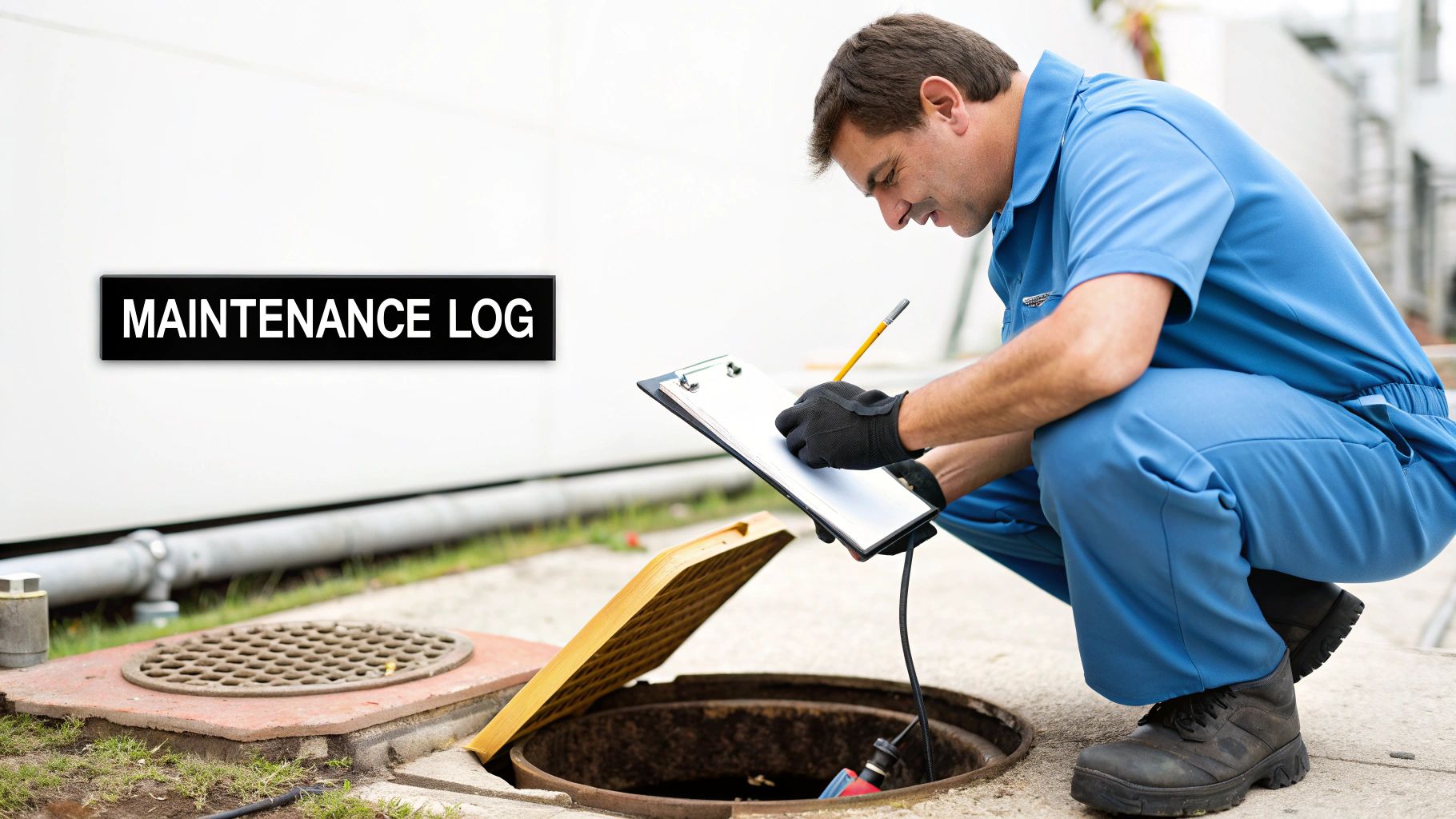
So how do you track the 25% rule and prove you're doing your part during a health inspection? A simple maintenance log. It doesn’t have to be fancy; a clipboard with a log sheet or a basic spreadsheet works perfectly.
For every service, make sure your log tracks these key details:
- Date of Service: When was it cleaned?
- Service Provider: The name and contact info for the pumping company.
- Condition of the Trap: How full was it? Ask the technician for the percentage of FOG and solids.
- Volume Removed: The total gallons of waste pumped out.
- Next Scheduled Service: A projected date for the next cleaning based on how full it was this time.
This simple piece of paper is your best friend during an inspection and a vital tool for managing your kitchen. Beyond just getting the work done, understanding the ongoing cost of grease trap cleaning is crucial for your budget. A well-kept log helps you predict these expenses so they don't come as a surprise. Consistent upkeep is always cheaper than dealing with the fallout from neglect.
Common Questions About Grease Trap Sizing
Even after you've run the numbers, a few lingering questions are perfectly normal. The world of grease traps is filled with tricky scenarios and technical fine print that can trip up even seasoned professionals.
We've pulled together some of the most common questions we hear from chefs and restaurant managers about sizing, compliance, and day-to-day maintenance. Getting these sorted out now will help you move forward with confidence and sidestep some simple but expensive mistakes.
Does My Dishwasher Need To Be Part Of The Sizing Calculation?
Absolutely, but you have to handle it with care. High-temperature commercial dishwashers are notorious for melting grease, which lets it sail right through a trap. The problem is, that liquefied grease just cools and hardens further down the sewer line, creating the exact kind of stubborn blockage you’re trying to prevent.
Because of this, most local codes have very specific rules for dishwashers. You’ll often find requirements like:
- Mandating a separate, dedicated grease trap just for the dishwasher.
- Requiring the dishwasher to connect to the main interceptor via a long pipe run. This gives the super-hot water a chance to cool down, allowing the grease to separate properly before it even hits the interceptor.
Never just assume you can tie your dishwasher into the main system. Double-check with your local plumbing authority first—it’s a crucial step to avoid major headaches later.
What's The Real Difference Between A Grease Trap And An Interceptor?
While people often use the terms interchangeably, your local plumbing code makes a very clear distinction based on size, capacity, and where it’s installed. Knowing the difference is critical for passing inspections.
A grease trap is what you picture inside the kitchen. It’s a smaller unit, often called a hydromechanical grease interceptor (HGI), that typically sits under a 3-compartment sink. These are designed to handle flow rates of less than 100 GPM.
A grease interceptor, on the other hand, is the big kahuna. These are usually massive gravity grease interceptors (GGIs) holding 500 gallons or more. Thanks to their size, they are almost always buried underground outside the building, serving the entire kitchen's drainage network. The flow rate you calculated, along with local rules, will point you to which one you need.
How Often Does My Grease Trap Need To Be Pumped?
The industry standard is known as the “25% rule.” It’s a simple guideline: once the top layer of grease (FOG) and the bottom layer of solids take up 25% of the trap’s total volume, it’s time for a cleanout.
If you're waiting until you smell something funky or see your sinks draining slowly, you've waited too long. At that point, the trap is no longer working efficiently, and you're running a serious risk of a backup or a health code violation.
How often you hit that 25% mark really depends on your menu and volume. A bustling fryer-heavy restaurant might need a pump-out every month, while a small coffee shop might only need it quarterly. The key is to keep a detailed service log to track your schedule and prove you’re staying compliant.
Can I Just Install A Grease Trap Myself To Save Some Money?
Please don't. Trying to DIY a grease trap installation is one of the biggest and costliest mistakes a business owner can make. This isn't a simple plumbing job; it’s governed by a web of strict health and building codes that require a professional’s touch.
A botched installation almost always leads to a disaster, including:
- Persistent Leaks: Improper seals will let wastewater seep out, creating a nasty, unsanitary mess.
- Foul Odors: Incorrect venting is a classic DIY error that allows sewer gas to flood your kitchen.
- Failed Inspections: An inspector will spot a non-compliant install from a mile away, forcing you to rip it all out and pay a licensed plumber to do it right.
Always bring in a licensed commercial plumber who knows your local FOG ordinances inside and out. The money you think you’re saving upfront is nothing compared to the cost of fixing a failed job and the operational downtime that comes with it.
Working through the details of grease trap sizing and compliance is a vital part of building a successful kitchen from the ground up. To discover the latest news, exclusive deals, and expert advice on restaurant equipment and supplies, the team at Encore Seattle Restaurant Equipment is ready to help. Take a look at our wide selection of commercial kitchen solutions at https://encoreseattle.com to make sure your operation is set up for success.