
Your Guide to the Best countertop convection oven commercial
A commercial countertop convection oven isn't just a smaller oven; it's a powerhouse designed to cook food faster and more evenly than its conventional cousins. The secret? An internal fan that constantly circulates hot air. For anyone running a restaurant, food truck, or busy café, this is the key to maximizing kitchen output without eating up precious floor space.
Stay informed about the latest industry trends, exclusive deals, and expert insights on restaurant equipment and supplies. Discover how the right gear can elevate your culinary operations and boost your bottom line.
The Secret Weapon for Compact Commercial Kitchens
In any professional kitchen, counter space is gold. You're constantly juggling the need for speed, quality, and cost control, which means every single piece of equipment has to earn its keep. This is where a commercial countertop convection oven truly shines, turning a small patch of stainless steel into a high-octane production hub.
Think of it as the ultimate kitchen multi-tool. It’s not just a scaled-down floor model; it's a piece of strategic equipment built for pure efficiency. By keeping that hot air moving, it wipes out the hot and cold spots that plague traditional ovens. The result? Everything from delicate pastries to roasted root vegetables gets cooked to perfection, every single time. That kind of consistency is what builds a great reputation.
Why This Oven Is a Kitchen Essential
At its heart, this oven delivers powerful, even cooking that has a direct, positive impact on your bottom line. It’s a smart investment in efficiency that pays for itself with every service. For chefs and owners, this means real-world advantages that can completely change a kitchen’s rhythm.
Here’s what you stand to gain:
- Serious Speed: Convection cooking can slash cooking times by up to 25%. That means turning tickets faster and getting more customers served during the dinner rush.
- Rock-Solid Consistency: The fan-forced heat gives you uniform results across every rack. No more shuffling pans around. Your team can focus on other prep instead.
- Menu Flexibility: These ovens are true workhorses. They're brilliant for baking, roasting, toasting, reheating, and putting the finishing touch on dishes, opening up a world of menu possibilities.
- A Boost to Your Bottom Line: Faster cooking at lower temperatures means smaller utility bills. Plus, consistent results cut down on food waste and keep happy customers coming back for more.
Whether you're a bustling café, a food truck where every inch counts, or a bar looking to serve great food, this oven is more than just an appliance. It's a direct route to higher output, better food, and healthier profits.
At the end of the day, picking the right commercial countertop convection oven can be one of the smartest moves you make for your business. In this guide, we'll dive into how these machines work, what to look for when you're buying, and how to get one set up in your kitchen to start reaping the benefits.
How Convection Ovens Actually Cook Your Food
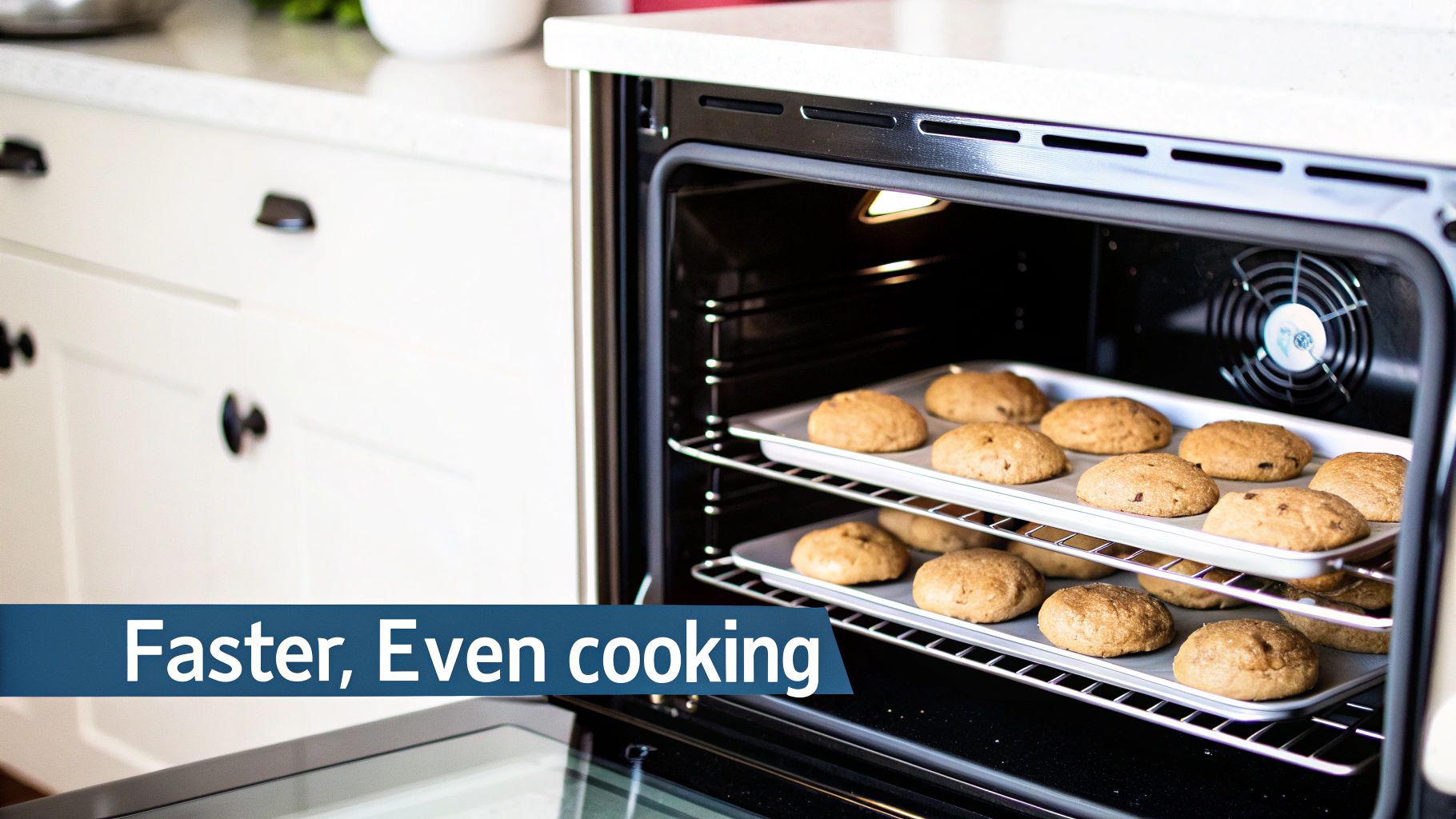
To really get what makes a countertop convection oven commercial unit so special, let's think about it this way. A regular oven is like a calm, sunny day. The heat just kind of sits there, radiating from the heating elements. This creates hot and cool spots all over the inside.
Now, imagine a windy day. That’s a convection oven. It has a fan inside that gets the hot air moving, blowing it all around the oven cavity. It’s simple, but it changes everything.
This constant air circulation is the secret sauce. Instead of just letting heat passively surround your food, the oven actively blasts it with hot air. This gets rid of those temperature fluctuations you see in standard ovens, giving you one consistent temperature from top to bottom, front to back.
That active heat circulation is what leads to better food, faster service, and a much smoother kitchen operation. For a deeper dive into the mechanics, check out our guide on what is a convection oven.
The Real-World Results
The magic of convection all comes down to heat transfer. The moving air literally strips away the little pocket of cooler air that hangs around the surface of your food. This lets the heat penetrate faster and more evenly, which you'll see on the plate.
- Faster Cook Times: By delivering that constant blast of heat, a convection oven can slash cooking times by up to 25%. That means quicker ticket times when you're slammed and more food out the door.
- Superior Browning and Crisping: That consistent, dry heat is exactly what you need for a perfect Maillard reaction. It's the key to getting that savory crust on roasted meats and a beautiful golden-brown finish on your baked goods.
- Incredibly Consistent Results: Since the heat is the same everywhere, everything on every rack cooks at the same speed. No more having to remember to spin your pans halfway through the cook time.
A countertop convection oven doesn't just heat food—it finishes it. That circulating air is what creates crispy chicken skin, helps pastries puff up perfectly, and gives you consistently roasted vegetables, every single time.
More Than Just Good Food
Beyond the quality of the food, the efficiency of a countertop convection oven commercial unit directly impacts your bottom line. Since they cook faster, they don't have to run for as long. You can often even set them to a lower temperature, which adds up to real energy savings over time.
This push for efficiency is a huge deal in commercial kitchens right now. Operators are looking for any edge they can get to lower utility bills without compromising on performance. It's no surprise that the market for these ovens is expected to jump from USD 1.974 billion in 2025 to USD 3.5 billion by 2035, all driven by the need for smarter, cost-effective equipment.
In fact, modern convection models often use 20-30% less energy than their conventional counterparts, thanks to things like better insulation and smarter airflow design.
At the end of the day, bringing convection technology into your kitchen isn't just about a new appliance. It’s an investment in consistency, speed, and quality. It’s about giving your team the right tool to do their best work while keeping a close eye on your operating costs.
Choosing Your Commercial Countertop Convection Oven
Picking the right countertop convection oven commercial model is one of those decisions that will quietly shape your kitchen's daily rhythm. Get it right, and you’ll see smoother service, better food quality, and a healthier bottom line. But with so many options out there, it's easy to get bogged down in spec sheets.
Let's cut through the noise. Think of this like buying a work truck—you wouldn't get a small pickup to haul heavy lumber, and you wouldn't buy a semi-truck for a few local deliveries. The same logic applies here. A bustling bakery's needs are worlds apart from a food truck that just needs to toast sandwiches.
This guide will walk you through the key features to look for so you can invest in an oven that’s a perfect fit for your operation.
Capacity And Pan Size
The first, most practical question to ask is simple: "How much food do we need to cook at once?" An oven's capacity is all about the number and size of sheet pans it can hold. The most common sizes you'll encounter are full-size (18"x26"), half-size (18"x13"), and quarter-size (9.5"x13").
- Quarter-Size Ovens: These are the compact players. Perfect for low-volume tasks like a bar kitchen warming up appetizers or a small coffee shop baking a handful of fresh scones.
- Half-Size Ovens: This is the sweet spot for most businesses and the most popular size for a countertop convection oven commercial unit. They offer a fantastic balance of a small footprint with serious output, making them a go-to for cafes, delis, and just about any quick-service spot.
- Full-Size Ovens: You don't see these as often in countertop models because of their size, but some specialized units can handle them. They're built for kitchens with high-volume baking needs that simply don't have the floor space for a full-sized oven.
Here’s a pro tip: Before you even start browsing, grab a tape measure. Measure the pans you use most often and then calculate how many you need to get through your busiest hour. An oven that’s too small will become an instant bottleneck, while one that’s too big is just a waste of energy and precious counter space.
Control Types Manual Versus Digital
How you "talk" to your oven directly impacts the consistency of your food. The choice between old-school manual dials and modern digital controls really comes down to a trade-off between rugged simplicity and foolproof precision.
Manual (Dial) Controls: These are the classic knobs for temperature and time. They're dead simple to use, incredibly durable, and usually cheaper to buy and fix. The downside? They don't offer the exact temperature accuracy of their digital counterparts, which can be an issue for more delicate baking.
Digital Controls: These give you pinpoint accuracy with electronic touchpads. The real magic, though, is in the ability to save programmable recipes. This feature is a game-changer for consistency, ensuring any staff member—from the head chef to a brand new hire—can produce the exact same result with the touch of a button. It's a lifesaver for businesses with multiple locations or high staff turnover.
Power Source Electric Versus Gas
Your decision here will likely be guided by what your kitchen is already set up for, but it's worth weighing the pros and cons of each. Electric and gas ovens cook differently and excel at different things.
It’s no surprise these ovens are becoming staples in modern kitchens. The commercial countertop convection oven market is expected to jump from USD 2.51 billion to USD 3.5 billion by 2035, thanks largely to the boom in quick-service restaurants and cafes. According to market analysis from resources like Wise Guy Reports, electric models are leading the charge in energy efficiency, while gas remains the champion for raw heating power—both critical factors in a fast-paced kitchen.
So, which one is right for you? Let's compare them side-by-side.
Feature Comparison For Electric vs Gas Countertop Convection Ovens
This table breaks down the key differences to help you decide which fuel type makes the most sense for your menu, kitchen setup, and budget.
| Feature | Electric Convection Oven | Gas Convection Oven |
|---|---|---|
| Heat Consistency | Excellent. Delivers a dry, even heat that's perfect for baking. | Very good, but the flame can introduce a bit of moisture. |
| Installation | Simple. Just plug it into the appropriate electrical outlet. | More complex. Requires a professional to connect a dedicated gas line. |
| Preheat Time | A bit slower to get up to temperature. | Super fast. Heats up in a flash for on-demand cooking. |
| Operating Cost | Varies widely based on local electricity rates. | Often cheaper to run, especially in areas with low natural gas prices. |
| Best For | Bakeries, cafes, and any operation that needs precise temperature control. | Restaurants that do a lot of roasting or need rapid heating for high volume. |
In the end, the best countertop convection oven commercial unit is the one that fits your space, matches your team's skills, and, most importantly, helps you execute your menu flawlessly. If you take the time to think through these core features—capacity, controls, and power—you’ll be sure to pick an oven that becomes a true workhorse in your kitchen.
Sizing and Throughput: Getting the Most Out of Your Oven
Choosing the right size for a commercial countertop convection oven is about more than just finding a spot for it. It's a critical business decision that directly impacts your kitchen's workflow and, ultimately, your bottom line. An oven that’s too small will quickly become a bottleneck during a lunch rush, leaving customers waiting and staff frustrated. On the flip side, an oversized unit is just an energy hog, wasting electricity and taking up valuable counter real estate.
The sweet spot is an oven that perfectly matches your production needs. You have to figure out your throughput—basically, how much food you need to cook and sell per hour to keep things moving smoothly. Getting this right turns the oven from a simple purchase into a profit-generating machine.
This quick planning guide breaks down the essential steps. It’s not about the price tag yet; it’s about the practicalities of space, power, and controls that will make or break your investment.
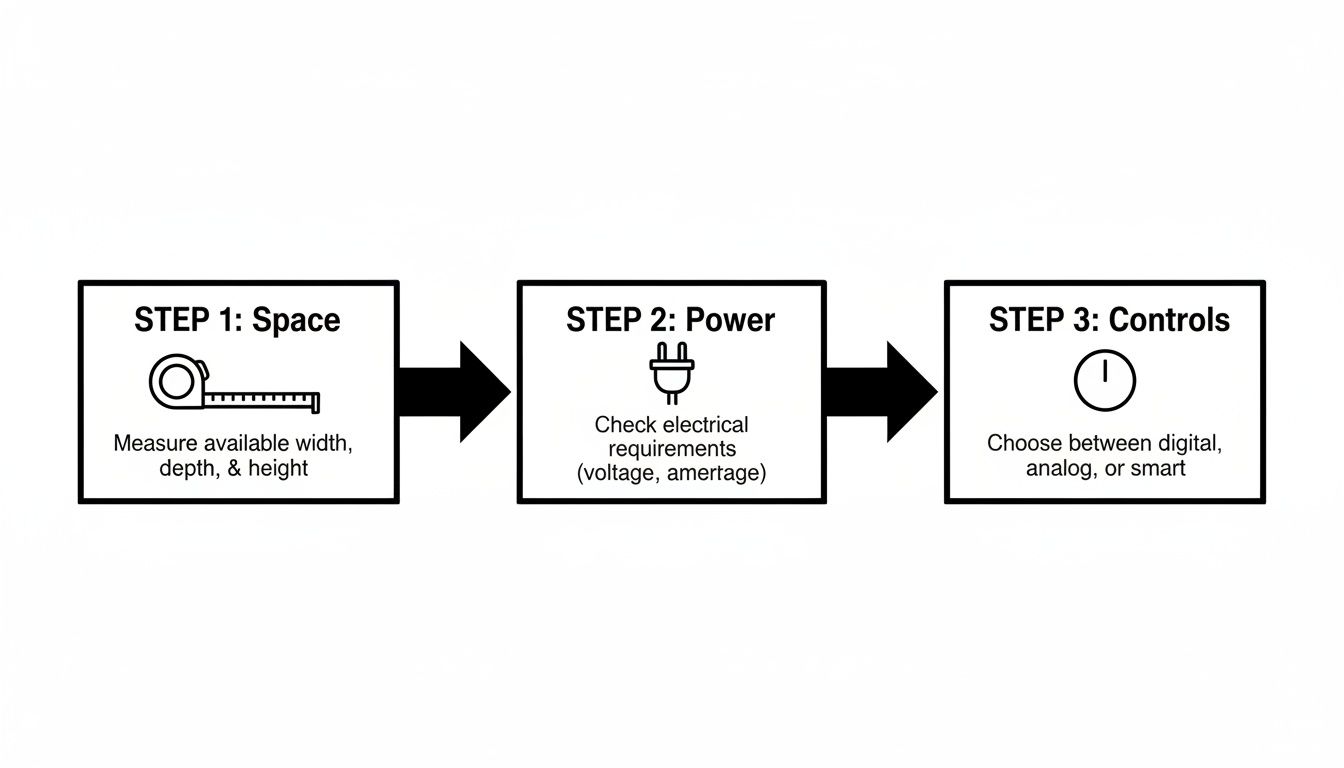
Nailing these three fundamentals—space, power, and ease of use—is the first step to making a smart purchase.
How to Calculate Your Throughput Needs
Before you even look at oven specs, look at your own operation. What are you going to cook in this thing? Pull up your sales data and pinpoint the menu items you’ll rely on it for. Then, figure out your peak hourly demand for those items. That number is your target.
Let’s walk through a real-world example for a café that needs to bake croissants.
- What Fits on a Pan? A standard half-size sheet pan (18"x13") can comfortably hold about 12 croissants.
- How Many Pans Fit in the Oven? A typical half-size countertop convection oven can accommodate 4 half-size pans. So, you can bake 48 croissants (12 per pan x 4 pans) in one go.
- How Long Does It Take? Thanks to that convection fan, a batch will take about 20 minutes to bake to golden-brown perfection.
- What's the Hourly Output? Since there are 60 minutes in an hour, you can run 3 full batches through the oven (60 min / 20 min).
So, what’s the final count? You can produce 144 croissants per hour (48 croissants per batch x 3 batches). If your morning rush tops out at around 100-120 croissants sold, this oven is your workhorse. If you're selling more than that, you'll either need a second unit or a larger full-size model to keep up.
When you connect the oven's capacity directly to your hourly sales potential, the appliance stops being an expense. It becomes a revenue-generating asset that actively supports your business instead of holding it back.
Matching the Oven to Your Menu
It’s rarely just one item, right? The variety on your menu adds another layer to this decision. A pizzeria that needs to blast pies with high heat and recover quickly between orders has totally different needs than a bakery that requires gentle, even heat for long bakes.
- For high-turnover foods like toasted sandwiches or personal pizzas, look for ovens that preheat in a flash and have excellent heat recovery. Here, speed per item is more important than the total batch size.
- For batch cooking like roasted vegetables or baked goods, capacity is everything. The number of pans you can load at once is what will dictate your hourly output.
- For a mixed menu, where your commercial countertop convection oven will be a jack-of-all-trades, programmable controls are a lifesaver. You can pre-set recipes for different items, which guarantees consistency and makes it easy for any staff member to get it right every time.
In the end, sizing your oven is a strategic move. By digging into your menu, analyzing your busiest hours, and thinking through your kitchen's flow, you can pick a machine that doesn’t just fit your counter—it fuels your profitability from day one.
Installation, Ventilation, and Safety Compliance
Getting your new countertop convection oven set up correctly is about more than just finding a spot and plugging it in. This is where you lay the groundwork for a safe, efficient, and compliant kitchen. Skipping these steps can lead to everything from poor cooking performance to serious safety hazards and even fines from the health inspector. Let’s get it right from the start to protect your investment, your staff, and your business.
First things first: the foundation. Your counter needs to be perfectly level and strong enough to support the oven's full weight, especially when it's loaded up with heavy hotel pans. A wobbly or uneven surface is a recipe for disaster—it can cause uneven baking and create a dangerous tipping risk.
Next, give it some breathing room. These ovens kick out a lot of heat, and they need proper airflow to keep from overheating. A good rule of thumb is to leave at least 4-6 inches of clear space on all sides (top, back, and sides) unless the manufacturer’s guide says something different. This buffer zone keeps nearby walls and equipment safe from heat damage and helps the oven’s internal components last longer.
Understanding Electrical and Power Needs
The power requirements for a commercial oven are non-negotiable. Before you even buy a unit, you have to confirm its voltage and amperage and make sure your kitchen's electrical system can handle the load. Most commercial models need a dedicated 208/240V outlet, which is a lot more powerful than your standard wall socket.
- Check the Spec Sheet: Always start with the manufacturer's specification sheet. It will tell you the exact electrical needs.
- Consult an Electrician: If you have any doubt about your kitchen's wiring, bring in a licensed electrician. They can inspect your setup and install the right outlet if needed.
- Avoid Extension Cords: Never, ever use a standard extension cord for a high-draw appliance like this. It’s a major fire hazard.
A common mistake is thinking any old outlet will work. Plugging a powerful oven into an inadequate circuit can cause tripped breakers during a busy rush, fry the oven's electronics, and instantly void your warranty.
Ventilation: The Most Overlooked Requirement
One of the most critical, and often confusing, parts of installation is ventilation. So, does a commercial countertop convection oven need a vent hood? The short answer is: it depends. The final say comes down to your local health codes, whether the oven is gas or electric (gas models almost always need a hood), and what you plan on cooking.
If you’re just baking simple pastries or bread, some jurisdictions might not require a hood. But the moment you start roasting meats or cooking anything that creates grease-laden vapors, a Type I hood usually becomes mandatory. It's essential for maintaining air quality and preventing fires. Ventilation is a huge topic, so be sure to check our detailed guide on commercial kitchen ventilation requirements to make sure you're compliant.
There’s no denying how vital these compact powerhouses are. Countertop convection ovens have become indispensable in tight kitchens, driving 74.9% of countertop oven revenue as more small restaurants, food trucks, and catering businesses open up. They deliver the power of a full-size oven without eating up precious floor space. But unlocking their true value means meeting all the necessary compliance and safety standards from day one.
Maintenance Tips To Extend Your Oven's Lifespan
Think of your commercial countertop convection oven as a long-term investment and a daily workhorse. To protect that investment, all it takes is a simple but consistent maintenance routine. Sticking to a basic schedule will help you sidestep unexpected breakdowns, keep your food safe, and get the most life out of your equipment.
Trust me, a proactive approach to maintenance is always cheaper than a reactive one. Putting together a clear daily, weekly, and monthly checklist takes the guesswork out of the equation and helps your team stay on top of the essentials. This simple habit is the best way to prevent costly downtime right in the middle of a busy service.
Daily Cleaning And Checks
These tasks should become second nature at the end of every shift. They only take a few minutes, but they're crucial for preventing the buildup of grease and food debris that can hurt performance and even create a fire hazard.
- Wipe Down the Interior: Once the oven is completely cool, wipe down all the inside surfaces with a soft cloth and a mild, food-safe degreaser.
- Clean the Door Gasket: Carefully wipe the rubber door seal to get rid of any crumbs or residue. A clean gasket is key for a tight seal, which locks in heat and keeps cooking temperatures consistent.
- Remove and Soak Racks: Pull out the wire racks and let them soak in warm, soapy water. This will dissolve any stubborn, baked-on grease without a fight.
Weekly And Monthly Maintenance Tasks
Set aside a little extra time each week and month to tackle issues before they turn into real problems. These deeper cleans and quick inspections will keep your oven running at peak efficiency.
Weekly Tasks:
- Thorough Interior Scrub: Give the oven's interior a more detailed cleaning. Pay close attention to the corners where grease loves to hide.
- Inspect the Fan: Make sure the convection fan is clear of any obstructions. If it's blocked, it can't circulate air properly, and you'll end up with unevenly cooked food.
- Check Door Hinge and Latch: Open and close the door a few times. Does it move smoothly? Does it latch securely? A misaligned door can leak a surprising amount of heat.
A well-maintained oven is an efficient oven. Regular checks on components like door gaskets and fans can prevent energy waste, which directly translates to lower utility bills each month.
Monthly Tasks:
- Calibrate the Thermostat: Pop an oven thermometer inside and see if the set temperature matches the actual internal temperature. If it’s off by more than a few degrees, you might need to call in a pro for recalibration.
- Inspect Power Cords: Look over the power cord and plug for any signs of fraying or damage. Safety first.
Routine maintenance is a non-negotiable for extending the life of any appliance in a commercial kitchen. You can learn more about the general principles of commercial appliance servicing to keep all your equipment in top shape. For more specific strategies, check out our comprehensive guide on commercial kitchen equipment maintenance.
Frequently Asked Questions
When you're outfitting a commercial kitchen, you're bound to have questions. You want to be sure the equipment you choose is the right fit for your menu, your space, and your team. Below, we’ve tackled some of the most common questions we hear from chefs and kitchen managers about commercial countertop convection ovens.
We've gathered the real-world concerns operators face and provided straightforward advice to help you invest with confidence.
Can I Bake Delicate Items Like Pastries In A Countertop Convection Oven?
Absolutely. This is a common worry, but modern commercial countertop convection ovens are engineered for exactly this kind of precision. The best models come with adjustable fan speeds or even a "no-fan" bake mode. This feature is a lifesaver for delicate items like macarons, meringues, or soufflés that would otherwise collapse under the force of the circulating air.
The trick is to start with a great oven and then make a few small tweaks to your recipes. As a general rule, try reducing the recommended baking temperature by about 25°F (15°C) and shaving a bit off the total baking time. This simple adjustment compensates for the powerful efficiency of convection heat, giving you that perfect, even, golden-brown finish without sacrificing texture.
What Is The Difference Between A Countertop Convection Oven And A Combi Oven?
While they might look similar, they are fundamentally different tools designed for different jobs.
A countertop convection oven is a specialist in dry heat cooking. It uses a fan to move hot air around, which makes it an absolute champion for roasting, baking, and broiling things faster. Its main purpose is to produce crispy skins and beautifully browned food with incredible efficiency.
A combi oven, on the other hand, is a far more versatile and complex machine. It bundles three cooking methods into one powerful unit:
- Convection (dry heat)
- Steam (moist heat)
- A combination of both
This flexibility opens up a much wider world of cooking techniques—everything from steaming vegetables and poaching fish to proofing bread. For kitchens that are primarily focused on baking, roasting, and finishing dishes, a convection oven is the smart, cost-effective workhorse. A combi oven is a bigger investment, best suited for kitchens needing an all-in-one solution to execute a highly diverse menu.
Think of it this way: a convection oven perfects dry-heat cooking, while a combi oven is a multi-tool designed to replace several other pieces of equipment.
How Much Clearance Do I Need Around The Oven For Safe Operation?
This is a critical detail you can’t afford to overlook. The exact requirements will be in the manufacturer's spec sheet, but a solid rule of thumb is to leave at least 4 to 6 inches of clearance on all sides of the unit—top, back, and both sides.
This empty space serves two crucial purposes. First, it ensures proper ventilation so the oven doesn't overheat and its components can work efficiently. Second, it creates a vital safety buffer that protects your walls, counters, and other equipment from potential heat damage.
Always, always check the manufacturer’s guide for your specific model before you install it. Following their guidelines isn't just about safety; it’s also required to keep your warranty intact.
Are Electric Or Gas Models More Energy Efficient?
In general, electric countertop convection ovens tend to be more energy-efficient. They usually have better insulation and deliver more precise, even heat, meaning less energy is wasted trying to hold the right temperature. Electric models are also much simpler and cheaper to install since you don't need to run a dedicated gas line.
But that’s not the whole story. Gas models heat up significantly faster and can have lower daily operating costs if your local natural gas prices are much cheaper than electricity. The right choice really comes down to your utility costs, your kitchen’s existing setup, and what you’re cooking.
If you need pinpoint temperature accuracy and want to prioritize long-term energy savings, an electric model is probably your best bet. If your kitchen thrives on high turnover and needs an oven that gets up to temp in a flash, a gas countertop convection oven is a very strong contender.
Ready to find the perfect countertop convection oven to boost your kitchen's efficiency? At Encore Seattle, we offer a wide selection of top-tier new and used equipment to fit any budget or operational need. Explore our inventory and get expert advice to find the ideal solution for your business.
Visit us online to see our collection at https://encoreseattle.com.