
Finding the Best Commercial Refrigerator for Your Business
Picking the right commercial refrigerator isn't just about what's "best" on the market—it's about finding the perfect fit for your kitchen's unique rhythm. For a busy restaurant, that might be a tough-as-nails reach-in unit that can handle the constant open-and-close of a dinner rush. For a compact café, it could be a sleek undercounter model that maximizes every square inch of space.
Your choice is a big deal. It's about protecting your inventory, keeping your food safe, and making sure your team can work smoothly and efficiently. We're here to help you discover the latest news and exclusive deals on restaurant equipment, ensuring you stay informed about industry trends and find the best supplies for your needs.
Your Commercial Refrigerator Is the Heart of Your Kitchen
Let’s be honest: a commercial refrigerator is one of the most important investments you'll make for your food business. It's the silent workhorse in the back-of-house, running 24/7 to protect thousands of dollars worth of ingredients.
Get it wrong, and you're looking at spoiled food, inconsistent temperatures, and a chaotic kitchen. But get it right, and that refrigerator becomes your most reliable partner, quietly ensuring quality and consistency day in and day out.
This guide will cut through the noise and technical specs to give you practical, straightforward advice. Whether you're opening your first restaurant, upgrading your café's equipment, or designing a food truck kitchen, we'll walk you through everything you need to know. We’ll cover the different models, how to figure out the right size, and what all those energy efficiency ratings really mean for your electric bill, keeping you informed on the latest industry trends.
What This Guide Will Cover
We've structured this guide to give you the confidence to choose the right unit for your budget and your business. Here’s a quick look at what we’ll dive into:
- The Main Types of Refrigerators: We’ll break down the pros and cons of everything from massive walk-in coolers to small bar fridges.
- Getting the Size and Capacity Right: Learn how to measure your space and estimate your storage needs so you don't end up with a unit that's too big or too small.
- Efficiency, Costs, and Your Bottom Line: We'll show you how choosing an ENERGY STAR-certified model can seriously slash your operating costs over time.
- Built to Last (And How to Pay for It): We'll look at what makes a refrigerator durable and explore smart financing options from Encore Seattle that put top-quality equipment within reach.
Remember, this investment is about more than just keeping things cold. To keep that investment running perfectly for years, it’s crucial to maintain it. Following a professional guide to cleaning commercial kitchens will help ensure your entire operation stays up to code and in top shape.
Understanding Commercial Refrigerator Types
Let’s get one thing straight: there’s no single “best” commercial refrigerator. The right choice for your kitchen is a direct reflection of your menu, your workflow, and the space you have to work with. Think of your refrigeration as a specialized team—each player has a specific job. You’ve got your daily workhorse, the reach-in, and your bulk storage MVP, the walk-in cooler. Matching the unit to the task is the first real step toward a smarter, more efficient kitchen.
This flowchart helps visualize the decision-making process. It all comes down to balancing the type of unit you need, its size, and what fits your budget.
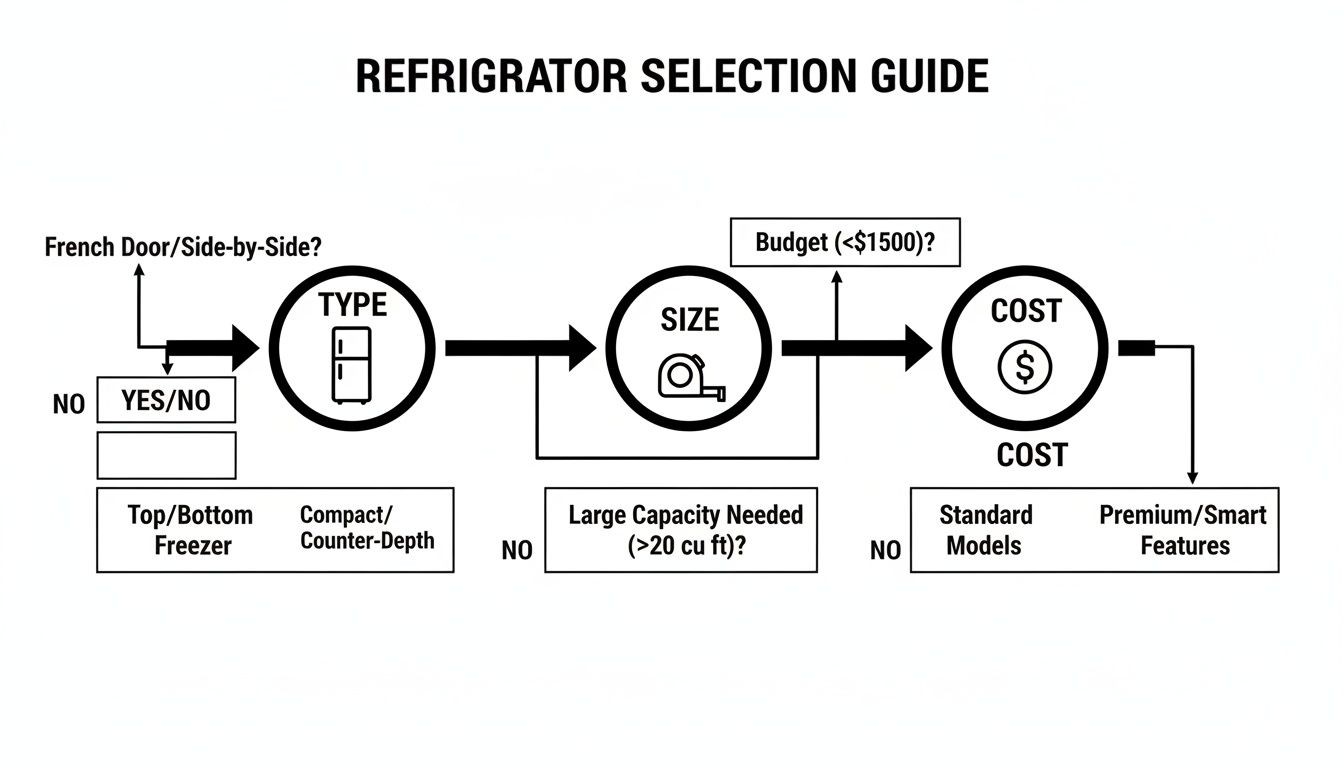
As you can see, your choice isn't just about picking a fridge; it's a strategic decision based on function, space, and cost.
Let's break down the four main categories of commercial refrigeration to find the perfect fit for your business.
H3: Reach-In Refrigerators And Freezers
The reach-in is the absolute workhorse of nearly every professional kitchen. You’ll see these upright units everywhere, and for good reason. They’re designed for constant, heavy use, keeping your high-turnover ingredients right where you need them—at arm's length from the prep line. They come in one, two, or three-door models, so you can scale up based on how busy you are.
Imagine a packed restaurant during the dinner rush. A three-door reach-in right off the main line, stocked with prepped veggies, sauces, and proteins, is a game-changer. It means your chefs aren't wasting precious seconds trekking to a back storeroom, which directly translates to faster ticket times.
The real beauty of a reach-in is its sheer versatility. You can stick one almost anywhere to create an instant cold storage station, smoothing out your workflow and crushing those service bottlenecks during peak hours.
H3: Undercounter And Worktop Units
When every square inch of your kitchen counts, undercounter and worktop refrigerators are brilliant. These compact units tuck right under your counters, putting cold storage exactly where it’s needed most. This simple change means your staff takes fewer steps, keeping the entire kitchen flowing smoothly. A bar is a perfect example—they rely on these to keep garnishes, mixers, and cold drinks right at the bartender's fingertips.
Worktop models push that efficiency even further by adding a durable stainless steel surface for prep work. This two-in-one functionality is a lifesaver for sandwich shops or cafés. Your team can build an order on the worktop while pulling ingredients from the refrigerated drawers or doors directly below.
H3: Refrigerated Prep Tables
Refrigerated prep tables are the undisputed champions of the assembly line. If you've ever seen a high-volume pizzeria or a crazy-busy sandwich shop in action, you've seen one of these powerhouses at work. The top is lined with cooled pans holding every ingredient imaginable, while the base provides refrigerated cabinet or drawer space for backups.
This design is all about speed and food safety. By keeping everything from lettuce and tomatoes to pepperoni and cheese at a consistent, safe temperature, your staff can assemble complex orders in record time without ever compromising quality. The right size—usually measured by how many pans it holds—is dictated entirely by how complex your menu is.
H3: Walk-In Coolers And Freezers
For any high-volume operation like a large restaurant, catering business, or school cafeteria, a walk-in cooler isn't a luxury; it's a necessity. These are essentially refrigerated rooms built for maximum storage capacity. This is where you'll keep cases of produce, bulk proteins, and large vats of stock—it's the central nervous system of your inventory.
Yes, they take up a lot of space and cost more upfront, but the organizational payoff is huge. You can install custom shelving to create a logical system, making inventory checks and food rotation a breeze. A well-organized walk-in means you can accept large deliveries and prep for a slammed weekend without ever worrying about running out of key ingredients.
To help you see how these different types stack up, here’s a quick-glance table. It’s a simple way to connect the right piece of equipment to the right kind of business.
Commercial Refrigerator Types at a Glance
| Refrigerator Type | Best For | Common Size Range | Ideal Business Type |
|---|---|---|---|
| Reach-In | Frequent access to daily ingredients | 23-85 cubic feet (1-3 doors) | Restaurants, Cafés, Bars |
| Undercounter | Point-of-use storage in tight spaces | 2-12 cubic feet | Bars, Coffee Shops, Food Trucks |
| Prep Table | High-speed food assembly | 48"-93" wide (8-24 pans) | Pizzerias, Sandwich Shops, Salad Bars |
| Walk-In | Bulk ingredient and inventory storage | 6'x6' and up | Large Restaurants, Caterers, Hotels |
Choosing the right type is the foundation. Once you know whether you need a reach-in, a prep table, or something else, you can start digging into the finer details like capacity and energy efficiency.
How to Calculate the Right Refrigerator Size and Capacity
Picking the right commercial refrigerator is a game of inches. Go too small, and you’re stuck with overstuffed shelves, food safety risks from poor airflow, and a daily game of inventory Tetris. Go too big, and you’re just wasting precious kitchen real estate and burning money on your energy bill.
Getting the size right isn’t just a suggestion—it’s fundamental to running a smooth, efficient kitchen. It’s all about hitting that sweet spot between your storage needs and your physical space.
Beyond Cubic Feet: Let Your Menu Be Your Guide
Sure, manufacturers list capacity in cubic feet, but that number is only half the story. The real secret to figuring out your needs is looking at your menu and how your kitchen actually operates. A common rule of thumb is to plan for 1.5 to 2 cubic feet of fridge space for every seat in your restaurant, but treat that as a starting line, not the finish.
Your menu is the biggest piece of the puzzle. A farm-to-table spot getting daily shipments of bulky produce needs something completely different than a steakhouse aging massive primal cuts of beef.
Think about these factors from your day-to-day operations:
- Delivery Frequency: If you’re getting deliveries multiple times a week, you can get by with less storage. But if your suppliers only show up once a week, you need the capacity to hold you over.
- Menu Complexity: The more fresh ingredients you juggle, the more organized, separate space you need to avoid cross-contamination and keep your prep line humming.
- Peak Volume: Always size for your busiest night. Plan for a packed Saturday service, not a slow Tuesday lunch, so you never run out of room when you need it most.
Real-World Scenarios: Sizing for Your Business Type
Let's put this into practice. Picture a high-volume bakery that specializes in cakes and pastries. For them, it’s not just about cubic feet; it’s about specific dimensions. They need shelves deep and wide enough to slide in a full-size sheet pan without it getting stuck. A standard reach-in might have the "right" volume, but if it can't fit their pans, it’s useless.
Now, think about a bustling sandwich shop. Their whole operation lives and dies by the refrigerated prep table. The most important number isn't overall capacity—it’s how many food pans fit in the top rail. That number directly dictates how many fresh toppings they can offer. The reach-in for backup supplies is important, but secondary to the prep table's design.
The right size isn’t just about how much you can cram inside. It’s about how the refrigerator's layout and dimensions actively support your kitchen's unique workflow. Always put function before raw numbers.
For a closer look at matching capacity to your kitchen’s demands, our guide on commercial refrigerator sizes breaks down the formulas and details even further.
The Pre-Purchase Checklist: Measure Twice, Buy Once
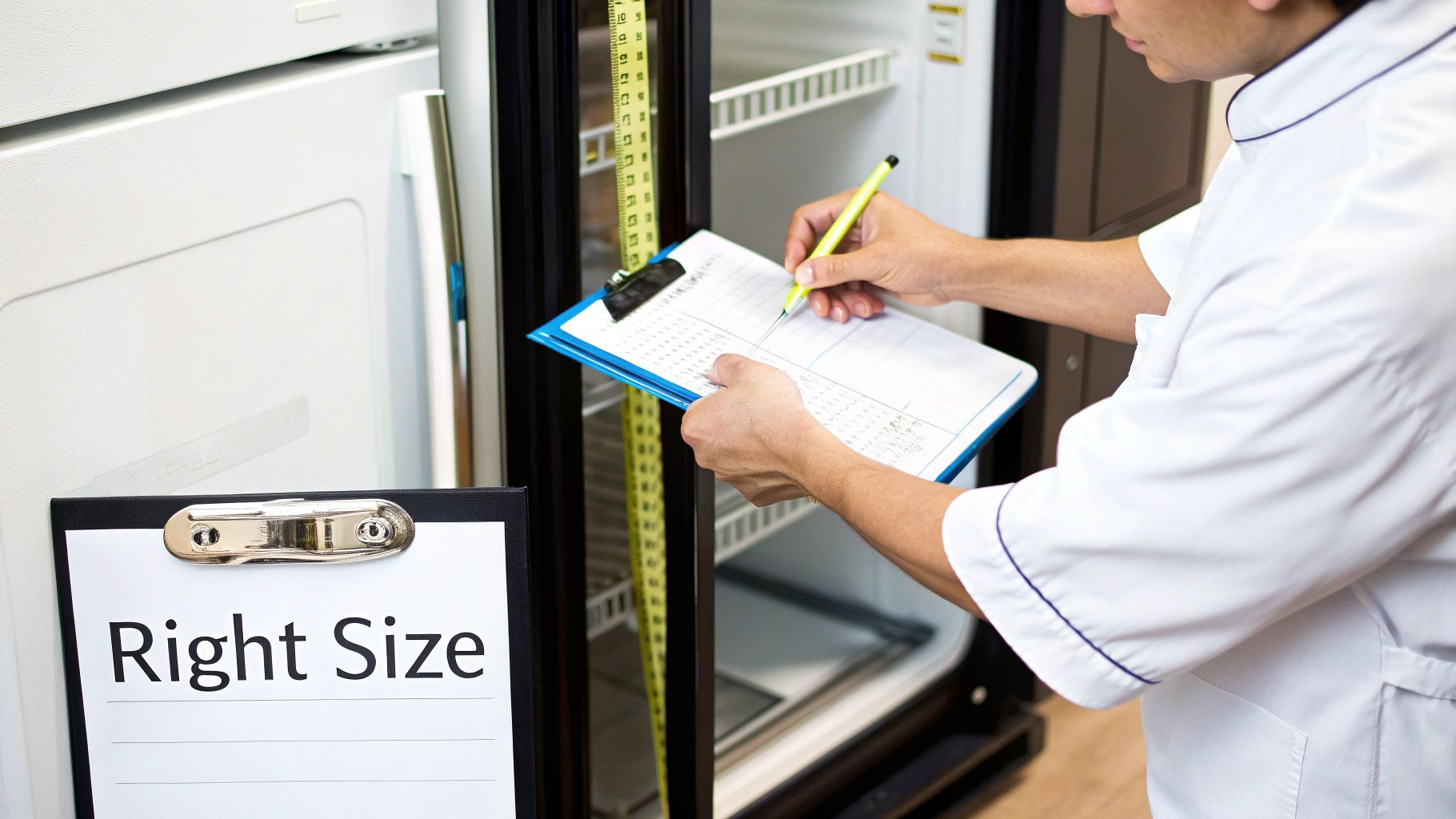
Before you even think about clicking "buy," grab a tape measure. One of the most expensive and easily avoidable mistakes is ordering a beautiful new fridge that can’t fit through the door. You need to measure every single entryway, hallway, and tight corner it has to pass through.
Make a quick checklist to dodge a delivery-day disaster:
- Measure the Path: Write down the height and width of every doorway, corridor, and stairwell from the loading dock to its final home in your kitchen.
- Check the Final Placement: Make sure you leave enough clearance for proper ventilation. Most units need at least 2-3 inches of breathing room on the sides and back for the condenser to work efficiently.
- Confirm Swing Direction: Will the doors open fully without blocking a busy walkway or slamming into another piece of equipment? This is a huge deal for both safety and workflow.
By taking the time to plan your space and match the unit’s capacity to how you actually cook, you can choose a commercial refrigerator that will be a reliable workhorse for years to come.
Decoding Energy Efficiency to Lower Operating Costs
Think of your commercial refrigerator as one of the hardest-working members of your kitchen staff. It runs 24/7, never takes a break, and as a result, it can be a huge drain on your monthly utility bill. Choosing the right unit isn't just about the sticker price; it's a long-term financial decision that can dramatically cut your operating expenses for years.
An old, inefficient refrigerator is like a car with a slow leak in the gas tank. Sure, it gets the job done, but it costs you more every single day. A modern, energy-efficient model is the hybrid version—it does the same essential work but with far less waste, leaving more cash in your pocket at the end of the month.
This push for efficiency is reshaping the entire industry. The global commercial refrigeration market, which hit USD 85.6 billion, is on track to reach a staggering USD 161 billion by 2034. Why the massive growth? Because businesses are demanding smarter, greener tech, especially when you consider that refrigeration can eat up nearly 40% of a supermarket's energy budget. Staying informed on these industry trends is key, and you can dive deeper into this commercial refrigeration market analysis.
Understanding ENERGY STAR and What It Means for You
When you see that ENERGY STAR label, it’s not just a nice-to-have sticker. It’s a guarantee from the U.S. Environmental Protection Agency (EPA) that the unit meets incredibly strict energy performance standards. On average, an ENERGY STAR certified refrigerator is 20-40% more efficient than a standard model.
That efficiency translates into real money. For a busy restaurant, swapping out just one solid-door reach-in for an ENERGY STAR model can save over $150 per year on electricity alone. The initial investment might be a bit higher, but you'll often see that money back quickly through lower utility bills.
An energy-efficient refrigerator isn't an expense; it's an investment that pays you back every month. The long-term savings on your utility bills often far outweigh the initial price difference compared to a less efficient model.
Key Features That Drive Savings
So what’s the secret sauce that makes a modern refrigerator so much more efficient? It boils down to a few key engineering upgrades that work together to slash energy waste. As you compare models, keep an eye out for these game-changing features.
These aren't just minor tweaks; they represent a huge leap forward in refrigeration technology, ensuring your unit works smarter, not harder.
- Advanced Compressor Technology: Modern variable-speed compressors are the heart of an efficient unit. Old compressors are either all on or all off, like a light switch. These new ones are like a dimmer, adjusting their power to match the cooling demand, which uses way less energy.
- High-Density Polyurethane Insulation: Better insulation simply means the fridge doesn't have to fight so hard to stay cold. This dense foam is injected into the walls and doors, creating a powerful thermal shield against the ambient heat of a hot kitchen.
- Self-Closing and Stay-Open Doors: Every time a refrigerator door is left ajar, cold air spills out, and the compressor has to kick into overdrive to cool things down again. Self-closing doors put an end to that waste, while a stay-open feature (usually locking at a 90-degree angle) makes stocking shelves much easier.
Making the switch to an efficient unit is one of the smartest financial moves a food business owner can make. To get a closer look at how these features add up to real savings, check out our guide on choosing energy-efficient commercial refrigerators and find a model that’s right for your operation.
Evaluating Durability, Warranties, and Smart Financing
A commercial refrigerator isn't just another piece of equipment; it's the workhorse of your kitchen. This is a long-term investment that has to survive the non-stop chaos of a professional culinary environment. When you’re picking the best commercial refrigerator, you need to think beyond its cooling power today and consider how it will hold up after years of hard service. That means taking a hard look at its construction, understanding the warranty, and exploring smart financing options that put top-tier equipment within reach.
Built to Withstand the Daily Grind
It all starts with the materials. Stainless steel is the industry standard for a reason, but not all stainless steel is the same. You'll want to look for lower-gauge steel, like 18- or 20-gauge, because a lower number means thicker, more durable metal that can take a beating without denting or corroding. Pay close attention to the parts that get the most abuse—doors, hinges, and shelves. These are the components that will fail first if they aren't built to last.
Beyond the grade of steel, here are a few other signs of a well-built unit:
- Welded Construction: A cabinet that’s fully welded is far more rigid and durable than one held together with screws or rivets that can loosen over time. It’s a sign of true craftsmanship.
- Heavy-Duty Shelving: The shelves need to be coated to prevent rust and strong enough to hold heavy stockpots or cases of produce without bowing. Check their weight rating.
- Quality Door Gaskets: A tight seal is everything. A good gasket keeps the cold air in and the warm air out, which takes a huge load off the compressor and saves you money.
Decoding Your Warranty Coverage
A solid warranty is the manufacturer's promise that they stand behind their product. It's your safety net, protecting you from the kind of unexpected, budget-busting repairs that can derail a business. Warranties can be tricky, though, so it's absolutely crucial to read the fine print.
A good warranty will clearly break down coverage into three key areas:
- Parts Coverage: This covers the physical components that might fail, like thermostats or fan motors. You should expect this to last for one to three years.
- Labor Coverage: This is what pays for the technician's time to come out and fix the problem. Look for at least one year of labor coverage.
- Compressor Coverage: The compressor is the heart of your refrigerator and by far the most expensive part to replace. A quality brand will offer a separate, extended warranty on the compressor—often for five years or more.
Think of a warranty as an insurance policy for your kitchen's most critical asset. A robust warranty that covers parts, labor, and the compressor signals a manufacturer's confidence in their equipment's durability and longevity.
Smart Financing to Power Your Growth
Getting the right equipment shouldn't mean wiping out your cash reserves. Smart financing is a powerful tool that lets you get the best refrigerator for your operation without a massive upfront payment. This frees up your capital for other essentials like inventory, marketing, and payroll, all while you get the benefits of brand-new, efficient equipment.
The demand for commercial refrigeration is a key industry trend. North America currently holds 34% of the global market share, and in the U.S. alone, the market reached USD 9.77 billion as more businesses upgrade to efficient, modern tech. Discover more insights about the commercial refrigeration market trends. This is where a model like Encore Seattle’s, which pairs great brands with flexible financing through The Restaurant Warehouse, really shines.
At Encore Seattle, we partner with The Restaurant Warehouse to provide financing solutions that put premium equipment in your kitchen. This approach lets you start generating revenue with your new gear right away, paying for it over time as it works for you. To see how this can work for your business, check out our guide on restaurant equipment financing. It’s a strategic move that helps you grow without the financial strain.
Your Partner in Commercial Refrigeration
Choosing the right commercial refrigerator isn't just another purchase; it's a foundational decision for your entire operation. It affects everything from food safety and quality to your daily workflow and, ultimately, your bottom line. We've walked through the key considerations—picking the right type for your space, calculating capacity, understanding energy costs, and navigating warranties. Now, let's talk about pulling it all together with a partner who gets the unique grind of running a food business in the Pacific Northwest and Alaska.
Here at Encore Seattle, we don't just move boxes. Our goal is to equip you with a refrigeration solution that fits your business like a glove. We help restaurant owners and chefs discover exclusive deals on restaurant equipment and supplies, ensuring you find a unit that will be a workhorse for your kitchen, not a headache.
Your Local Advantage in Seattle
There’s only so much you can learn from a spec sheet online. That's why we've always believed in the importance of getting hands-on with the equipment. Our showroom in Seattle’s Sodo District is packed with a huge range of models for you to explore. Swing open the doors, feel the weight of the shelves, and really picture how that unit will function in the heat of your dinner rush. It’s an experience an online catalog just can't replicate.
When you work with a local expert, you're not just buying a machine. You're getting real-world advice, access to a massive local inventory for fast delivery, and the peace of mind that comes from dealing with people who are genuinely invested in seeing your business succeed.
Our entire model is built around a simple idea: delivering new-equipment quality at used-equipment value. We pair our team's deep industry knowledge with competitive pricing and a warehouse full of ready-to-go inventory. This approach puts top-tier refrigeration within reach for everyone, whether you're just launching your first food truck or upgrading a multi-location restaurant group.
Ready to find your perfect refrigeration solution?
- Visit our Seattle showroom and see the options for yourself.
- Browse our inventory online to check out the latest arrivals and deals.
- Contact our expert team today for a chat and a no-nonsense quote.
Let Encore Seattle be the local partner you can count on to help you grow.
Frequently Asked Questions
Choosing the right commercial refrigeration can feel like a minefield of technical specs and confusing options. Let's clear up a few of the most common questions we hear from restaurant owners, so you can make a choice with confidence.
What’s the Single Most Important Thing to Consider?
While things like energy efficiency and brand reputation are crucial, it all starts with one thing: matching the refrigerator's type and size to how your kitchen actually works. It's all about workflow.
A bustling kitchen with high-volume service needs a spacious walk-in or a bank of reach-ins to keep service running smoothly. On the other hand, a cozy café might just need a small undercounter unit for milk and cream. Getting this piece of the puzzle right is fundamental—it prevents storage headaches, keeps food safe, and makes your team more efficient. Before you look at anything else, map out your space and be honest about how much inventory you truly need to hold.
Do ENERGY STAR Refrigerators Actually Save Money?
Yes, and the savings are significant. An ENERGY STAR certified refrigerator isn't just a marketing gimmick; it's a promise of lower operating costs. These models are typically 20-40% more efficient than standard units, and that adds up quickly on your monthly power bill.
To put it in perspective, just one certified solid-door reach-in can save you over $150 a year. The initial sticker price might be a bit higher, but between the long-term energy savings and potential utility company rebates, you’ll often see a quick return on that investment.
Think of the ENERGY STAR label as a roadmap to lower overhead. Over the life of the unit, those savings can easily run into the thousands of dollars, making it one of the smartest financial decisions you can make for your kitchen.
Top-Mount vs. Bottom-Mount Compressor: Which Is Better?
This is a classic debate, and the right answer really depends on your kitchen environment. Each design has its own pros and cons.
- Top-Mount Compressors: Because they're positioned high up, they don't suck in as much dust and grease from the floor. This generally keeps them running more efficiently with less frequent cleaning. The trade-off? They can be a pain to reach for maintenance.
- Bottom-Mount Compressors: Service and cleaning are a breeze since the mechanical parts are right at floor level. This design also lifts the bottom shelf, putting less strain on your staff's backs when they're grabbing heavy items. The downside is that in a hot kitchen, the compressor has to work harder because it's sitting where warm air tends to collect.
So, what's the verdict? If your kitchen is consistently hot, a top-mount might be more efficient. If easy access for maintenance is your top priority, a bottom-mount is probably the way to go.
Ready to find the perfect commercial refrigerator that fits your kitchen and your budget? The expert team at Encore Seattle Restaurant Equipment is here to help you navigate the options and secure the best equipment for your business. Explore our extensive inventory and flexible financing solutions today at https://encoreseattle.com.