
Your Guide to the Correct Water Temperature for a 3-Compartment Sink
Let's get straight to the point: the water temperature for a 3 compartment sink is non-negotiable for food safety. Your wash sink needs to be at least 110°F, the rinse sink should also hit 110°F, and if you're using hot water to sanitize, that third sink has to be a blistering 171°F for a full 30 seconds.
Meeting these temperatures isn't just best practice—it's a hard-and-fast rule for passing your health inspection and keeping your customers safe. Staying informed about industry standards like this is key to running a successful kitchen.
Why Sink Temperatures Are a Big Deal for Kitchen Compliance
In a professional kitchen, that three-compartment sink is your primary defense against foodborne illness. It’s far more than just a place to scrub pots and pans; it's a critical control point that health inspectors scrutinize for a reason.
Getting the water temperature wrong isn't a minor slip-up. It can lead to failed inspections, a damaged reputation, and, worst of all, sick customers. Think of these temperature requirements not as mere suggestions, but as the bedrock of your entire sanitation protocol, a core industry trend you can't afford to ignore.
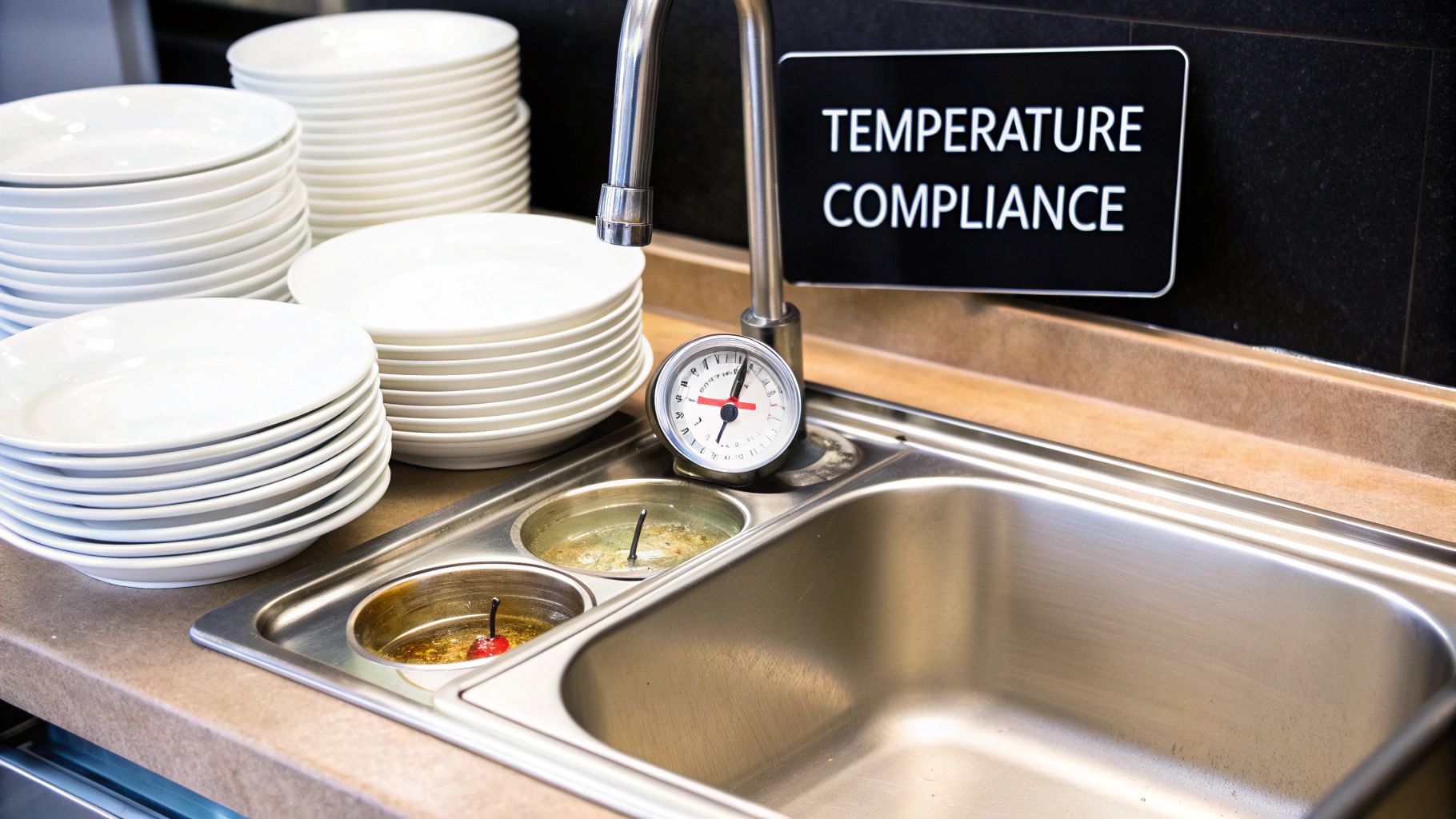
The whole point of the three-sink method is to create a systematic workflow that wipes out harmful pathogens. To nail this process, it's crucial to start by understanding the distinction between cleaning and sanitizing. They are two very different steps with distinct goals, and the right water temperature is what makes each one effective.
The Science Behind the Numbers
Those temperature rules from the health department aren't just random numbers. They're rooted in food safety science to ensure your manual warewashing process actually works.
- Wash Sink (110°F-120°F): This isn't just about comfort. This temperature range is hot enough to help your detergent do its job, breaking down grease and lifting stuck-on food. Water that's too cool just won't cut through fats, leaving behind a nasty film that makes sanitizing impossible.
- Rinse Sink (Minimum 110°F): Warm, clean water is essential here to wash away every bit of soap. Any lingering detergent residue can completely neutralize your sanitizer in the next step, rendering it useless.
- Sanitize Sink (171°F or Chemical): If you're using heat to sanitize, the water absolutely must be at least 171°F to kill bacteria effectively. If you opt for chemical sanitizers, the water temperature has to be what the manufacturer specifies (usually around 75°F) for the chemical to work properly.
Maintaining the correct water temperature in a 3 compartment sink is a core component of your HACCP (Hazard Analysis Critical Control Point) plan. It is a critical control point that, if not managed, can directly lead to a food safety hazard.
The manual three-compartment sink method is the gold standard, and getting the temperatures right is what makes it work. It's a surprisingly common failure point; a 2023 study found that almost 30% of kitchens failed inspections because their sanitizer temperatures or concentrations were off.
To make sure your setup is 100% compliant, check out our deep dive into the latest 3-compartment sink rules and trends.
For a quick reference you can post by the sink, here’s a simple breakdown of what’s required for each compartment.
3-Compartment Sink Temperature & Sanitizer Quick Reference
| Compartment | Purpose | Required Temperature | Chemical Sanitizer Concentration (PPM) |
|---|---|---|---|
| Sink 1 | Wash | 110°F - 120°F (43°C - 49°C) | Not Applicable |
| Sink 2 | Rinse | Minimum 110°F (43°C) | Not Applicable |
| Sink 3 | Sanitize (Hot Water) | Minimum 171°F (77°C) for at least 30 seconds | Not Applicable |
| Sink 3 | Sanitize (Chemical - Quat) | 75°F (24°C) or as per manufacturer's instructions | 200-400 PPM or as per manufacturer's instructions |
| Sink 3 | Sanitize (Chemical - Chlorine) | 75°F - 100°F (24°C - 38°C) or as per manufacturer's instructions | 50-100 PPM or as per manufacturer's instructions |
| Sink 3 | Sanitize (Chemical - Iodine) | 75°F (24°C) or as per manufacturer's instructions | 12.5-25 PPM or as per manufacturer's instructions |
This table serves as a solid starting point, but always remember to check your local health department’s specific regulations and the instructions on your chemical sanitizer's label, as requirements can vary.
Getting Each Sink Compartment Set Up for Success
Alright, let's move from the 'why' to the 'how.' A truly effective dishwashing process hinges on a solid setup. Each basin in your 3-compartment sink has a specific job, and if you don't prep it correctly, the whole system falls apart. Getting this right from the jump is the best way to avoid a headache during a health inspection and, more importantly, to ensure you're getting a safe, effective clean every time.
Think of it like an assembly line. A small mistake in the first sink—like letting the water get too greasy or the soap too diluted—can make the sanitizer in the third sink completely useless by the time a dish gets there.
The First Basin: Wash and Prepare
The first sink is where you launch the main attack on grease and food grime. Your goal here is simple: fill it with hot, soapy water that’s right in the sweet spot of 110°F to 120°F. This isn't an arbitrary number. This is the temperature range where most commercial detergents are formulated to really go to work, breaking down all the fats and caked-on food.
Just as important is the detergent itself. You'll want a commercial-grade, low-sudsing detergent designed for this temperature window. We've seen kitchens try to save a few pennies on cheap, high-foam soaps, and it always backfires, leaving a stubborn film that’s a nightmare to get off in the rinse sink.
A Pro Tip from the Trenches: The most common mistake we see is staff topping off a low wash sink with hot water but forgetting to add more soap. The detergent gets diluted and loses its punch. Always train your team to add both hot water and the correct amount of detergent together to keep that cleaning power strong.
The Second Basin: Rinse and Remove
The middle sink can seem like just a quick stop, but its role is critical. The whole point of the rinse compartment is to wash away every trace of detergent and any leftover food particles from the first sink. If you leave even a little soap residue on a plate, it will kill the sanitizer in the next sink on contact, making that final step completely worthless.
For this basin, you just need clean, warm water. Aim to keep it at a minimum of 110°F. The water needs to stay clear. The moment it starts getting cloudy or you see soap suds building up, it’s time to drain and refill. Keeping this water clean is non-negotiable if you want your sanitizer to work.
The Third Basin: Sanitize and Finalize
This last compartment is where you eliminate the invisible threats—the pathogens. You’ve got two ways to do this, and both have very specific rules for temperature and concentration.
Hot Water Sanitization If you're using heat to sanitize, that water has to be a scalding 171°F or hotter. And it's not a quick dip; dishes have to be completely submerged for at least 30 seconds to ensure a proper kill. This method is incredibly effective, but it demands a heavy-duty water heater that can keep up and requires you to constantly check the temperature.
Chemical Sanitization This is the route most kitchens take. Here's where it gets a little counterintuitive: the water temperature needs to be cooler, usually around 75°F, but you must check the manufacturer's label. If the water is too hot, it can cause the chemicals to evaporate right out of the water or break down, rendering them useless.
Here’s a quick rundown of the most common chemical sanitizers:
- Chlorine: The target here is a concentration of 50-100 parts per million (PPM). You'll need chlorine test strips to prove it.
- Quaternary Ammonium (Quat): This one needs to be stronger, typically 200-400 PPM. Make sure you have Quat-specific test strips; the chlorine ones won't work.
- Iodine: This sanitizer requires a concentration between 12.5-25 PPM.
Always, and we mean always, follow the mixing instructions on the sanitizer bottle and use the right test strips to verify the PPM. This isn't a "good enough" situation. A health inspector will absolutely ask to see you test the water. When you nail the setup in each compartment from the very beginning, the whole dishwashing flow becomes smooth, safe, and compliant.
Essential Tools and Daily Verification Checks
Setting up your sink correctly is just the first step. The real work is in the day-to-day grind of keeping it compliant. A 3-compartment sink isn't a "set it and forget it" piece of equipment; it's a living, breathing part of your kitchen that needs constant monitoring, especially when you're in the weeds.
Having the right tools and a solid daily process is what separates a kitchen that's running smoothly from one that's a health code violation waiting to happen.
The basic flow is simple: wash, rinse, sanitize. Each step is critical and has to happen in the right order to prevent cross-contamination and ensure every dish is truly clean.
Your daily checks don't need to be a huge production, but they absolutely must be consistent. This is where having the proper gear right at the dish pit is non-negotiable.
Your Must-Have Tool Kit
To keep your 3-compartment sink in line with health codes, your dish crew needs two key tools within arm's reach at all times. These aren't just nice to have—they're essential for proving you're doing things by the book.
- A Calibrated Probe Thermometer: This is the only reliable way to know if your water is hot enough. A quick dip of the thermometer tells you the real story, taking all the guesswork out of compliance. If you need help choosing one, you can find more information about a good pocket digital thermometer built for the chaos of a professional kitchen.
- The Correct Sanitizer Test Strips: Make sure you have the right strips for your sanitizer. Chlorine strips are useless for a Quat-based sanitizer, and the other way around. These little strips give you instant proof that your chemical concentration is in the safe and effective PPM range.
Building a Bulletproof Daily Process
Picture a slammed Saturday night. The dish pit is a war zone, and the sink water has been dumped and refilled a dozen times. This is precisely when things can go sideways.
A simple, logged check at the start of every shift—and every single time the water is changed—is your best defense. This creates a paper trail that proves to inspectors you have a system that works, even when you're slammed.
Your daily verification routine should become second nature for the team.
- Start of Shift Check: Before a single dish hits the water, the opening staff fills the sinks, tests everything, and logs the results. This sets the standard for the day.
- Mid-Shift Water Changes: When any sink gets too dirty and needs to be refreshed, that new water has to be tested again. Just topping it off with a bit of hot water from the faucet won't cut it—the entire basin has to meet the temperature spec.
- Log Everything: Keep a simple logbook or clipboard right by the sink. All it needs are columns for the date, time, wash temp, rinse temp, and sanitizer PPM. This creates accountability and gives you a record to show any health inspector who walks through the door.
This kind of discipline turns your dish station from a potential weak link into a documented control point for food safety, ensuring every plate going out to a customer is as safe as it is clean.
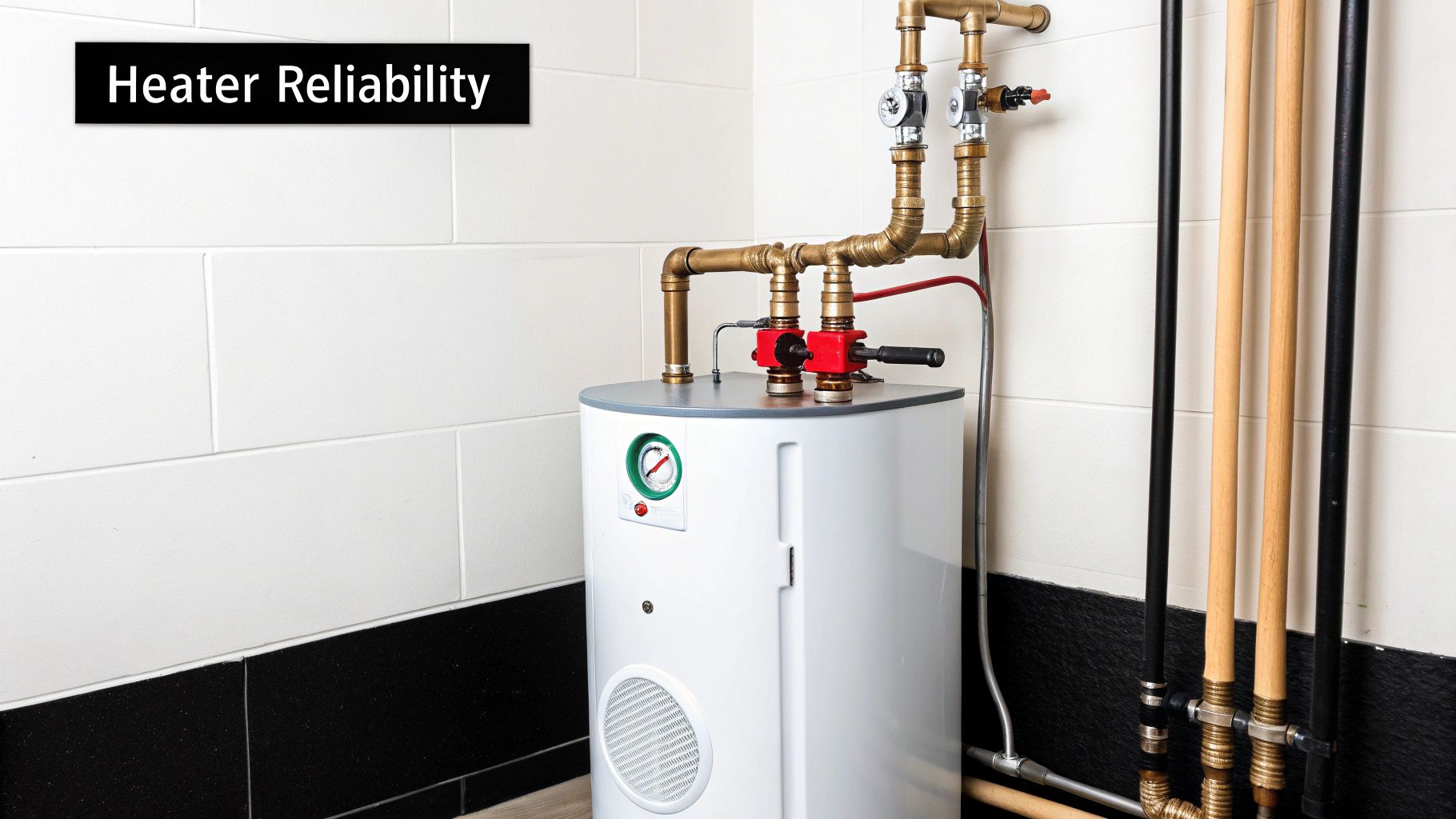
Your Water Heater Is the Unsung Hero of Food Safety
If you're constantly struggling to keep your 3-compartment sink water at the right temperature, take a step back from the sink itself. The real problem is often hiding in a back room or utility closet: your water heater. This workhorse is the true engine of your kitchen's entire sanitation process, and a standard residential unit just can't keep up.
A water heater designed for a house is built for small, intermittent jobs—a shower, a load of laundry, a bit of dishwashing. But a commercial kitchen is a different beast entirely. It needs a massive, non-stop supply of incredibly hot water, sometimes for 12 hours straight. This is especially critical if you rely on heat sanitizing, which demands a sustained 171°F in that third sink. Most residential models can't even reach that temperature, let alone hold it during a dinner rush.
Beyond the Sink: Your Water Heater's Reach
A weak water heater doesn't just create problems in the dish pit. Its performance—or lack thereof—has a domino effect across your entire facility, touching every hot water tap and creating multiple compliance headaches.
- Handwashing Sinks: These need to deliver water at a minimum of 100°F so your staff can actually wash their hands effectively.
- Prep Sinks: From rinsing produce to cleaning surfaces, consistent hot water is a must for basic food prep and safety.
- Mechanical Dishwashers: These machines have their own precise temperature requirements that are often even higher than your 3-compartment sink.
When you see it this way, it's clear that a struggling water heater can trigger a cascade of health code violations. It’s worth understanding the capacity of your system; different setups like high-pressure hot water systems like Megaflow can have a big impact on your overall supply and pressure.
Commercial-Grade Solutions for Commercial-Grade Demands
To keep up, you need equipment built for the job. A commercial-grade water heater is designed for rapid recovery, meaning it can heat huge volumes of water fast enough to keep pace with a busy service.
For kitchens that use high-temperature sanitizing, a booster heater is usually non-negotiable. This secondary unit grabs the already hot water and gives it a final "boost" to get it up to the required 171°F (or higher), ensuring that final sanitizing step is always effective.
The same goes for your automated systems. A mechanical dishwasher needs water between 150°F and 165°F for its wash cycle, and the final rinse has to hit a sterilizing temperature between 165°F and 180°F.
Investing in the right water heating infrastructure isn't just another line item on a budget; it’s a cornerstone of your food safety program. And buying it is only half the battle. Having a solid plan for commercial kitchen equipment maintenance is what keeps your kitchen running smoothly and safely day in and day out. Modern heating systems are specifically designed to help restaurants meet these strict FDA temperature standards. For a deeper dive, you can find more insights about the demands on commercial plumbing systems.
Navigating Common Sink Issues: What to Do When Temps and Sanitizers Fail
Even the best-run kitchens run into trouble with their 3-compartment sinks. It happens. You’re in the middle of a dinner rush, a health inspector walks in, or you’re just doing your routine check, and suddenly the water is lukewarm or the sanitizer isn't reading correctly.
Don't panic. This isn't just a compliance headache; it's a sign that something in your system needs attention. Think of it as a puzzle to solve.
Most of the time, these issues boil down to just a few usual suspects: your equipment, your process, or maybe just a gap in training. Finding the real root of the problem is the only way to fix it for good instead of just slapping a band-aid on it.
Getting to the Bottom of Temperature and Sanitizer Problems
One of the most common complaints we hear is, "The wash water is hot at the start of the shift but lukewarm by 8 PM." Before you start cursing the dishwasher, check your water heater. This is a classic symptom of a poor recovery rate—your heater simply can't keep up with the demand of a busy service.
Sanitizer issues are a whole different ballgame, but just as common. If your test strips are coming back weak or showing nothing at all, it's time to play detective. A few things could be going wrong:
- Water Temperature is Off: Chemical sanitizers are finicky. If the water is too hot—chlorine, for example, can start to break down above 120°F—the chemical essentially evaporates and does nothing.
- Soap is Sneaking In: This one is subtle but deadly for sanitizers. If your rinse sink isn't kept clean and fresh, soap residue from the wash sink gets carried over on the dishes. That soap instantly kills the sanitizer in the third compartment.
- "Eyeballing" the Mix: Your team might have the best intentions, but "a little splash" of sanitizer isn't a measurement. An improper ratio is one of the fastest ways to get a weak, ineffective solution.
We've learned that the best first step is to just watch. Stand back during a busy period and observe the flow. Is the rinse water getting changed out? Are people using measuring cups for the sanitizer, or are they just pouring from the bottle? You'll often spot the problem right away, and it's usually about process, not broken equipment.
A Practical Guide to Quick Fixes
Once you've zeroed in on the cause, you can take smart, direct action. Today's kitchens often use mixing valves for better temperature control, but operational issues are still surprisingly common. In fact, a key industry trend we noted in 2023 was that nearly 30% of inspected kitchens got dinged on compliance checks related to their sanitizer temperature and concentration. To get a deeper understanding of how modern rules affect your setup, it's worth reading up on commercial water temperature compliance on wrenvironmental.com.
Here's a quick reference table we've put together based on years of seeing the same problems pop up again and again. It’s a simple way to diagnose what’s happening and find a solution on the fly.
Common 3-Compartment Sink Issues and Solutions
| Problem | Likely Cause | Immediate Solution |
|---|---|---|
| Wash water is lukewarm | Water heater has a low recovery rate and can't keep up with demand. | Stagger heavy-duty cleaning (e.g., greasy pots) to non-peak hours to give the heater a chance to catch up. |
| Sanitizer tests weak | Water in the sanitizer bay is too hot, causing the chemical to evaporate or degrade. | Use your thermometer. Drain the sink and refill with water at the correct temperature (usually 75°F for quat/chlorine). |
| Sanitizer instantly fails | Soap from the wash sink is being carried over in dirty rinse water, neutralizing the sanitizer. | Change the rinse water immediately. Make it a rule to change it whenever it looks cloudy or sudsy. |
| Sanitizer is inconsistent | Staff are "free pouring" or guessing the chemical-to-water ratio instead of measuring. | Provide measuring cups or a wall-mounted dispenser. Post a clear, visual guide for the correct ratio right at the sink. |
This table covers the big ones, but long-term fixes are where you'll see real improvement.
For Lukewarm Wash Water If you're constantly fighting with a slow water heater, scheduling is your best friend. Move tasks like scrubbing stock pots to slower morning or afternoon prep times. The ultimate fix? That might mean upgrading to a commercial-grade heater with a higher BTU rating or even installing a dedicated booster heater just for your dish pit.
For Ineffective Sanitizer This almost always comes down to good habits and clear training. Post a simple, laminated, waterproof sign right above the sink that shows the exact sanitizer-to-water ratio. Make it a non-negotiable rule: every time the sanitizer sink is refilled, it gets tested with a strip, and the result is logged. This isn't about micromanaging; it's about building muscle memory until doing it the right way is automatic for everyone.
Got Questions About Your 3-Compartment Sink?
Even when you've got everything set up just right, questions are bound to pop up during a busy service. Let's tackle some of the most common things chefs and kitchen managers ask about keeping their water temperature 3 compartment sink safe and compliant.
How Often Should I Be Changing the Water?
The short answer? Whenever it's dirty. The health code doesn't give you a strict "every 60 minutes" rule; it's all about what you can see.
- Wash Sink: The second that water gets greasy, cloudy, or the suds disappear, it’s time for a change. You're not cleaning anything with dirty water—you're just spreading the mess around.
- Rinse Sink: This one has to stay clear. Any hint of suds or murkiness means it's already weakening your sanitizer in the next bay.
- Sanitizer Sink: Plan on changing this solution at least every four hours. If it gets visibly contaminated with food bits before then, change it immediately.
During a busy dinner rush, you might end up changing your wash and rinse water several times. Don't think of it as wasting water; think of it as protecting your customers.
What Does a Health Inspector Look for First?
When an inspector makes a beeline for your dish pit, they have a specific checklist in mind. Knowing what they're looking for can make the whole visit feel a lot less stressful.
Here's what they'll almost always do right away:
- Scan for Signage: Are the "Wash," "Rinse," and "Sanitize" steps clearly labeled? This is an easy win.
- Test Your Sanitizer: They'll have their own test strips and will want to see if your PPM concentration is on the money.
- Check the Temps: Out comes their own calibrated thermometer to verify the water temperature in each sink.
- Check for Air-Drying: They'll glance over to see if you have a clean, dedicated space for items to air-dry. Towel-drying is a huge red flag for them, as it can easily re-contaminate a clean plate.
An inspector’s first impression of your dish station can really set the tone. A clean, organized, and obviously compliant setup shows them you take food safety seriously right from the start.
Can I Use the Same Thermometer for Food and Water?
While you technically can, it's a risky habit. If you do, you have to be incredibly strict about cleaning and sanitizing it between uses. Imagine taking the temperature of raw chicken and then dunking that same thermometer into your sanitizer sink—that's a classic cross-contamination nightmare.
The best and safest approach is to have a dedicated, waterproof thermometer that lives at the 3-compartment sink. It completely removes the risk of cross-contamination and means the tool is always right there when the dish crew needs it for their checks. This is a small investment that pays off big in building a rock-solid food safety system.
At Encore Seattle Restaurant Equipment, we help chefs and restaurant owners stay informed about the latest industry trends and best practices. We know that a safe, compliant kitchen starts with the right gear. From heavy-duty 3-compartment sinks to commercial water heaters that can handle your busiest nights, we offer exclusive deals on the new and used equipment you need. Explore our inventory today and let us help you build a kitchen that’s ready for anything.