
Discover portable propane deep fryers for mobile cooking success
For restaurant owners and chefs operating mobile kitchens, discovering the right equipment isn't just about cooking—it's about seizing opportunity. If you’ve ever wondered how a food truck at an outdoor festival serves up perfectly crispy fries time and time again, the answer is almost always a portable propane deep fryer. These workhorses are the secret weapon for any food business that needs to cook on the go.
Think of them as a full-power commercial frying station, completely untethered from walls and electrical outlets. They give culinary professionals the freedom to set up shop anywhere, combining immense power with unmatched mobility. Stay informed about industry trends like this, and you'll find exclusive deals on the restaurant equipment and supplies that drive your business forward.
Why Mobile Kitchens Run On Portable Propane Fryers
In the world of food trucks, catering, and pop-ups, your success is measured by how fast, flexible, and reliable you are. You're constantly battling logistical puzzles, from flaky power sources to the pressure of serving huge crowds in a short amount of time. Portable propane fryers were built from the ground up to solve these exact problems.
Their biggest advantage is simple: they’re completely self-sufficient. While electric fryers demand a heavy-duty power outlet or a loud, clunky generator, a propane fryer just needs a standard propane tank to get going. This opens up a whole new world of business, allowing you to bring your A-game to a farmer's market, a wedding in a park, or a sidewalk food stall.
The Power of Untethered Performance
The real magic behind these fryers is their raw heating muscle, measured in BTUs (British Thermal Units). This isn't just a number on a spec sheet; it directly translates into two things that make or break a busy service:
- Rapid Heat-Up: A good propane burner gets a huge vat of oil up to the perfect frying temperature in just minutes. Less waiting, more cooking.
- Instant Recovery Time: Every time you drop a basket of cold food into the oil, the temperature plummets. A powerful propane flame brings that temperature right back up almost instantly. This is the key to food that comes out crispy and golden, not soggy and greasy.
This ability to perform under pressure means you can churn out consistently great food, batch after batch, no matter where you are. And the industry is taking notice. The global deep fryer market was valued at around USD 1.29 billion in 2024 and is expected to hit USD 1.34 billion in 2025, with a huge part of that growth coming from the boom in mobile food businesses and outdoor cooking.
For any mobile kitchen, the ability to operate independently of the electrical grid is not just a convenience—it's a fundamental competitive advantage. It means saying "yes" to more opportunities and delivering restaurant-quality results in places you otherwise couldn't.
At the end of the day, these fryers are revenue machines. They let you add high-profit crowd-pleasers like french fries, onion rings, and fried chicken to your menu, directly boosting your bottom line. Their combination of power, mobility, and efficiency is why they’re a cornerstone of so many successful mobile kitchens. For a deeper dive into setting up a mobile operation, check out our guide on essential equipment for food truck kitchens.
Choosing The Right Fryer For Your Business Needs
Picking the right portable propane deep fryer isn't about the brand on the side—it's about matching the machine's muscle to your menu and your customer flow. Think of it like buying a truck. The engine you need for hauling heavy loads up a mountain is totally different from the one you need for light-duty city driving. Your fryer is the engine of your mobile kitchen, and a smart investment starts with understanding what the specs really mean for your bottom line.
This flowchart breaks down the core value of these fryers in a nutshell.
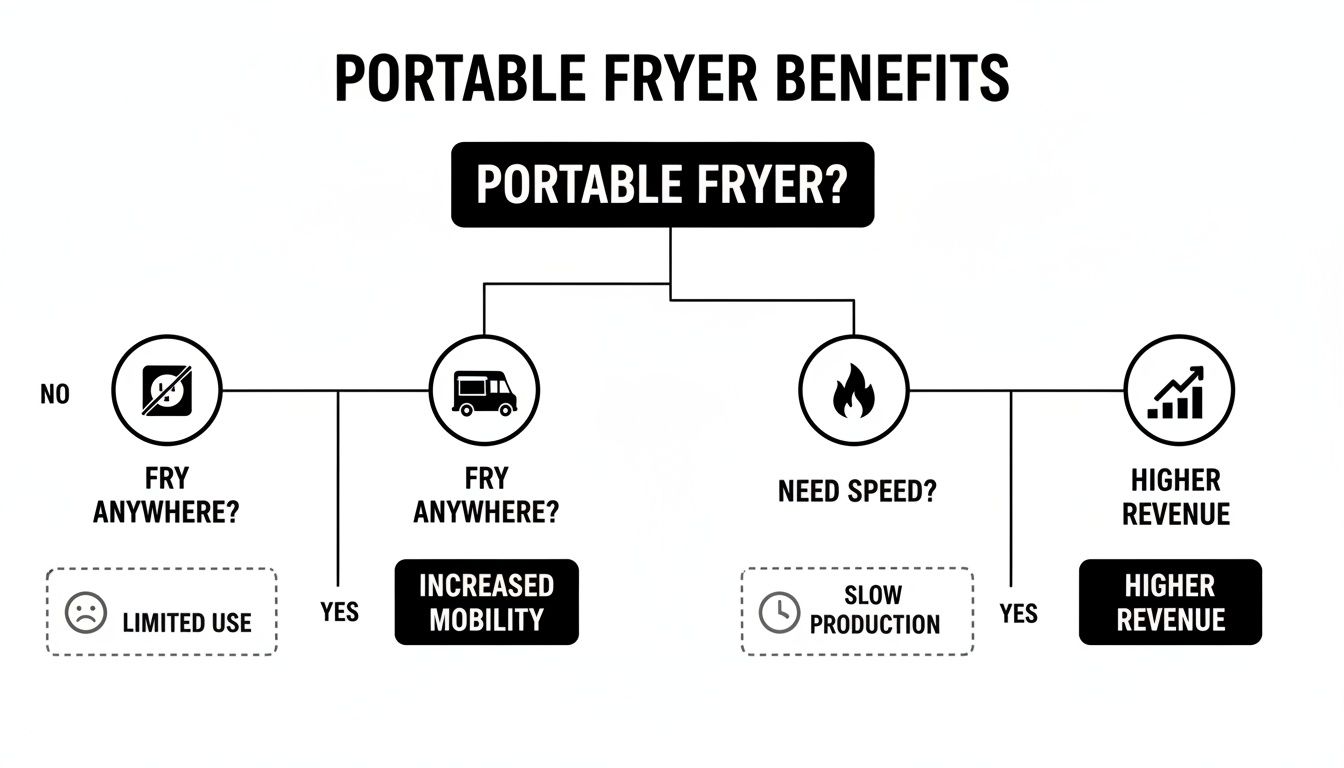
As you can see, the mobility and speed you gain are what open the door to new events and bigger profits. It’s all about getting out there and serving people, whether you're at a festival or just handling the weekend rush.
Translating BTUs Into Real-World Performance
The first number you'll see advertised on any fryer is its BTU (British Thermal Unit) rating. Don't glaze over this—it's the single most important measure of the fryer's raw horsepower. A higher BTU rating means the burner cranks out more heat, and that directly impacts two things you care about:
- Heat-Up Speed: A powerful burner gets a big pot of oil up to that perfect 350-375°F much faster. Less time waiting means more time selling.
- Recovery Time: This is the make-or-break factor for food quality. When you drop a basket of frozen onion rings into hot oil, the temperature plummets. A high-BTU burner snaps that temperature right back up. We call this heat recovery.
Fast recovery is the secret to crispy, golden food that isn't greasy. If the oil stays too cool for too long, your food soaks up oil like a sponge and comes out limp and soggy. If you’re planning for high-volume service, don't even look at anything under 90,000 BTUs.
Matching Oil Capacity To Your Menu
Just as critical as power is capacity. The size of the fry pot, usually measured in pounds of oil it holds, determines how much food you can pump out at once. A little 25-35 lb capacity fryer is great for a coffee shop adding a side of fries to the menu. But if you’re running a dedicated fish-and-chips operation, you’ll need a 50 lb capacity model, minimum, to avoid getting buried.
Think about your best-selling items. Are you frying big pieces of chicken or churning out baskets of fries? Overcrowding a small fryer is a classic rookie mistake that kills your recovery time and ruins the food. It’s always better to have a little more capacity than you think you’ll need.
When you're comparing different models, it can be tough to visualize how specs translate to actual performance. This table breaks down the key numbers and what they mean for your specific business.
Key Specifications For Commercial Portable Propane Fryers
A breakdown of crucial features to compare when selecting a portable propane fryer for professional use, helping operators match specifications to their operational needs.
| Specification | What It Means For Your Business | Recommended Range for High Volume | Recommended Range for Low Volume |
|---|---|---|---|
| BTU Rating | Measures heating power. Higher BTUs mean faster heat-up and quicker temperature recovery for crispier food. | 90,000+ BTUs | 50,000 - 80,000 BTUs |
| Oil Capacity | The amount of oil the fry pot holds. Directly impacts how much food you can cook in a single batch. | 50+ lbs | 25 - 40 lbs |
| Construction | The material of the fryer. Stainless steel is essential for durability, sanitation, and longevity. | 16-Gauge Stainless Steel | 18-Gauge Stainless Steel |
| Fryer Type | The design of the heating element. Tube-fryers are for breaded items; open-pot is for low-sediment foods. | Tube-Fryer (for sediment) | Open-Pot (for easy cleaning) |
Ultimately, these specs work together. A high-BTU fryer with low capacity won't do you much good, and vice-versa. Finding the right balance is what sets you up for success.
Why Stainless Steel Construction Is Non-Negotiable
In a commercial kitchen, flimsy equipment doesn't last. While you might find consumer-grade fryers made of aluminum, a true professional portable propane deep fryer needs to be built from heavy-gauge stainless steel. Period.
A stainless steel fry pot and exterior aren't just a nice-to-have feature; they are a requirement for a business that wants to last. This stuff resists rust from salt and harsh cleaners, stands up to being moved around, and gives you a smooth, non-porous surface that's easy to sanitize for the health inspector.
This isn't just about durability; it's a smart business decision. With the North American deep fryer market holding a massive 38.3% market share in 2024, driven largely by the explosion of food trucks and pop-ups, operators are demanding equipment that can take a beating.
Comparing Tube Fryers and Open-Pot Fryers
Finally, let's talk about the inside of the fry pot. The design will make a huge difference depending on your menu. You’ve got two main choices:
- Tube-Fryers: These have heating tubes running right through the oil. This creates a "cool zone" at the bottom where crumbs and sediment from breaded items (like fried chicken or mozzarella sticks) can fall without scorching. This makes your oil last longer and keeps flavors clean.
- Open-Pot Fryers: These have their burners on the outside, leaving the pot totally open and smooth inside. They are incredibly easy to scrub clean and are the perfect choice for things that don't shed a lot of breading, like french fries, donuts, or tempura vegetables.
So, which one is for you? It’s simple: if your menu is full of heavily breaded items, you need a tube-fryer. If you prioritize easy cleaning and mostly cook "clean" foods, an open-pot design is your best friend. For a more detailed look, check out our guide to the best commercial deep fryers for any kitchen setup.
Mastering Your Propane Fryer Safety Protocols
Let's be blunt: the raw power that makes a portable propane fryer so great is exactly what demands your full respect. Out in the field—whether at a festival or a catering gig—things get hectic. Safety can't be an afterthought; it has to be second nature. Think of it like a pilot's pre-flight check. It’s a non-negotiable routine that ensures everything goes off without a hitch.
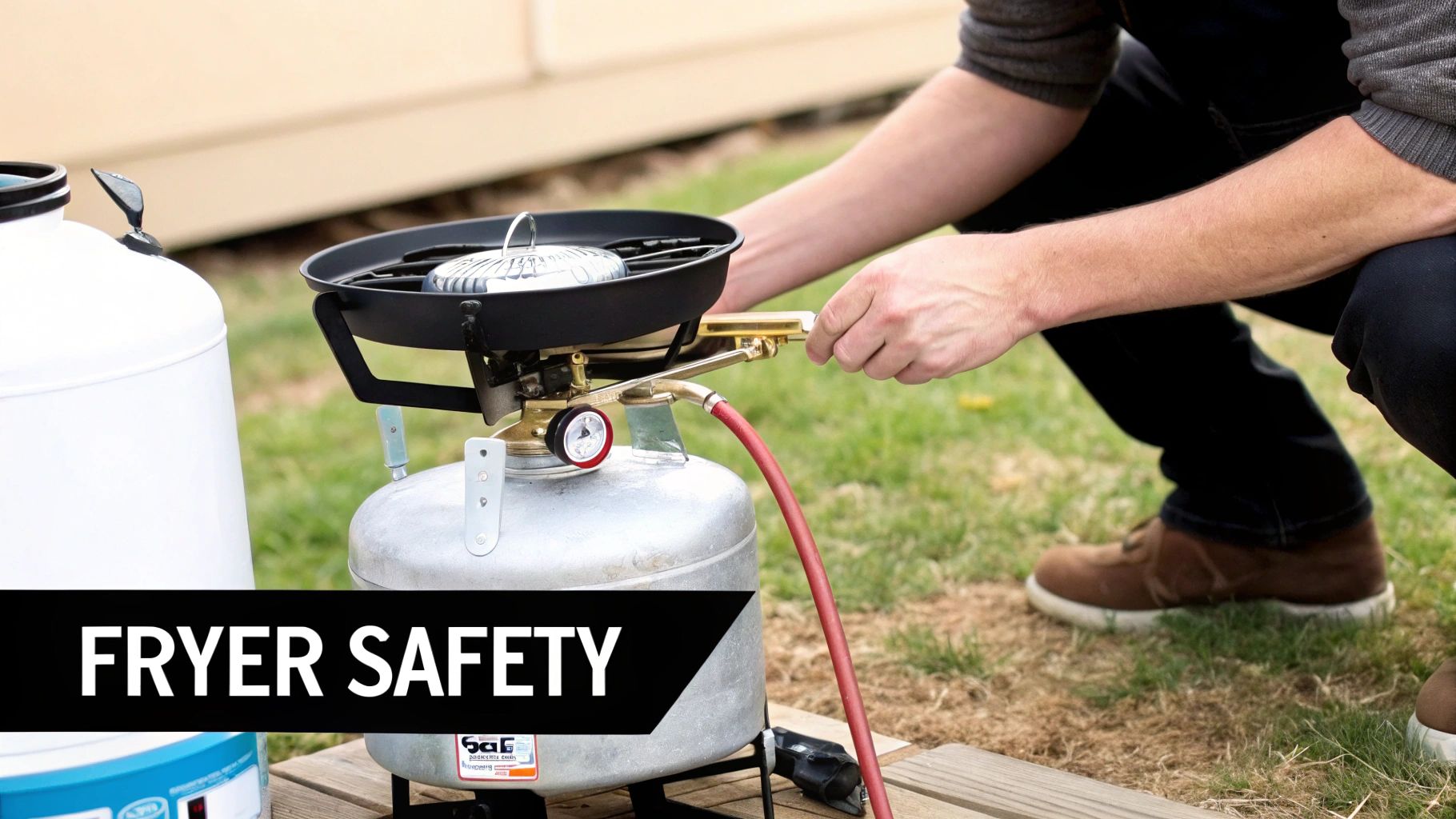
Nailing down a clear, repeatable safety protocol isn't just about protecting people and gear. It’s about protecting your business and your reputation. These steps are your playbook for keeping potential disasters firmly under control.
Establishing Your Hazard-Free Cooking Zone
Your most important safety decision is made before you even think about lighting the burner: where you set up. A wobbly, uneven, or poorly chosen spot is the single biggest cause of accidents that are entirely preventable.
Your fryer needs to be outdoors on a totally flat, stable, and non-flammable surface. Concrete is your best friend here. Never, ever set up on a wooden deck, under a pop-up tent, inside a garage, or beneath any kind of roof or overhang.
- Create a Buffer Zone: Give yourself plenty of room. Position the fryer at least 10-15 feet away from buildings, vehicles, trees, or anything else that could catch fire. Think of this space as your safety net.
- Clear the Area: The ground around the fryer should be free of clutter. No equipment cases, no boxes, no stray cords—nothing that could trip someone up.
- Establish a No-Go Zone: This is crucial. Keep kids, pets, and any staff not trained on the fryer far away from the cooking area while it's in use.
The Propane Connection Checklist
The propane tank and its connections are the heart of your setup. Making sure they're in perfect working order is non-negotiable. It helps to understand all the components, from the tank itself to the RV Propane Gas Regulators that control the flow.
Before every single use, do the soapy water leak test. It takes two minutes and is the single most effective way to catch a gas leak before it becomes a serious fire or explosion hazard.
Make this a mandatory part of your setup routine. Here’s how it's done:
- Mix the Solution: Just add a little dish soap to some water in a spray bottle or a cup.
- Pressurize the System: Keep the burner off, but open the valve on top of the propane tank. This lets gas flow into the hose and regulator.
- Apply and Inspect: Spray or brush the soapy water onto every connection point—where the regulator screws into the tank and where the hose attaches to the burner.
- Look for Bubbles: If you see bubbles forming, you've got a leak. Immediately shut the valve on the propane tank.
- Tighten and Retest: Snug up the leaky connection, turn the gas back on, and re-test with the soapy water. Don't even think about lighting the fryer until the bubbling stops completely.
Oil Management and Fire Prevention
Hot cooking oil is the other major hazard you need to manage. A grease fire isn't like a regular fire; it's incredibly violent and dangerous. Your best bet is to do everything you can to prevent one from ever starting.
- Watch the Oil Level: Never fill the fry pot more than halfway. Remember, the oil level will rise dramatically when you add food, especially frozen food. Overfilling is the #1 reason for dangerous boil-overs.
- Monitor Temperature Religiously: A long-stemmed thermometer is your most important tool here. Keep a constant eye on the oil temperature, aiming for the sweet spot between 325°F and 375°F. If you see the oil start to smoke, it's way too hot—kill the heat immediately and let it cool down.
- Keep Water Away: Make sure any food going into the fryer is thawed and patted completely dry. Even a tiny bit of water or ice will cause a violent splatter of scalding oil.
Finally, you have to be ready for a worst-case scenario. Always keep a Class K fire extinguisher within arm's reach of the fryer. These are made specifically for grease and oil fires. For more on professional-grade fire safety, it's worth understanding the fundamentals of commercial kitchen fire suppression. And the golden rule: never, ever use water on a grease fire. It will cause an explosive flare-up.
Your Essential Cleaning And Maintenance Routine
Think of your portable propane deep fryer as the heart of your mobile kitchen. Just like any high-performance engine, it needs consistent care to keep running smoothly and efficiently. If you let maintenance slide, you’re not just shortening the fryer's lifespan; you're actively hurting the taste of your food and, ultimately, your profits.
A solid cleaning schedule is your best defense against flavor transfer, expensive oil waste, and a dreaded failed health inspection. Smart chefs know that staying informed about the latest maintenance techniques for restaurant equipment and supplies is key to longevity and performance.
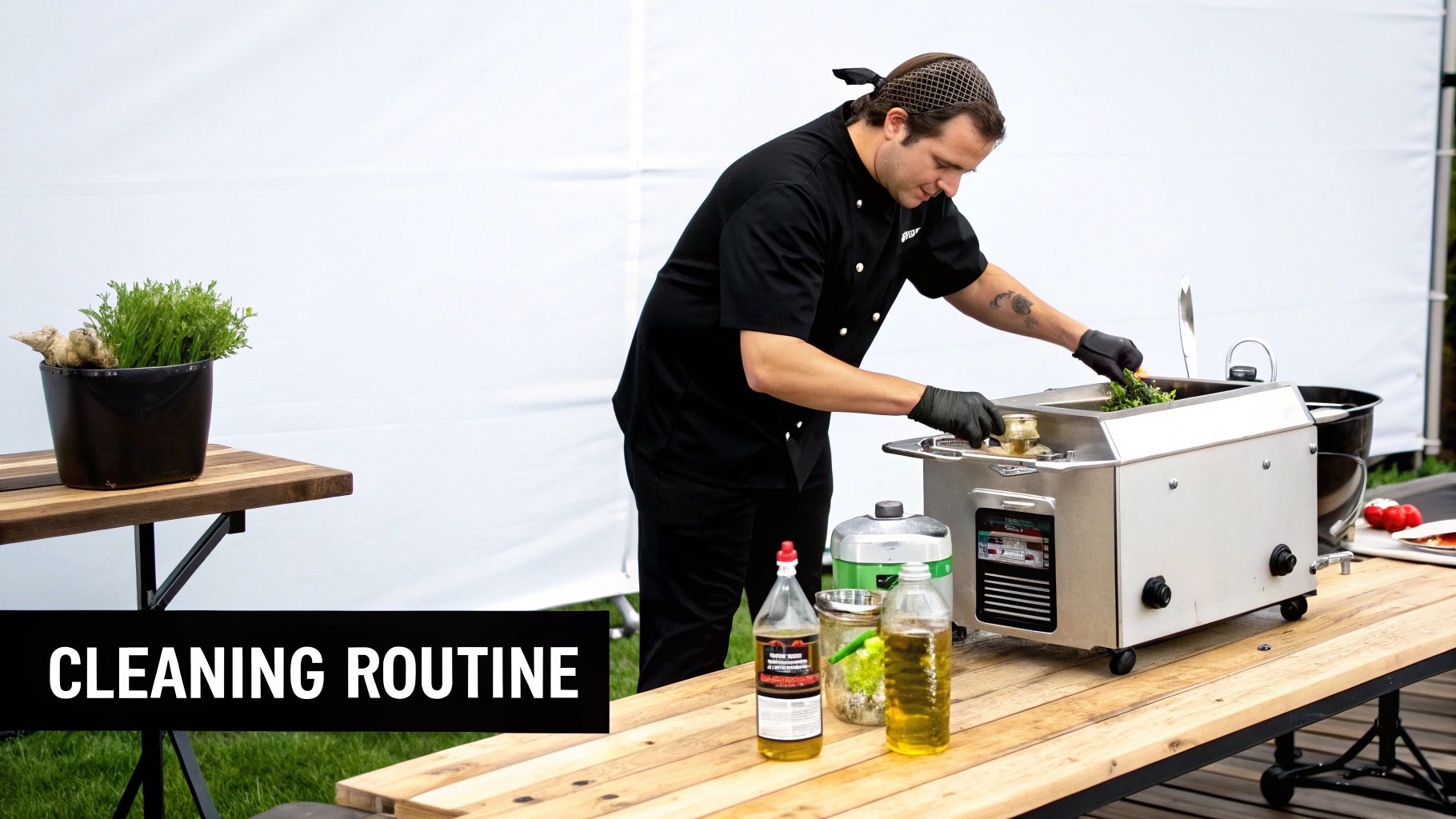
This goes way beyond just wiping down grease. It's about protecting your investment and making sure every single order that leaves your station builds your reputation for top-notch quality. It’s also about getting the most out of your most expensive consumable: your cooking oil.
The Daily Ritual Your Oil Deserves
The single most impactful habit you can build is managing your cooking oil every single day. At the end of each service—once the oil has cooled down completely—you absolutely have to filter it. This simple step removes all the tiny food particles and sediment that would otherwise get left behind to burn during the next rush.
Those burnt bits are the number one cause of bitter, off-flavors and what makes your oil break down so quickly. Consistent filtering can easily double the usable life of your cooking oil, which adds up to a huge cost saving over a month.
Don't think of filtering as a chore; think of it as a profit-saving measure. Every day you filter is another day you don't have to buy expensive new oil, all while serving a better-tasting product.
The Weekly Deep Clean or Boil-Out
At least once a week, your fryer needs a much deeper clean, what we in the industry call a "boil-out." This process is designed to strip away the stubborn, baked-on grease that a simple wipe-down won't touch. A weekly boil-out is non-negotiable for proper sanitation, preventing old grease buildup that taints your food's flavor and can even become a fire hazard.
Here’s how to do an effective boil-out:
- Safety First: Make sure the unit is off, the propane tank is disconnected, and the oil is completely cool. No shortcuts here.
- Drain and Scrape: Drain all the old oil. Grab a rubber spatula and scrape out any loose gunk and debris from the bottom of the fry pot.
- Fill and Add Cleaner: Fill the pot with water, stopping just below the oil-fill line. Add a commercial-grade, non-foaming fryer cleaner, following the product's instructions to the letter.
- Simmer Gently: Reconnect the propane, turn the fryer on, and bring the water and cleaner solution to a slow, gentle simmer for about 20-30 minutes. You never want it to come to a rolling boil or boil over.
- Cool, Drain, and Scrub: Turn everything off again and let the water cool down before draining it. Use a long-handled, non-abrasive brush to give the inside of the pot a good scrub.
- Rinse and Neutralize: Rinse the pot thoroughly with hot water. For the final rinse, use a solution of one part white vinegar to ten parts water—this neutralizes any leftover cleaner residue.
- Dry Completely: This is the most important step. The fry pot must be 100% dry before new oil goes in. Even a small amount of water will cause a violent, dangerous splatter when it meets hot oil.
Monthly Mechanical Health Check
Your portable fryer is more than just a metal pot; it’s a system of interconnected parts that all need to be in good working order. Once a month, take five minutes to do a quick mechanical checkup. Catching a small issue now can save you from a major breakdown later.
- Hoses and Connections: Look over the propane hose carefully. Are there any cracks, brittle spots, or abrasions? Do the soapy water test on all connections to check for gas leaks.
- Burner Orifices: Check the burner ports for clogs from grease or carbon buildup. A stiff brush or even a straightened paperclip can clear blockages that cause a weak or uneven flame.
- Thermocouple and Pilot: Make sure the thermocouple (that little metal sensor right next to the pilot light) is clean and positioned correctly. A dirty thermocouple is the most common reason a pilot light refuses to stay lit.
- Stand and Frame: Give the fryer a little shake. Is it stable? Check that the legs and frame are solid and that all nuts and bolts are tightened down. A wobbly fryer is a serious safety hazard.
This simple, tiered approach—daily filtering, weekly boiling, and monthly inspections—is the key to keeping your portable propane deep fryer in peak condition, ensuring safety, quality, and profitability day in and day out.
Navigating Local Regulations And Ventilation Rules
Getting your recipes perfect is one thing, but knowing the rules of the road is what keeps a mobile food business running. When you're working with portable propane fryers, staying on the right side of local regulations isn't just a good idea—it's essential. Every city, county, and state has its own health and fire codes, and not knowing them can get you shut down fast.
Think of your local health department and fire marshal as your business partners. They're not there to make your life difficult; they're there to ensure everyone stays safe. Before you even think about firing up that fryer at your first event, make a call. They are the final word on what's allowed in your area.
Where You Cook Matters
The rules for using a propane fryer can change dramatically depending on your setup. Frying in an open field at a farmer's market is a world away from working inside a food truck or under a tent at a street festival. The biggest variable? Ventilation.
Propane is fantastic, but burning it creates carbon monoxide (CO)—a gas you can't see or smell that can be lethal in enclosed spaces. This is precisely why most portable fryers are designed strictly for outdoor use.
- Open-Air Setups: Out in the open with nothing overhead? Natural airflow is your best friend. Regulations in these spots usually focus on keeping a safe buffer zone between your fryer, buildings, flammable stuff, and the public.
- Tents and Canopies: The moment you put a roof over your head, even a temporary one, the game changes. Fire marshals will want to see that your canopy is made of fire-retardant material. They'll also specify how far the fryer needs to be from the tent walls to keep air moving and prevent heat buildup.
- Food Trucks: This is the big leagues of regulation. A food truck is a confined space, so you can't just stick a portable fryer inside. It has to be part of a complete system, which means a commercial-grade ventilation hood and a fire suppression system that meets strict NFPA 96 standards.
Ventilation Isn't Optional
Proper ventilation is the single most important part of operating safely and legally. It does a few critical jobs at once: pulling out intense heat, getting rid of greasy smoke, and, most importantly, exhausting dangerous combustion fumes like carbon monoxide.
In a food truck, that means a powerful mechanical hood system. For an outdoor setup, it means making sure you have a good cross-breeze and no way for gases to get trapped under your canopy.
The demand for high-quality, compliant fryers is exploding. The specialty commercial deep fryers market is expected to jump from USD 1.3 billion in 2025 to USD 2.5 billion by 2035. This industry trend shows that serious chefs are investing in professional-grade equipment, and they need propane's power and efficiency for high-volume events where safety can't be an afterthought.
"Compliance isn't an obstacle; it's your license to operate. A proactive conversation with your local fire marshal and health inspector before an event is the smartest business decision you can make. It demonstrates professionalism and prevents costly surprises on opening day."
As you plan your mobile kitchen, remember that installing gas appliances and adhering to safety standards is foundational. Getting the right permits and having your setup professionally checked isn't just red tape; it's how you build a safe, legal, and successful business from the ground up.
Your Top Propane Fryer Questions, Answered
Out in the field, even the best equipment brings up practical questions. When you're in the middle of a busy service, you need clear, fast answers. This is where we tackle the most common questions we hear from chefs and food truck operators every day.
Think of this as your go-to guide for real-world fryer problems. From keeping your oil fresh to figuring out why a pilot light won't stay lit, these answers will help you run a safer, more profitable operation. We want to help restaurant owners and chefs discover the latest news and get answers about their restaurant equipment and supplies.
How Often Should I Filter or Change The Oil?
This is, without a doubt, the number one question we get. It's so important because your oil directly affects both the taste of your food and your bottom line. There’s no single, magic number for how often to change it—the real answer depends on what you're frying and how much of it.
A few things will wreck your oil quality in a hurry:
- Heavily Battered Foods: Think fried chicken, onion rings, or anything with a thick coating. All that breading sheds tiny particles that burn, making your oil break down and taste funky much faster.
- High-Volume Cooking: If your fryer is running nonstop at a festival, the oil is working hard. It's going to degrade way quicker than it would at a small catering gig.
- Running Too Hot: Pushing your oil past 375°F consistently will shorten its life.
For a busy food truck or pop-up, a good rule of thumb is to filter your oil daily and expect to change it completely every 3-7 days. But honestly, your best tools are your eyes and nose. If the oil is dark and thick, smokes before it hits temp, or your food starts tasting greasy, it's time for a change. Daily filtering is the single best thing you can do to get more life out of your oil and save money.
What's The Difference Between a Tube Fryer and an Open Pot Fryer?
Understanding how your fry pot is designed is key to matching the right fryer to your menu. While both get the job done, tube fryers and open-pot fryers are built for very different kinds of food.
A tube-fryer has heating tubes that run right through the oil. This clever design creates a "cold zone" at the bottom of the fry pot. All the crumbs and sediment from breaded foods fall past the hot tubes and settle in this cooler area, where they won't burn and ruin your oil. This makes tube-fryers the absolute best choice for high-sediment foods like breaded chicken, fish and chips, and mozzarella sticks.
An open-pot fryer, on the other hand, is much simpler. The burners are on the outside, underneath the pot, leaving the inside completely smooth and open. This makes them incredibly easy to clean—there are no tubes to scrub around. If your menu is mostly low-sediment items like french fries, donuts, or tempura, and easy cleaning is your top priority, an open-pot model is perfect.
Can I Use a Portable Propane Fryer Indoors?
Let's be crystal clear on this: absolutely not. Not unless it’s installed under a commercial-grade ventilation and fire suppression system, just like any other indoor fryer. These portable units are designed and certified for outdoor use only.
Trying to run one inside a building, garage, or even a poorly-ventilated tent is asking for disaster. You're facing two huge risks:
- Carbon Monoxide (CO) Poisoning: Burning propane creates carbon monoxide, a deadly gas you can't see or smell. In an enclosed space without a powerful vent hood, CO levels can become lethal in minutes.
- Massive Fire Hazard: You have an open flame, intense heat, and gallons of flammable oil. Without the professional hood and fire suppression systems required by fire codes, you're setting the stage for a catastrophic fire.
Any indoor use of a propane fryer demands a professionally installed commercial kitchen hood system that meets NFPA 96 standards. Anything less isn't just against the law—it's life-threatening. Always check with your local fire marshal and health department first.
What Are The Most Common Troubleshooting Issues?
Even the most dependable fryer can have a bad day. When something goes wrong during a rush, knowing what to check first can save you a lot of stress. Here are the three most common problems we see in the field and how to fix them fast.
- Pilot Light Won't Stay Lit: Nine times out of ten, this is a thermocouple issue. The thermocouple is a safety sensor that shuts the gas off if the pilot goes out. First, make sure it’s clean—a gentle wipe with a dry cloth is all it needs. Then, check that its tip is sitting right in the pilot flame. A weak gas flow from the tank or a strong gust of wind can also be the culprit.
- Weak or Yellow Burner Flame: A healthy flame is blue with just a little yellow at the tips. If your flame is mostly yellow and sooty, you've got a bad air-to-gas mix. This is usually caused by clogged burner orifices. Shut everything down, let it cool completely, and use a stiff brush or a paperclip to carefully clean out any gunk from the little holes on the burner.
- Oil Temperature Is All Over The Place: If your oil is getting way too hot or can't seem to reach temperature, start with the simple stuff. Is your propane tank getting low? A nearly empty tank won't provide steady pressure. Also, make sure your thermometer is working correctly and that wind isn't blowing the flame around, causing hot and cold spots.
Learning these quick diagnostic checks can turn a potential meltdown into a two-minute fix, keeping your customers happy and the food coming out perfect.
Ready to equip your mobile kitchen with the power and reliability of a commercial-grade portable propane deep fryer? The team at Encore Seattle Restaurant Equipment has the expertise to help you select the perfect model for your menu and budget. From high-capacity fryers for festivals to compact units for pop-ups, we provide top-tier equipment that helps your business thrive. We help restaurant owners and chefs discover the latest news and exclusive deals on restaurant equipment and supplies. Explore our extensive selection and find your next essential piece of kitchen gear today at https://encoreseattle.com.