
Leasing a Commercial Dishwasher: A Smart Guide to leasing commercial dishwasher
For restaurant owners and chefs, leasing a commercial dishwasher isn't just an option; it's a strategic financial move. It's a way to get a top-of-the-line machine in your kitchen without draining your bank account on day one. This frees up thousands of dollars you can put toward marketing, inventory, or that new patio you've been dreaming of, helping you stay informed about industry trends and invest in what matters.
Essentially, you're turning a huge one-time purchase into a predictable monthly bill.
Is Leasing a Commercial Dishwasher a Smart Move for Your Kitchen?
Choosing whether to lease or buy a commercial dishwasher is a major decision. An outright purchase can set you back anywhere from $3,000 to over $20,000, which is a tough pill to swallow for a new or expanding restaurant. Leasing, on the other hand, keeps that cash in your business and gives you a clear, manageable path to running an efficient kitchen, often with access to exclusive deals on restaurant equipment and supplies.
Picture this: you're launching a new cafe here in Seattle. Instead of dropping $15,000 on a new conveyor dishwasher, you could lease it for a few hundred bucks a month. That extra capital could fund your entire grand opening campaign, buy a high-end espresso machine, or just give you a much-needed cash cushion for those unpredictable first few months. This is exactly why so many smart operators are leaning into leasing.
Keeping Cash on Hand with Predictable Costs
The biggest win with leasing is getting the equipment you need right now with very little money down. This protects your cash flow, which is the absolute lifeblood of any restaurant.
But it goes beyond the initial savings. A lease locks in a predictable monthly payment, which makes budgeting and forecasting a whole lot easier. You don't have to worry about a surprise four-figure repair bill derailing your finances. Most full-service leases wrap everything you need into one payment:
- The Dishwasher: You get a modern, efficient machine that’s perfectly sized for your operation.
- Routine Maintenance: Scheduled service calls are usually part of the deal, keeping the machine in top shape and heading off problems before they start.
- Emergency Repairs: When something inevitably breaks during a slammed dinner rush, your lease provider is on the hook to fix it, often at no extra cost to you.
This bundled approach means you're not just renting a piece of metal; you're buying yourself some serious operational peace of mind.
"For most restaurants and many other commercial kitchens, leasing is the preferred path. The burden of dishwasher management is taken off your plate, and you won’t face unexpected costs if something goes wrong."
This isn't just a local trend. The global leased dishwasher market is on track to grow at a compound annual growth rate of 6.5%, expected to hit $2.12 billion by 2033. This surge shows just how much foodservice businesses everywhere are prioritizing financial flexibility. You can discover more insights about the leased dishwasher market and its trajectory to see the bigger picture.
Leasing vs. Buying Your Dishwasher at a Glance
Making the right choice comes down to weighing the pros and cons for your specific situation. Here’s a quick breakdown to help you compare.
| Consideration | Leasing | Buying |
|---|---|---|
| Upfront Cost | Low to none. Usually just the first month's payment and a security deposit. | High. Full purchase price is due upfront, a major capital expense. |
| Monthly Payments | Predictable, fixed operating expense. | None, but you might have loan payments if you financed the purchase. |
| Maintenance & Repairs | Often included in the lease. The provider handles scheduling and costs. | Your responsibility. You pay for all service calls, parts, and labor. |
| Equipment Upgrades | Easy. You can upgrade to a newer model at the end of the lease term. | Costly. You have to sell the old unit and buy a new one. |
| Asset Ownership | None. You're renting the equipment. | Yes. The dishwasher is a business asset you own. |
| Tax Implications | Lease payments are typically fully tax-deductible as an operating expense. | You can depreciate the asset over time, which offers a tax benefit. |
Ultimately, buying gives you an asset on your books, but leasing provides unmatched financial flexibility and operational support, which is often more valuable for a growing restaurant.
Choosing the Right Dishwasher for Your Kitchen's Workflow
Picking a commercial dishwasher is about more than just sparkling plates. It's about finding a machine that can keep up with the rhythm of your kitchen. The wrong choice creates a bottleneck right when you can't afford one, leaving your staff scrambling and your customers waiting. A great lease choice, on the other hand, means your back-of-house hums along smoothly, supporting your team instead of holding them back. Staying informed about the latest equipment trends will help you discover the perfect fit.
Before you even start browsing models, you need a realistic picture of your busiest moments. Don't guess—do the math. A packed Saturday night is the only true measure of what your kitchen needs to handle.
To get a handle on this, you have to figure out your peak-hour dish volume. Take a look at your busiest hour on your busiest day and count the number of covers (guests) you served. From there, a solid rule of thumb is to assume about five dishes per person—think dinner plate, side plate, bowl, glass, and cutlery. Multiplying your covers by five gives you a reliable baseline for the hourly capacity you need.
A bustling coffee shop might find that a quiet, efficient undercounter model is perfect for its steady but manageable flow. But a hotel banquet hall? That operation needs a high-capacity conveyor dishwasher that can chew through hundreds of place settings in a very short amount of time.
This quick calculation is your best defense against leasing a machine that’s too small and creates chaos, or one that’s too big and just burns through cash, water, and energy.
Matching the Machine to Your Space
Once you’ve nailed down your volume, it's time to get out the measuring tape and take a hard look at your kitchen's layout and utility hookups. The most incredible dishwasher in the world is just a big metal box if it doesn't fit the space or connect to your pipes.
- Undercounter Dishwashers: These are the go-to for tight spots. Perfect for coffee shops, bars, and small cafes, they slide right under a standard counter and can wash 20-40 racks per hour. They're the workhorses for any place where every square foot counts.
- Door-Type (Pass-Through) Dishwashers: A solid step up in power, these machines need more vertical clearance. They’re designed to sit between a "dirty" and "clean" dishtable, creating a logical workflow. Capable of handling 50-85 racks per hour, they're a fantastic fit for mid-sized restaurants that have outgrown an undercounter unit.
- Conveyor Dishwashers: These are the absolute beasts of the warewashing world, built for high-volume operations like hospitals, big hotels, and university dining halls. They can power through anything from 200 to over 1,000 racks per hour. Leasing one of these is a serious commitment, requiring a lot of floor space and heavy-duty utility connections.
Your choice here directly shapes how your kitchen operates. An undercounter unit keeps a small bar moving, but a conveyor system is the only thing that will keep a major catering event from grinding to a halt. You can dig deeper into the pros and cons in our guide to different types of dishwashing machines for restaurants.
Utility Needs and Essential Features
Beyond the physical footprint, you have to confirm your kitchen is ready for the machine. Are you eyeing a model that needs a 208V three-phase electrical hookup when all you have are 120V single-phase outlets? Does it demand high-temperature water that your current water heater simply can't deliver?
Your utility infrastructure is a non-negotiable. A mismatch here can lead to thousands in surprise costs for electricians and plumbers, completely wiping out the financial benefits of leasing in the first place.
It's also smart to separate the must-have features from the nice-to-have bells and whistles. For example, if you're in an area with hard water—like much of the Pacific Northwest—a built-in water softener isn't a luxury; it's essential for preventing scale buildup and keeping the machine alive. On the other hand, a slick touchscreen display might look cool but add unnecessary cost for a kitchen that just needs to get the job done.
This fork in the road is a critical one for most operators, and this decision flowchart can help you think it through.
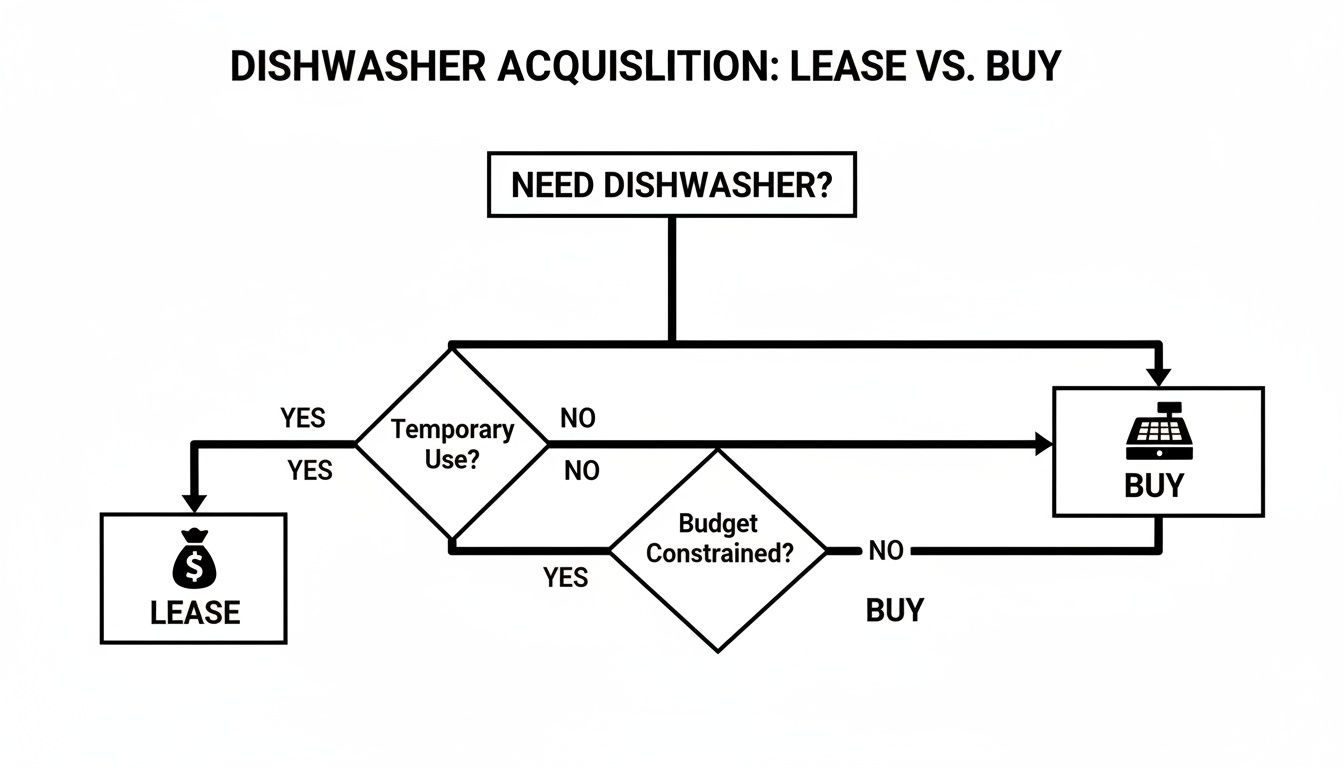
As the flowchart shows, leasing is often the smartest path for businesses that need financial flexibility and want to avoid a massive upfront expense—which all ties back to choosing the right-sized, right-priced machine for your needs.
Decoding Lease Agreements and Your Total Cost
That attractive monthly payment on a lease quote? It’s just the opening act. To really understand what a commercial dishwasher lease will cost you, you have to look past that one number and get comfortable with the fine print. This is where hidden fees and long-term costs hide, and spotting them is what separates a smart financial decision from a costly mistake.
Before you even think about signing, you need a crystal-clear picture of the full financial commitment. I've seen seemingly small details in a contract add up to hundreds, sometimes thousands, of dollars over the life of a lease.
FMV vs. $1 Buyout Leases
One of the first forks in the road you'll encounter is the lease type. The two big ones are the Fair Market Value (FMV) lease and the $1 Buyout lease, and they have completely different outcomes for your bottom line.
-
Fair Market Value (FMV) Lease: Think of this as a true rental. You get lower monthly payments for a set period, like 36 or 48 months. When the term is up, you can return the dishwasher, renew the lease, or buy the machine for whatever it's worth at that moment (its fair market value). This is a solid choice if you want to keep up with the latest tech and value flexibility above all else.
-
$1 Buyout Lease (or Finance Lease): This is much closer to a loan. Your monthly payments are higher because you're essentially paying off the machine's full value. Once the term ends, you own it for a token amount—usually just $1. This is the path for operators who know they want to own the equipment when all is said and done.
The right choice really boils down to your business goals. An FMV lease keeps your monthly operating costs lower and makes upgrading easy, while a $1 Buyout builds equity and leads to ownership. It's always a good idea to explore different financing structures, and you can learn more by checking out this guide to restaurant equipment financing.
Calculating Your True Total Cost
To dodge any nasty surprises down the road, you absolutely have to calculate the Total Cost of Ownership (TCO) for the entire lease term. The monthly payment is just one piece of the puzzle.
Let's walk through a real-world comparison for a door-type dishwasher.
Lease Quote A (FMV Lease):
- Monthly Payment: $160
- Term: 48 months
- Installation Fee: $400
- Mandatory Maintenance Plan: Included
- End-of-Lease FMV Estimate: $1,200
Lease Quote B ($1 Buyout Lease):
- Monthly Payment: $210
- Term: 48 months
- Installation Fee: Waived
- Mandatory Maintenance Plan: $30/month extra
- End-of-Lease Buyout: $1
At a quick glance, Quote A looks like the cheaper option. But let's run the numbers assuming you plan to keep the machine.
Quote A Calculation: ($160/month x 48 months) + $400 installation + $1,200 buyout = $9,280
Quote B Calculation: (($210 + $30)/month x 48 months) + $1 buyout = $11,521
In this scenario, even with the higher monthly payments, the FMV lease comes out ahead if you buy it. However, if your plan is to return it, your total cost for Quote A is just $8,080 ($7,680 in payments + $400 installation), making it a very different financial picture.
Uncovering Hidden Fees and Tricky Clauses
Beyond the main numbers, lease agreements are notorious for clauses that can trip you up. As you break down the lease agreement, remember to account for insurance. This A Guide to Commercial Property Insurance is a great resource for making sure your new equipment is properly covered.
Always be on the lookout for these potential red flags:
- Automatic Renewal Clauses: I've seen this bite so many operators. Some contracts will automatically lock you into another full year if you don't give written notice to terminate, often 90 days in advance.
- Return Condition Penalties: You could get hit with big fees if the machine isn't returned in "like-new" condition—a standard that can be frustratingly subjective.
- Early Termination Fees: What if you need to close up shop or want to upgrade sooner than planned? You could find yourself on the hook for the entire remaining balance of the lease.
Don't ever hesitate to question every single line item. A leasing partner worth their salt will be transparent and walk you through every clause, making sure you know exactly what you're signing.
Finding the Right Partner and Nailing the Negotiation
Choosing the right leasing partner is every bit as important as picking the right dishwasher. The company you sign with can be a genuine partner in your success or, frankly, a constant headache. A great vendor delivers a reliable machine, shows up when you need them, and offers fair terms. A bad one? They’ll leave you high and dry with a dead machine during the Saturday night dinner rush.

This isn’t just about comparing the monthly payment. You're vetting a long-term relationship. You need a company that gets the urgency of a professional kitchen and has the boots on the ground to back you up when things inevitably go sideways.
Questions to Ask Every Potential Vendor
Before a contract ever hits your desk, you need to interview these companies. Treat it like you’re hiring a key employee, because their performance directly impacts your ability to operate.
Walk into the conversation armed with these questions:
- What’s your guaranteed service response time? Don’t let them get away with a vague "as soon as possible." You need a firm commitment, like "within 4-6 hours," and you need it in writing.
- Are your technicians based locally? A vendor whose service center is three hours away isn’t going to be much help in an emergency. Proximity is everything for minimizing downtime.
- Do your techs carry common parts on their trucks? A technician showing up empty-handed, only to tell you they have to order a basic heating element, is a huge liability. The best providers stock their vans for the most common fixes.
- What are your service hours, and what are the after-hours fees? Kitchen equipment doesn't break on a 9-to-5 schedule. You need to know exactly what it will cost if your machine gives up the ghost on a Saturday night or holiday.
How a vendor answers these questions tells you everything about their readiness to support a demanding restaurant environment. A true partner invests in their service infrastructure because they know their reputation is tied to your uptime.
Your Negotiation Checklist for a Stronger Lease
Once you have a shortlist of solid vendors, it’s time to talk turkey. Remember, their first offer is just that—a first offer. Your job is to secure terms that protect your business and give you some breathing room. Keep an eye out for exclusive deals that could give you an edge.
Don’t be afraid to advocate for your restaurant's bottom line. A good leasing company wants to build a long-term relationship and will often be willing to negotiate on key points to win your business.
Use this checklist to guide your negotiation. These are the points that can make or break a deal:
- Mid-Lease Upgrade Options: Your business is going to grow. Make sure the contract spells out a clear path to upgrade to a bigger, better machine without getting hit with massive penalties.
- Early Termination Clause: What happens if you sell the restaurant or, worst-case scenario, have to close? Get the exact financial penalty for ending the lease early and push for a more reasonable exit strategy.
- Maintenance Coverage Specifics: The devil is in the details here. Get a specific list of what is and isn't covered. Does it include descaling in a hard-water area like ours? Is labor always included, or only parts?
- End-of-Lease Obligations: Clarify the machine's return condition. Vague language like "normal wear and tear" is a recipe for a dispute. Insist on specific terms to avoid surprise charges down the line.
Your most powerful tool here is a competing offer. If Vendor A is willing to waive the installation fee, let Vendor B know. You’d be surprised how quickly they might match it or even throw in a few months of cleaning chemicals. By negotiating from a position of strength and knowledge, you can turn a standard agreement into a real asset for your operation and your budget.
From Delivery Day to Daily Operation: Installation, Maintenance, and Compliance
You’ve signed the lease, and the hard part is over, right? Not quite. Now comes the phase that determines whether your new dishwasher becomes a kitchen workhorse or a constant headache. A smooth installation and a solid maintenance plan are what make a leasing deal truly successful.
Getting this right from the start means your machine will perform as promised from day one, keeping your operation running without a hitch.
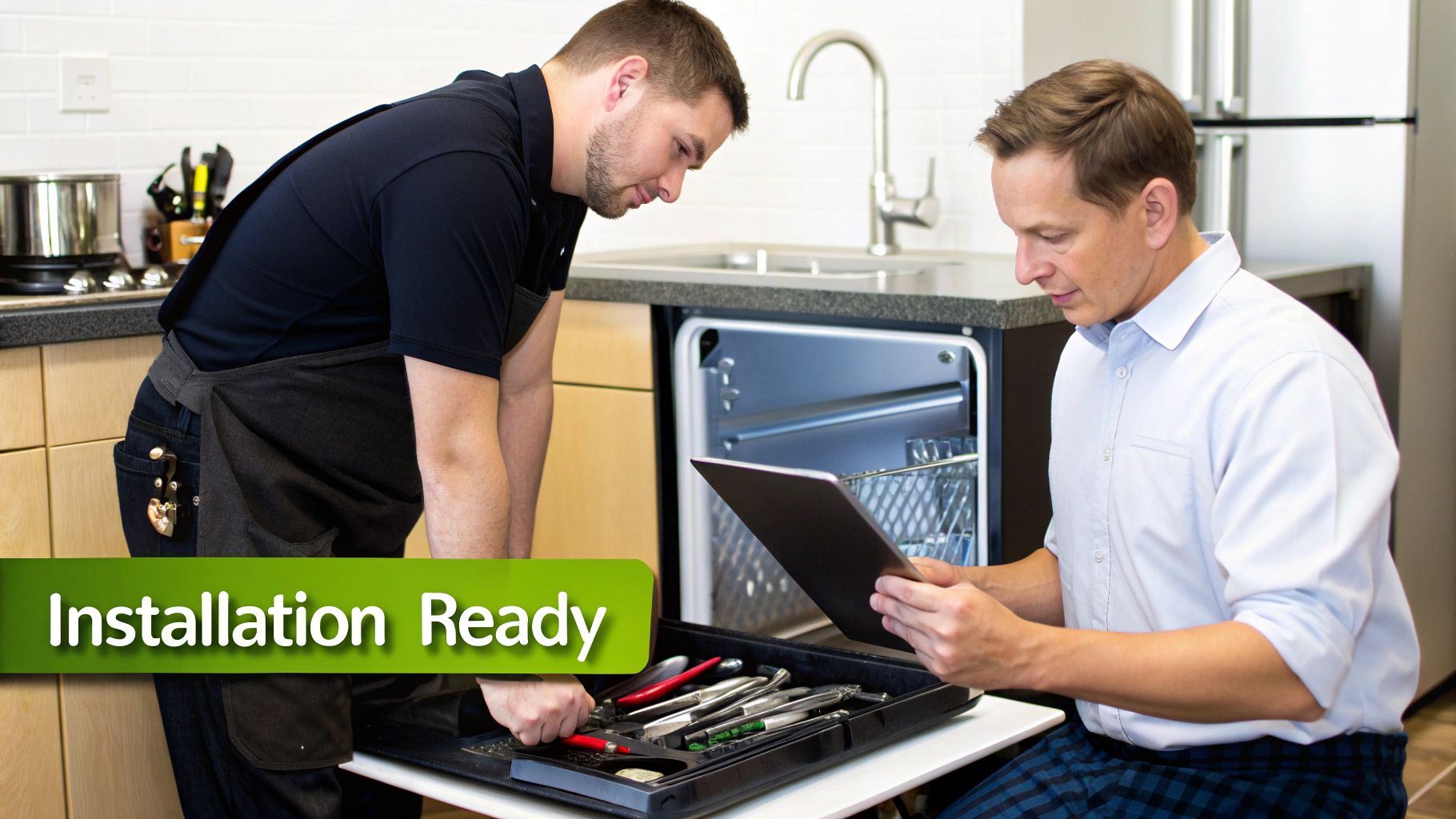
This process actually kicks off well before the delivery truck pulls up. Your job is to prepare the site, and believe me, it’s a crucial step for a hassle-free installation.
Your Site Readiness Checklist
Nothing throws off a schedule like a chaotic installation. It costs you time, money, and can even lead to extra fees if the technicians have to come back. To avoid this, grab a tape measure and run through this checklist about a week before your scheduled installation day.
- Are Your Utility Hookups Ready? Double-check the electrical outlet. Does it match the dishwasher's voltage and phase (208V, three-phase, for example)? Make sure the hot water lines and drainage are exactly where they need to be and have the correct fittings.
- Is the Path Clear? Measure the entire route from the loading dock to the machine's final home. You need to be certain it will fit through every doorway and hallway. Clear the area completely of any obstacles.
- Who is Getting Trained? The installation tech is your first and best source of hands-on training. Designate a couple of key staff members to be present. They’ll learn the essentials of daily operation, cleaning cycles, and basic troubleshooting—you don't want that knowledge walking out the door.
Lessor-Provided vs. In-House Maintenance
Most leasing agreements include a maintenance package, but the details matter. Your main decision is whether to rely on the lessor’s technicians or try to handle things yourself.
For most businesses, a lessor-provided maintenance plan is the way to go. It rolls routine service, emergency repairs, and often parts and labor into a predictable monthly payment. You get peace of mind knowing an expert is just a phone call away.
Handling maintenance in-house is pretty rare. It really only works if you already employ a skilled facilities or maintenance team. It might look cheaper initially, but one big, unexpected repair could easily cost more than an entire year's service contract. No matter what your lease says, it's smart to think about proactive commercial plumbing maintenance to keep your whole kitchen in top shape.
A well-maintained machine isn't just about avoiding breakdowns; it's about consistency. Proper care ensures every plate, glass, and fork meets health and safety standards, protecting your customers and your reputation with every wash cycle.
The Non-Negotiables of Health and Safety
Let’s be clear: compliance isn't optional. Your commercial dishwasher is a critical checkpoint for any health inspector. Getting it wrong can lead to hefty fines or, even worse, a temporary shutdown.
Here are the absolute must-haves:
- Hitting the Right Temps: High-temperature dishwashers have to reach a final rinse of at least 180°F to properly sanitize. If you have a low-temp unit, the chemical sanitizers must be at the correct concentration.
- Look for the NSF Mark: Your leased machine absolutely must be NSF-certified. This certification is your guarantee that it's designed for food safety and is easy to clean properly.
- Daily Cleaning and Descaling: Your team needs a rock-solid daily cleaning routine. If you're in an area with hard water, regular descaling is critical to prevent mineral buildup that can hide bacteria and wreck the machine.
These strict hygiene standards are a huge reason the commercial dishwasher market is growing so fast. The industry, including leasing, was valued at USD 3.49 billion and is expected to hit USD 4.98 billion by 2032. Regulations, especially in places like North America, are pushing businesses to invest in reliable, compliant equipment. You can dig deeper into the factors driving the commercial dishwasher industry to see where things are headed.
Local Leasing Tips for Seattle and Pacific Northwest Restaurants
For anyone running a restaurant in the Pacific Northwest, you know that local conditions are everything. It’s not just a minor detail; it’s a critical factor in every equipment decision you make. When you're looking to lease a commercial dishwasher in Seattle or anywhere in the Puget Sound, what's happening outside your four walls has a direct impact on what happens in your kitchen.
The unique challenges we face here—from our water chemistry to our utility providers—can make or break your entire warewashing program. This is practical, local knowledge you can use to save money and stay ahead of the game.
Taming Pacific Northwest Hard Water
Let's talk about one of our biggest regional headaches: the famously hard water found all over the Puget Sound area. This high mineral content is absolutely brutal on commercial dishwashers. It leads to limescale buildup that clogs spray arms, wrecks heating elements, and leaves that dreaded chalky film on your glassware.
When you're leasing, you aren't just picking a machine; you're picking a complete solution. Your vendor needs to be an expert on our local water.
- Insist on a Water Test: Any reputable local provider will test your water's hardness right away. From there, they should recommend the right water softening or filtration system for your specific location.
- Verify the Chemical Program: Make sure your lease includes a chemical package specifically formulated for hard water. This is what prevents scale and guarantees your dishes are properly sanitized. Skipping this can actually void your machine's warranty and stick you with costly repair bills.
This isn’t some upsell tactic. It’s a non-negotiable for keeping your leased dishwasher running efficiently and making it last.
The Value of a Local Service Network
Picture this: it’s a Friday night rush in Fremont, and your dishwasher goes down. You absolutely cannot afford to wait for a technician driving in from hours away. Downtime is a profit killer, which is why a vendor’s service network is arguably more important than the machine itself.
Before you sign anything, confirm that your leasing partner has a solid team of local technicians who can promise a fast response time. Proximity means quicker repairs and less chaos in your kitchen. You're looking for a partner who truly gets the urgency of a professional kitchen. As you explore your options, you'll find many of the best local partners are also featured among the top restaurant supply stores in Seattle, proving they have a real stake in our local community.
Tapping Into Local Energy Rebates
Here in the PNW, there’s a huge focus on sustainability, and our local utility companies often reward businesses for making green choices. This is a massive, and often overlooked, financial perk when leasing a commercial dishwasher.
Providers like Seattle City Light and Puget Sound Energy (PSE) frequently offer significant rebates for installing high-efficiency, ENERGY STAR® certified equipment. These rebates can actually offset a good chunk of your lease payments, turning an operational expense into an even smarter financial move.
Ask potential vendors if they know about the current local rebate programs. A good partner won't just help you select a qualifying high-efficiency model; they’ll often help with the paperwork, making it dead simple to claim these valuable incentives. This one step can literally save you hundreds of dollars over the life of your lease.
Answering Your Top Questions About Commercial Dishwasher Leasing
When you're thinking about leasing a commercial dishwasher, a few key questions always bubble up. I've heard these from countless restaurant owners over the years, so let's get you some straight answers to help you feel confident about your decision. Staying informed helps you discover the best path for your restaurant.
Planning for Business Growth
What happens if my business grows and I need a bigger dishwasher?
This is a great question and actually highlights one of the biggest perks of leasing. Most good leasing companies expect you to grow and build upgrade paths right into their agreements. This lets you swap out your current machine for a bigger, badder model just by adjusting your lease terms.
The trick is to bring this up early. When you're talking to vendors, make sure you ask exactly how an upgrade works. What are the fees? Does it reset your lease term? Getting this flexibility spelled out in your contract from day one means your equipment will never hold back your success.
Understanding Repair Responsibilities
Am I on the hook for repairs if the dishwasher breaks down?
This really comes down to the fine print in your contract. If you have a full-service lease, you're golden—all the maintenance and repairs are usually bundled into your monthly payment. It's the "set it and forget it" option. Other, more basic leases might only cover parts, meaning you’re paying for a technician’s time.
My advice? Always, always clarify exactly what's covered in the maintenance package before you sign anything. A five-minute conversation can save you from a four-figure repair bill right in the middle of a dinner rush.
Are my lease payments tax deductible?
More often than not, yes. Lease payments are typically considered an operating expense, which means you can often deduct the full amount from your taxes. This can be a huge financial advantage compared to buying a machine, which is a depreciating asset.
That said, tax laws have their quirks, and how you benefit depends on the type of lease (operating vs. capital) and your specific financial situation. This is where your accountant is your best friend. Have a quick chat with them to see exactly how leasing a dishwasher will play out on your restaurant's balance sheet so you can make the most of it.
Ready to find a warewashing solution with terms that actually work for your business? The team at Encore Seattle Restaurant Equipment has been in the trenches with Pacific Northwest restaurants for decades. We pride ourselves on expert advice, transparent leasing contracts, and a huge selection of the best dishwashers in the game. Explore our leasing options today and let's build a more efficient, profitable kitchen together.