
Lease to Own Concession Trailer: Launch Your Mobile Kitchen Today
So, you're dreaming of launching a food trailer, but the idea of dropping a huge chunk of cash upfront feels a little daunting. That's where a lease to own concession trailer program comes in. Think of it as a 'rent-to-buy' plan for your mobile kitchen. It’s a practical way for restaurant owners and chefs to get their business on the road by making regular monthly payments, all while working their way toward owning the trailer outright.
This model is a game-changer for chefs and aspiring entrepreneurs who want to break into the mobile food scene without draining their savings account from day one. It's an ideal way to stay on top of industry trends by getting access to the latest equipment now.
Breaking Down the Lease To Own Model
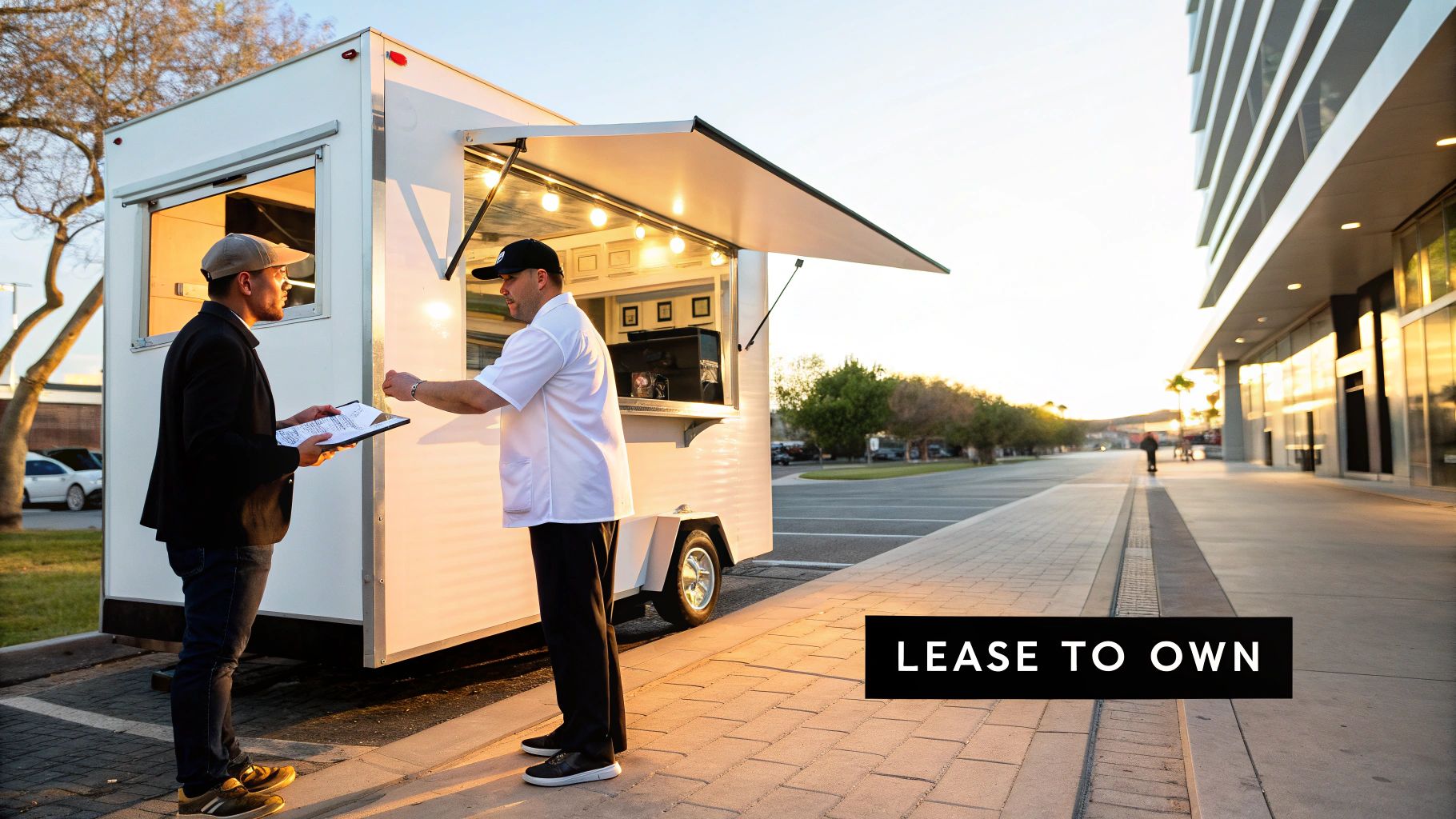
It’s a lot like leasing a car with the intention of buying it when the lease is up. Instead of shelling out $40,000 to $60,000 for a brand-new trailer, you start with a much smaller initial payment. This smart approach keeps your cash free for other essentials, like stocking up on ingredients and restaurant supplies, getting the right permits, and marketing your new venture.
Every monthly payment you make is doing double duty. A portion covers the "rent" for using the trailer, and the rest goes toward building your ownership equity. It’s a structure designed to get you serving customers and making money far sooner than if you had to save up for the full purchase price. If you want to explore this idea further, we have a helpful guide on food truck rent-to-own options that goes into more detail.
This financial pathway has become incredibly popular as the mobile food industry booms. Historically, lease-to-own has slashed entry costs by 35%. That’s a huge deal, especially considering that since 2020, about 28% of food business operators have shifted to mobile models. With concession trailers making up 43% of the mobile food market and the global food truck industry expected to hit USD 3.6 billion by 2030, this isn't just a trend—it's a smart business move.
Lease to Own At a Glance
To make it even clearer, here's a simple breakdown of the key parts you'll find in almost every lease-to-own agreement.
| Component | Description |
|---|---|
| Lease Agreement | The initial contract you sign, which sets out the monthly payment, term length, and usage rules for the trailer. |
| Monthly Payments | Your fixed regular payment. Part of this covers the lease, and the other part builds your equity toward ownership. |
| Term Length | This is how long the lease period lasts before you can buy the trailer, typically ranging from 1 to 6 years. |
| Purchase Option | The critical part of the deal. At the end of the term, you have the right to buy the trailer for a predetermined price. |
| Final Buyout | This is the final amount you pay to take full ownership. It could be a percentage of the original value or a nominal fee like $1. |
This table shows how each component fits together to create a clear, step-by-step path to owning your food trailer.
The Core Components
So what does a typical agreement actually look like? While the fine print can differ between leasing companies, you'll always find a few fundamental pieces that shape the deal.
- Lease Term: This is simply the length of your payment plan. Most agreements run anywhere from one to six years, giving you time to build your business.
- Monthly Payments: You'll make the same payment every month. This predictability is fantastic for budgeting and managing your cash flow, especially in the early days.
- Purchase Option: This is the light at the end of the tunnel. When your lease term is up, you get the option to buy the trailer for a price that was set from the very beginning. In many cases, it’s a symbolic amount, sometimes as low as $1.
This setup gives you a direct and manageable route to owning a valuable asset for your business—all while you're out there building a loyal customer base and making a name for yourself.
The Strategic Advantages of Leasing to Own
Choosing to lease to own a concession trailer isn't just about managing upfront costs; it's a savvy strategic move that seasoned food entrepreneurs and chefs use to get ahead. Think of it this way: it frees up your working capital, which is the absolute lifeblood of any new business.
Instead of sinking a massive chunk of cash into a down payment, you can put that money to work immediately. We're talking about investing in top-tier ingredients, restaurant supplies that make your menu unforgettable, designing bold branding that stops people in their tracks, or launching a marketing blitz that has customers lining up on day one.
Test the Waters with Less Risk
One of the smartest reasons to go this route is the chance to test your business idea without putting everything on the line. A lease-to-own agreement lets you hit the streets, see what menu items actually sell, and figure out which locations are goldmines—all before you're locked into the full financial weight of ownership.
A lease to own agreement is your safety net. You get all the operational freedom of an owner but with the financial flexibility of a renter. It gives you room to breathe, to pivot, and to really nail down your business plan based on what customers actually want.
This approach is all about gathering real-world data and building a customer base while you confirm that the food truck life is truly for you. It’s a calculated, intelligent way to prove your concept works.
Unlock Tax Benefits and Modern Equipment
Beyond just testing the market, a lease-to-own plan comes with some very real financial perks. Your monthly lease payments are typically considered operating expenses, which often means you can write them off on your taxes. That can add up to significant savings over the life of your agreement. We dive deeper into this in our guide on restaurant equipment financing.
Plus, leasing gives you access to brand-new, top-of-the-line trailers. You start your journey with modern, reliable restaurant equipment that won’t break down mid-service. This not only keeps your operation looking professional but also saves you the headache and cost of surprise repairs right when you can least afford them.
This financial model is making a huge impact on the industry. As mobile food businesses boom, lease-to-own has become a go-to strategy, especially with the explosion of food festivals and outdoor events. The food truck market was valued at USD 5.7 billion in 2025 and is expected to more than double to USD 11.4 billion by 2035. Here in the US, the market hit USD 4.52 billion in 2024, with lease-to-own helping over 60% of new entrepreneurs get their trailers without draining their startup funds. You can dig into more of these food truck market trends on MarketResearch.com.
Getting Into the Weeds: Costs and Contract Details

The difference between a great deal and a money pit is always buried in the details. When you're looking at a lease-to-own concession trailer, you have to get comfortable with the fine print. This is how you avoid nasty surprises down the road and make sure the agreement is actually setting you up for success.
Let's pull back the curtain on the financial and legal side of things. It's not just about the monthly payment you see advertised. The real cost is a mix of three things: what you pay upfront, your monthly payments, and the final price to take ownership. It's a structure built to get you into the game, but you need to see the big picture of what you'll pay over the entire term.
A Hypothetical Cost Breakdown
Let's make this real with an example. Say you've got your eye on a concession trailer that costs $50,000. Here’s how a lease-to-own plan might shake out:
- Initial Payment: Most programs will ask for a deposit, usually somewhere around 30%. For our $50,000 trailer, that means an upfront payment of $15,000. This shows the leasing company you’re serious and gets the keys in your hand.
- Monthly Payments: Now for the regular payments. Let's assume a four-year (48-month) term. Based on various factors, your payment might land around $1,100 per month. Over those four years, you’d pay a total of $52,800.
- Final Buyout: This is the best part of many agreements—the $1 buyout option. After you’ve made that last monthly payment, you hand over a single dollar, and the title is officially yours.
So, in this example, the total cost to own that trailer comes to $67,801 ($15,000 + $52,800 + $1). Yes, it's more than the original sticker price. But the trade-off is that you get to use the trailer to make money and build your business while you pay for it over time.
Decoding Common Contract Clauses
The numbers are only half the story. The contract is where the rules of the game are written, and not understanding them can cause major headaches and unexpected bills.
Reading your lease agreement carefully is non-negotiable. Every clause, from maintenance duties to early termination penalties, directly impacts your business's bottom line and operational freedom.
Here are the big ones you need to hunt for and understand completely:
- Maintenance and Repairs: Who fixes it when something breaks? In virtually every lease-to-own deal, you, the lessee, are responsible for all of it. From routine oil changes on the generator to fixing a broken fryer, it’s on your dime. You need to budget for this from day one.
- Insurance Requirements: You’ll be required to carry pretty robust insurance on the trailer. This protects the leasing company’s asset until you own it, but it’s a real operational cost you must factor into your monthly expenses.
- Early Termination Clause: What if your plans change and you need to get out of the lease? The contract will spell out the penalties, and they can be steep. You need to know exactly what you're facing before you sign on the dotted line.
Remember, the trailer lease is just one piece of the puzzle. You'll also need to get a handle on all the local food truck permit requirements to operate legally. And these leasing principles don't just apply to trailers; they're common for other big-ticket items. You can see how the finances work in a similar way by checking out our guide on leasing a commercial dishwasher.
How to Qualify for a Concession Trailer Lease
Getting approved for a lease-to-own concession trailer is usually a different ballgame than trying to get a traditional bank loan. Banks tend to get fixated on a perfect credit history, but leasing companies often look at the bigger picture. They know the food business and are often more interested in your vision and real-world experience.
So, what about your credit score? That's the first thing most people worry about, and for good reason. The good news is that you don't necessarily need a flawless score. Many lease-to-own providers are looking for a score of 600 or higher, which is often a more realistic target than the 650+ that banks typically demand. A few bumps in your credit history won't automatically disqualify you; it's just one piece of the puzzle.
Assembling Your Application Package
To get that approval, you need to show them you’re a solid bet. Think of it like your financial mise en place—having everything prepped and ready proves you're organized and serious about making this work.
Here’s a quick checklist of what you’ll almost always need to have on hand:
- Recent Bank Statements: Lenders want to see your cash flow. Having your last three to six months of statements ready shows them how you manage your money.
- Personal and Business Tax Returns: These give a clear snapshot of your financial history and how much you've been earning.
- A Solid Business Plan: This isn't just paperwork; it’s where you sell your dream. It tells the story of your business and shows its potential.
Especially if you’re just starting out, a well-thought-out business plan is your secret weapon. It shows you've done the research and crunched the numbers.
A strong business plan is more than a formality—it's the story that convinces a lender your concession trailer will be a money-maker. It needs to clearly lay out your menu, who you're selling to, and honest financial projections.
Making Your Application Stand Out
Submitting the documents is just the first step. To really increase your odds of getting approved, you need to show you're a partner they can count on. Lenders want to see that you're prepared, you know your stuff, and you're all in on making your food truck a success.
One of the best things you can do is offer a larger down payment if you can swing it. The standard is often around 30%, but putting more cash down upfront lowers the lender's risk and signals that you have skin in the game.
Another huge plus? Industry experience. If you’ve worked as a chef, managed a restaurant, or run a catering business, make sure they know it. It proves you understand the grind of the food service world, which makes you a much more compelling applicant.
Comparing Your Food Trailer Financing Options
A lease-to-own concession trailer program can be a game-changer, but it’s just one tool in your financial toolbox. To make the best call for your new venture, you have to see how it stacks up against the other ways people get into this business.
Each path—leasing to own, getting a traditional bank loan, or just renting—is built for different business plans and financial realities. It's all about finding the right fit for you.
Financing Options Compared: Lease-to-Own vs. Loan vs. Rental
The perfect financing route really comes down to your cash on hand, credit history, and what you’re trying to build. This table lays out the core differences between the three main choices.
| Feature | Lease-to-Own | Bank Loan | Direct Rental |
|---|---|---|---|
| Upfront Cost | Moderate (Typically a 30% deposit) | High (Requires a 10-20% down payment) | Low (First/last month's rent and security deposit) |
| Path to Ownership | Eventual ownership is the end goal. | You own the trailer from day one. | No ownership path; you never build equity. |
| Credit Score | More flexible (often 600+ is acceptable) | Strict (Usually requires a score of 650+) | Most flexible (Often no major credit check) |
| Flexibility | Moderate (Locked into a term with a buyout option) | Low (Locked into a long-term loan agreement) | High (Short-term contracts, easy to end) |
As you can see, it's all about trade-offs. A lease-to-own arrangement hits a sweet spot, giving you a clear shot at ownership without the sky-high credit requirements of a bank. That's why it's such a popular option for entrepreneurs just getting started.
Making the Right Choice for Your Business
Picking your financing isn't just a numbers game; it's a strategic move that will define the early days of your business. The best choice hangs on where you are right now and what you need most. Is it more important to keep cash in your pocket upfront, or is your main goal to pay the least amount possible over the long haul?
Think about it this way: a chef who already has a successful catering company and a great credit score might find a bank loan is the cheapest way to own a trailer. On the flip side, someone just testing out a new food concept might prefer the no-strings-attached feel of a direct rental.
This simple decision tree can help you visualize which path might be your best bet.
The flowchart shows how things like your credit score, how solid your business plan is, and your experience in the food industry all point toward the right financing for you.
A lease-to-own agreement is the ideal middle ground for many. It's designed for the serious entrepreneur who wants to own their asset but needs a more accessible entry point than a traditional loan provides.
In the end, you want to choose the financing that gives your business the best chance to thrive. By really thinking through the upfront costs, the path to ownership, and the flexibility of each option, you can make a smart decision that turns your mobile food dream into a reality.
Taking the Next Step with a Trusted Partner
Turning that mobile food dream into a real, functioning business comes down to one thing: picking the right partner. The road to getting a lease to own concession trailer is a whole lot smoother when you've got an equipment supplier who truly gets the pressures of the food service world.
You're not just looking for a salesperson. You need an ally—a team that knows the difference between a good layout and a great one, and who can guide you to the right restaurant equipment without just trying to make a sale. That's where a partner like Encore Seattle comes in. We connect you with top-tier brands and offer straightforward financing because we've been there. We know what it takes to build a mobile kitchen that actually works.
Your Action Plan for Launch
Feeling ready to make a move? Here’s a simple game plan to get you started down the path to ownership.
- Browse the Inventory: First things first, get a feel for what’s out there. Look at the different trailers available and really think about how the size, layout, and build will work with your specific menu and the way you need to operate.
- Assess Key Features: Zero in on the details that matter. Is the construction solid? Are the surfaces NSF-certified? Does the flow from prep to cooking to service make sense? A well-designed trailer is the backbone of an efficient business.
- Start the Application: Once you’ve got a trailer in your sights, it's time to begin the application. A good partner makes this part easy, helping you pull together the right documents to get you across the finish line.
Connecting with the Right Resources
Remember, the right partner offers more than just the trailer itself. As you weigh your options, it’s smart to look into companies that provide specialized operational solutions for food trucks to set you up for success long after you hit the road.
There’s a reason lease-to-own has become such a popular route. It makes launching a food business genuinely attainable. In the US, trailers hold a massive 43.27% market share in 2024 precisely because the entry costs are so much lower, and this model is a proven winner for entrepreneurs. You can dig deeper into the expanding US food truck market on Mordor Intelligence to see just how much opportunity is out there.
Frequently Asked Questions
When you're digging into the details of a lease-to-own concession trailer, a few key questions always come up. Let's tackle some of the most common ones I hear from restaurant owners and chefs gearing up to launch their mobile food business.
Can I Get a Lease with Bad Credit?
It's a common worry, but the short answer is yes, it’s definitely possible. Lease-to-own arrangements are often more forgiving than a traditional bank loan, which typically demands a credit score of 650 or higher.
Many of our leasing partners are willing to work with scores down to the 600 range. They tend to look at the bigger picture—like the strength of your business plan and your overall financial health—not just a single number. Be prepared, though; a lower score might require a larger down payment or a co-signer to get you over the finish line. It’s all about giving serious entrepreneurs a shot.
Who Handles Repairs and Insurance?
This is a crucial point to understand: you do. Once you sign the agreement, you, the lessee, are responsible for all maintenance and insurance on the trailer. Think of it like owning a car—from routine tune-ups to fixing a fryer that decides to quit mid-service, it's all on you.
You'll also need to carry comprehensive insurance for the trailer. This is a non-negotiable requirement to protect the leasing company's asset until the title is in your name. Make sure you factor this ongoing expense into your monthly budget from day one.
Think of the trailer as your business's home on wheels from day one. You're in charge of keeping it safe, insured, and in perfect working order, even while you're still on the path to ownership.
Are the Monthly Payments Fixed?
Absolutely. This is one of the biggest draws of a lease-to-own plan. Your monthly payment is locked in from the start and won't change over the entire term. That kind of predictability is a massive advantage for budgeting.
Knowing exactly what you owe each month helps you manage cash flow, which is especially helpful when dealing with the seasonal ups and downs of the food truck business. Just remember that opting for a longer term might give you a lower monthly payment, but it could also mean paying more for the trailer in the long run.
Ready to stop dreaming and start serving? At Encore Seattle Restaurant Equipment, we provide the high-quality restaurant equipment and supplies, financing connections, and industry news to get your mobile kitchen on the road. Explore your options and exclusive deals with us today at https://encoreseattle.com.