
How to Start a Coffee Shop Business An Entrepreneur's Guide
So you've got a passion for coffee. That's the perfect starting point, but turning that passion into a profitable business means swapping your barista apron for a planner and a calculator. It’s time to build a concrete plan by testing your concept, digging into the local market, and creating a financial roadmap that proves your idea can actually make money.
From Passion Project to Viable Business Plan
Every great coffee shop starts with a vision—maybe it’s for a cozy neighborhood spot, a high-end roastery, or a super-fast drive-thru. But the journey from that first spark to opening day is paved with careful planning. This is the stage where the romance of owning a café meets the reality of running a serious business.
The global coffee market is enormous, projected to hit $473.15 billion by 2025. But don't let that fool you into thinking it's easy. The hard truth is that over half of independent coffee shops fail within five years. And it's almost never because of bad coffee. The real killers are usually financial missteps, a poor location, or skimping on the right restaurant equipment.
Defining Your Unique Coffee Shop Concept
Before you even think about writing a business plan, you need to get crystal clear on what kind of coffee shop you're opening. A vague idea of "a nice place with good coffee" won't cut it. You need a specific, compelling concept that will guide every decision you make, from the music you play to the mugs you buy.
What's your model? Consider a few popular routes:
- Specialty Roastery & Tasting Room: This is for the true coffee nerds. You're roasting beans in-house, hosting cuppings, and educating customers. Your clientele is willing to pay more for exceptional quality and a deep dive into the craft.
- Cozy Community Hub: Think comfy chairs, reliable Wi-Fi, and a vibe that makes people want to hang out all day. Here, the atmosphere is just as important as the coffee. You’re building a "third place" for locals to work, meet, and relax.
- High-Speed Drive-Thru: This model is all about speed and convenience. It's built for high-traffic commuter routes where people want great coffee without getting out of their car. Your menu needs to be tight and your workflow has to be flawless.
This initial process of refining your idea through research is absolutely fundamental.
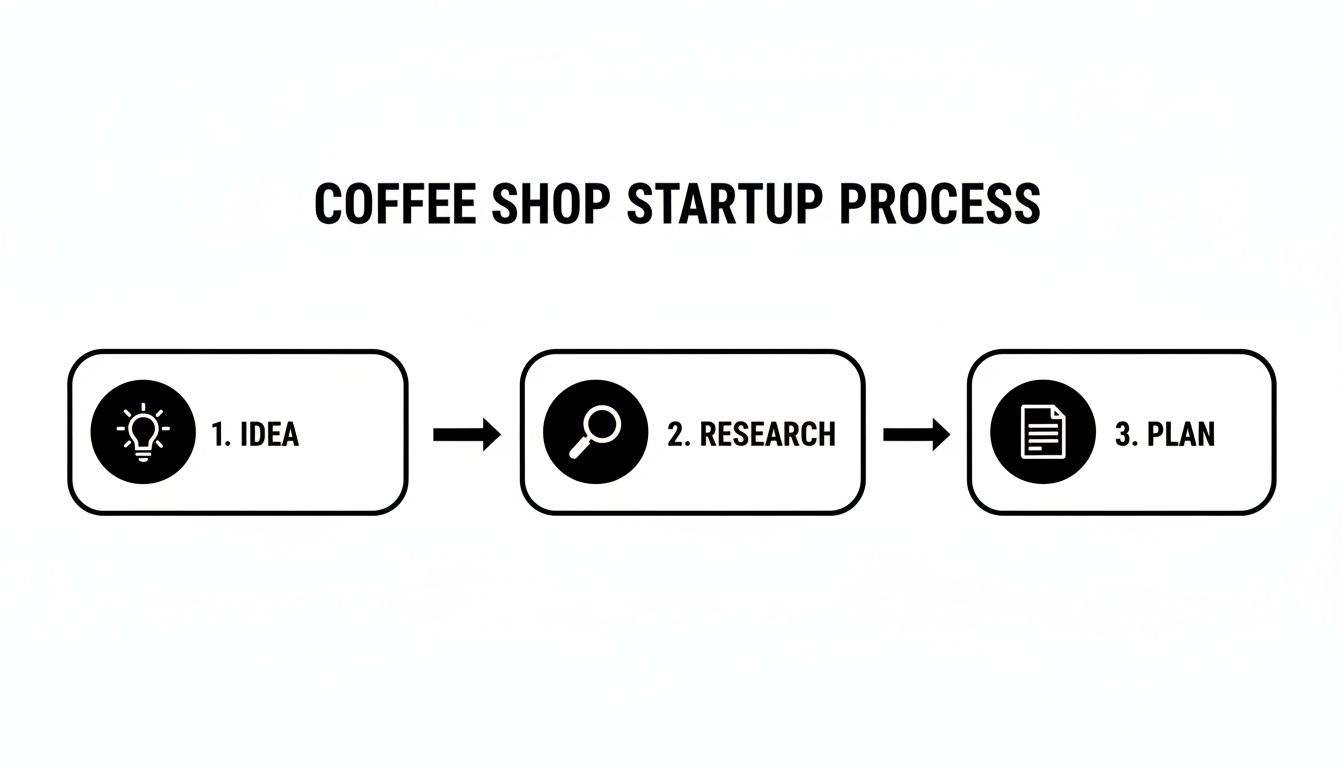
As you can see, a solid plan isn’t just a document you write. It’s the result of challenging your own ideas and doing your homework on the market.
Crafting a Business Plan That Attracts Investors
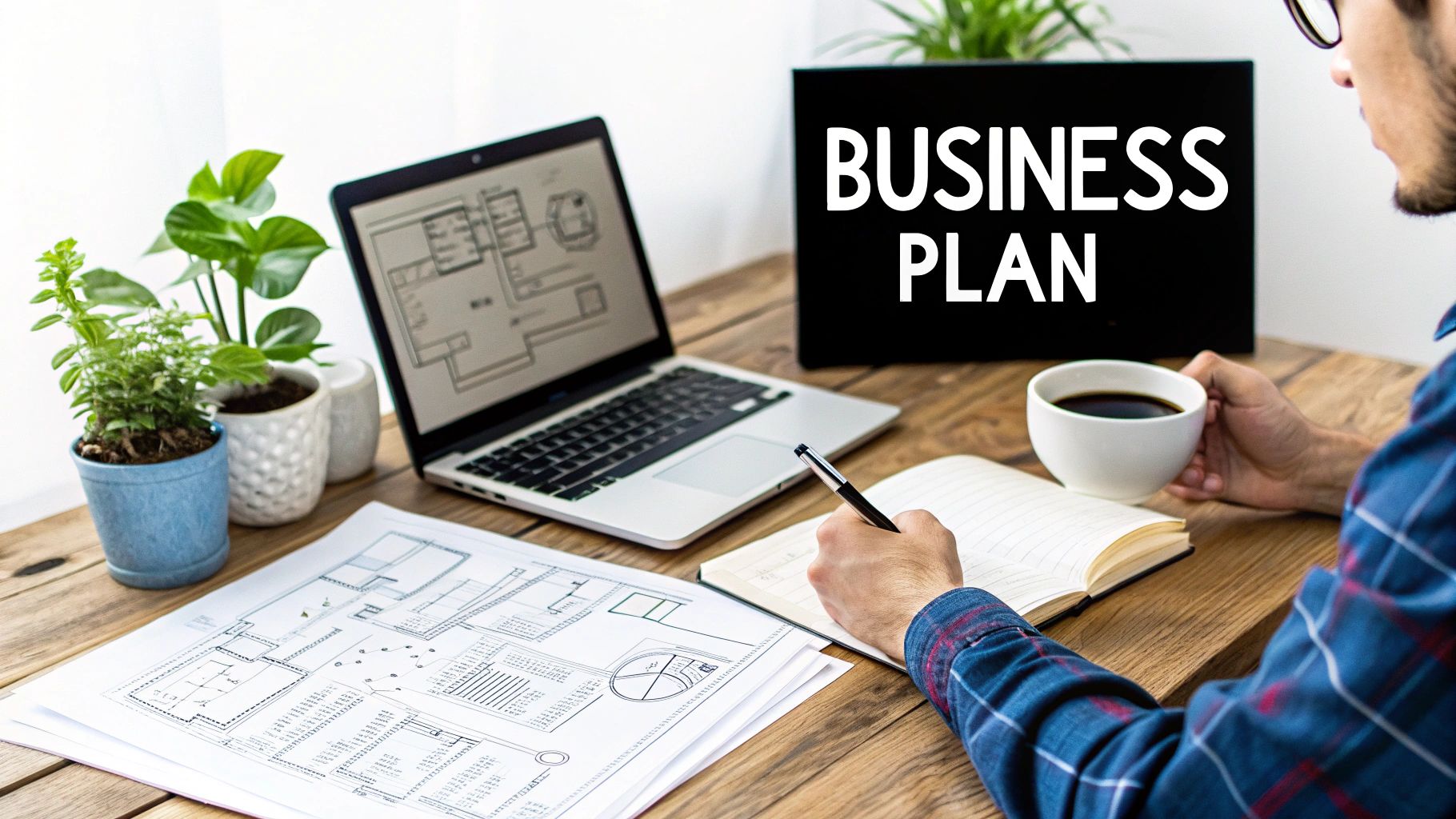
Your business plan is the single most important document you'll create. It's your roadmap, your sales pitch to the bank, and your personal reality check. It forces you to think through every single detail. If you're wondering where to start, this guide on how to write a business plan that actually works is an excellent resource.
A great business plan does more than just outline your idea; it tells a compelling story backed by realistic data. It demonstrates that you understand your market, know your numbers, and have a clear strategy for profitability.
Your plan needs to cover your operational strategy, your marketing game plan, and who’s on your team. But most importantly, it needs rock-solid financial forecasts. These numbers are what prove your concept isn't just a dream. You'll need to build out detailed financial statements, and it can be incredibly helpful to look at a sample profit and loss statement for a restaurant to see what lenders expect. Without believable numbers, getting a loan or attracting investors is next to impossible.
Budgeting For Your Launch
Estimating startup costs can feel overwhelming, but breaking it down makes it manageable. From rent deposits to your first big coffee order, every dollar needs a home in your budget. This worksheet is designed to help you organize your thoughts and build a realistic financial picture.
Initial Startup Cost Estimation Worksheet
| Expense Category | Estimated Cost Range (Low) | Estimated Cost Range (High) | Notes & Considerations |
|---|---|---|---|
| Lease & Build-Out | $25,000 | $150,000+ | Includes security deposit, rent, construction, plumbing, and electrical. Highly variable based on location and space condition. |
| Professional Fees | $5,000 | $25,000 | Architect, attorney for lease review, business registration, accountant. Don't skip the experts. |
| Permits & Licenses | $1,000 | $5,000 | Health department permits, business licenses, food handler cards. Varies significantly by city/county. |
| Equipment & Supplies | $30,000 | $100,000 | Espresso machine, grinders, brewers, refrigeration, dishwasher. Buying used vs. new is a major factor. |
| Initial Inventory | $5,000 | $12,000 | Coffee, milk, syrups, pastries, paper goods. Includes first orders from all suppliers. |
| POS System & Tech | $2,000 | $8,000 | Point-of-sale hardware/software, Wi-Fi setup, security cameras, sound system. |
| Furniture & Fixtures | $10,000 | $40,000 | Tables, chairs, lighting, cabinetry, decor. Reflects your brand and concept. |
| Marketing & Grand Opening | $3,000 | $10,000 | Signage, website, social media ads, soft opening events. Crucial for a strong start. |
| Working Capital | $15,000 | $50,000 | The cash reserve to cover payroll, rent, and utilities for the first 3-6 months. This is non-negotiable. |
Remember, these are just estimates. Your own research will help you plug in numbers that are specific to your market and vision. Having a well-thought-out budget is your best tool for convincing lenders—and yourself—that you’re ready for this.
Securing Funding and Finding the Perfect Location
Alright, you've got a killer business plan. Now comes the part where the dream starts to meet reality: money and a physical address. These two pieces of the puzzle are completely connected. The location you fall in love with will dictate how much funding you need, and the capital you can actually get your hands on will define where you can afford to set up shop.
When you walk into a lender's office, you need to show them you've done more than just daydream about latte art. They need to see a clear, believable path to making money. This is where all that hard work on your financial projections pays off—it proves you understand the real costs of running this business.
Exploring Your Financing Options
Let's be honest: raising capital is often the biggest hurdle. The good news? You've got options, and most successful shops use a mix of them.
- Traditional Bank and SBA Loans: Small Business Administration (SBA) loans are a fantastic starting point. Because they're backed by the government, banks are often more willing to take a chance on a new coffee shop.
- Personal Savings and Investors: Putting your own skin in the game shows commitment. Bringing on partners who believe in your vision not only provides cash but also reduces your personal debt.
- Equipment Financing: Your espresso machine, grinders, and refrigerators are a huge expense. Instead of draining your cash reserves, equipment financing lets you make monthly payments. This is a smart move that keeps your working capital free for things like payroll, inventory, and marketing.
For restaurant owners and chefs looking to stay informed about the latest industry trends, exploring different financial models is key. For a deeper dive, check out our guide on restaurant equipment financing options to see how you can manage this major expense without breaking the bank.
The Science of Site Selection
Think of your location as your most important employee—it works for you 24/7. The right spot can practically pull customers in off the street, while the wrong one will feel like an uphill battle every single day.
Here’s a hard and fast rule I tell every new owner: your rent or mortgage should never exceed 15% of your projected monthly sales. So, if you're aiming for $25,000 in monthly revenue, your absolute ceiling for rent is $3,750. Pushing past that number puts your business in a precarious position before you’ve even brewed your first cup.
Choosing a location is a data-driven decision, not an emotional one. Analyze foot traffic, vehicle counts during peak hours, and the demographics of the neighborhood to ensure there's a built-in audience for your specific coffee shop concept.
Analyzing Potential Locations
Scouting a spot is more than just a quick drive-by. You need to become a mini-expert on the neighborhood.
Get out there and start counting. A solid benchmark is to aim to capture about 1.5% of the morning commuter traffic that passes on your side of the street. If 10,000 cars drive by during the morning rush, you can realistically hope for about 150 of them to stop. This quick math is a powerful tool for filtering out locations that simply don’t have the volume to support your goals.
Next, think about the personality of the area. Is it a bustling downtown core, a sleepy residential street, or a busy suburban strip mall? Each has its own rhythm:
- Downtown: You'll get plenty of daytime traffic from office workers, but be prepared for quiet evenings and weekends.
- Suburban Drive-Thru: This is all about speed and convenience for commuters and families on the go. Easy access is non-negotiable.
- Residential Hub: Success here is built on becoming a beloved local spot. It demands a cozy vibe and a genuine connection to the community.
Finally, when you find a place, negotiate that lease like your business depends on it—because it does. Push for a tenant improvement (TI) allowance, where the landlord chips in for your build-out costs. A well-negotiated lease is one of the most effective ways to lower your startup costs and give your shop the best possible chance to thrive.
Choosing the Right Equipment for Your Coffee Shop
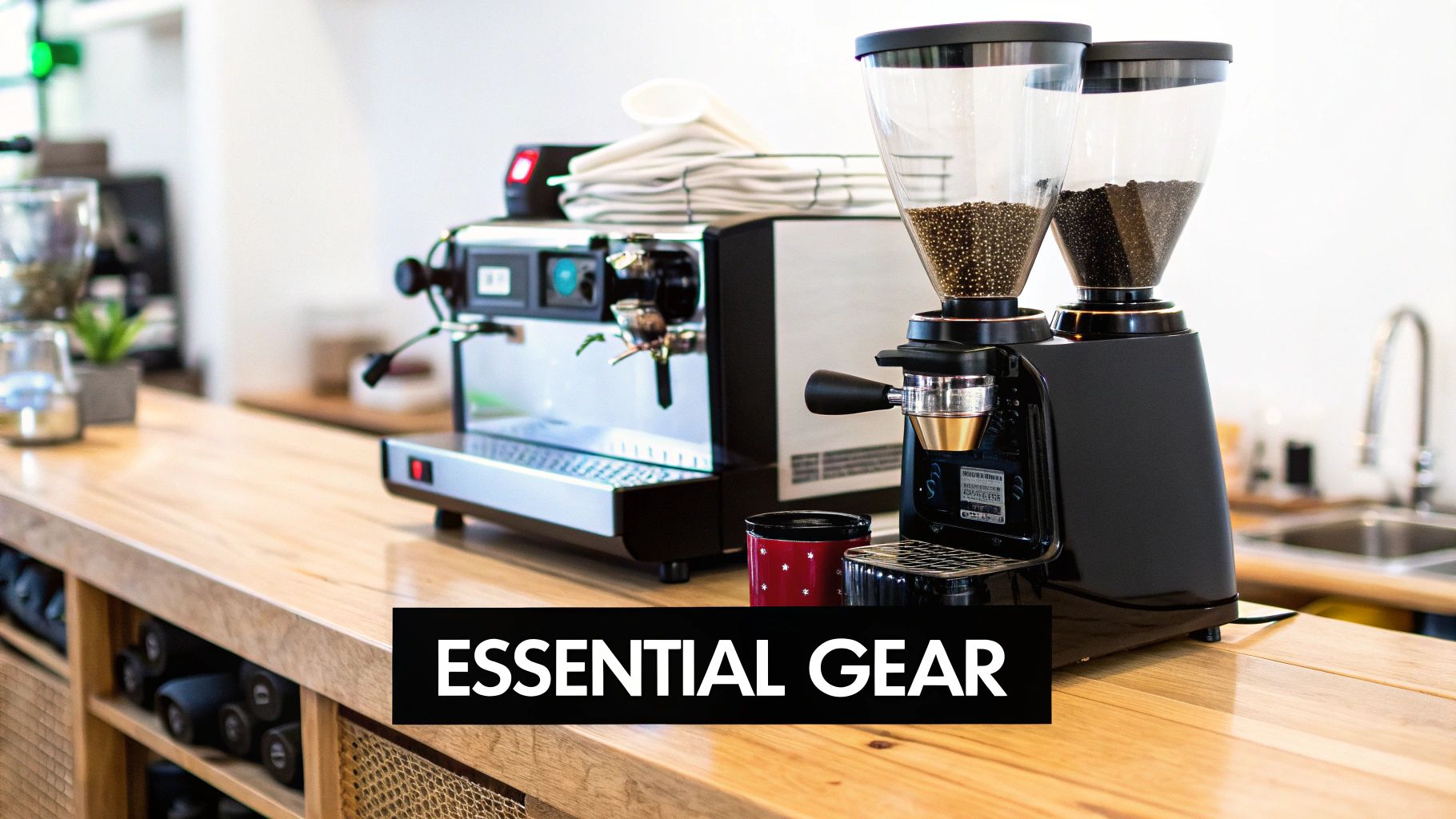
Your equipment is the heart and soul of your coffee shop. It's the engine that drives everything, from that perfect shot of espresso to the humming efficiency of your back-of-house. Making smart choices here isn't just about buying shiny new toys; it's a critical investment that directly impacts your coffee quality, your workflow, and your bottom line.
The real trick is striking that perfect balance between quality, your budget, and where you see your business in a few years. Let's get into what you actually need.
The Stars of the Show: Espresso Machines and Grinders
Before anything else, you have to nail down your espresso machine and grinders. These are the absolute non-negotiables. Skimp here, and it will show in every single cup you serve.
You need a commercial-grade espresso machine that can handle the volume you’re projecting, especially during those hectic morning rushes. Consistency and speed are the name of the game. Likewise, a quality burr grinder is fundamental. It ensures a uniform grind, which is the key to a balanced, flavorful extraction.
So, how do you pick an espresso machine? The choices can be dizzying, but it really boils down to your expected volume and workflow.
- Semi-Automatic: This machine puts your baristas in the driver's seat, giving them full control over extraction time. It’s perfect for specialty shops that want to showcase the craft and artistry of coffee-making.
- Automatic (Volumetric): This is all about consistency. Baristas can program preset shot volumes, ensuring that every espresso pull is nearly identical, no matter who is behind the counter. This is a lifesaver in high-volume settings.
Most shops need a two- or three-group machine to keep things moving. For grinders, plan on having at least two—one for your house espresso blend and another for decaf or a rotating single-origin. A separate grinder for your drip or pour-over coffee is also a very smart move.
For a deeper dive into specific models and features, check out our complete guide on how to pick the best coffee machine for your cafe.
Essential Support Equipment for a Smooth Workflow
While the espresso machine gets all the glory, the supporting cast is just as important. Your refrigeration, ice machine, and dishwasher are the unsung heroes that keep your entire operation running. A busted cooler can shut you down just as fast as a broken espresso machine.
Here's what you can't forget:
- Commercial Refrigeration: You'll need under-counter fridges for milk right at the bar, plus reach-in coolers for bottled drinks and food items.
- Ice Machine: This is an easy one to overlook, but it's crucial for iced lattes, cold brew, and other popular drinks. Make sure it can keep up on a hot summer day.
- High-Temperature Dishwasher: This isn't just a convenience; it's a food safety requirement. A commercial dishwasher sanitizes everything properly and gets mugs back into circulation quickly.
- Water Filtration System: The water you use has a massive impact on the taste of your coffee and the lifespan of your expensive machines. A good filtration system prevents scale buildup, saving you thousands in future repairs.
To make sure you don't miss anything, it's always helpful to review an ultimate coffee shop equipment list as you plan.
Sourcing Smart: New vs. Used Equipment
Here's where you'll make one of your biggest financial decisions: buying new or used. While it's tempting to get everything fresh out of the box, a savvy hybrid approach can save you a ton of cash without sacrificing quality where it counts.
The golden rule I've seen work time and again is this: Invest in new for your core coffee gear—your espresso machine and grinders. For support equipment like refrigeration and dishwashers, high-quality used items offer incredible value.
The coffee market in the US is a $343 billion industry, and it heavily favors shops that create a great experience. Since 1990, we at Encore Seattle have been helping chefs and new business owners in the Pacific Northwest do just that. We provide access to top-tier brands at used prices, which means you can stretch your startup budget further. With exclusive deals on restaurant equipment and supplies, we help you stay on top of industry trends without breaking the bank.
This kind of strategic sourcing lets you put more money toward the things your customers will actually see and taste, like that beautiful espresso machine and amazing local beans, while still building a reliable back-of-house. It’s a pragmatic approach that seasoned pros use to get ahead.
Getting Licensed and Assembling Your Team
You’ve got the money and you’ve got the space. Now comes the part where your coffee shop starts to feel real: getting the official green light to operate and hiring the people who will bring your vision to life. Tackling the legal paperwork and building your team are two tracks you’ll need to run on simultaneously.
Don't underestimate the bureaucracy. Getting all your permits in order can be a painstakingly slow process, and delays here are costly. Every day you're not open, you're burning through cash. Start early.
Laying the Legal Groundwork
The exact list of permits you'll need depends heavily on your city and state, but a few are pretty much universal for anyone serving food and drinks. Think of this as your ticket to play.
Here’s a typical rundown of what you’ll be chasing down:
- Business License: The basic permit from your city or county to legally exist as a business.
- Food Service License: This is a big one. Your local health department will issue it after inspecting your shop and confirming you meet all the public health codes.
- Food Handler’s Permits: Every single person on your team who touches food or drinks will need one of these. Yes, all your baristas.
- Certificate of Occupancy: A formal document that says your building is safe for people to be in and complies with local zoning and building codes.
A pro tip: make friends with your local health inspector. Seriously. Don't view them as an enemy. They can be an incredible resource. If you ask them questions early in your build-out, they can help you avoid expensive mistakes that you'd otherwise have to tear out and redo.
Get ahead of the paperwork game. Assume this entire process will take a few months, minimum. Map out every required permit, deadline, and inspection on a calendar. Staying organized now will prevent a mad dash that could push back your grand opening.
Hiring Your Dream Team
With the legal stuff in motion, it's time to focus on the heart and soul of your shop: your people. Your baristas aren't just making coffee; they're your ambassadors, your hosts, and the biggest reason a customer will come back tomorrow instead of going somewhere else.
When you're hiring, look for personality first. You can teach anyone the mechanics of pulling a good shot, but you can’t teach genuine warmth or a natural love for making people happy. I’ll take a friendly, reliable person with zero coffee experience over a technically perfect but aloof barista any day.
Ditch the boring interview questions. Ask about real-world situations. Try something like, "A customer complains their drink is too bitter. Walk me through exactly what you'd do." Their answer tells you everything you need to know about their attitude toward service and problem-solving.
Crafting a Killer Training Program
Consistency is king in the coffee world. A customer should get the exact same amazing latte on a Tuesday morning as they do on a Saturday afternoon, no matter who's behind the counter. That level of consistency only comes from a rock-solid training program.
Your training needs to hit three key areas:
- The Craft: All the hands-on stuff. Dialing in the grinders, pulling shots, steaming milk, basic latte art, and workflow behind the bar.
- The Knowledge: Your team has to speak confidently about your coffee. Where is it from? What does it taste like? They should be able to guide a customer to their new favorite drink.
- The Vibe: This is where you teach your shop's culture. Run through role-playing scenarios. Define how you greet every customer. Empower your team to fix problems on their own without needing a manager.
Plan for several days of paid training before you even think about opening. This isn't just about practice; it's about building a cohesive team that clicks. They need time to get comfortable with the equipment, learn to move around each other, and build the chemistry that will make for a smooth, successful launch.
Crafting Your Menu and Choosing Your Suppliers
Think of your menu as more than just a list of what you sell—it's your number one salesperson. A thoughtfully designed menu does more than display prices; it tells your shop's story, nudges customers toward your most profitable items, and is a cornerstone of your financial success. Every single decision, from the espresso beans you choose to the baker who supplies your croissants, directly shapes your bottom line.
It all starts with the coffee. This is one of your first big decisions: do you partner with a beloved local roaster or go with a larger, more established distributor? Working with a local roaster can give you a unique story, an instant connection to the community, and often, truly exceptional coffee. On the other hand, a larger distributor might offer more competitive pricing, marketing materials, and rock-solid consistency—something that can be a lifesaver when you're just getting your feet wet.
Engineering a Menu That Actually Makes Money
Menu engineering is where the art and science of your coffee shop meet. It’s all about strategically balancing what’s popular with what’s profitable. To get this right, you have to know the exact cost of every single thing you sell, down to the last pump of vanilla syrup. This means you need to meticulously calculate your cost of goods sold (COGS) for every item on the menu.
Let's get practical and break down the cost of a standard 12oz latte:
- Espresso Shot (18g): A 5lb bag of quality beans might run you $70. If you get about 80 shots per pound, that puts your cost per shot at roughly $0.22.
- Milk (10oz): With a gallon of milk costing around $4.00, the 10oz you use is about $0.31.
- The "Paper" Goods: Don't forget the cup, lid, and sleeve. This trio of supplies can easily add another $0.25 to your cost.
Your direct cost for that one latte is already around $0.78. To stay healthy, a good target for your beverage cost is between 20-25% of the menu price. So, for a drink that costs you $0.78 to make, you should be charging somewhere in the ballpark of $3.15 to $3.90. You have to run this math for everything you plan to sell.
Here’s a piece of hard-won advice: Never set your prices by just looking at what the café down the street is charging. Your pricing has to be based on your costs and the profit margin you need to thrive. Copycat pricing is one of the fastest ways to go out of business.
Building Your Network of Suppliers
Your suppliers are more than just vendors; they're your business partners. This goes for everyone—the dairy that delivers your milk, the bakery that drops off pastries, and the company that provides your restaurant supplies and paper goods. Finding people who deliver a consistent, high-quality product on time, every time, is absolutely non-negotiable. A flaky pastry supplier who’s always running out of your best-selling almond croissant will cost you sales and damage your reputation.
When you're looking for suppliers, you have to look beyond just the price sheet.
- Quality & Consistency: Can they deliver the exact same product with every single order? Your customers expect it.
- Reliability: What's their track record for on-time deliveries? Don't be afraid to ask for a few references from other local shops.
- Minimum Order Quantity: Make sure their minimum order requirements make sense for your initial sales volume. You don't want to be forced into buying more than you can sell.
- Communication: How do they handle problems? Find out if they're responsive and easy to work with before you're in a bind.
From day one, focus on building strong, mutually respectful relationships. Pay your invoices on time, be clear about your needs, and treat your suppliers like the crucial part of your team they are. A great supplier might just give you a heads-up on a price increase or offer you a deal on a new product, saving you both money and headaches. These relationships are the quiet foundation of a smooth, profitable coffee shop.
Marketing Your Launch and Building Customer Loyalty
You’ve calibrated the equipment, your team is ready to go, and the shelves are stocked with fresh beans. Now for the final, crucial piece: getting people through the door. A killer launch strategy is so much more than just hanging a "Grand Opening" banner. It’s about building momentum from day one and turning those curious first-time visitors into regulars who genuinely love your spot.
The Power of a Soft Opening
Before you swing the doors wide open to the public, you need a dress rehearsal. This is your soft opening. Invite friends, family, and maybe some owners of neighboring businesses for a low-key, limited-service event a few days before your official launch.
This isn't about making a huge splash; it's about finding your rhythm. It gives your team a low-pressure environment to work out the kinks in the workflow, smooth out service, and catch any potential snags before you're slammed with a real morning rush. Trust me, it’s a lifesaver.
From Grand Opening to Lasting Buzz
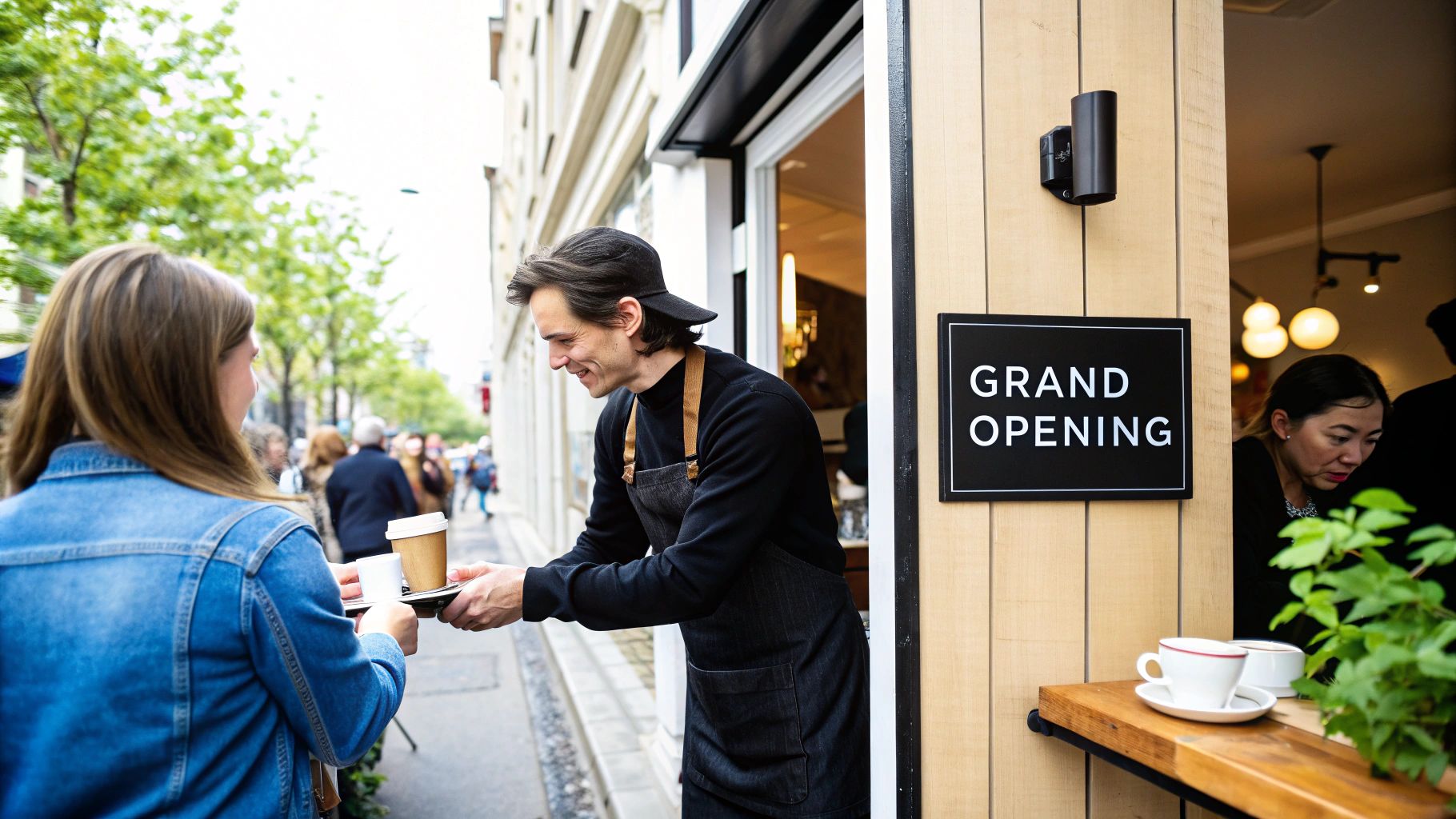
Once you've ironed out the wrinkles, it's time for the main event. Think of your grand opening as a community party, not just a sale. You could partner with the bakery next door for a cross-promotion or create an irresistible introductory special that gets people talking.
Reach out to local food bloggers and media outlets. The goal here is to generate as much local press and social media buzz as you can, positioning your shop as the new must-visit spot in the neighborhood. This is where sharing the latest news about your opening can make a huge difference.
But that opening day high doesn't last forever. The real challenge—and where the magic happens—is keeping people coming back. This is where you have to shift from a "launch" mindset to a "loyalty" mindset.
Your most powerful marketing tool will always be exceptional service. A friendly barista who remembers a customer’s name and their usual order creates a personal connection that no ad campaign can ever buy. That’s how you build a tribe.
Creating a Loyal Following
Long-term success is all about turning those first-timers into devoted fans. A simple, effective loyalty program is a fantastic place to start. Whether you go with a classic punch card or a digital points system, rewarding people for their repeat business gives them a reason to choose you over the competition down the street. It's a proven strategy: studies show 79% of consumers are more likely to join a loyalty program that doesn't require them to carry a physical card.
But loyalty goes beyond just points and freebies. You have to weave your shop into the fabric of the community.
- Showcase local art: Host a local artist's work on your walls and rotate it monthly.
- Get involved: Sponsor a local youth sports team or offer your space for small community meetings after hours.
- Build partnerships: Collaborate with other local businesses for events or promotions.
When you become a genuine part of the neighborhood, you build a kind of loyalty that has nothing to do with discounts and everything to do with connection.
Finally, you have to own your digital presence. Your Instagram should be a visual story of your brand—showcasing gorgeous latte art, happy customers, and behind-the-scenes glimpses of your team. Actively encourage and respond to online reviews on platforms like Google and Yelp. A strong, positive digital footprint is what makes your shop the first and best choice when someone searches for "coffee near me."
Got Questions About Opening a Coffee Shop? We've Got Answers.
Thinking about opening your own coffee shop is exciting, but it's totally normal to have a million questions swirling around. Let's tackle some of the biggest ones we hear from people just like you, breaking them down with some real-world advice.
So, How Much Does It Really Cost to Open a Small Coffee Shop?
This is the big one, and the honest answer is: it depends. The price tag can swing wildly based on your city, the size of your space, and the vibe you're going for.
That said, you should realistically budget between $80,000 and $250,000 for a small to mid-sized independent shop. This number covers the big-ticket items like your security deposit, initial inventory, all those permits and fees, and of course, the restaurant equipment.
One of the best ways to bring that number down is to get smart about your gear. You can often find high-quality, used equipment for things like refrigerators and dishwashers, which could slash your startup costs by 20-30% without compromising on reliability.
What’s the Single Most Important Piece of Equipment?
Everyone immediately thinks of the espresso machine, and they're not wrong. Your espresso machine and grinder are the heart and soul of your cafe. Don't skimp here. A top-notch, reliable machine that can keep up with your busiest rush is a non-negotiable investment. It directly impacts the quality of nearly every drink you sell.
But here’s a pro tip: the gear that keeps you open is just as critical. Your commercial refrigerator and high-temp dishwasher are the unsung heroes. If your fridge dies overnight or your dishwasher can't sanitize properly, you’re closed. Simple as that. A health code violation can shut you down faster than a bad Yelp review.
It's a tough truth, but new coffee shops rarely fail because of bad coffee. The real killers are almost always poor financial planning, a location that just doesn't get enough foot traffic, and underestimating how complex the day-to-day operations really are.
Why Do So Many New Coffee Shops Fail?
It usually boils down to a few common, avoidable mistakes. Many aspiring owners dive in without a rock-solid business plan and a realistic budget, which leads to bad calls on everything from rent to staffing levels.
A well-thought-out plan and savvy equipment sourcing are your best defense. If you protect your cash flow and pick a location where customers are already walking by, you've already won half the battle.
From your first business plan sketch to your grand opening, having the right equipment is what makes it all possible. For over 30 years, Encore Seattle Restaurant Equipment has been outfitting cafes and restaurants across the Pacific Northwest with top-tier new and used gear. We help restaurant owners and chefs discover the latest news and exclusive deals on restaurant equipment and supplies. Find everything you need to build your dream shop at a price that makes sense.
Check out our inventory at https://encoreseattle.com.