
How to Choose an Espresso Machine for Your Restaurant
As a restaurant owner or chef, selecting the right espresso machine is one of the most critical equipment decisions you'll make. It's easy to get sidetracked by shiny stainless steel and impressive-looking features, but the best machine for your establishment is the one that perfectly matches your operational needs. The right equipment is a cornerstone of success, helping you stay ahead of industry trends and deliver quality consistently.
We're talking about your customer volume and the complexity of your drink menu. Get this part right, and you'll have a workhorse that powers your coffee program for years. Get it wrong, and you're looking at frustrating bottlenecks, burnt-out baristas, and a poor return on a significant investment. Stay informed with us to find exclusive deals and the latest news on the restaurant equipment that drives your business forward.
Matching Your Machine to Your Menu and Volume
Before we even touch on boiler types or group heads, we need to do a reality check on your operation. I’ve seen it a hundred times: a restaurant owner overspends on a massive three-group machine that sits idle most of the day, or a bustling café tries to save a few bucks on a smaller unit that chokes during the morning rush.
The right machine is never about guesswork; it's about your actual numbers. A machine that’s a hero in a high-volume coffee shop pushing out 200 lattes before 10 AM is complete overkill for a fine-dining spot that might serve 20 espressos over an entire evening.
Calculating Your Peak Hour Drink Output
First thing's first: identify your absolute busiest period for coffee. Is it the frantic 8 AM commute, the 2 PM slump-buster, or a steady flow all day? You need to nail down the maximum number of espresso drinks you have to crank out in a single hour. This number is your compass.
- For Cafés and Coffee Shops: Your peak is almost always the morning rush. A small-to-midsize shop might be looking at 80-100 drinks in that first hour. That kind of relentless demand calls for a machine that can brew and steam back-to-back without breaking a sweat. You're solidly in two or three-group territory here.
- For Full-Service Restaurants: The pressure is different. It’s more spread out. A 100-seat restaurant might only sell 15-25 espresso drinks during a busy dinner service. In that case, a high-quality single-group or a compact two-group machine is often the smarter play, saving you both cash and precious counter space.
- For Quick-Service or High-Volume Venues: If you’re a busy bakery or a grab-and-go counter, speed is king. Your peak could easily push past 150 drinks per hour. Here, a three-group machine is standard, and for some, a top-tier super-automatic machine becomes a serious contender to keep the line moving.
As a starting point, a good rule of thumb is to estimate that roughly 25-30% of your customers will order an espresso-based drink during your busiest times. Just multiply your peak hour customer count by 0.30 to get a solid baseline.
How Your Menu Dictates Your Machine Choice
Once you've got a handle on your volume, look at your menu. The drinks you actually sell have a huge say in what machine you need. A menu heavy on straight espresso and Americanos is a walk in the park compared to one loaded with milk-heavy lattes, mochas, and cappuccinos.
If milk-based drinks are your bread and butter—say, over 70% of your coffee sales are lattes—you are putting a massive strain on the machine's steam power. This is non-negotiable. You need a machine with a big, dedicated steam boiler or a seriously robust heat exchanger system. This is what lets your baristas pull shots and steam milk at the same time, which is the only way to maintain an efficient workflow.
Think about it this way: a local bistro adds a popular lavender honey latte to their menu. Suddenly, their old single-boiler machine can't keep up. The barista has to pull a shot, then wait for the machine to heat up to steam temperature, then steam the milk. It creates a painful bottleneck and kills their ticket times. A dual boiler machine would have solved that problem from day one. Investing in equipment that truly supports your menu isn't a luxury; it's a core business strategy.
Alright, you've figured out your volume and what your drink menu will look like. Now comes the part where you select the hardware. The world of commercial espresso machines can feel like a maze of jargon, but it all really boils down to a single, critical question:
How much control do you want your baristas to have, versus how much automation do you need to keep things moving?
Your answer to that question will immediately point you toward the right category of machine for your shop. Let's walk through the main types you'll find, starting with the most hands-on and moving toward the fully automated. Each has its place, but they're built for very different kitchens and coffee bars.
The Automation Spectrum: Control vs. Consistency
This is probably the biggest decision you'll make. It’s a choice that directly impacts your workflow, how much you need to invest in training, and ultimately, the consistency of the drink you hand over the counter. There's no "best" answer here—just the right fit for your business model.
If you're trying to get a basic feel for the landscape, even home-use comparisons like this article on Espresso Machine vs. Bean-to-Cup models can help frame the fundamental trade-offs between manual craft and automated convenience.
Choosing the right machine is about matching the technology to your operational needs. The following table breaks down the most common types of commercial espresso machines to help you see where your business fits.
Commercial Espresso Machine Type Comparison
| Machine Type | Best For | Pros | Cons |
|---|---|---|---|
| Semi-Automatic | Specialty coffee shops, restaurants with a dedicated coffee program, any business prioritizing craft and quality. | Gives baristas complete artistic control over the extraction. The gold standard for quality. | Requires highly skilled and consistent training to get great results. Slower workflow. |
| Automatic (Volumetric) | Busy cafes, high-turnover restaurants, operations that need a balance of quality and consistency. | Delivers consistent shot volumes every time, reducing human error. Great for busy periods. | Less room for on-the-fly adjustments; can feel a bit restrictive for seasoned baristas. |
| Super-Automatic | Hotels, corporate offices, quick-service restaurants, locations with high staff turnover or no dedicated barista. | Extremely fast, incredibly consistent, and requires almost no training to operate. | Offers zero room for barista craft. A significant upfront investment. |
As you can see, there's a clear trade-off. Do you invest more in staff training for a semi-automatic machine to produce top-tier, artisanal espresso? Or do you need the push-button reliability of a super-automatic to serve hundreds of customers an hour with minimal staff oversight?
The automatic (volumetric) machine is often the happy medium. Your barista still handles the grinding and tamping, but they just have to hit a pre-programmed button to pull the shot. The machine stops the water flow automatically based on a set volume.
This is a game-changer for busy shops. It means the double shot your lead barista pulls tastes the same as the one a new hire makes, drastically reducing errors during a hectic lunch rush.
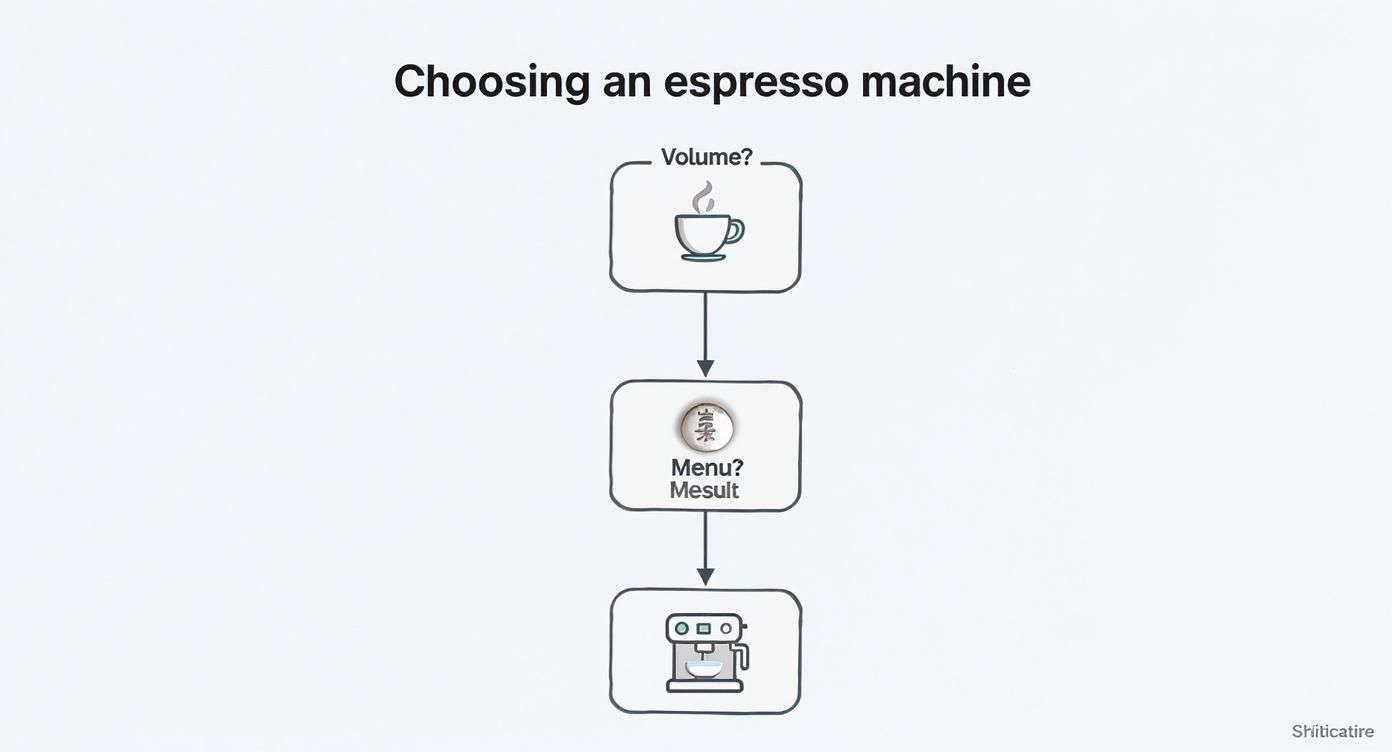
This flowchart really brings it home. If you’re a high-volume spot with a simple menu, a super-automatic is a no-brainer. But if your brand is built on quality, you’ll naturally lean toward a semi-automatic. It’s no surprise that the automatic espresso machine market is booming—valued at $2,011.75 million in 2024—as more businesses look for that sweet spot between quality and operational smarts.
Under The Hood: Let's Talk Boilers
The last big piece of the puzzle is the engine of the machine—its boiler system. This determines how well your machine can brew espresso and steam milk at the same time, which is absolutely crucial when you've got a line of latte orders.
-
Single Boiler: These are pretty rare in a commercial setting for a reason. They use one boiler for both brewing and steaming, but you can't do both at once. After you pull a shot, you have to wait for the machine to heat up to steam temperature. It’s a workflow killer and really only suited for very low-volume offices or homes.
-
Heat Exchanger (HX): This is the workhorse of the industry. An HX machine has one big boiler kept at steaming temperature. A copper tube carrying fresh water for brewing runs right through it, flash-heating the water to the perfect espresso temp on its way to the group head. This clever setup lets you pull shots and steam milk simultaneously. It’s the standard for most cafes and restaurants.
-
Dual Boiler (DB): This is the top of the line. A DB machine has two separate boilers—one perfectly dialed in for brewing espresso, and another, larger one dedicated to producing a relentless supply of steam. This gives you unparalleled temperature stability and power. For a high-volume specialty shop where precision is everything and you can't afford any performance dips during the morning rush, a dual boiler is the ultimate tool.
Getting Your Space Ready: Utilities, Plumbing, and Power
You’ve got a good idea of the volume you’ll be doing and the type of machine that fits your menu. Now for the nuts and bolts—literally. An espresso machine isn’t something you just unbox and plug in. It’s a serious piece of equipment, and getting your space prepped before it arrives can save you from a world of headaches and costly delays.
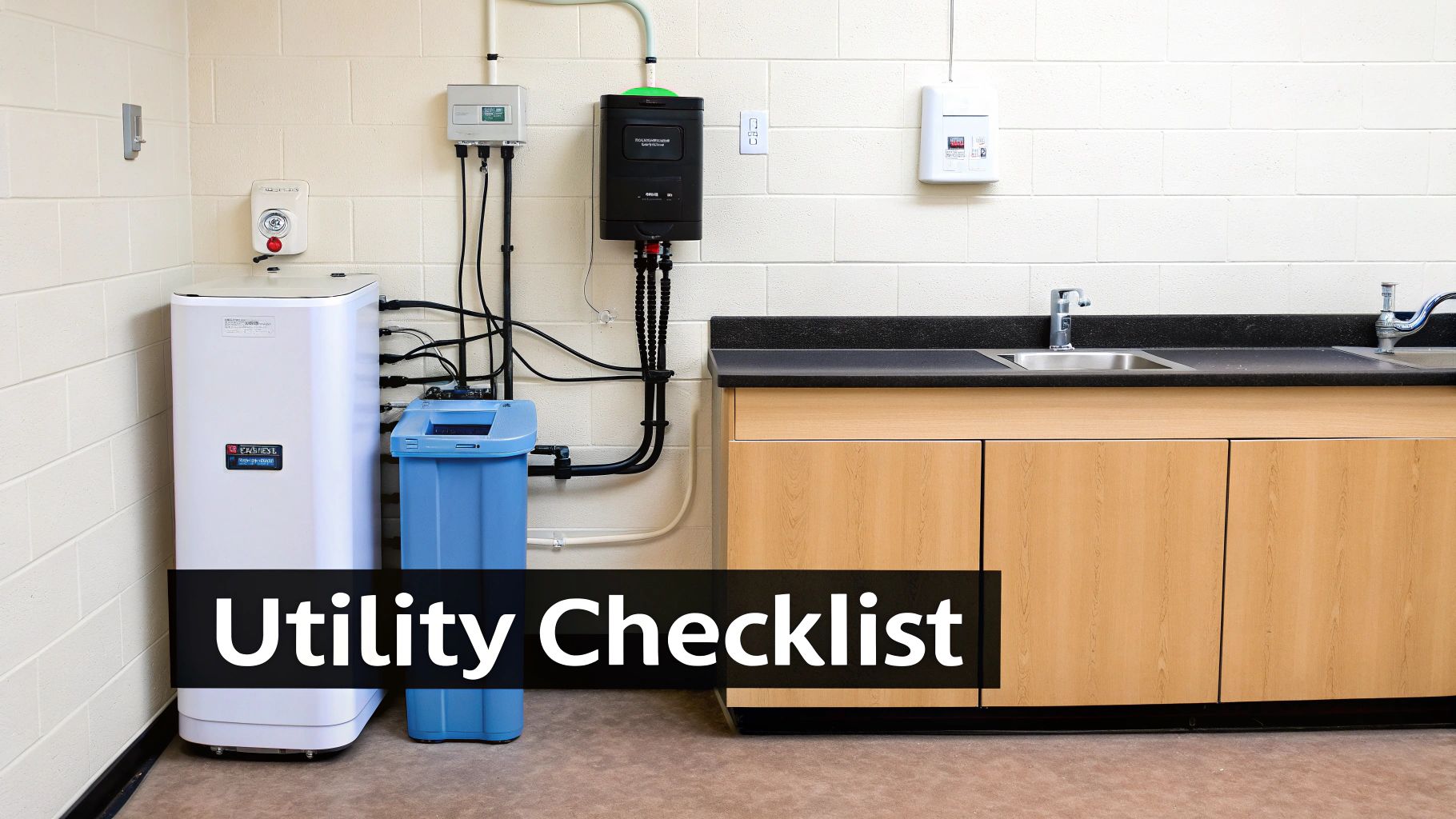
This is all about the behind-the-scenes work. Your machine needs the right power, the right water hookups, and the right drainage to run smoothly day in and day out. Get this wrong, and even the best machine on the market will fail you. Let's walk through what you need to coordinate with your electrician and plumber.
Dialing in Your Electrical Needs
First things first: call your electrician. That standard 120V outlet behind your counter isn't going to cut it. High-performance espresso machines are power-hungry, with big heating elements and powerful pumps that demand a dedicated 220V-240V circuit.
Trying to run a 220V machine on the wrong circuit is asking for trouble. You'll either be tripping breakers all day, or worse, you could fry the machine’s expensive internal components. Before you even sign the purchase order, get the spec sheet for your chosen machine and have a licensed electrician install a dedicated outlet exactly where you plan to put it.
Expert Insight: While you have the electrician there, have them run a separate dedicated circuit for your grinder(s), too. It’s a small extra cost that prevents power sags from other appliances (like a kicking-on ice machine) from messing with your grind consistency.
Plumbing Water In and Draining It Out
Next, get your plumber involved. Commercial machines need a direct water line to keep the boiler full and a drain line to get rid of wastewater from the drip tray and cleaning cycles.
Don’t even think about running a hose from the nearest sink. You need a dedicated 3/8" water line installed right behind the machine for a clean, permanent connection. A proper drain is just as critical. A bucket under the counter is a messy, unhygienic nightmare waiting to happen. The professional standard is an "air gap" drain, which prevents any nasty sink water from ever backing up into your espresso machine.
The Make-or-Break Importance of Water Filtration
If you take one piece of advice from this guide, let it be this: invest in a good water filtration system. The minerals in regular tap water—calcium and magnesium—are the mortal enemy of your espresso machine. When heated, they form limescale, a hard, chalky buildup that is the #1 killer of espresso machines.
Scale will clog up your pipes, insulate your heating elements so they can’t work properly, and seize up your valves. These are not cheap fixes. In fact, most manufacturers will flat-out void your warranty if they find damage caused by scale. Filtration isn’t optional; it’s mandatory.
You’ve got a few options here:
- Carbon Filters: Great for stripping out chlorine and other things that make your water taste bad, but they don't remove the hard minerals that cause scale.
- Water Softeners: These use an ion-exchange process to pull out scale-causing minerals. Absolutely essential if you're in an area with hard water.
- Reverse Osmosis (RO): This is the gold standard, stripping nearly everything out of the water to give you a pure, clean base to build your coffee's flavor profile.
To really protect your machine for the long haul, it pays to understand the science behind it. You can learn more about reverse osmosis purification for espresso machines and see why it’s the best way to prevent the limescale that brings so many great cafes to a grinding halt.
Remember, getting your site ready is just as important as choosing the right gear. And don't forget that these utility changes can affect your whole setup, so it's a good idea to review your overall commercial kitchen design and layout at the same time.
Building Your Complete Coffee Station
A top-tier espresso machine is the heart of your coffee program, but it can't carry the whole operation on its own. The real secret to incredible coffee and a profitable business is the entire ecosystem you build around that machine. I'm talking about the grinder, the flow of your bar, and, most importantly, the people behind the counter. Thinking through these pieces now is how you turn a major equipment purchase into a smooth, money-making engine for your business.
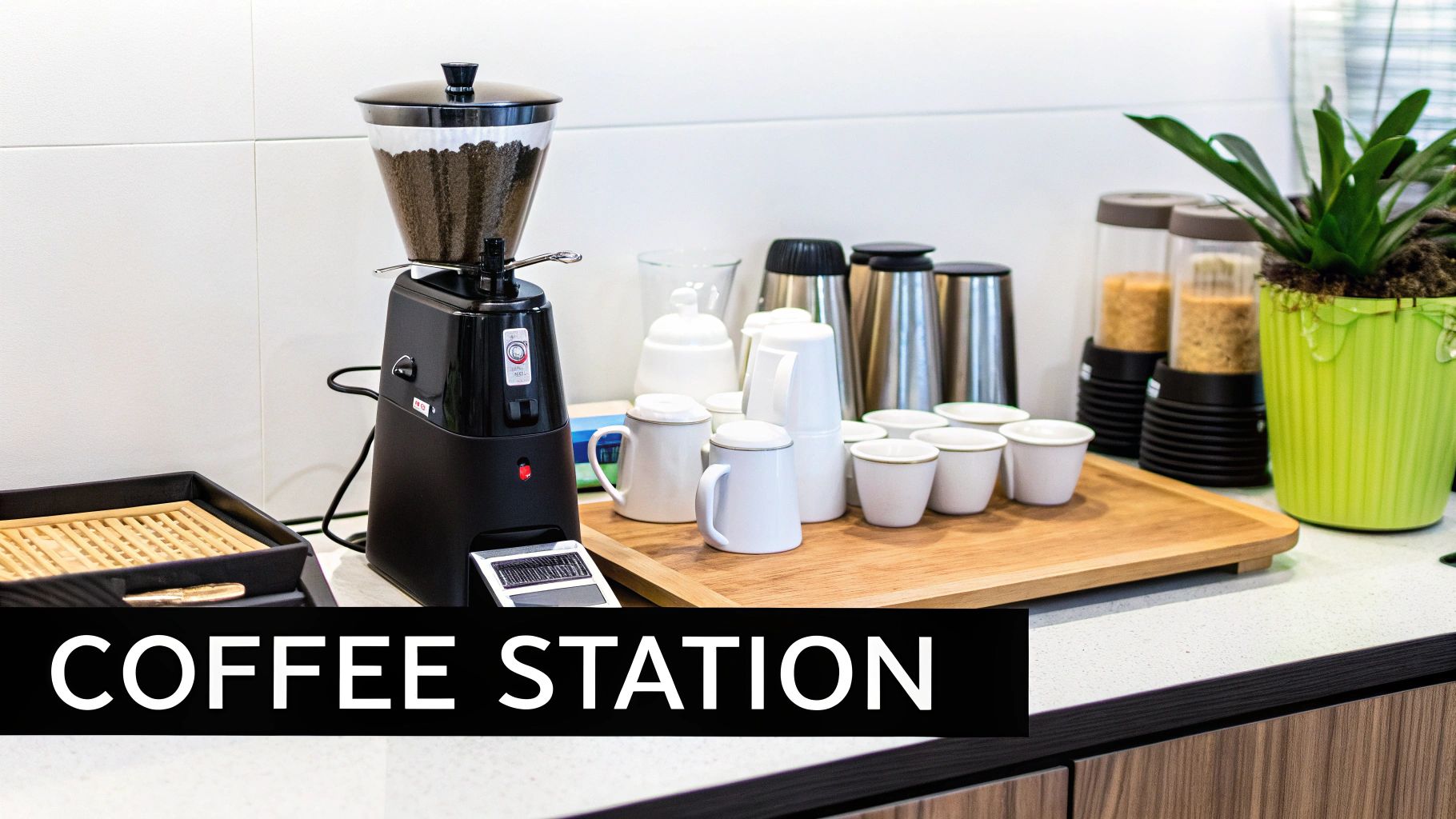
This holistic view is more important than ever. Your customers are getting savvier. With the home espresso machine market projected to grow from $1.5 billion in 2025 to $3.2 billion by 2034, people are more educated about good coffee than ever before. Your complete setup—not just the shiny machine—is what will set you apart.
Your Grinder Is Not an Afterthought
Let me be blunt: your grinder is just as important as your espresso machine. Pairing a $15,000 La Marzocco with a cheap grinder is like putting budget tires on a Porsche. You're completely kneecapping its performance. A quality commercial grinder is a non-negotiable partner that dictates the flavor, consistency, and speed of every shot you pull.
You’ll generally be looking at two main styles:
- Doser Grinders: These have a chamber that holds a supply of ground coffee, and the barista pulls a lever to dose it out. They’re fantastic for insane-volume environments where a dose needs to be ready right now.
- Doserless (Grind-on-Demand) Grinders: These grind a precise, programmed dose of coffee directly into the portafilter at the touch of a button. This guarantees absolute freshness and cuts down on waste, making it the go-to for most specialty coffee shops and restaurants focused on quality.
Pro Tip: For any serious café, investing in two high-quality grinders is a game-changer. Dedicate one to your house espresso blend and use the second for decaf or a rotating single-origin. This simple move prevents flavor contamination and lets you add profitable variety to your menu without creating a bottleneck.
Designing an Efficient and Ergonomic Bar
Okay, you've got the gear. Now, where does it go? The physical layout of your bar is where efficiency is won or lost. A poorly planned station creates chaos, with baristas taking extra steps, reaching awkwardly, and literally bumping into each other during a rush. A great bar is all about economy of motion.
We call this barista ergonomics. The goal is to create a seamless "work triangle" between the grinder, the espresso machine, and the milk fridge. Everything a barista needs should be within an arm's reach or a single step.
Think about a logical, left-to-right workflow:
- Grinders are on the left.
- The espresso machine is your central hub.
- A knock box for spent pucks is right beside it.
- The milk fridge and cup station are on the right.
This flow is intuitive. Grind, tamp, brew, steam, serve. No wasted movement. Spending time on this during your build-out pays off every single day. If you're planning a new space, you can dive deeper into the principles of commercial kitchen design and layout to get it right from the start.
Investing in Your Most Valuable Asset: Your Baristas
Finally, and this is the big one, you can have the world's best equipment and a perfectly designed bar, but your coffee program will fall flat without a skilled team. Professional barista training isn't an expense; it's one of the highest-return investments you can make. It's about so much more than latte art.
A well-trained barista understands how to dial in espresso as conditions change throughout the day. They can steam milk to a perfect, creamy microfoam consistently and work cleanly under pressure. Even better, they become your first line of defense for equipment care. They'll know how to backflush the group heads, perform daily cleaning, and spot a small leak before it becomes a weekend-killing service call. This proactive maintenance keeps your machine humming and can add years to its life.
Budgeting for Long-Term Value and ROI
An espresso machine is one of the most significant investments you'll make for your café or restaurant. It's easy to get fixated on the initial price tag, but the real cost—and the real value—reveals itself over the lifetime of the machine. To truly understand how to choose espresso machine that actually makes you money, you have to look beyond the sticker price and consider the total cost of ownership.
What does that mean? It means looking at everything from routine maintenance and inevitable repairs to how that machine impacts your daily cash flow. A cheaper machine that dies during the Saturday morning rush can cost you more in lost sales and angry customers than a premium, reliable workhorse ever would have upfront. The goal here is to find that perfect balance where price, performance, and durability meet to give you a solid return on your investment.
Understanding the Total Cost of Ownership
The number on the invoice is just where the spending starts. A truly realistic budget needs to account for all the little (and not-so-little) expenses that pop up over the machine's life.
To get a full picture, you need to factor these things in from day one:
- Preventative Maintenance: Plan on having a qualified tech visit at least once or twice a year. This isn't optional; it's essential for replacing worn-out gaskets, recalibrating pressures, and catching small problems before they turn into full-blown disasters.
- Water Filtration: Those water filter cartridges don't last forever. Depending on your local water and how busy you are, you'll be swapping them out every 6 to 12 months.
- Consumable Parts: Think group head gaskets and shower screens. These are the tires of your espresso machine—they wear out with use and your baristas will need to replace them regularly.
- Unexpected Repairs: Even the most bulletproof machines have off days. It's just smart business to have a small contingency fund set aside for those emergency service calls that always seem to happen outside of your warranty.
Thinking about these costs upfront saves you from major headaches and financial surprises down the road.
Decoding Warranties and Service Plans
A good warranty is more than just a piece of paper; it’s your financial safety net. When you're comparing machines, the warranty is a huge deal, but you have to read the fine print. A "one-year parts" warranty sounds decent, but it leaves you paying for pricey labor if a tech has to spend three hours taking your machine apart.
The gold standard is a parts and labor warranty. This is the one you want. It means if a critical component fails, the manufacturer covers both the new part and the skilled technician needed to install it. A warranty like this can save you thousands and shows the manufacturer truly stands behind their equipment.
Once the initial warranty is up, look into a preventative maintenance plan. Suppliers like us here at Encore Seattle offer them, bundling regular service calls into a predictable annual cost. It keeps your machine running like a top and transforms unpredictable repair bills into a manageable line item in your budget.
New vs Used Equipment: A Smart Comparison
The classic new-versus-used debate really boils down to upfront cost versus long-term risk. A shiny new machine gives you peace of mind, the latest tech, and a full warranty, but it also comes with the biggest initial hit to your bank account.
A used machine, on the other hand, can save you a significant amount of cash. But you have to be careful. Only buy from a reputable dealer who has professionally refurbished and thoroughly tested the equipment. Buying a used machine "as-is" from a private seller is a gamble I'd never recommend for a commercial operation. For a deeper dive, check out our guide on the best coffee machine for a cafe, which lays out more of the pros and cons.
Financing and Leasing Your Investment
Let's be realistic: not every business can or should pay cash for a new espresso machine. That’s where financing and leasing come in, making top-tier equipment accessible without draining your working capital.
- Financing: This is a straightforward loan. You make monthly payments over a set term, and when it's paid off, the machine is 100% yours.
- Leasing: Here, you're essentially renting the machine. You pay a monthly fee for a fixed period. At the end, you might have the option to buy it, start a new lease, or upgrade to a newer model.
Working with a supplier that offers flexible financing, like we do at Encore Seattle, can be a huge advantage. It lets you get the right machine for your business—not just the cheapest one you can afford today—which keeps your cash free for inventory, payroll, and all the other things that keep your doors open.
Common Questions We Hear From Restaurant Owners & Chefs
When you're ready to pull the trigger on a new machine, a few final questions always seem to pop up. This is a big investment, and you want to be sure. Having walked hundreds of restaurant owners through this process, we've heard them all. Let's clear up the most common ones right now.
How Much Training Will My Staff Actually Need?
This is probably the number one question we get, and the honest answer is: it completely depends on the machine you choose.
- Super-Automatic Machines: You're looking at an incredibly short learning curve. We can usually get a whole team comfortable in under an hour. Since the machine does all the work—grinding, tamping, brewing—it's perfect for places with high turnover or where coffee isn't the main event.
- Semi-Automatic & Automatic Machines: This is where you're stepping into the world of true barista craft. Don't underestimate the training required. You'll need to dedicate real time to teaching grinding, dosing, tamping, and the art of milk steaming. A solid introductory session takes a few hours, but genuine skill and consistency will take weeks of hands-on practice.
Is a Service Contract Really Worth It?
After the warranty is up, many owners wonder if a service contract is just an extra expense. For any business that relies on that machine to make money, my answer is a hard yes. Think of it less as a cost and more as insurance against lost revenue.
If your machine dies on a Saturday morning, how much business do you lose? It adds up fast. A service contract gets you priority repairs and, more importantly, includes preventative maintenance that spots little problems before they become catastrophic, profit-killing failures. It turns a potential financial emergency into a predictable, budgeted line item.
A single emergency service call for a major component failure can easily run $500 to $1,000 or more in parts and labor. A good preventative maintenance plan often costs less than one of those visits and can save you from several.
What's the Real-World Lifespan of a Commercial Machine?
A well-built commercial espresso machine isn't a disposable appliance; it's a workhorse designed for a long life. With proper care and maintenance, you should expect to get 7 to 10 years of solid service from a quality machine, and frankly, I’ve seen many go for much longer.
The secret to hitting that decade mark? Two things: consistent daily cleaning and sticking to a professional maintenance schedule. Water quality is the other huge factor. A machine running on properly filtered and softened water will always outlast one battling hard water scale day after day. Investing in a brand known for its durability and parts availability means you can keep it running for years, making it one of the best ROIs in your whole kitchen.
Ready to discover the latest deals on restaurant equipment and supplies? The expert team at Encore Seattle Restaurant Equipment lives and breathes this stuff. We help restaurant owners and chefs like you stay informed about industry trends and find the perfect machine to anchor your coffee program. We can help you sort through the options, talk financing, and get it installed by pros. Swing by our showroom or check out our selection online at https://encoreseattle.com and let’s get started.