
Food Truck Profit: A Practical Guide for Owners to Real Profits
Starting a food truck is an incredible ride, but let's be real—your success comes down to the numbers. A tight grip on your food truck profit isn't just for your accountant. It’s what informs every single decision you make, from pricing your signature tacos to choosing the right fryer. Stay informed about industry trends and the latest news on restaurant equipment and supplies to give your business a competitive edge.
Your Realistic Path to Food Truck Profitability
So, what kind of money can you actually make? You hear stories of trucks making a killing, but the day-to-day reality is a bit more grounded.
Across the U.S., most food trucks operate on a profit margin somewhere between 3% and 8%. Now, that might not sound like a lot, but with smart management, killer food, and efficient operations, some owners push that net profit margin up toward 17%.
Think of it this way: a well-run truck pulling in $18,000 in monthly sales with $15,000 in costs hits that 17% mark. That’s a $3,000 monthly profit in your pocket. This journey from a passion project to a profitable business starts with a clear-eyed view of your finances.
Before we dive into the nitty-gritty, here’s a quick snapshot of what you can expect.
A Quick Look at Food Truck Profit Benchmarks
This table breaks down some of the key financial benchmarks in the food truck world. It’s a great starting point to see how the industry averages stack up, giving you a realistic picture of potential earnings and common expenses.
| Financial Metric | Industry Average Figure |
|---|---|
| Annual Revenue | $250,000 - $500,000 |
| Startup Costs | $50,000 - $150,000 |
| Net Profit Margin | 3% - 8% |
| High-End Profit Margin | 10% - 17% |
| Food Costs | 28% - 35% of Revenue |
| Labor Costs | 22% - 30% of Revenue |
Seeing these numbers in one place helps you set realistic goals and spot areas where you might be over or under-spending. Remember, these are averages—your specific concept and location will play a huge role.
What Really Influences Your Profit Margins
Several make-or-break factors determine whether your truck thrives or just sputters along. Getting a handle on these from the very beginning is the secret to building a business that lasts.
Your strategy needs to be built around these core components:
- Menu Engineering and Food Costs: This is the heart of it all. What you sell and how much it costs to make is the foundation of your profit. A few high-margin items can totally change your daily take.
- Operational Expenses: We're talking about everything from propane and generator fuel to insurance, commissary fees, and those pesky payment processing charges. These costs can sneak up on you if you're not watching them like a hawk.
- Location and Event Strategy: Where you park is everything. High-foot-traffic lunch spots, weekend festivals, and private catering gigs are where the real money is made. Don't just park and pray.
- Labor Costs: Even if it's just you and a friend, payroll is a major expense. You have to be smart about scheduling to keep costs down without burning out your team or slowing down service.
A classic rookie mistake is focusing only on sales. Real, sustainable profit comes from widening the gap between what you earn and what you spend. Every dollar you save on costs goes straight to your bottom line.
Setting a Strong Financial Foundation
Before you get lost in designing a cool truck wrap or perfecting your recipes, you absolutely have to lay the financial groundwork. This isn't the fun part for most people, but it's non-negotiable.
You need to map out your expected income and every possible expense in a detailed plan. Think of this financial projection as your GPS—it helps you set real-world goals and makes it much easier to get a loan if you need one.
Building this financial picture is a crucial step. To get started, you can learn more about how to get your numbers in order by reading our comprehensive guide to creating a food truck business plan. Trust me, the effort you put in here will pay off big time, giving you the clarity and confidence to turn your mobile food dream into a reality.
Getting a Grip on Your Food Truck's Financial Health
If you really want to boost your food truck's profit, you have to get comfortable with the numbers. I'm not just talking about glancing at the daily sales total. I mean digging into where every single dollar comes from and where it goes. Your best friend in this process is the Profit and Loss (P&L) statement.
Think of the P&L (sometimes called an income statement) as your business's monthly report card. It’s a straightforward summary of your revenue, costs, and expenses over a certain period, and it tells you exactly how much money you’re actually making. Don't let the name scare you off; this isn't about becoming a CPA. It's about getting real, actionable insights.
At its core, profitability is a pretty simple concept.
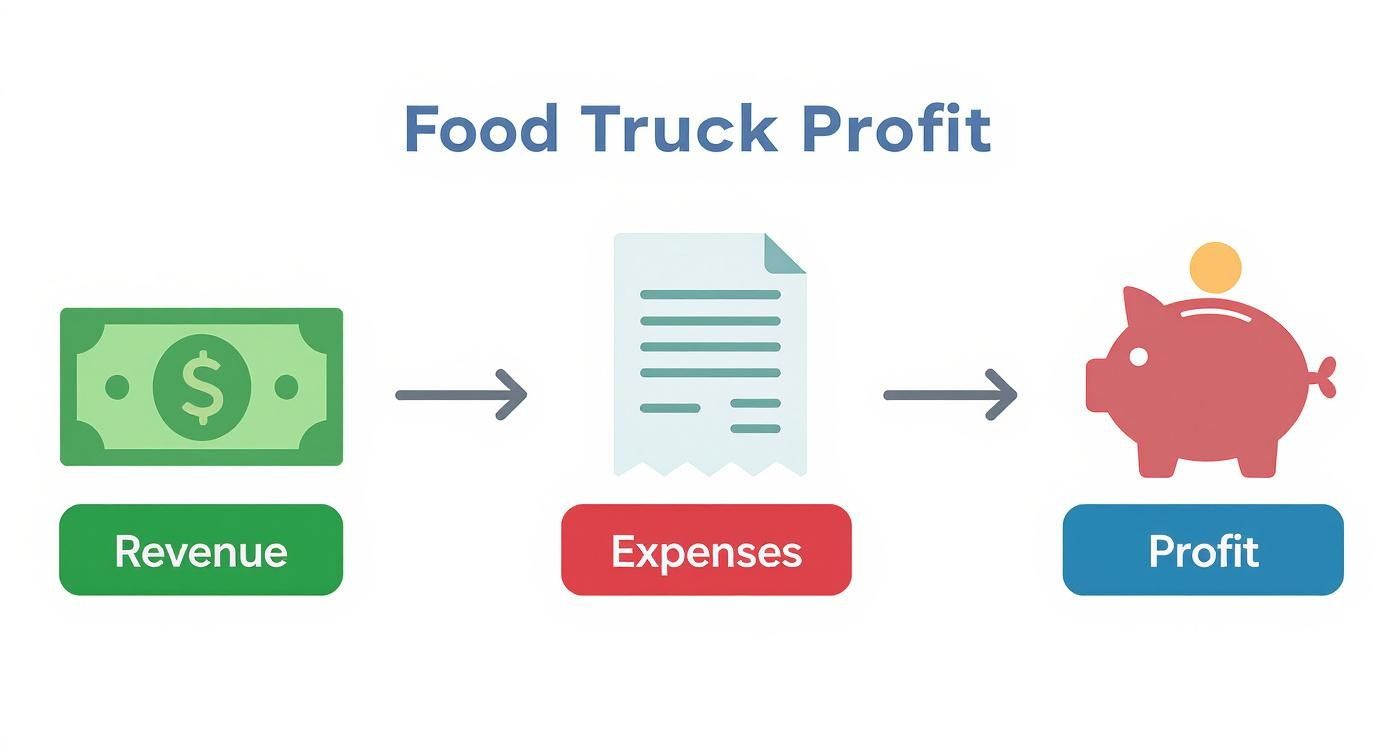
It all boils down to what's left in the piggy bank after you've paid all your bills. Getting this equation right is the absolute foundation of a successful food truck business.
What Goes Into a Food Truck P&L?
Running a mobile kitchen means you have some unique costs that a brick-and-mortar spot doesn't. Nailing down these specific categories on your P&L is the only way to get a true picture of your financial situation.
Let's walk through the essential lines you need to be tracking:
- Revenue: This is your top line—every dollar you bring in. Track it all: daily street service, private catering gigs, festival fees, and even merch sales.
- Cost of Goods Sold (COGS): This is the direct cost of what you sell. It includes all your ingredients, from meat and produce to spices and cooking oil. Don't forget to include your serving supplies like taco boats, napkins, and forks.
- Labor Costs: This covers your team's wages, payroll taxes, and any benefits. If you're running the show solo, it’s crucial to pay yourself a regular salary and record it here. You're not a volunteer.
- Direct Operating Costs: Here’s where the "truck" part of "food truck" really shows up. This category is for fuel, propane for your cooktops, and all your vehicle maintenance.
- Overhead (Fixed Costs): These are the bills you pay every month, regardless of how much you sell. Think truck insurance, commissary kitchen rental fees, your POS system subscription, and credit card processing fees.
When you track these categories consistently, you stop guessing and start knowing where your money is going. That knowledge is power. It's the first real step you can take toward making smarter decisions that actually grow your profit.
A Taco Truck P&L in Action
To make this less abstract, let’s look at a sample P&L for a gourmet taco truck called "The Tortilla Trail." This is a simplified look at one month of their operations, but it shows how these numbers tell a story.
| Category | Amount | Percentage of Revenue |
|---|---|---|
| Total Revenue | $15,000 | 100% |
| Cost of Goods Sold (COGS) | $4,800 | 32% |
| Gross Profit | $10,200 | 68% |
| Labor Costs | $4,200 | 28% |
| Direct Operating Costs | $900 | 6% |
| Overhead (Fixed Costs) | $2,250 | 15% |
| Total Expenses | $12,150 | 81% |
| Net Profit | $2,850 | 19% |
Looking at this, The Tortilla Trail is doing quite well with a 19% net profit margin. Their gross profit is a solid 68%, which tells me their food costs are under control. The P&L also immediately flags that labor, at 28%, is their biggest expense after the food itself—a key area to watch.
Finding Your Break-Even Point
With a P&L in hand, you can figure out your break-even point. This is the magic number—the exact amount of sales you need to cover every single one of your costs. Every dollar you make beyond that point is pure profit.
Knowing this number is a game-changer for setting realistic sales goals. Here's the formula:
Break-Even Point ($) = Total Fixed Costs / ((Total Sales - Total Variable Costs) / Total Sales)
Your fixed costs are things like insurance and commissary rent. Variable costs, like food and fuel, go up or down with your sales. For The Tortilla Trail, this calculation tells them precisely how much they need to sell each month just to keep the lights on.
If you want to play with your own numbers, this restaurant profit margin calculator is a great tool for getting a better handle on your margins.
By making the P&L a regular part of your routine, you’ll gain the clarity you need to steer your business with confidence. You’ll see rising costs before they become emergencies and make informed choices that put more money in your pocket.
Controlling Costs to Protect Your Bottom Line
Once you have a clear financial picture from your P&L statement, you can stop just tracking numbers and start actively managing them. True food truck profit isn’t just about a busy service window; it's about systematically plugging the leaks in your budget. Every single dollar you save on expenses goes straight to your bottom line, and you'd be surprised how small changes can add up to huge gains over a year.
This means digging deeper than the obvious stuff. You need to find savings in every corner of your operation, from the ingredients you buy to the gas in your generator. A disciplined approach to cost control is what separates the most successful trucks from the ones just scraping by.
Slashing Your Biggest Expense: Food Costs
For any food business, ingredients are your single largest variable expense. Period. Getting a handle on your food cost percentage is the most powerful lever you can pull to boost your profitability. A huge piece of this puzzle is understanding your Cost of Goods Sold (COGS), because it directly ties to your profit margins.
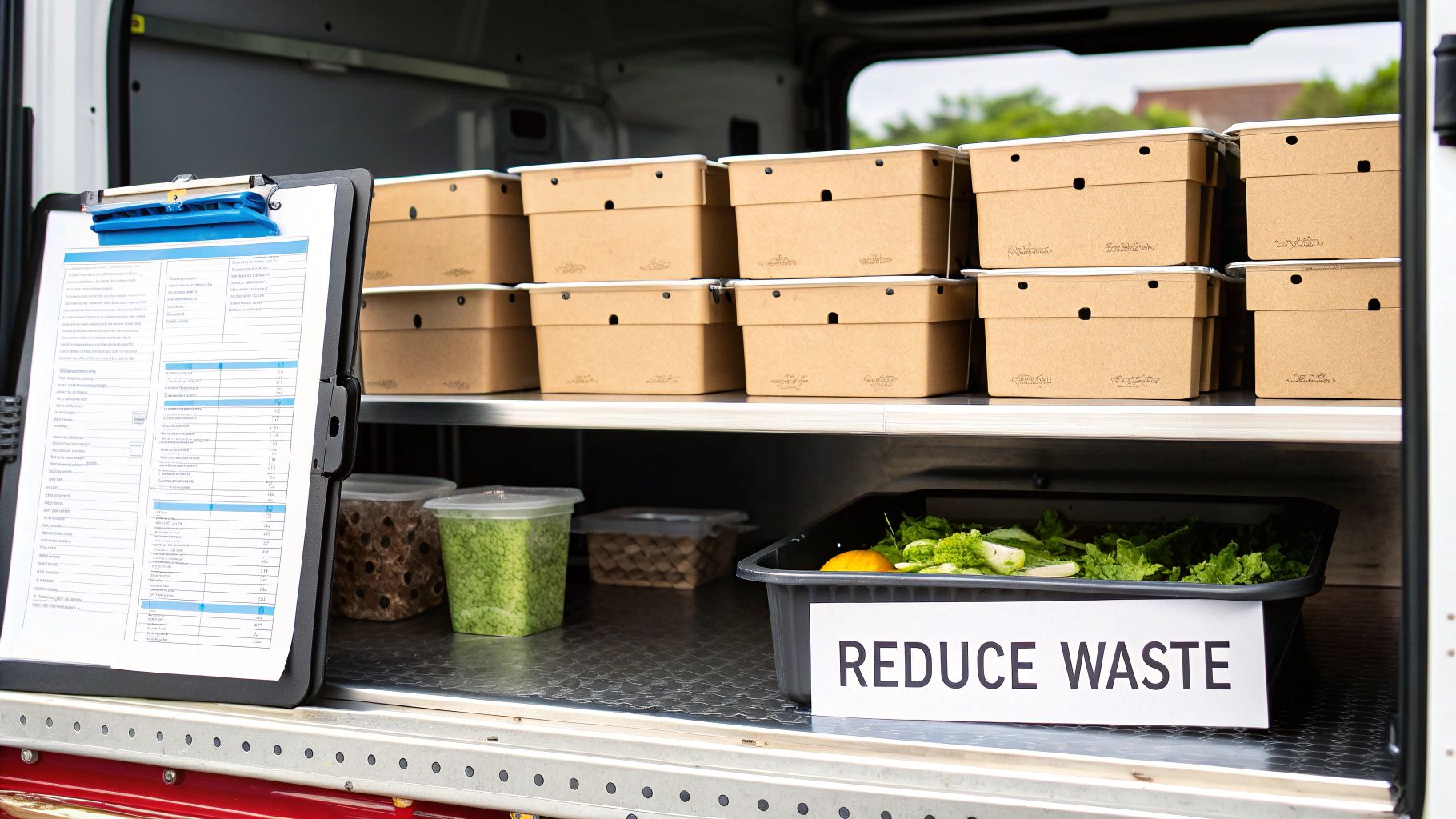
Start with a top-to-bottom inventory audit. You need to know exactly what you have, what you use, and—most importantly—what gets tossed. Food waste is a silent profit killer. Remember, an item that spoils or gets thrown out is a 100% loss.
Here are a few battle-tested strategies to tighten up your food cost management:
- Source Smarter: Don't get complacent with one supplier. Regularly compare prices from different vendors, and don't forget to check out local farmers' markets or wholesale clubs. Keeping an eye on industry trends for supplies can lead to big savings.
- Negotiate and Team Up: If you’re a loyal customer, don't be afraid to ask for better pricing. See if you can consolidate orders with other local food trucks to buy in bulk and unlock those sweet volume discounts.
- Embrace FIFO: The "First-In, First-Out" rule is non-negotiable. This simple inventory principle ensures you use older stock before it can spoil. Get a label maker and put the delivery date on everything.
- Track Your Trash: For one week, keep a clipboard near the bin and log every single item that gets thrown away. I guarantee the results will shock you and pinpoint exactly where your money is going.
Optimizing Your Labor for Peak Efficiency
Right after food, labor is your next biggest line item. Building a lean, efficient team is absolutely crucial. One of the best things about the food truck world is that you can often run with just one or two employees, which helps keep those labor costs way down compared to a brick-and-mortar restaurant.
The key is smart scheduling. Dive into your sales data to identify your busiest and slowest hours. It makes sense to staff up for the lunch rush, but it’s a waste of money to pay someone to stand around during a dead afternoon.
Cross-training is another game-changer. When everyone can handle multiple roles—taking orders, prepping food, and running payments—you can operate with a smaller crew without ever sacrificing service speed.
Pro Tip: Technology is your best friend here. Modern POS systems can automate ordering, and a simple tap-to-pay terminal speeds up the entire payment process. Staying current on new restaurant equipment can help you discover exclusive deals on tech that frees up your team to focus on what they do best: cranking out orders and keeping the line moving. A faster crew means more customers served per hour, which flows right to your bottom line.
Taming Those Overlooked Operating Expenses
It's easy to get tunnel vision on food and labor costs, but the smaller, recurring expenses can bleed your profits dry if you let them. These are the "silent killers" that often fly under the radar but add up fast.
Take a hard look at these often-neglected costs:
- Fuel and Propane: These costs are all over the place and can eat into your margins without warning. Use an app like GasBuddy to find the cheapest fuel on your route. Plan your locations strategically to minimize driving time and avoid backtracking.
- Insurance: Never just auto-renew your policy. Make it a yearly ritual to shop around for quotes. Your business needs can change, and another provider might offer a much better rate for the exact same coverage.
- Payment Processing Fees: Those little 2-3% fees on every credit card swipe might seem small, but they accumulate into a massive number by year's end. Compare rates from different payment processors; some offer lower fees for high-volume trucks or have flat-rate monthly plans.
- Commissary Kitchen Fees: Are you paying for more time or space than you actually use? Pull out your contract and review it. See if you can switch to a more flexible plan that better aligns with your real-world needs.
By adopting a mindset of constant vigilance, you can turn cost control from a chore into a real competitive advantage. Finding these small savings across your entire operation is the most reliable way to directly boost your food truck's profit and build a more resilient, successful business for the long haul.
Driving Revenue Beyond the Daily Service Window
https://www.youtube.com/embed/bCkx7ilXcio
Controlling costs is critical, but you can only trim so much fat. The real key to a healthier food truck profit is finding creative ways to bring in more money, day in and day out. This means thinking beyond the standard lunch rush and building multiple income streams that keep cash flowing, even when the truck is parked.
The most successful food truck owners I know are masters of opportunity. They don't just wait for customers to show up; they actively chase down lucrative gigs, fine-tune their menus for maximum return, and build a brand that people genuinely want to follow. It's about shifting from a passive kitchen-on-wheels to a proactive, money-making machine.
Engineer Your Menu for Maximum Profit
Your menu board isn’t just a list of items; it’s your number-one sales tool. Small, strategic adjustments here can have an outsized impact on your daily revenue. The idea is to gently guide customers toward your most profitable offerings without ever feeling pushy.
You want to zero in on items that have both high margins and a quick prep time. Think about loaded fries, gourmet mac and cheese, or specialty donuts—these dishes often have low food costs but a high perceived value, which means you can mark them up nicely. A simple cheese pizza, for example, can boast a profit margin as high as 94%.
Here’s how you can put this into practice:
- Create Irresistible Combos: Package a main, a side, and a drink together. This does more than just bump up your average ticket; it also makes ordering faster, which is a lifesaver during a busy service.
- Spotlight Your Stars: Use a box, a photo, or even just a star icon to draw the eye to your highest-margin dishes. A little visual nudge goes a long way.
- Master the Upsell: Train your team to offer simple, high-profit add-ons. Asking "Want to add bacon for $2?" or "Try it with our signature sauce for just $1?" are easy wins that compound quickly.
Master Your Location and Event Strategy
Where you park your truck is one of the most important decisions you'll make every single day. Just showing up and hoping for foot traffic isn't a business plan. You have to be strategic about finding and securing spots that put you directly in front of hungry customers with money to spend.
Don't just stick to the usual downtown lunch spot. Breweries, office parks, and farmers' markets can be goldmines. When you partner with a local brewery, for instance, you get access to a captive audience that's already looking for something delicious to pair with their beer.
Securing a steady rotation of profitable locations is the key to consistent revenue. Don't be afraid to build relationships—a quick chat with a business owner or event organizer can lead to a recurring gig that becomes your bread and butter.
And don't overlook private events and catering—these are often the most profitable gigs you can land. Weddings, corporate lunches, and graduation parties offer guaranteed income and let you plan your inventory and staff with precision, slashing waste and maximizing your take-home pay.
Expand Your Brand Beyond the Truck
Your brand is so much more than your logo; it's one of your most valuable assets. When you build a strong, loyal following, you open up new ways to make money that have nothing to do with serving food from the window.
Start by asking what else your loyal customers might want from you.
- Sell Some Merch: T-shirts, hats, and stickers with a killer logo are a fantastic source of extra income. Plus, they turn your biggest fans into walking billboards for your business.
- Bottle Your Best Sauces: Are you famous for a unique BBQ sauce or a secret spicy aioli? Bottle that magic up and sell it. This creates a brand-new retail product that could even find its way onto local store shelves.
- Build a Strong Social Following: Use Instagram and Facebook to announce your daily location, post drool-worthy food photos, and connect with your followers. A vibrant online presence keeps you top-of-mind and turns passive scrollers into paying customers. To really widen your net, consider strategies like Local Boost SEO to make sure new customers can find you.
The U.S. food truck industry is absolutely booming, with projections showing it will hit $2.8 billion by 2025. With customers spending an average of $12.50 per visit and 60% coming back after a good experience, building that loyal following is everything. By diversifying how you make money, you're not just growing your business—you're making it more resilient and profitable for the long haul.
Investing in Equipment That Maximizes Profitability
Your truck and the kitchen gear inside it are the engine of your business. They're your biggest assets, but a few bad choices can turn them into your biggest liabilities. Making smart, forward-thinking decisions on these big-ticket items is absolutely critical for building a healthy food truck profit that lasts.
It all starts with the truck itself. The new versus used debate is as old as the industry, and frankly, there's no magic answer that fits everyone. A brand-new, custom build gives you reliability and the peace of mind that comes with a warranty. The trade-off? A massive upfront cost and instant depreciation the moment it's yours.
Going with a used truck, on the other hand, can save you a serious chunk of change upfront. But you're also buying its entire history—every potential mechanical gremlin, every worn-out appliance, and every unexpected repair bill that comes with it. This is where you have to look past the sticker price.
Thinking in Terms of Total Cost of Ownership
The initial purchase price is just the first chapter of the story. To make a decision that's truly good for your bottom line, you need to think about the Total Cost of Ownership (TCO). This just means looking at the complete financial picture over the entire time you'll own the asset.
TCO includes the upfront cost, plus all the other expenses that sneak up on you:
- Maintenance and Repairs: A new truck is covered by a warranty. A used one is a bit of a gamble, so you must budget for more frequent and potentially costly repairs.
- Energy Efficiency: Don't overlook this. Modern refrigerators, griddles, and fryers are often way more energy-efficient, which can save you hundreds of dollars a year on propane and generator fuel.
- Reliability and Downtime: What's the real cost of a breakdown? It's not just the mechanic's bill. It's an entire day of lost sales at a huge festival. That lost revenue is a massive part of the TCO.
A cheaper used truck that spends one weekend a month in the shop is costing you far more in lost sales than a reliable new vehicle ever would. Profitability is all about uptime.
Choosing Between Buying and Leasing Equipment
The same TCO logic applies to every piece of kitchen equipment inside your truck. Buying gear outright means you own it, building equity. But it also ties up a lot of cash that you might need for other things.
Leasing, on the other hand, means lower upfront costs and predictable monthly payments. This can be a lifesaver for managing your cash flow, especially when you're just starting out. It's a brilliant strategy for expensive or specialized items you want to test before fully committing, letting you get top-tier gear without draining your startup funds.
The choice between a new and used food truck is one of the most significant you'll make. It's a balance of upfront cost, long-term reliability, and potential hidden expenses.
Comparing New vs Used Food Truck Investments
| Consideration | New Food Truck | Used Food Truck |
|---|---|---|
| Upfront Cost | High ($100,000 - $175,000+) | Low ($40,000 - $100,000) |
| Reliability | Very high; comes with a warranty. | Variable; depends on age and history. |
| Repairs | Minimal in the first few years. | Expect ongoing repairs and maintenance. |
| Customization | Fully customizable to your exact needs. | Limited; you adapt to the existing layout. |
| Depreciation | High and immediate. | Lower; has already depreciated. |
| Downtime Risk | Low risk of unexpected breakdowns. | Higher risk, which means lost revenue. |
Ultimately, a new truck offers security and efficiency at a premium, while a used truck requires more diligence and a repair fund but frees up initial capital.
Selecting High-ROI Kitchen Equipment
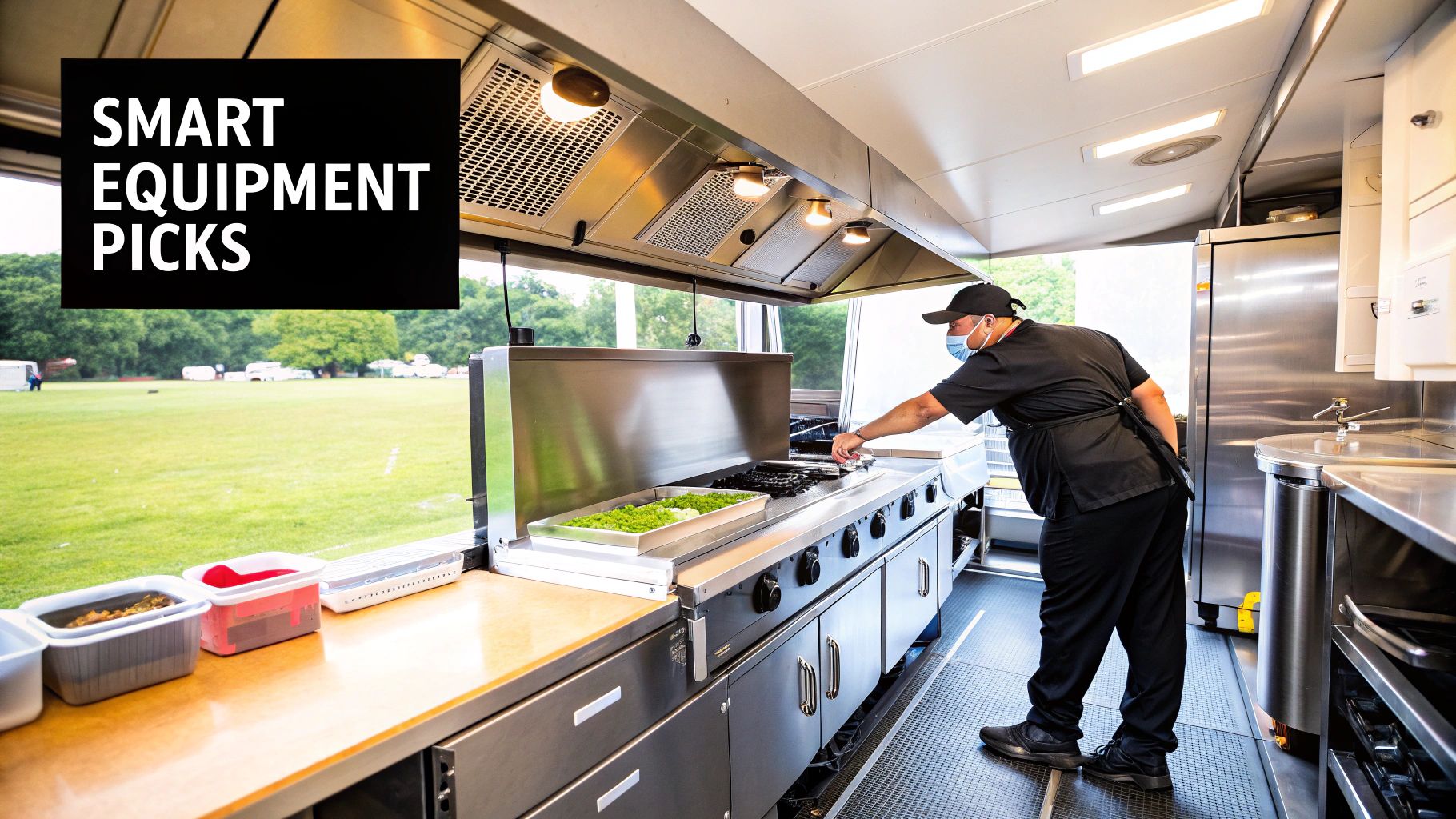
Every single piece of equipment you buy should pay for itself by improving your workflow, speeding up service, or cutting down on costs. A faster ticket time means more customers served per hour, which is a direct line to more revenue. Simple as that.
When you’re outfitting your kitchen, prioritize gear that gives you a clear return on your investment. If you want a deeper look at this, our guide on essential kitchen equipment for a food truck breaks down exactly what you should be looking for.
Here’s what to focus on when you’re making your list:
- Speed and Efficiency: Can this griddle heat up faster? Can this prep station hold more ingredients to save you trips to the cooler? Every second counts.
- Compact Footprint: Space is the most valuable real estate you own. Multi-function equipment, like a combination oven, can be a total game-changer.
- Durability: Food truck equipment takes a beating from constant vibration on the road. Always choose commercial-grade, road-ready appliances built to last.
- Ease of Cleaning: The faster you can clean, the sooner you can head home. Smooth, stainless-steel surfaces and easy-to-disassemble parts are your best friends.
When you start treating your truck and equipment as strategic investments instead of just expenses, you build a much stronger foundation for long-term success.
Answering Your Top Questions About Food Truck Profit
Running the numbers on a food truck can bring up some tricky questions. Whether you're just firing up the grill for the first time or you're a seasoned pro looking to tighten things up, getting the right answers is what separates a hobby from a profitable business. Let's dig into some of the most common questions I hear from owners on the ground.
My aim here is to give you straightforward advice you can put to work immediately. We'll get into the weeds on managing your biggest expenses and making smarter pricing moves to build a food truck that’s built to last.
What Is the Single Biggest Expense I Should Watch?
Your food cost. Hands down. It’s the one variable expense that can absolutely sink your profit if you're not watching it like a hawk. While you'll certainly feel the pinch from fuel and insurance, those costs are generally more stable than the price of your ingredients, which can change daily.
The real profit-killer within food cost is waste. Every bit of spoiled produce or an over-scooped portion represents a 100% loss—money that comes directly out of your pocket. The best defense is a good offense: get serious about a "First-In, First-Out" (FIFO) system for your inventory and start tracking what you throw out. It might feel tedious, but it's one of the most powerful ways to protect your margins.
How Often Should I Update My Menu Prices?
You need to be reviewing your menu pricing at least every quarter. And honestly? Be ready to make changes even faster if the market for your key ingredients gets volatile. One of the biggest mistakes I see owners make is setting their prices on day one and never touching them again. The cost of everything from beef and cooking oil to your takeout containers can swing wildly.
Don't be shy about raising your prices when your own costs go up. Your regulars get it—they know quality food isn't free. It’s far better to charge what you’re worth than to slowly watch your profit margin evaporate because you're absorbing every price hike from your suppliers.
A great habit to get into is recalculating the plate cost for your best-selling items every single month. If you notice the cost has been creeping up for a few weeks, it's time to update the menu board.
Are Expensive Festival Spots Really Worth It?
This is the classic "it depends" answer, but you can take most of the guesswork out of it with some simple math. A spot at a huge festival with a steep entry fee can be a goldmine if it puts you in front of a massive, hungry crowd. But it can also be a very expensive bust.
Before you write that check, do some recon:
- Dig up the history: Ask the event organizers for past attendance figures. Better yet, find other vendors who worked it last year and ask them how sales were.
- Know your break-even point: Calculate the exact number of dishes you have to sell just to cover the fee, extra staff, and all your food.
- Think about the intangibles: Is this event a major branding opportunity? Could it lead to high-paying catering gigs down the road?
Sometimes, a cheaper spot at a smaller, more focused event—like a local brewery's anniversary party—can deliver a much better return on your investment. Always run the numbers before committing.
At Encore Seattle Restaurant Equipment, we help restaurant owners and chefs discover the latest news and exclusive deals on restaurant equipment and supplies. From commercial-grade fryers that can handle the rush to refrigeration that makes the most of every inch, we stock the gear that helps you serve faster and keep your operating costs low. See how we can help drive your success by exploring our inventory at https://encoreseattle.com.