
Mastering Food Cost Percentages for Restaurant Profit
Food cost percentage is one of the most important numbers in your restaurant. It tells you exactly how much of your revenue is spent on the ingredients you use to create your menu. For restaurant owners and chefs, mastering this metric is the key to discovering lasting profitability and navigating industry trends.
For most operators, the sweet spot for food cost is somewhere between 28% and 35%. Put simply, for every dollar in sales that comes through the door, you're spending 28 to 35 cents on food. Staying informed about your percentages is the best way to control costs and find exclusive deals that boost your bottom line.
Why Food Cost Percentage Is Your Kitchen's Pulse
Think of your food cost percentage as the financial pulse of your kitchen. It’s not just some abstract number on a P&L statement; it's a real-time indicator of your restaurant's health and profitability. Getting a handle on this metric is what separates the restaurants that just get by from the ones that truly thrive, especially when it comes to managing the cost of restaurant equipment and supplies.
When you master this number, you can make smarter, more strategic decisions about everything. It guides your menu pricing, helps you choose daily specials that actually make money, and even informs how you manage inventory and negotiate with suppliers. Knowing the true cost of every plate that leaves your kitchen is the key to building a menu that your guests love and your accountant does, too.
Gaining Control Over Profitability
Tracking your food cost percentage isn't a one-and-done task. It's something you have to monitor constantly to maintain financial clarity and catch problems before they spiral out of control. If you see that percentage start to creep up, it’s a red flag signaling something needs your immediate attention.
What could a sudden spike mean?
- Hidden Waste: Maybe portion sizes are getting a little too generous, or perhaps you've got a spoilage problem lurking in the walk-in. Tracking costs brings these operational leaks to the surface.
- Supplier Price Creep: Have your vendors quietly raised their prices? It happens all the time. Regular calculations keep everyone honest.
- Menu Imbalances: What if your best-selling dish is also the one with the razor-thin margin? This data is exactly what you need to re-engineer your menu for maximum profit.
By consistently measuring your cost of goods sold against your revenue, you turn raw financial data into powerful, actionable insights for your kitchen. This isn't just about penny-pinching; it's about fine-tuning your entire operation for long-term, sustainable success.
A Foundation for Financial Health
At the end of the day, your food cost percentage is a critical piece of your restaurant's bigger financial puzzle. It doesn't tell the whole story on its own. It works hand-in-hand with your labor costs, rent, and other overhead to calculate your prime cost and, ultimately, your true profitability.
To really grasp its significance, it helps to see it as one of several key business accounting ratios that every owner needs to watch.
This guide will break it all down for you, from the basic formula to the pro-level strategies for keeping your costs in line. We'll give you practical tools and advice that work whether you're running a fine-dining spot, a buzzing food truck, or a high-volume catering company. Let's get started.
How To Calculate Your Food Cost Percentage
Figuring out your food cost percentage doesn't involve any crazy math. It’s really just about having a solid formula and keeping your numbers straight.
Think of it this way: you start the month with a pantry full of ingredients, you buy more groceries throughout the month, and at the end, you count what’s left. The difference between what you started with plus what you bought, and what you ended with, is what you actually used to cook. Simple as that.
The industry-standard formula is straightforward but incredibly powerful:
(Beginning Inventory + Purchases – Ending Inventory) / Food Sales = Food Cost Percentage
This calculation gives you what's known as your actual food cost. It’s the real-world number that shows you exactly how much of your revenue went toward buying the ingredients you turned into sales. It accounts for everything—the perfectly plated dishes, the occasional spillage, and the produce that didn't quite make it.
This flow, from buying ingredients to making money off them, is the financial heartbeat of your kitchen.
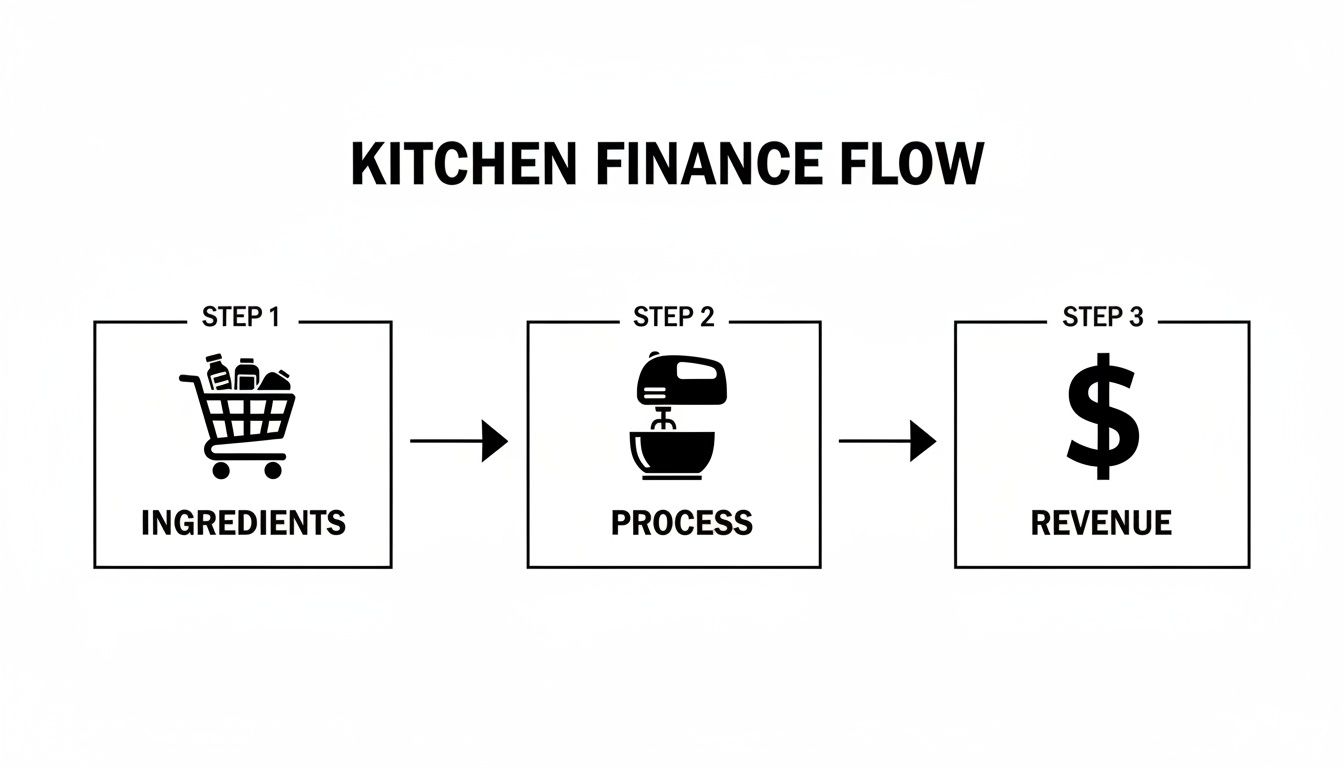
As the chart shows, every dollar you spend on raw goods has to be efficiently managed in the kitchen to maximize the revenue you bring in.
A Practical Walkthrough
Let's put the formula to work with a quick example. Imagine you run a small bistro in Seattle and you want to calculate your food cost for April.
Here’s what your numbers look like:
- Beginning Inventory: On April 1st, you did a full count of your walk-in, freezers, and dry storage. The total value came to $12,000.
- Purchases: Over the course of the month, you spent $8,000 on new deliveries from your suppliers.
- Ending Inventory: On April 30th, you did another count. This time, you had $11,000 worth of stock left.
- Food Sales: You check your POS report, and it shows you brought in $30,000 in food sales for April.
Now, let’s plug those numbers into the formula:
($12,000 + $8,000 – $11,000) / $30,000
Do the math inside the parentheses first: $9,000 / $30,000 gives you 0.30. Multiply that by 100, and you get your percentage.
Your bistro’s actual food cost for April was 30%. This means for every dollar you earned, 30 cents went right back out the door to pay for ingredients.
Ideal vs. Actual Food Cost
The number we just calculated is your actual food cost. But there's another key figure every operator should know: your ideal food cost.
Think of your ideal food cost as your "on-paper" cost. It's what your food cost should be in a perfect world with zero waste, no mistakes, and every dish portioned exactly to spec.
- Ideal Food Cost: The theoretical cost based on your recipes and menu prices.
- Actual Food Cost: The real-world cost that reflects all inventory used, including waste and spoilage.
The gap between these two numbers is called variance, and it’s where your profits can quietly disappear. A big variance is a red flag telling you something's off. It could be anything from over-portioning on the line to unrecorded staff meals or spoilage in the walk-in. Finding that gap is your first step to plugging the leaks.
If you want a hand running these numbers, you can use our handy food cost percentage calculator.
Benchmarking Your Food Cost Percentage
Alright, so you’ve calculated your food cost percentage. That's a huge first step. But what does that number actually mean? Is it good? Bad? Somewhere in between? The truth is, a food cost percentage on its own is just a number. It needs context.
Think of it this way: comparing a high-end steakhouse to the local pizzeria is like comparing a race car to a delivery van. Both are vehicles, but they're built for entirely different purposes and have vastly different operating costs. Your "ideal" food cost is a benchmark, a realistic goal post based on what businesses like yours are achieving.
A prime steakhouse, for example, is naturally going to have a higher food cost percentage. Its main attraction—that beautiful, dry-aged cut of beef—is expensive. On the flip side, a pizzeria can often run a much leaner food cost because its core ingredients (flour, water, cheese) are relatively cheap, giving it a healthier margin on every pizza that goes out the door.
Average Food Cost Percentages by Concept
To set goals that make sense for your operation, you have to know the typical ranges for your specific corner of the industry. Each business model—from a food truck to a fine dining spot—has its own unique pressures that shape its target numbers. A quick-service restaurant (QSR) is all about speed, volume, and low-cost ingredients, while a caterer has to think about bulk purchasing for event-specific menus.
Understanding these differences is absolutely critical for smart financial planning. A fine dining restaurant might be perfectly healthy and profitable with a food cost of 40%, but a coffee shop hitting that same number would be in serious trouble.
Historically, U.S. restaurants have aimed for a food cost between 28-35% of their sales. Recent inflation has definitely put that standard to the test. The latest data shows average food costs hovering around 34%, which is actually a 7% drop from 2023 as operators get a handle on things. To cope, about 61% of restaurants have had to raise their menu prices.
To give you a clearer picture, here’s a quick breakdown of what you can typically expect.
Typical Food Cost Percentages by Restaurant Type
This table gives you a handy reference for average food cost benchmarks across different types of foodservice businesses. Use it to see where you stand.
| Restaurant Type | Average Food Cost Percentage Range |
|---|---|
| Full-Service Dining | 30% - 40% |
| Quick-Service (QSR) | 25% - 35% |
| Catering Services | 28% - 35% |
| Bars & Taverns | 20% - 30% |
| Food Trucks | 28% - 35% |
| Coffee Shops | 15% - 25% |
Remember, these are just averages. Your own numbers might be a little different, and that’s okay. The key is to understand why and have a target to aim for.
Why Restaurant Concepts Differ So Much
So, what drives these big differences in benchmarks? It usually comes down to a few key factors that shape your restaurant's financial DNA.
- Ingredient Sourcing: A farm-to-table bistro that prides itself on local, organic produce will always have higher raw material costs than a fast-food chain that can leverage massive bulk purchasing power.
- Menu Complexity: Simple, standardized menus like those in a QSR are just plain cheaper to produce than the intricate, multi-component dishes you’d find in a fine dining kitchen.
- Service Style: A food truck's lower overhead for things like rent and front-of-house staff means it might be able to absorb slightly higher food costs. A full-service restaurant, on the other hand, has to juggle food costs with much higher labor and facility expenses.
At the end of the day, your food cost percentage doesn’t exist in a vacuum. It’s one half of a much bigger, more important metric: your prime cost. This number combines your total cost of goods sold (food and beverage) with your total labor cost. To truly get a handle on your restaurant's financial health, you need both pieces of the puzzle. Check out our guide on calculating your restaurant prime cost to get a complete view of your operational efficiency.
Actionable Strategies to Control Food Costs
Knowing your food cost percentage is one thing. Actually managing it is where the real money is made. Controlling costs isn't about being cheap or sacrificing quality. It’s about building smart, consistent systems that protect your profits from the day-to-day chaos of a busy kitchen. This isn’t a one-and-done fix; it’s a constant effort across your entire operation, from the menu you design to the vendors you partner with.
Waging this war on costs has never been more critical. A recent National Restaurant Association survey painted a grim picture: 2023 was a brutal year for restaurants in the U.S. A mere 16% of operators expected their profits to grow, while a full 50% braced for lower profits than in 2022, pointing fingers directly at soaring food and labor bills.
In fact, a staggering 90% of operators flagged rising ingredient costs as a major hurdle, making food cost control a top priority for sheer survival. You can read more about these restaurant industry cost pressures at Restaurant Business Online.
Fine-Tune Your Menu for Maximum Profitability
Think of your menu as your single most powerful financial tool. It's not just a list of dishes; it's a strategic guide for your customers. Smart menu engineering is the art and science of analyzing every item based on its popularity (how often it sells) and its profitability (its food cost percentage). The goal is to gently steer guests toward your most profitable dishes.
Start by sorting your menu into four distinct categories:
- Stars: These are your rockstars—highly popular and highly profitable. Feature them prominently, use mouth-watering photos, and train your staff to recommend them first.
- Plow Horses: Everyone loves these dishes, but they don't make you much money (high popularity, low profitability). Don't kill them, but see if you can nudge the price up slightly or re-engineer the recipe with less expensive ingredients to improve the margin.
- Puzzles: These are your hidden gems. They have fantastic margins but just don't sell well (low popularity, high profitability). Try giving them a better description, moving them to a more visible spot on the menu, or running them as a special to see if you can get some traction.
- Dogs: These dishes are dead weight—nobody orders them, and they don’t make you money (low popularity, low profitability). Unless they serve a very specific purpose, it's often best to cut them from the menu.
Enforce Ironclad Portion Control
In the kitchen, inconsistency is the enemy of profit. An extra ounce of protein here, a little too much sauce there—it might not seem like much, but over the course of a year, these small variances can bleed thousands of dollars from your bottom line.
The only way to fight this is by removing all the guesswork. This starts with perfectly costed, standardized recipes that every single cook follows, no exceptions. But recipes alone aren't enough.
Investing in proper portioning tools—like food scales, measured ladles, portion scoops, and ramekins—is not an expense; it's a direct investment in consistency and cost control. When every plate that leaves the kitchen has the exact same amount of protein, sauce, and sides, your ideal food cost and actual food cost will align much more closely.
Master Your Inventory to Reduce Waste
Your walk-in cooler, freezer, and dry storage are not just shelves—they are vaults holding your cash. Managing that inventory poorly is like leaving the register drawer wide open. A messy storeroom inevitably leads to over-ordering, spoilage, and theft, all of which send your food costs through the roof.
The bedrock of good inventory management is a simple but powerful principle: First-In, First-Out (FIFO). This system ensures older products get used before new ones, which dramatically cuts down on food expiring on your shelves. All you have to do is label every delivery with the date it arrived and organize your storage so older items are always in the front.
A solid inventory system also includes:
- Regular Audits: Do a full inventory count every week. This helps you track what you're using, spot any discrepancies, and catch potential theft early.
- Par Levels: Figure out the minimum amount of each key ingredient you need on hand. This stops you from over-ordering while making sure you don't run out of something critical during a Saturday night rush.
- Organization: Keep your storage areas clean, organized, and clearly labeled. A tidy walk-in makes it effortless to see what you have and what you need at a glance.
Negotiate Effectively with Your Suppliers
Your relationship with your food suppliers should be a partnership, but it's also a business deal that you need to manage closely. Don't ever be afraid to negotiate for a better price. Staying informed about commodity prices and industry trends can help you discover exclusive deals and better terms.
Use volume as your leverage. If you can commit to a larger order of a non-perishable item, ask for a bulk discount. It can also pay to consolidate your orders with fewer suppliers to increase your buying power with each one. And always, always read your invoices line by line. Watch out for "price creep," where costs for everyday items slowly inch up over time without you noticing.
Make Waste Reduction a Kitchen Culture
Waste is a silent killer of profit. It shows up everywhere: spoiled produce, over-prepped food that doesn't sell, trim from butchering, and even food that comes back on a customer's plate. Tackling waste requires a creative, team-wide effort.
Start by tracking it. Set up a simple log or a designated bin to record everything that gets thrown out and, most importantly, why. This data will quickly show you where the problems are. Maybe a certain vegetable always spoils before you can use it, or perhaps a particular dish consistently comes back half-eaten. For more detailed tips, check out our guide on reducing food waste in restaurants.
Getting creative can also turn trash into cash. Vegetable scraps can become rich stocks and soups. Stale bread makes fantastic croutons or bread pudding. Meat trimmings can be ground for burgers or sausages. When you build a kitchen culture where every single ingredient is respected and used to its fullest potential, you're building a foundation for a healthy food cost percentage.
The Right Tools for Keeping Food Costs in Check
You can’t control what you don’t measure. That old saying is the gospel truth in the restaurant business. Shifting from just knowing your food cost percentage to actively managing it comes down to having the right tools in your corner. These aren't just for massive restaurant chains, either—simple, powerful tools can give any owner the data they need to protect their margins.
The whole point is to build a system that follows the money, tracking an ingredient’s cost from the moment you order it to the second a customer buys the dish. This creates a constant feedback loop, helping you spot trouble long before it craters your monthly profit and loss statement.
Start with Your Recipe Costing Sheets
The most important tool in your entire kitchen isn't a knife or a pan—it's the recipe costing sheet. This is your ground zero for understanding profitability. It’s where you meticulously break down every single menu item into its individual components to find out what it truly costs to make.
Yes, it’s a detailed process, but it's non-negotiable for smart menu pricing. A solid costing sheet gets down to the nitty-gritty, accounting for everything from the protein to the pinch of salt and the sprig of parsley on top. Once you know the precise cost per serving, you can set your menu prices with confidence.
Let's break down a classic example to see how it works.
Sample Recipe Costing Template for a Signature Burger
This table shows you exactly how to itemize a single menu item to nail down its cost and, from there, its ideal food cost percentage.
| Ingredient | Unit Cost | Amount per Serving | Cost per Serving |
|---|---|---|---|
| Ground Beef (80/20) | $4.50/lb | 8 oz (0.5 lb) | $2.25 |
| Brioche Bun | $0.75/each | 1 bun | $0.75 |
| Cheddar Cheese | $6.40/lb | 1 oz slice | $0.40 |
| Lettuce | $1.50/head | 1 leaf (0.5 oz) | $0.05 |
| Tomato | $2.00/lb | 2 slices (2 oz) | $0.25 |
| Special Sauce | $8.00/quart | 1 fl oz | $0.25 |
| Pickles | $5.00/jar | 3 slices | $0.10 |
| Total Plate Cost | $4.05 |
With a total plate cost of $4.05, you now have the power to price this burger strategically to hit your target food cost percentage.
Put Your POS System to Work
Your Point of Sale (POS) system is so much more than a digital cash register. It’s a goldmine of information for reining in your food costs. Every sale you ring up logs crucial data about what’s selling, when it’s selling, and how much of it you’re moving.
This sales data is the other half of your food cost equation. When you combine your recipe costs with your POS sales reports (often called a "product mix" or "PMIX" report), you can:
- Figure out your theoretical food cost for any given day, week, or month.
- Pinpoint your best-selling and most profitable dishes.
- Analyze sales trends to make smarter purchasing and prep decisions.
Pulling these reports regularly lets you compare what you should have spent on food (based on what you sold) with what you actually spent (based on inventory). That gap is where your profit is leaking out.
Level Up with Inventory Management Software
Spreadsheets are a fantastic place to start, but dedicated inventory management software is the next step for serious cost control. These platforms are built to sync directly with your POS system and even your food suppliers, creating a seamless flow of data.
The real power here is automation. These systems handle the grunt work of tracking inventory levels, updating ingredient prices as invoices come in, and calculating food costs in near real-time. This gives you an immediate, up-to-the-minute look at your financial health.
Getting all those invoices and purchase orders into the system quickly is key. To make that happen, many operators find that the best OCR software can be a game-changer, automatically digitizing and categorizing receipts to ensure every cost is captured accurately.
The Weekly Food Cost Tracker
Finally, a simple weekly tracking template is a surprisingly powerful tool for staying on top of your numbers. Instead of waiting for the end of the month to see how you did, a weekly check-in gives you a quick snapshot of your performance so you can react fast.
It’s a simple rhythm that holds you accountable. All you need are four key numbers:
- Beginning Inventory: The total dollar value of your stock at the start of the week.
- Purchases: The total of all food invoices received during the week.
- Ending Inventory: The value of your stock at the close of business on the last day.
- Weekly Sales: The total food sales, pulled straight from your POS.
By plugging these four figures into the food cost formula every single week, you create a routine of financial oversight. This regular pulse-check makes it nearly impossible for small profit leaks—like a sudden jump in produce prices or a new cook being a little too generous with the cheese—to fly under the radar for long.
How Smart Equipment Investments Protect Profits
Your kitchen equipment is a silent, tireless partner in the battle for profitability. We spend so much time on active strategies like menu engineering and inventory counts, but the hardware you use every day is quietly working to either protect or eat away at your margins. Discovering how the right restaurant equipment and supplies can impact your bottom line is a game-changer.
Even the most perfectly costed recipe can be wrecked by an old, unreliable oven or a leaky walk-in cooler. Suddenly, your ideal food cost is just a number on a spreadsheet, completely disconnected from reality.
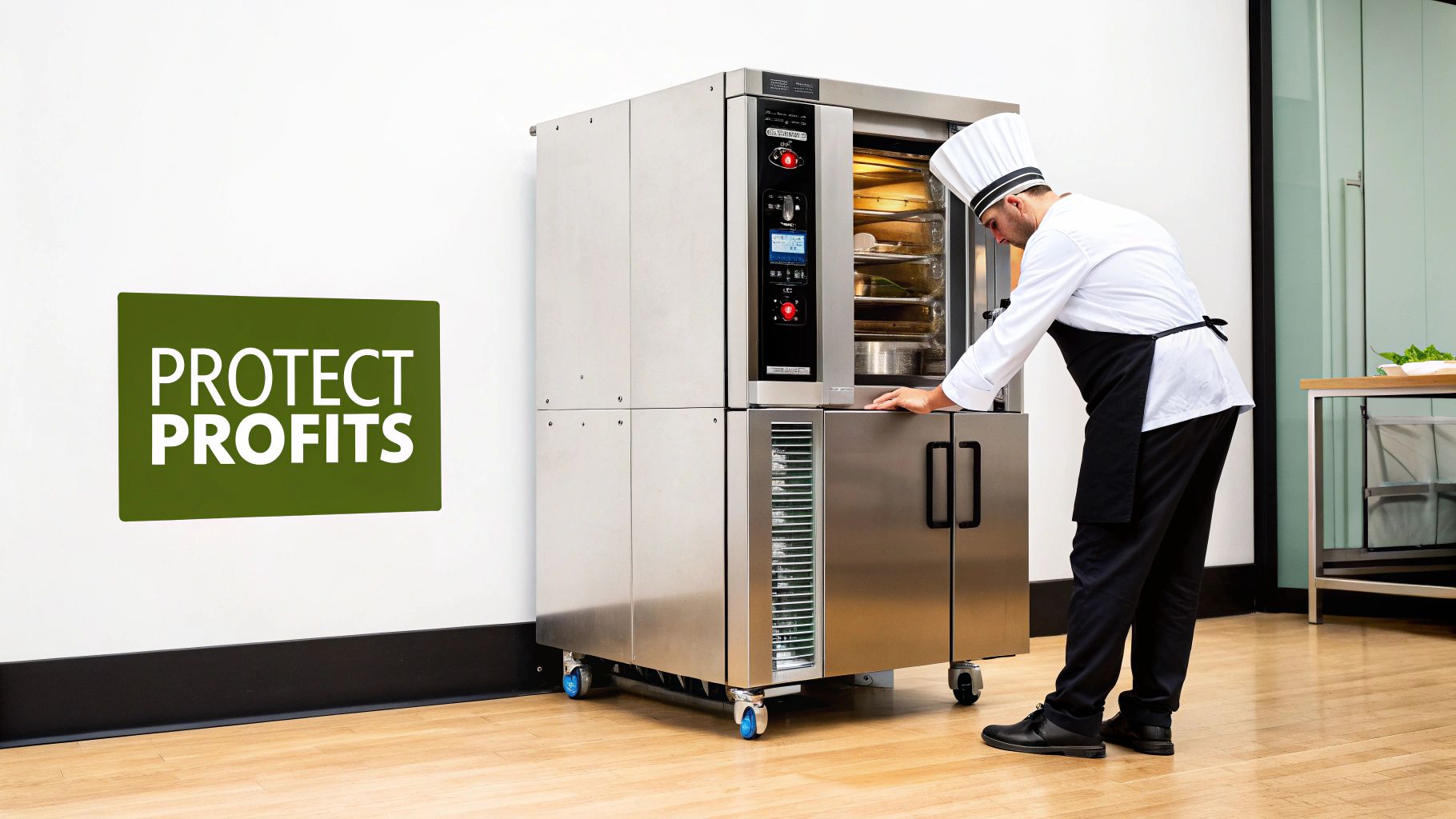
Investing in quality equipment isn't just another line item expense; it's a strategic move to defend your bottom line. Think of it as the foundation for all your other cost-control efforts. Inconsistent oven temps, poorly sealed fridge doors, and inefficient fryers all lead to waste, spoilage, and inconsistent dishes—and every one of those problems sends your actual food cost percentage climbing.
Upgrading for Efficiency and Consistency
Modern commercial kitchen equipment is built with profitability in mind. Today's tools are engineered to slash waste, improve your yield, and make sure every dish that leaves the kitchen is as perfect as the last. That consistency has a direct, positive impact on your food cost.
Just think about the financial difference a few key upgrades can make:
- Combi Ovens: These things are versatile workhorses. They use a combination of controlled steam and convection heat to cook food more evenly and at lower temperatures. The result is a major reduction in product shrinkage, especially for pricey proteins like prime rib. That means you get more sellable portions out of every single roast.
- Blast Chillers: By cooling hot foods down fast, blast chillers can dramatically extend the shelf life of your prepped ingredients and cooked dishes. This lets you cook in larger, more efficient batches, which cuts down on both labor costs and food waste from spoilage.
- High-Performance Refrigeration: A walk-in or reach-in that holds a precise, consistent temperature is your number one defense against spoilage. A bad refrigeration unit can turn thousands of dollars of inventory into garbage overnight.
The Long-Term Value of Reliability
Making smart equipment choices creates a more stable, predictable kitchen environment. And in the world of food cost, predictability is gold. When your fryer always gets back to temp quickly, your flat-top doesn't have hot spots, and your oven cooks true, you get rid of a ton of costly variables.
This translates to fewer mistakes, less food being re-fired, and a more accurate execution of your recipes. By guaranteeing product consistency, reliable equipment directly supports your portion control efforts and helps close that frustrating gap between your ideal and actual food costs.
Even high-quality used equipment from a trusted supplier can provide a fantastic return on your investment. The key is to find reliable, well-maintained pieces that bring modern efficiency into your kitchen without the sticker shock of a brand-new model. When you start seeing your equipment as a long-term asset that actively fights waste, you're building a foundation to protect your profits for years to come.
Common Questions About Food Cost (Answered)
Even when you've got the basics down, running a restaurant's finances means new questions are always popping up. Here are some quick, straight-to-the-point answers to the questions I hear most often from operators about food cost.
How Often Should I Be Calculating Food Cost?
For real control over your spending, you need to be calculating your actual food cost at least once a week.
I know, I know—monthly is standard for the big financial statements. But if you wait a whole month, a small issue like a bit of waste, some minor theft, or a supplier's price creeping up can quietly snowball into a massive loss.
Checking in weekly gives you a tight, immediate feedback loop. You can catch a sudden cost spike and fix the problem right away, instead of finding out about the damage a month after the fact. This rhythm makes financial tracking a proactive tool, not just a reactive chore.
Isn't Food Cost the Same as COGS?
This is a common point of confusion. They're very closely related, but they aren't the same thing. Think of it this way: Cost of Goods Sold (COGS) is the big umbrella, and food cost is one specific thing under it.
- Food Cost: This is only the cost of the food ingredients you use to make your dishes.
- Cost of Goods Sold (COGS): This includes your food cost, but it also includes the cost of all your beverages—both alcoholic and non-alcoholic.
Your total COGS gives you the complete picture of what it costs to stock your entire operation. But breaking out food cost and beverage cost separately is crucial. It gives you much clearer insight into how profitable each part of your business actually is.
Can I Actually Lower My Food Cost Without Buying Cheaper Ingredients?
Yes, one hundred percent. And honestly, you should avoid that route. Trying to lower your food cost by switching to cheaper, lower-quality products is a classic mistake that can drive away your guests.
The smartest way to lower food costs isn't about pinching pennies on procurement; it's about maximizing the value of every single ingredient you already have in-house.
The best strategies are all about efficiency and cutting down on waste. Here are three powerful ways to do it without touching your supplier list:
- Get Serious About Portion Control: Every plate needs to be consistent. Use standardized recipes, scales, and measured scoops for everything. It eliminates guesswork and the slow bleed of over-portioning.
- Start Tracking Your Waste: Grab a log or a clipboard and start writing down everything that goes in the trash. Is it spoilage? Over-prepping? A dish that keeps getting sent back? That data is pure gold—it shows you exactly where your money is disappearing.
- Cross-Utilize Your Ingredients: Smart menu design is your best friend here. Create dishes that share ingredients. This helps you turn over your inventory faster, cuts down the risk of something going bad, and makes your ordering process a whole lot simpler.
Ready to get a better handle on your kitchen's efficiency and protect your bottom line? Find the equipment that makes it happen at Encore Seattle Restaurant Equipment. We provide the latest news and exclusive deals to help you stay informed about industry trends and the best restaurant equipment and supplies. Take a look at our inventory today at https://encoreseattle.com.