
A Guide to Commercial Dishwasher Leases
So, you need a high-powered commercial dishwasher, but the thought of dropping thousands of dollars upfront makes your wallet clench. You're not alone. This is a massive hurdle for many restaurant owners and chefs, and it's exactly where leasing comes in as a smart financial play.
Instead of draining your bank account to buy a machine outright, leasing lets you get the top-tier equipment you need for a manageable, predictable monthly payment. It's less about owning a piece of metal and more about securing the result: sparkling clean dishes, day in and day out. Stay informed about industry trends and exclusive deals to make the best decision for your kitchen.
A Savvy Financial Move for Your Kitchen
Every chef and owner knows the dance: you need the best gear to run a tight ship, but you're also watching every single penny. A commercial dishwasher isn't just a luxury; it's the backbone of your kitchen's hygiene and workflow. The problem is, the price tag for a new one can be a real shock, easily running anywhere from $3,000 to over $20,000.
That's a huge chunk of cash that could be used for so many other things. This is why savvy operators are looking at leasing not just as a way to get equipment, but as a core financial strategy for their business.
Think of it this way: you're subscribing to a "clean dish service" rather than buying a complex machine that starts losing value the second it's installed. This simple shift in perspective frees up a ton of capital. Instead of locking that money into a depreciating asset, you can put it toward things that actually grow your business—like a killer marketing campaign, a patio expansion, or that star line cook you've been trying to hire.
Keep Your Cash and Upgrade Your Operation
The number one reason to lease? You hang onto your working capital. In the restaurant world, where industry trends can change in a heartbeat, cash is king. Opting for a lease unlocks some serious advantages for your finances and your daily operations.
- Get Better Equipment: Leasing often puts a more powerful, water-efficient, or high-tech dishwasher within reach than you could afford to buy. That means lower utility bills and faster table turns.
- Budgeting Becomes a Breeze: Your payment is the same every month. No more surprise repair bills throwing your entire budget into chaos, because most leases bundle in maintenance and service.
- Stay Up and Running: If a leased dishwasher breaks down, it's typically the leasing company's headache, not yours. They handle the repairs or replacement, so you experience minimal downtime.
It's a strategy that's catching on fast. The global commercial dishwasher market was valued at USD 4.51 billion in 2023 and is expected to climb to USD 7.29 billion by 2029. That's a lot of clean plates, and it shows just how essential this equipment is. You can dig into the numbers and learn more about commercial dishwasher market growth on Arizton.com.
Treating a dishwasher lease as a smart operating expense, not a capital purchase, changes the game. Your focus shifts from owning the machine to getting the job done—which is keeping your kitchen clean, safe, and efficient. It lets you invest in what truly matters: making your customers happy and growing your bottom line.
Exploring Your Commercial Lease Options
When you start looking at commercial dishwasher leases, it can feel like you're trying to decode a new menu. You'll quickly see there are two main "specials" on offer: the Fair Market Value (FMV) lease and the $1 Buyout lease. Getting to know the difference is key, as your choice will have a real impact on your cash flow, what you spend in the long run, and how much flexibility you have.
Think of these two leases as different routes to the same destination: a reliable, hard-working dishwasher in your kitchen. One route is more like a long-term rental, giving you lower monthly payments and the freedom to upgrade. The other is a straight path to ownership, perfect for when you know a machine is going to be a permanent fixture. Which one is right for you really comes down to your business goals.
This decision tree helps lay out the choice between saving cash upfront with a lease or investing for the long haul.
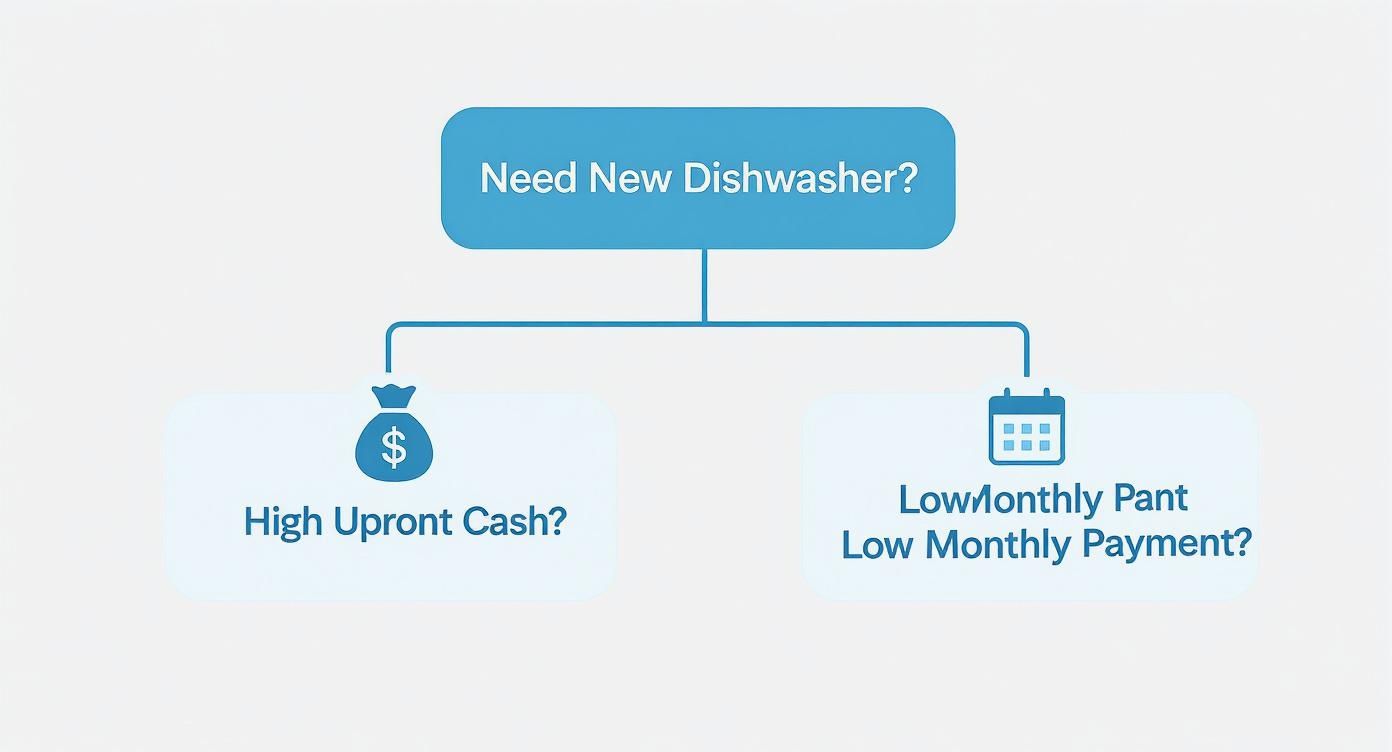
As the chart shows, it really boils down to your immediate cash situation versus your long-term plans for your warewashing setup.
The Fair Market Value (FMV) Lease
The Fair Market Value (FMV) lease is basically a straightforward rental agreement. It’s designed for restaurants that need the lowest possible monthly payment and want the flexibility to keep up with the latest warewashing technology. With an FMV lease, you’re simply paying to use the dishwasher for a set period, which is usually between 24 and 60 months.
When your term is up, you've got options:
- Upgrade to a new model: This is a huge plus for businesses that want to get their hands on the newest, most water- and energy-efficient machines every few years.
- Return the equipment: If your needs have changed, you can just send it back. No fuss, no further obligation.
- Purchase the dishwasher: Feel like keeping it? You can buy the machine for its current Fair Market Value—whatever it’s worth at that moment.
Here’s a real-world example: A new, trendy bistro in Seattle is focused on keeping its monthly overhead low during its first couple of critical years. An FMV lease lets them get a top-of-the-line conveyor dishwasher without draining their startup capital. In three years, they can easily upgrade to a newer, even more efficient model as technology improves.
The $1 Buyout Lease
On the other side of the coin, you have the $1 Buyout lease. This is your direct path to owning the machine. People often call it a lease-to-own or a capital lease. Your monthly payments will be a bit higher than with an FMV lease, but that's because every payment you make is building equity.
The biggest draw is right there in the name. After you've made all your payments, you can buy the dishwasher for a token $1. Just like that, it's a permanent asset for your business. This is a fantastic option for established restaurants with steady cash flow who plan on running the same machine for years to come. You get the benefit of spreading out the cost while locking in ownership.
If you're leaning this way, it's also smart to understand the full market, including what reliable used commercial dishwashing machines can offer in terms of durability and value. This type of lease is a great fit for any business that sees its dishwasher as a long-term workhorse, not just a temporary fix. You trade a slightly higher monthly payment for the certainty of owning it outright at the end.
Understanding the True Cost of Your Lease
When you start looking at commercial dishwasher leases, it's easy to get fixated on one number: the monthly payment. But that's just the headline. The real cost of any lease is hidden in the details—all the extra fees and charges that can pop up over the life of the agreement.
Think of it like a menu at a restaurant. The monthly payment is the price of your main course, but your final bill is going to have drinks, appetizers, and maybe a service charge. To make a smart financial decision for your business, you need to see the whole check before you agree to pay.
This is a big deal, especially in North America, where the commercial dishwasher market hit revenues around USD 1.2 billion in 2023. The United States alone accounts for about 78.1% of that, which tells you just how many businesses are running these exact same numbers. You can find more insights on the commercial dishwasher market from Global Market Insights if you want to dig deeper.
Breaking Down Costs Beyond the Monthly Fee
To really budget accurately for your new equipment, you have to look past that monthly number and account for all the other potential expenses. These are the costs that can sneak up and turn what seemed like a great deal into a financial headache if you aren't ready for them.
Here are the key things to look for in any lease agreement:
- Installation and Setup Fees: Getting a commercial dishwasher installed isn't a simple plug-and-play job. You're looking at costs for delivery, professional installation, and making sure everything is calibrated to meet local health codes. This can easily add hundreds of dollars right at the start.
- Mandatory Maintenance Packages: Many leasing companies will require you to buy into a service plan. These are great for preventing breakdowns, but they're still another monthly or annual cost you need to bake into your total operating budget.
- Service Call Charges: What happens when something breaks outside of a scheduled maintenance visit? Some leases cover all service calls, but others will charge you extra for "after-hours" emergencies or for problems not covered by the standard warranty. A single unexpected repair could cost as much as $1,000.
Factors That Shape Your Lease Terms
Not every restaurant gets the same deal. The final numbers on your contract will be shaped by a few key factors that are specific to your business and the machine you’re choosing. Knowing what these are puts you in a much stronger position when it's time to negotiate.
The three big ones are:
- Equipment Value: This is the starting point. A high-capacity conveyor dishwasher is obviously going to have a higher monthly lease payment than a small undercounter unit.
- Lease Term Length: How long you lease the machine for makes a huge difference. A longer term, like 60 months, will usually get you a lower monthly payment, but you could end up paying more in total over the life of the lease compared to a shorter 24-month term.
- Your Business's Credit Profile: The leasing company is going to take a close look at your restaurant's financial health and credit history. A strong credit score and solid financials will almost always land you a better interest rate and more favorable terms.
Don't forget the administrative side of things, either. Managing lease payments and paperwork takes time, which costs money. Looking into things like automating accounts payable can help reduce these hidden operational costs.
A great lease isn’t just about the lowest monthly payment. It's about total cost clarity. A slightly higher monthly fee that includes comprehensive maintenance and no-surprise service calls can often be a much better deal for your restaurant's bottom line.
By looking at the complete financial picture—from the first installation fee to your end-of-lease options—you can pick a commercial dishwasher lease that actually supports your business without any nasty surprises.
Unlocking Key Tax and Financial Advantages
Thinking about a commercial dishwasher lease purely in terms of keeping cash in your bank account is selling it short. It’s actually a powerful financial lever for your restaurant. By leasing, you're strategically shifting a major capital expenditure into a manageable operating expense, and that move unlocks some serious tax and accounting benefits that can really shore up your business's financial health.
This isn't just about getting a dishwasher; it's about making a smart financial play that helps you stay on top of the latest industry trends.
The real magic happens in how the IRS often treats lease payments. When you buy a big-ticket item, you usually have to depreciate its value over several years. That’s a slow, gradual tax benefit. A lease, on the other hand, can completely change the game.
Maximizing Your Tax Deductions
With many lease agreements, especially Fair Market Value (FMV) leases, your monthly payments are considered operating expenses. Think of them in the same bucket as your rent, utilities, and payroll. The immediate benefit here is huge: you can often deduct the full amount of your lease payments from your taxable income each year.
This direct deduction can put a lot more money back in your pocket in the short term compared to the slow drip of depreciation. It gives you a more immediate and predictable way to lower your tax bill, freeing up funds you can pump right back into your business. As you dig into your options, understanding lease vs. buy tax benefits is crucial, as the core principles apply to more than just vehicles.
By classifying your dishwasher as a deductible operating expense, you're not just cleaning dishes—you're actively reducing your taxable income. This strategy can be far more impactful than waiting years to realize the full tax benefit of a purchased asset through depreciation.
Strengthening Your Balance Sheet
Another critical financial advantage of leasing is how it looks on your balance sheet. When you buy a pricey piece of equipment with a loan, it shows up as an asset, sure, but that loan also gets booked as a long-term liability. This can throw your financial ratios out of whack and make your business look like it’s carrying more debt than it really is.
An operating lease, however, keeps that large liability off your books entirely. Here’s why that’s such a big deal:
- Improved Financial Ratios: Key metrics that lenders and investors scrutinize, like your debt-to-equity ratio, will look much healthier. This can make it significantly easier to get other types of financing when you need it.
- Preserved Credit Lines: Since you're not tying up a large loan to buy a dishwasher, your existing lines of credit stay open. You preserve your borrowing power for strategic growth opportunities, like expanding your patio or launching a major marketing push.
This approach ensures your balance sheet gives a clearer picture of your business's operational health, without being weighed down by heavy equipment debt. For a complete overview of funding options, our guide on restaurant equipment financing can provide deeper insights. At the end of the day, leasing is a forward-thinking tool that strengthens both your tax position and your financial standing, giving you the stability to focus on growth.
How To Choose The Right Leasing Partner
Picking a commercial dishwasher lease is about more than just finding the lowest monthly payment. The company you choose to partner with is every bit as important as the machine itself. A great leasing partner becomes an extension of your team, offering support, flexibility, and exclusive deals when you need them. A bad one, on the other hand, can lead to operational nightmares, surprise costs, and infuriating downtime.
You're looking for a genuine partner, not just a vendor. You need someone who understands the high-pressure restaurant world and is invested in keeping your kitchen humming.
What to Look For in a Leasing Company
Before you even think about signing on the dotted line, you have to do your homework. Not all leasing companies are built the same—many specialize in things like office copiers or company cars and simply don't have the specific experience needed for foodservice. You need a company that knows a broken dishwasher during the Saturday night rush isn't just an inconvenience; it's a full-blown crisis.
Start by seeking out providers with a proven history in the restaurant industry. Dig into online reviews, ask for references from other local restaurant owners, and get a feel for their reputation. A company that truly gets the demands of a commercial kitchen will have service agreements and support built for it.
Essential Questions for Your Leasing Vendor
When you're comparing leasing companies, the details matter. Don't be afraid to dig deep and get specific answers. The right questions now can save you a world of hurt later.
Here’s a checklist to guide your conversations and ensure you’re making a well-informed decision.
| Category | Key Question |
|---|---|
| Industry Expertise | How many other restaurants in our area do you work with? Can you provide references? |
| Service Response | What is your guaranteed service response time in your contract? 4 hours? 24 hours? |
| After-Hours Support | Is weekend and evening service included, or does that trigger emergency fees? |
| Technician Quality | Are your technicians in-house or third-party? Are they factory-trained on the brand I'm leasing? |
| Loaner Policy | If my machine is down for an extended repair, do you provide a loaner unit? How quickly? |
| Replacement Terms | What's the process if the machine is a lemon and can't be fixed? |
| End-of-Lease Options | What are my exact options when the lease term ends (return, buy, renew)? |
| Upgrade Flexibility | Can I upgrade my equipment mid-lease if my business grows? What does that process look like? |
| Hidden Fees | Are there any fees for de-installation, return shipping, or "excessive wear and tear" at the end? |
Treat this like an interview—you're hiring a critical partner for your operation. Their answers will tell you everything you need to know about how they'll perform when things inevitably go wrong.
Don't Overlook Upgrade and End-of-Lease Policies
Your restaurant isn't static, and your equipment needs shouldn't be either. You might get busier, expand your dining room, or just want to upgrade to a newer, more water-efficient machine. A flexible leasing partner will have clear policies that let your equipment grow with your business.
Before you commit, get a crystal-clear understanding of what happens when the lease is up and what your options are for upgrading.
- What happens at the end of the term? Pin down the exact process for returning the equipment, purchasing it (if that's an option), or renewing the lease.
- Can I upgrade my machine mid-lease? If your business takes off, you might need a higher-capacity dishwasher sooner than planned. See if they have a clear path for you to upgrade before your term is up.
- Are there any end-of-lease fees? Ask directly about potential charges for de-installation, shipping the old unit back, or what they consider excessive wear and tear.
Choosing a partner who provides transparent, flexible terms ensures your commercial dishwasher lease is an asset that supports your growth—not a liability that holds you back.
So, What's the Best Choice for Your Restaurant?
Figuring out the world of commercial dishwasher leases can feel a bit overwhelming, but it really comes down to a simple question: what makes the most sense for your restaurant's specific financial situation and long-term goals? We've walked through how leasing can be a powerful financial tool. It helps you hang onto your cash, get your hands on better equipment than you might otherwise afford, and even offers some nice tax benefits.
Think of it this way: instead of sinking a huge chunk of money into a machine, you're securing a reliable and efficient way to get your dishes clean. By turning that massive upfront cost into a predictable monthly operating expense, you gain incredible financial flexibility. That's capital you can now put toward things that actually grow your business—like a fresh marketing push, a menu expansion, or hiring another great line cook.
Putting It All Together in Your Kitchen
The real decision isn't just about leasing versus buying. It’s a deeper question of how you want to manage your kitchen's assets and your restaurant's cash flow. Leasing can give you a real competitive advantage by ensuring your kitchen is always running with modern, efficient technology, all without weighing down your balance sheet with a depreciating machine.
A smart lease isn't just about getting clean plates. It's about boosting your restaurant's financial health, cutting down on equipment headaches and downtime, and giving you the freedom to adapt as you grow.
Ultimately, the right path is the one that fits your restaurant like a glove. Maybe you're drawn to the super-low monthly payments of an FMV lease, or perhaps the path to ownership with a $1 Buyout lease feels more secure. The goal is to find a solution that blends perfectly with your budget and the daily rhythm of your kitchen. Of course, choosing the right lease starts with choosing the right machine. For a deep dive, check out our complete guide to dishwashing machines for restaurants.
Your Next Step to a Smarter Kitchen
Feeling confident in your choice means having all the facts. You've got a great foundation now, but a quick chat with an expert can really help clarify the perfect path for your unique situation. A warewashing specialist can look at your kitchen's layout, your daily volume, and your budget to map out a setup that gives you the most bang for your buck. Stay informed about the latest news and exclusive deals on restaurant equipment to make the most of your investment.
The right commercial dishwasher lease is more than a piece of paper; it’s a partnership that supports your restaurant's success. Ready to find a complete warewashing solution that lines up with your vision? Let's talk. Connect with the equipment pros at Encore Seattle Restaurant Equipment today for a personalized consultation and take the next step toward a more efficient, profitable kitchen.
Answering Your Lingering Questions About Dishwasher Leases
Even after weighing the pros and cons, there are always a few practical, "what if" questions that pop up. As a restaurant owner, you're juggling a million things, and you need straight answers before signing on the dotted line. Let's tackle the common concerns we hear from operators every day.
Getting clarity on these final points can be the difference between making a confident decision and feeling uncertain.
What Happens If My Restaurant Closes Down?
This is the tough one nobody wants to think about, but it's essential to plan for. If your business has to shut its doors, the lease doesn't just go away. It’s a binding financial contract, which means you're still on the hook for the remaining payments until the term is up.
The good news is that most leasing companies would rather work with you than not. They might help you transfer the lease to whoever buys your restaurant's assets, or you could negotiate a settlement to pay a lump sum and end the contract early. The most important thing is to be upfront and talk to your leasing partner as soon as you know there's a problem.
Can I Get Out of My Lease Early?
Yes, but it will almost certainly cost you. Leasing agreements are built around the idea that the company will receive the full value of payments over the entire term. If you need to bail early, expect to pay a termination fee.
This fee is usually calculated as the total of all your remaining monthly payments. Sometimes they’ll offer a small discount for paying it all off at once, but you should plan on paying the full remaining balance. Always, always ask about the early termination clause before you sign anything.
Some partners offer a bit more wiggle room. They might let you upgrade to a newer, better machine and roll your old contract into a new lease. It’s not a true "out," but it can be a good solution if your needs change.
Can I Lease a Used Dishwasher?
Absolutely! Leasing used or refurbished equipment is a fantastic move for many restaurants, especially those watching their budget. Reputable dealers, like us at Encore Seattle Restaurant Equipment, have leasing programs specifically for certified pre-owned dishwashers. You get a reliable, workhorse machine without the brand-new price tag.
Opting for a used lease has some major perks:
- Lower Monthly Payments: This is the biggest draw. Your monthly operating costs are immediately lower compared to leasing a new model.
- Proven Performance: A good refurbished unit has been stripped down, serviced, and rigorously tested. You're not getting a lemon; you're getting a machine that's proven it can handle the pressure.
- Quicker Return on Investment: With a lower cost barrier, the savings on labor and utilities start paying for the machine much faster.
This strategy gives you the best of both worlds: the cash-flow benefits of leasing and the cost savings of used equipment. It’s a savvy way to get the cleaning power your kitchen needs without breaking the bank.
Ready to find the right leasing solution for your kitchen? The team at Encore Seattle Restaurant Equipment is here to walk you through all the options, for both new and used equipment. We'll help you find a plan that fits your operation and your budget. Get a personalized consultation by visiting us at https://encoreseattle.com.