
Commercial Deep Freezer: A Guide to a commercial deep freezer
A commercial deep freezer is more than just a cold box; it's a workhorse built for the grind of a professional kitchen. It's engineered to hold vast amounts of food at a rock-solid 0°F (-18°C) or colder, locking in freshness and ensuring food safety day in and day out. These units are worlds apart from what you have at home—they’re built with beefier components and more powerful cooling systems to handle constant door openings and quickly bring new product down to temp.
Why Your Commercial Deep Freezer Is a Strategic Asset
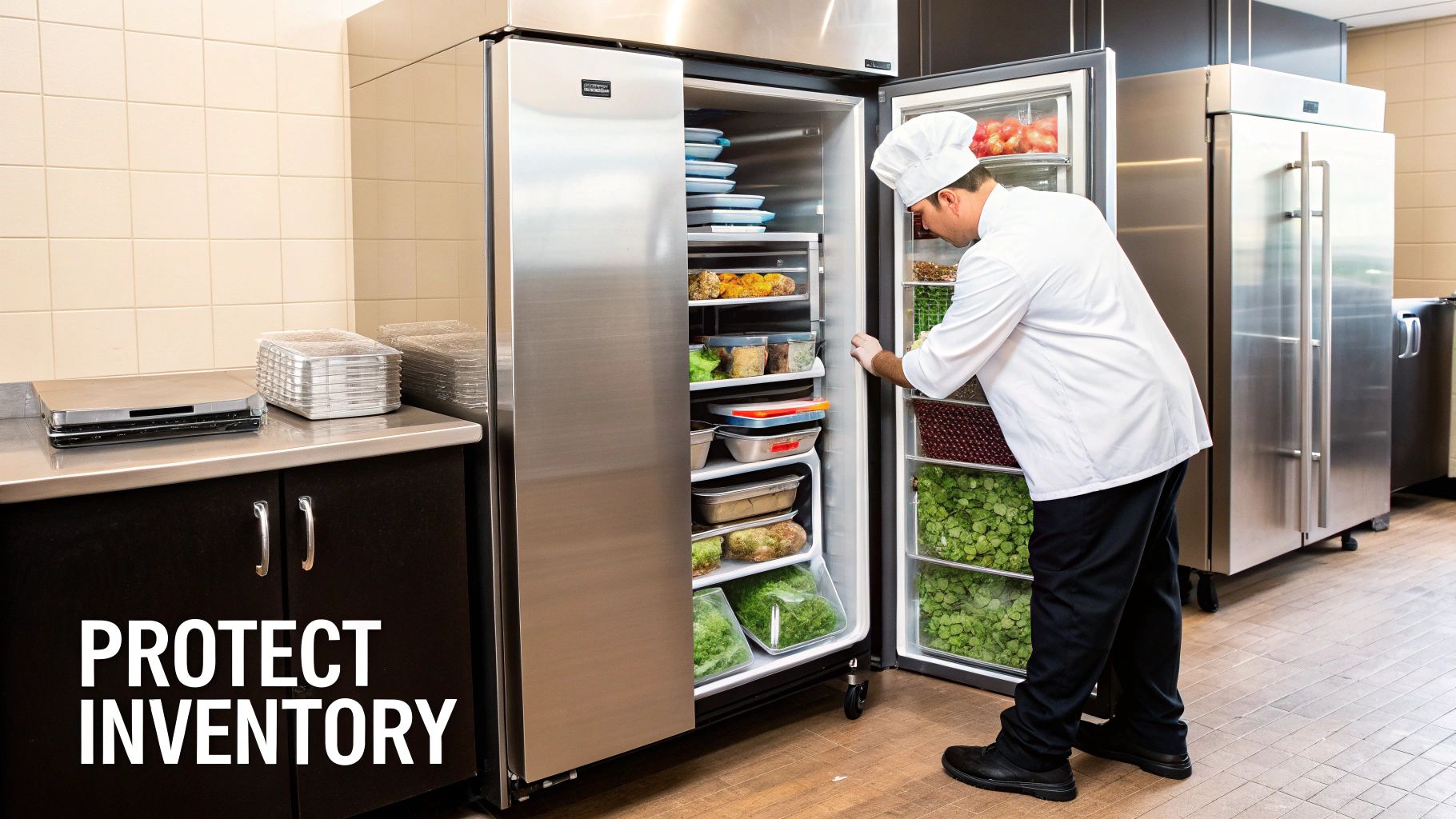
In the chaos of a busy restaurant, it's easy to see your deep freezer as just another appliance. But experienced operators know the truth: it's the financial engine of the kitchen. Think of it as a strategic tool that directly protects your bottom line.
Your freezer is essentially an insurance policy for your most expensive inventory. It’s guarding thousands of dollars in prime cuts of meat, delicate seafood, and specialty ingredients from spoilage. Protecting that investment is absolutely crucial for managing food costs—one of the biggest make-or-break factors in this business.
Beyond Cold Storage: The Heart of Kitchen Operations
A reliable freezer does so much more than just keep things frozen. It underpins your entire kitchen workflow and menu planning. Having ample, dependable freezer space means you can buy ingredients in bulk, letting you lock in better pricing and negotiate volume discounts from suppliers. This buying power is your shield against volatile market prices and unexpected supply chain hiccups.
It’s also the key to a smoother, more efficient back-of-house. A well-stocked freezer allows your team to prep ingredients and batch-cook components during slower hours. When the dinner rush hits, you’re ready to go. That means faster service, more consistent dishes, and a much less frantic kitchen crew.
A dependable commercial deep freezer isn't a cost center—it's a revenue protector. It gives you the peace of mind to focus on what matters most: creating an incredible dining experience for your guests.
This guide is here to cut through the confusing technical specs and industry jargon. We'll give you a clear, practical roadmap for choosing, running, and maintaining this vital piece of equipment. Let's make sure you're making a smart investment that pays you back in less waste, lower costs, and a smoother operation.
Choosing the Right Type of Commercial Freezer
Picking the right commercial freezer isn't about just finding the biggest box that gets cold. It's a strategic decision that needs to match the unique flow and rhythm of your kitchen. The first choice you'll make—and it's a big one—is the style of freezer, which will directly impact how efficiently your staff can store, prep, and grab what they need. Get it right, and your kitchen runs smoother; get it wrong, and you're creating headaches and higher energy bills.
Essentially, you have three main players to choose from: chest, upright, and walk-in freezers. Each one is a tool designed for a specific job in a professional kitchen. Let's break down which tool is right for you.
Chest Freezers: The Bulk Storage Vault
Think of a chest freezer as your long-term food vault. It's a big, deep, open space perfect for stashing bulk items you don't need to get to every single day—things like whole cases of meat, big bags of french fries, or seasonal produce you bought on a deal.
Their design makes them incredibly energy-efficient. Cold air is heavy, so when you lift that top-loading lid, very little of it escapes. An upright freezer, by contrast, spills cold air out onto the floor every time you swing the door open. That efficiency means lower utility bills, making a chest freezer a smart financial move for your deep-frozen stock.
The trade-off? Accessibility. Finding something at the bottom can feel like an archaeological dig. That's why they aren't great for high-turnover ingredients you need in the middle of a dinner rush.
Upright Freezers: The Everyday Pantry
An upright freezer is the workhorse of the daily grind, functioning more like a well-organized pantry. With shelves and door bins, your chefs can see everything at a glance, making it easy to grab ingredients quickly and follow a proper "first-in, first-out" (FIFO) rotation.
This style is perfect for the items your line cooks need to access constantly throughout the day. Uprights also have a smaller footprint, which is a huge plus in a cramped kitchen where every square foot counts. For restaurant owners and chefs looking for exclusive deals on the latest equipment, it's worth keeping an eye on suppliers offering promotions on these popular models.
The convenience comes at a small cost, as they do use a bit more energy. Every time that door opens, cold air floods out, and the compressor has to kick on to bring the temperature back down.
Walk-In Freezers: The High-Volume Warehouse
For a large restaurant, hotel, catering business, or any high-volume operation, the walk-in freezer is the king. This isn't just an appliance; it's an entire cold-storage room that acts as the warehouse for your whole menu. Walk-ins give you maximum capacity, letting you accept pallet-sized deliveries and keep massive amounts of inventory perfectly organized.
The demand for these units is a great barometer for the health of the food service industry. In fact, this is an industry trend to watch: the global commercial walk-in freezer market is projected to hit an estimated USD 1,214.1 million by 2035. This isn't just a fad; it's a reflection of how essential high-capacity, robust cold storage is for modern food businesses.
A walk-in is a serious capital investment, but for a large-scale operation, its ability to centralize inventory and simplify your receiving process is a game-changer. It truly becomes the heart of your supply chain.
Commercial Deep Freezer Types at a Glance
Choosing the right freezer often comes down to balancing space, accessibility, and your specific storage needs. This table simplifies the decision by putting the three main types side-by-side.
| Freezer Type | Best For | Space Footprint | Accessibility | Energy Use |
|---|---|---|---|---|
| Chest Freezer | Long-term bulk storage of items used infrequently. | Large and wide, requires significant floor space. | Low; items at the bottom are hard to reach. | Low; holds cold air effectively when opened. |
| Upright Freezer | Everyday access to high-turnover ingredients. | Smaller, vertical footprint, ideal for tight spaces. | High; shelves and door bins make organization easy. | Moderate; loses more cold air when the door is opened. |
| Walk-In Freezer | High-volume operations needing massive, centralized storage. | Very large; requires dedicated room-sized space. | Very High; allows for organized shelving and pallet storage. | High; depends on size, insulation, and usage. |
Ultimately, the best choice depends entirely on your operational reality. A small cafe might thrive with an upright, while a bustling catering company simply can't function without a walk-in.
How to Calculate Your Ideal Freezer Size
Picking the wrong size freezer is one of those classic kitchen mistakes that can cost you dearly. Go too small, and you're stuck—you can't take advantage of bulk pricing, your staff is constantly playing inventory Tetris, and you might even have to pare down your menu. But going too big is just as bad. You’re essentially paying to air-condition empty space, and that shows up on your utility bill every single month.
Getting this right isn't about wild guesses. It’s a practical calculation based on how your kitchen actually runs. The best way to start is by looking at your restaurant's seating capacity and how quickly you turn over ingredients. This helps you figure out the real cubic footage you need to support your service without wasting energy or precious floor space.
A Simple Formula for Estimating Freezer Needs
While no two kitchens are identical, a solid rule of thumb is to plan for 1.5 to 2.5 cubic feet of freezer space for every seat in your restaurant. A high-volume, quick-service spot with a simple menu can probably get by on the lower end of that spectrum. On the other hand, a fine-dining restaurant with a complex, prep-heavy menu will need to aim higher.
Let's put some numbers to it.
- Your Restaurant: A casual 50-seat bistro.
- Low-End Estimate: 50 seats x 1.5 cubic feet/seat = 75 cubic feet.
- High-End Estimate: 50 seats x 2.5 cubic feet/seat = 125 cubic feet.
This quick math gives you a realistic ballpark to start your search. It keeps you from buying a tiny unit you'll outgrow in six months or a monster that eats up your profits. For a deeper dive, you can learn more about how to correctly size a commercial refrigerator, since a lot of the same logic applies.
This flowchart helps visualize how your specific needs should guide your choice.
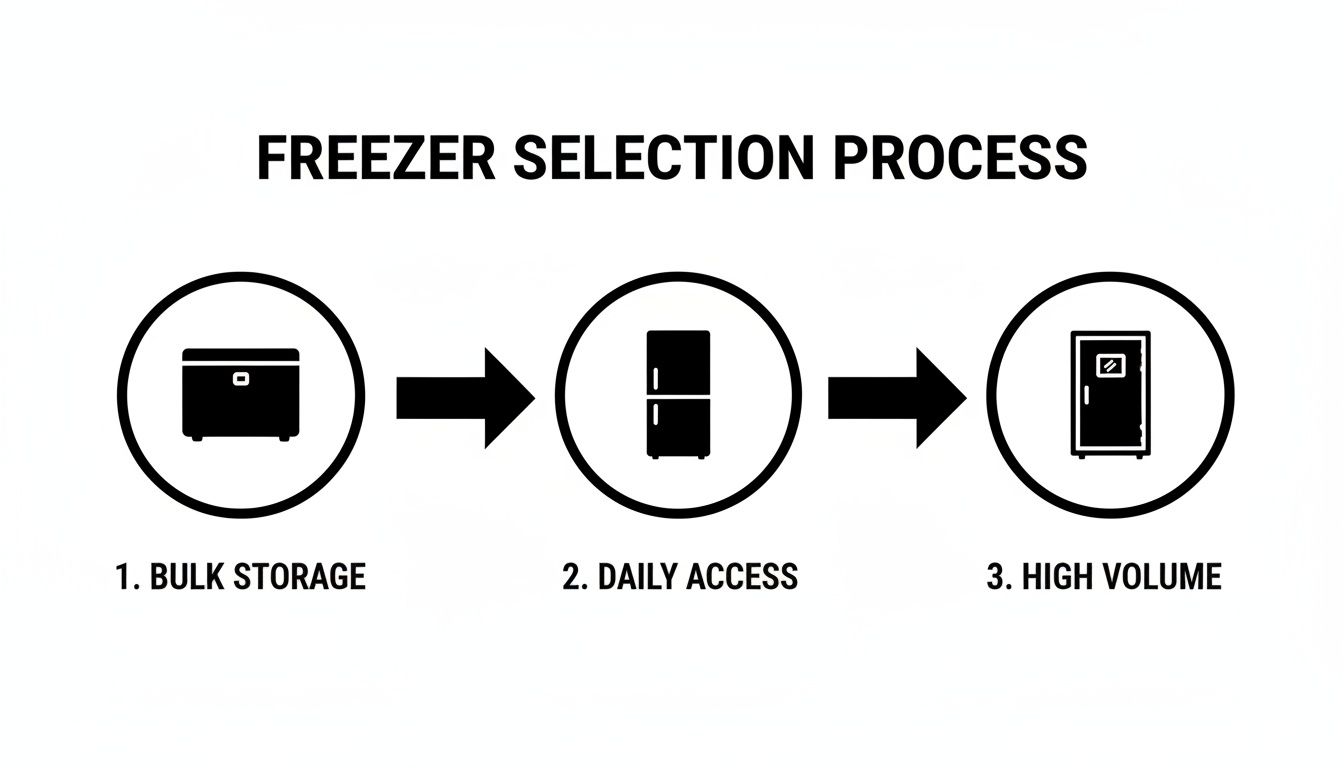
As you can see, the right freezer type is all about its primary job, whether that's long-term bulk storage or high-frequency access during a busy service.
More Than Just Cubic Feet
But let's be clear: "size" isn't just about the internal volume. You have to think about the freezer's physical footprint and where it’s going to live in your kitchen. Before you even think about clicking "buy," grab a tape measure and map out its exact spot.
A perfectly sized freezer dropped in the wrong location can torpedo your kitchen’s workflow. Think about the journey your staff takes from the delivery door to the freezer, then from the freezer to the prep line. A clear, easy path saves precious seconds and prevents accidents.
You also absolutely must account for proper clearance. These units are workhorses that kick off a lot of heat, and they need room to breathe.
- Ventilation Space: Plan for at least 3-4 inches of clearance around the back and sides. This space allows air to circulate around the condenser, and without it, the machine will overheat, work way too hard, and burn out fast.
- Door Swing: Don't forget to measure for the full swing of the door. An upright freezer door that constantly bangs into a prep table is more than just an annoyance—it's a bottleneck that will slow your whole team down.
When you pair a smart volume calculation with thoughtful spatial planning, you’ll land on a freezer that doesn't just hold your inventory, but actually makes your kitchen run better.
Understanding Key Performance and Technical Specs
When you're staring at the spec sheet for a new commercial deep freezer, it’s easy to feel like you’re reading a foreign language. But a few of those numbers and terms are absolutely critical—they directly impact your food quality, your monthly utility bill, and how long the machine will last. Getting these right is what separates a reliable kitchen workhorse from a constant headache.
At the end of the day, a deep freezer has one job: to stay incredibly cold with unwavering consistency. It's not just about freezing food; it's about locking in its quality for the long haul.
The Critical Role of Temperature Stability
The magic number for any commercial deep freezer is 0°F (-18°C), or even a little colder. This isn't an arbitrary figure. It's the scientifically proven point where the growth of bacteria, yeast, and mold grinds to a complete halt. Hitting this temperature essentially presses the pause button on spoilage, preserving the flavor, texture, and safety of your inventory.
But just getting down to 0°F is only half the battle. A great freezer can hold that temperature steady, even when the kitchen is blazing hot during a dinner rush and the door is being opened and closed constantly. A unit that struggles to recover its temperature will cause freezer burn, create nasty ice crystals on your products, and slowly degrade the quality of everything inside.
Think of your freezer's temperature like a steady hand holding a valuable asset. Even small wobbles over time can cause damage. Consistent, unwavering cold is the best insurance for your expensive inventory.
One of the biggest culprits behind those temperature wobbles—and a huge factor in your operating costs—is the defrost system.
Manual Defrost vs. Auto-Defrost Systems
Choosing between a manual and an auto-defrost (or "frost-free") freezer is one of those classic trade-offs between convenience and cost. There’s no single right answer; it really depends on your kitchen’s workflow.
-
Manual Defrost: These are the simple, ultra-efficient workhorses. They don't have internal heating elements that cycle on and off, so they maintain a more stable, colder internal environment and use far less electricity. The catch? You have to do the defrosting yourself, usually 2-4 times a year. It’s a real chore that requires emptying the unit and planning for downtime.
-
Auto-Defrost (Frost-Free): These models are all about convenience. A built-in timer and heating coil automatically melt any frost before it builds up, saving you a ton of labor. The downside is that these brief warming cycles introduce slight temperature fluctuations and, because that heater is kicking on, they consume more energy. That convenience shows up on your monthly power bill.
Making the right call here comes down to balancing your labor budget against your utility budget.
Insulation: The Unsung Hero of Efficiency
While everyone focuses on the compressor and defrost cycle, it's the insulation packed into the freezer's walls that's quietly doing some of the most important work. The quality and thickness of that insulation determines how hard the compressor has to run to keep things cold.
Look for freezers that use high-density, foamed-in-place polyurethane. This stuff creates a seamless, airtight barrier that keeps the kitchen's heat out. The thicker the insulation—you’ll typically see a range from 2 to 3 inches—the better the freezer is at trapping the cold air inside.
Better insulation gives you a powerful one-two punch. First, the compressor runs less often, which directly lowers your energy bill. Second, by easing the strain on the compressor, great insulation helps extend the lifespan of the entire unit, protecting your investment for years to come.
Thinking Beyond Price to Total Cost of Ownership
That sticker price on a new commercial freezer? It's just the down payment. The real story of what that unit will cost you plays out over the next decade, showing up month after month on your utility bills. One of the smartest financial moves you can make is to shift your focus from the upfront price to the long-term Total Cost of Ownership (TCO).
It's easy to see a high-efficiency freezer as just another big expense, but that’s a mistake. Think of it as a strategic investment. An energy-saving model might have a higher price tag today, but it actively pays you back with lower electricity bills for its entire working life. It's like buying a car with better gas mileage—you pay a bit more initially, but you save money every single time you hit the road.
Decoding Efficiency for Real-World Savings
So, how do you unlock these long-term savings? You have to know what modern efficiency actually looks like. That means keeping an eye out for models with the ENERGY STAR certification and understanding what those ratings really mean for your restaurant's bottom line.
An ENERGY STAR certified commercial solid door freezer can be up to 20% more efficient than a standard model. For a busy kitchen, that can easily add up to hundreds, if not thousands, of dollars in savings over the life of the freezer.
This isn't just marketing fluff. That efficiency comes from tangible improvements: better compressors, higher-quality insulation, and smarter designs that don't have to work nearly as hard to keep things frozen.
The Rise of Eco-Friendly and Cost-Effective Refrigerants
Another huge piece of the TCO puzzle is the type of refrigerant the freezer uses. Staying informed about industry trends like the shift to eco-friendly refrigerants can lead to significant savings. The industry is quickly ditching older hydrofluorocarbons (HFCs) for natural, eco-friendly options like R290, which is essentially a highly purified propane.
This switch is a win-win:
- Environmental Responsibility: R290 has a tiny fraction of the Global Warming Potential (GWP) of older refrigerants, making it a much more responsible choice.
- Operational Efficiency: It turns out R290 is also more thermodynamically efficient. Freezers using it simply need less energy to get cold and stay cold, which translates directly into lower operating costs for you.
Choosing a unit with a modern refrigerant isn't just about getting ahead of future regulations; it's about picking a more effective, less expensive system to run right now. For larger operations, the savings are significant. A 10–20% improvement in energy use can mean tens of thousands of dollars back in your pocket over the typical 10 to 15-year lifespan of commercial refrigeration equipment.
Ultimately, the initial purchase is a one-time event. The energy bill is forever. When you're thinking about the TCO, it's smart to consider all the ways you can improve HVAC efficiency and lower energy bills, because those same principles apply to every major appliance in your kitchen. A smart investment here can shrink that recurring cost for years to come.
Essential Maintenance to Prevent Costly Failures
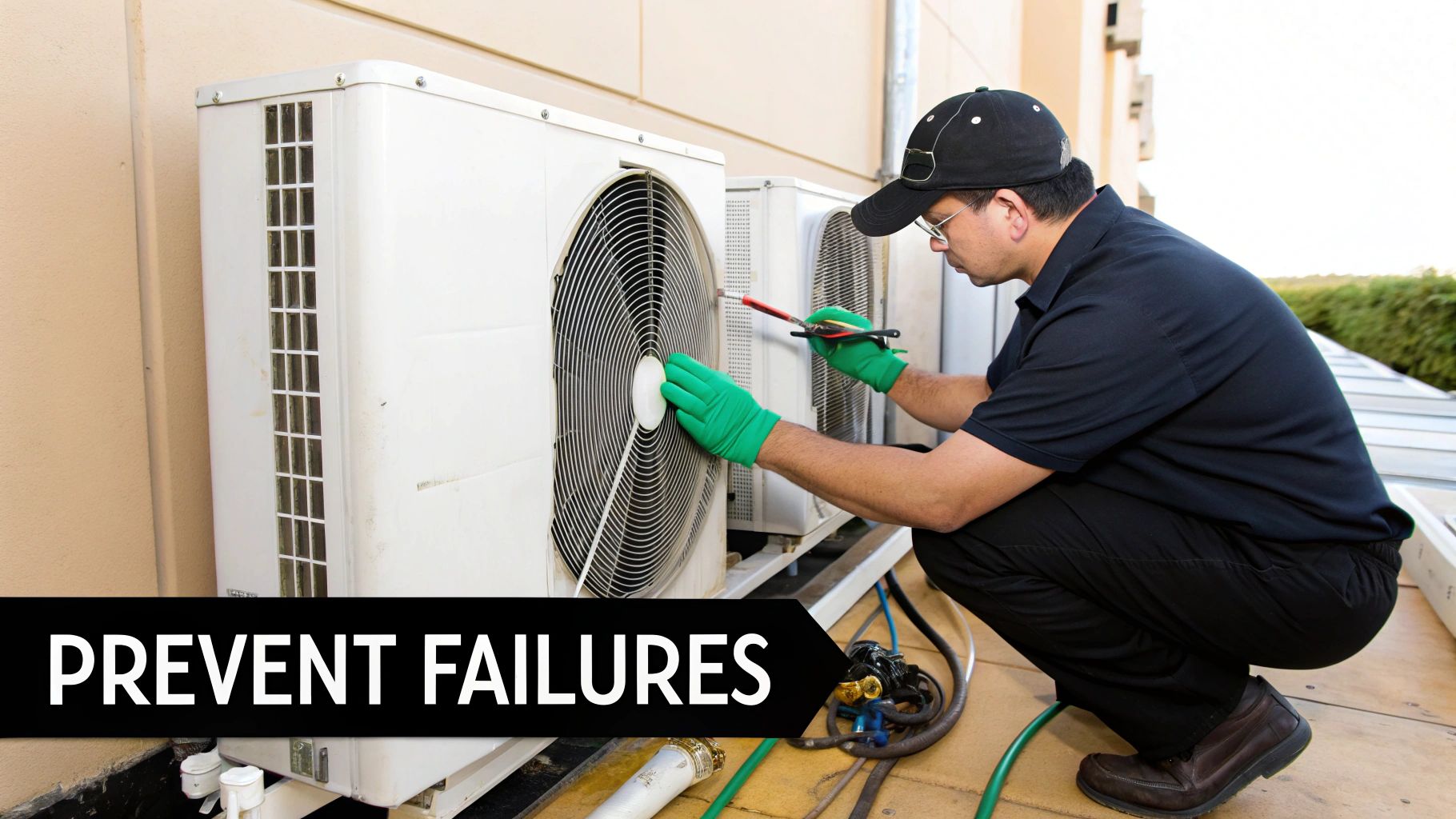
Think of routine maintenance as the cheapest insurance policy you can get for your frozen inventory. It’s a hard lesson to learn, but a single freezer failure overnight can easily wipe out thousands of dollars in prime cuts or prepped ingredients, turning profit into a complete write-off. Treating your commercial deep freezer like a set-it-and-forget-it appliance is a gamble you can't afford to take.
The smart move is to treat maintenance as a core part of your kitchen's workflow, right alongside ordering produce or sharpening knives. Being proactive doesn't just sidestep those catastrophic breakdowns. It also extends the life of your freezer and keeps it running at peak efficiency, which you'll see reflected in lower energy bills. A simple, consistent checklist is all you need to protect this workhorse of your kitchen.
Your Preventative Maintenance Checklist
You can head off over 90% of common freezer issues by building a few simple checks into your team’s weekly and monthly routines. These aren’t complicated technical jobs—they’re quick inspections that anyone on your staff can handle.
Weekly Tasks:
- Inspect Door Gaskets: This one is easy. Just run a hand along the door seals. If you feel even a hint of cold air escaping, the gasket is compromised. A bad seal makes the compressor work overtime, burning through electricity and wearing itself out.
- Check for Ice Buildup: On manual defrost units, keep an eye on frost. Once that ice gets to be about a quarter-inch thick, it starts acting like a blanket, insulating the inside and forcing the freezer to fight to stay cold.
- Clear Airflow: Make sure inventory isn't crammed up against the interior vents. On the outside, the unit needs to breathe—give it at least three to four inches of clear space all around for proper ventilation.
Monthly Tasks:
- Clean Condenser Coils: Your kitchen’s air is full of dust and grease, and it all ends up on the condenser coils. When they get dirty, they can’t release heat properly. A quick, careful vacuum or brush-down keeps your compressor from overheating.
- Wipe Down Fan Blades: Take a moment to gently clean any gunk off the evaporator and condenser fan blades. Clean blades push air way more effectively, putting less strain on the motors.
- Check and Clear Drain Lines: The defrost drain line can get clogged with ice or debris. Make sure it's clear so water can escape instead of backing up, freezing, and causing real damage.
Troubleshooting Common Freezer Problems
Even with the best care, you’ll run into hiccups. The key is knowing how to tell a quick fix from a call-the-tech emergency.
A freezer that’s constantly running isn’t just an annoying background noise—it’s a massive red flag. The cause could be as simple as a bad door seal, but it could also signal a serious refrigerant leak. Don't ignore it.
If you spot excessive frost, hear a new, strange noise, or see the temperature creeping up, your first step should be to run through the maintenance checklist. More often than not, a good cleaning or a minor adjustment will solve it. But if the problem sticks around after you’ve covered the basics, it’s time to bring in a professional.
For a deeper dive into taking care of all your kitchen gear, it's wise to stay informed about the latest news and maintenance tips for all your restaurant equipment and supplies.
To get a bigger picture on equipment care in general, check out these top preventive maintenance best practices. Building a solid care program across your entire kitchen is one of the smartest financial decisions you can make. Remember, proactive care is always cheaper than an emergency repair bill.
Your Commercial Deep Freezer Questions Answered
Even after you've nailed down the basics of type, size, and features, a few specific questions always seem to pop up right before you're ready to pull the trigger on a big purchase like a commercial deep freezer. We get it. This is a major investment, and you want to be sure.
To help you move forward with confidence, we've put together answers to the most common questions we hear from chefs and restaurant owners every day. Think of this as your final sanity check before choosing the right workhorse to protect your valuable inventory.
What Is the Ideal Temperature for a Commercial Deep Freezer?
The magic number you're looking for is 0°F (-18°C). That's the industry-wide, food-safety standard. Why that specific temperature? It's the point where the growth of bacteria, yeasts, and molds grinds to a complete halt, keeping your food safe and sound for the long haul.
But hitting 0°F is only half the battle—staying there is what really counts. Wild temperature swings are the enemy. They cause freezer burn, create those large, unappetizing ice crystals, and degrade the texture and flavor of your food.
Pro Tip: Don't just trust the built-in thermostat. Get a separate, calibrated thermometer and hang it inside. Logging the temperature daily is a simple habit that not only keeps health inspectors happy but also gives you an early warning if your equipment is starting to fail.
How Often Should I Defrost My Commercial Freezer?
That all depends on what kind of freezer you have. Ice buildup is handled in one of two ways.
- Auto-Defrost Models: If your unit is "frost-free," you can relax. These clever machines take care of everything on their own, running short, gentle heating cycles to melt away frost before it ever becomes a problem.
- Manual-Defrost Models: With these, you have to be more hands-on. The golden rule is to defrost whenever the ice reaches about a quarter-inch (6mm) thick. In a fast-paced kitchen, this usually works out to two to four times a year. Don't let it go beyond that—thicker ice makes the compressor work overtime, which just wastes electricity and shortens the life of your freezer.
Can I Use a Residential Deep Freezer in My Restaurant?
I know the price tag on a residential freezer looks tempting, but trust me on this: it’s a huge mistake for any professional kitchen. There are a few critical reasons why.
First, they simply aren't built for the job. The constant door openings, the high ambient heat of a kitchen—it will burn out a residential compressor in no time. They just can't handle the abuse.
Second, they don't have the power to recover their temperature quickly. Every time you open the door, the cold air rushes out, and a residential unit struggles to get back down to a safe temperature. That lag time puts your food in the danger zone. Most importantly, a residential freezer is not NSF International certified. Using one is an automatic health code violation that can get you fined or even shut down.
What Is the Difference Between a Commercial Freezer and a Deep Freezer?
While people often use these terms interchangeably, there's a technical difference that really matters when it comes to protecting your inventory.
"Commercial freezer" is the umbrella term for any freezer designed for a professional environment. This could include a reach-in that operates between 0°F and 10°F, which is fine for items you'll use up quickly.
The term "commercial deep freezer" is much more specific. It refers to units purpose-built for long-term, bulk storage at a rock-solid 0°F (-18°C) or below. Walk-in freezers and chest freezers are the classic examples. If you're looking to store expensive proteins, seafood, or seasonal produce for weeks or months at a time, you need a true deep freezer.
Ready to discover the latest news and exclusive deals on restaurant equipment? Find a commercial deep freezer that protects your inventory and supports your kitchen's workflow with the experts at Encore Seattle Restaurant Equipment. Explore our wide selection of new and used units and find the perfect fit for your restaurant at https://encoreseattle.com.