

Your Essential Guide to the Perfect Food Truck Grill
Your food truck grill is the heart of your entire operation. It dictates what you can cook, how fast you can serve, and ultimately, how successful your business becomes. This decision goes way beyond just picking a piece of metal; you're choosing the engine that will define your menu and your brand. The right grill will power you through the craziest lunch rush, but the wrong one will create a bottleneck that bleeds customers and cash. Stay informed with our expert guides to get the latest news and discover exclusive deals on the equipment you need to succeed.
Matching Your Grill to Your Menu
Think of choosing your grill as casting the lead role in your kitchen. The equipment has to align perfectly with your culinary vision. What works for a gourmet burger concept is all wrong for a street taco truck. It needs to be a workhorse that can perform day in and day out, delivering the consistent, delicious results that build a loyal following.
This isn't a decision to take lightly, especially with the market heating up. Staying informed about industry trends is critical; the global food truck scene is projected to explode from USD 6.4 billion in 2025 to a staggering USD 11.9 billion by 2034. It's telling that customized, medium-sized trucks—the ones built to house specialized, high-performance equipment—are leading the charge. Successful owners know they need to invest in the right cooking setup from the get-go.
Defining Your Cooking Style
Before you even start browsing models, take a hard look at your menu. What does it need to be successful? Are you chasing that perfect sear and smoky flavor, or do you need a jack-of-all-trades surface that can handle anything you throw at it? Discover the perfect match from our exclusive deals on top-tier restaurant equipment.
- Charbroilers: If you want classic, flame-grilled flavor and those beautiful sear marks, this is your tool. It's the only way to get that authentic taste for steak sandwiches, premium burgers, grilled chicken, and kebabs. The open flame delivers an intense, dry heat that’s simply impossible to fake.
- Flat Top Grills (Griddles): These are the undisputed champions of versatility. A flat top can crush a breakfast service with pancakes, eggs, and bacon, then pivot instantly to lunch for smash burgers, cheesesteaks, and quesadillas. That huge, evenly-heated surface is a lifesaver for high-volume service.
- Clamshell Grills: These are built for one thing: speed. By cooking food from both sides at once, they slash ticket times. They’re a perfect fit for concepts built around quick-turnaround items like paninis, grilled wraps, and certain styles of burgers.
Your menu is the blueprint. Don't buy a grill and then force your menu to fit its limitations. Design the menu you're passionate about first, then find the grill that executes it flawlessly.
Grill Type Comparison For Food Truck Menus
To help you visualize the best fit, here’s a quick comparison of the most common grill types. Think about your core menu items and which of these tools will help you produce them consistently and efficiently, even during a crazy rush. We can help you find exclusive deals on any of these essential supplies.
| Grill Type | Best For Menu Items | Key Advantage | Main Consideration |
|---|---|---|---|
| Charbroiler | Burgers, steaks, chicken, kebabs, grilled vegetables | Authentic flame-grilled flavor and sear marks | Requires robust ventilation; can create a lot of smoke |
| Flat Top / Griddle | Smash burgers, cheesesteaks, breakfast items, quesadillas | High-volume versatility and even heat distribution | Less "char" flavor; requires diligent cleaning |
| Clamshell Grill | Paninis, wraps, uniform patties, quesadillas | Maximum speed and efficiency; cooks both sides at once | Limited to items with a consistent thickness |
Each grill has its purpose. Your job is to match the equipment's strengths to your brand's culinary identity.
Propane vs. Electric: The Mobile Kitchen Debate
Choosing your grill's power source is a massive operational decision with daily consequences. This isn't just about personal preference—it's about reliability, power, and performance when you're under pressure. Keep up with the latest industry news to see which technology is right for you.
Propane grills are the industry standard for a damn good reason. They deliver raw, responsive power that doesn't depend on a generator. When you're at a remote festival with sketchy shore power, propane is your lifeline. It gives you the heavy-duty BTUs you need for a fast pre-heat and, more importantly, quick recovery when the line is out the door.
Electric grills, on the other hand, offer incredible temperature precision. They can be a fantastic choice for trucks with a seriously beefy electrical system. You also get to skip the hassle of storing and swapping heavy propane tanks, which can make some safety inspections a little smoother. The big trade-off? They put a huge strain on your generator, which might limit what other appliances you can run at the same time.
Picture this: It's a perfect Saturday at a food festival, and you've got a line 20 people deep. A propane charbroiler will roar right back to temperature after you slap a dozen cold burger patties on it. An underpowered electric model might lag, struggling to recover its heat. That slowdown cascades through your entire line, costing you sales and frustrating customers. Your grill is just one part of a larger system, so understanding the full range of essential equipment for food truck kitchens is crucial before you commit.
Sizing Your Power and Ventilation Systems
So you've picked the perfect grill for your menu. Awesome. But now comes the part that a lot of new owners overlook: feeding that grill the power it needs and getting all that heat and smoke out of the truck. This is the technical backbone of your mobile kitchen, and getting it wrong means tripped breakers, a smoke-filled workspace, and a lunch rush that grinds to a halt. Stay informed about the latest trends in restaurant equipment to make the right choice.
Think of it this way: your grill's power, measured in BTUs (British Thermal Units), is its engine. A wimpy grill just can't recover its temperature fast enough when you slap down cold patties, leading to painfully long ticket times and lost customers. You have to size it for your busiest hour. A high-volume burger operation, for example, is going to need a beast of a grill, something pushing 90,000 BTUs or more.
This flowchart breaks down how your menu dictates everything that comes after.
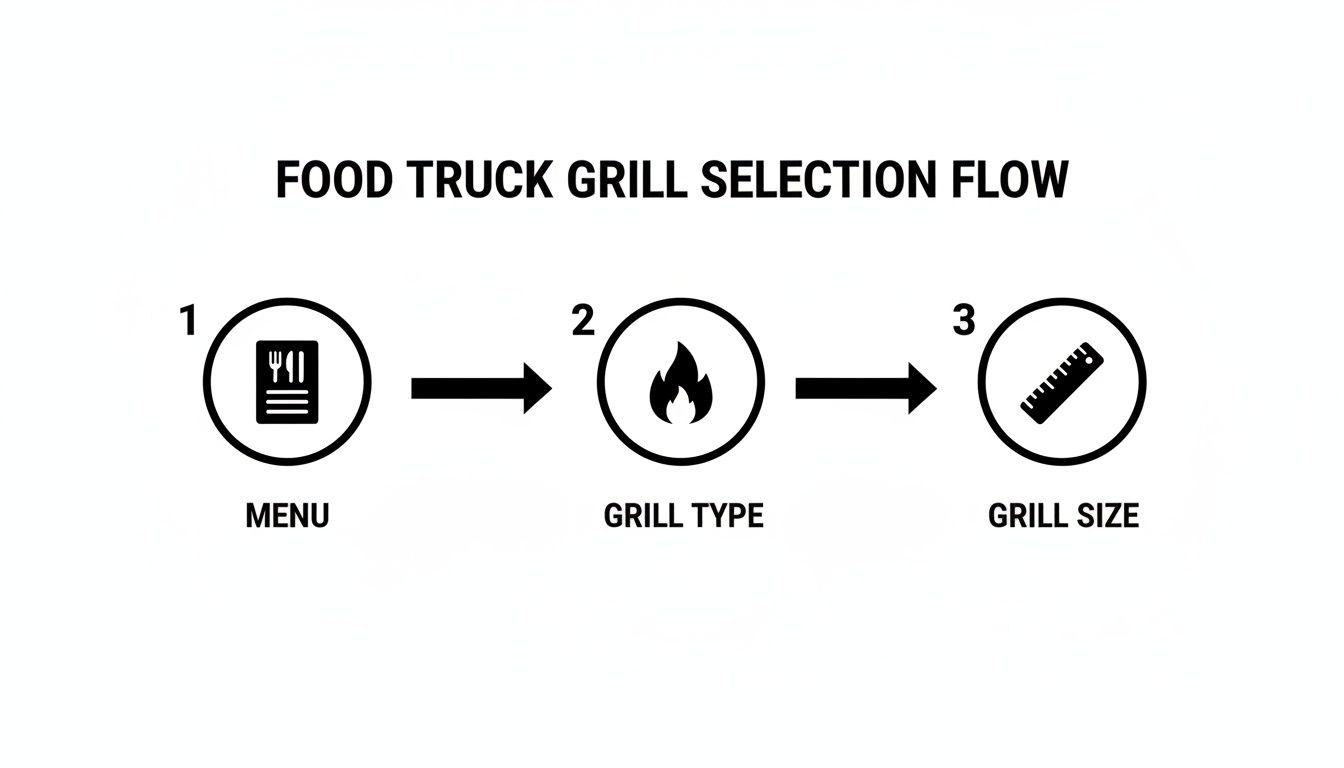
As you can see, every major equipment decision starts with what you plan to cook. It's a chain reaction that determines the scale of your entire build-out.
Calculating Your Power Demands
Your grill is hungry for power, and you need to keep it fed. If you're running on propane, this means getting your tanks right. Most trucks I've seen run on one or two 100-pound propane tanks, which absolutely must be secured in a ventilated, approved cabinet. My biggest piece of advice here? Always, always have a full backup tank ready to go. Running out of fuel mid-service is a rookie mistake that can cost you a day's revenue.
If you're going with an electric grill, your power math has to be even more precise. You need a generator that can handle the grill plus everything else—your fridges, lights, and POS system—all running at once. I’ve seen too many operators buy a generator that just barely covers their needs, only to have it fail when everything kicks on during a rush.
Pro Tip: Don't skimp on the generator. Buy one with at least 20-25% more wattage than your absolute peak demand. That buffer is your safety net, preventing overloads and ensuring you have consistent power when you need it most.
The Non-Negotiable Role of Ventilation
Let me be blunt: ventilation is not where you cut corners. Ever. An undersized system isn't just a miserable, hot, and smoky place to work—it's a massive fire hazard and a surefire way to fail your health inspection.
Your ventilation system is a team of three essential components:
- The Hood: This canopy sits over your grill and has to be bigger than the cooktop on all sides to properly catch grease, smoke, and heat.
- The Exhaust Fan: This is the motor pulling all that junk out of the air. Its power is measured in CFM (Cubic Feet per Minute), and the rating you need depends entirely on your hood size and how much smoke your cooking creates.
- Fire Suppression System: This is usually an Ansul system, and it’s non-negotiable. It's the automated system that can save your truck—and your life—if a fire breaks out. Trust me, the fire marshal will be looking at this with a magnifying glass.
Designing these systems can feel overwhelming, but it’s critical to get them right from the start. You'll save yourself a lot of headaches if you dive into the specifics of proper commercial kitchen ventilation systems before you start your build. Passing that first inspection is a huge milestone.
Installing Your Grill for Life on the Road
So, your brand-new grill has arrived. You can’t just plop it on the counter and call it a day, though. In a food truck, every single piece of equipment is part of a moving vehicle, and that changes everything. A solid, road-ready installation isn't just about making sure the grill works—it's a critical safety measure that protects your truck, your team, and your customers.
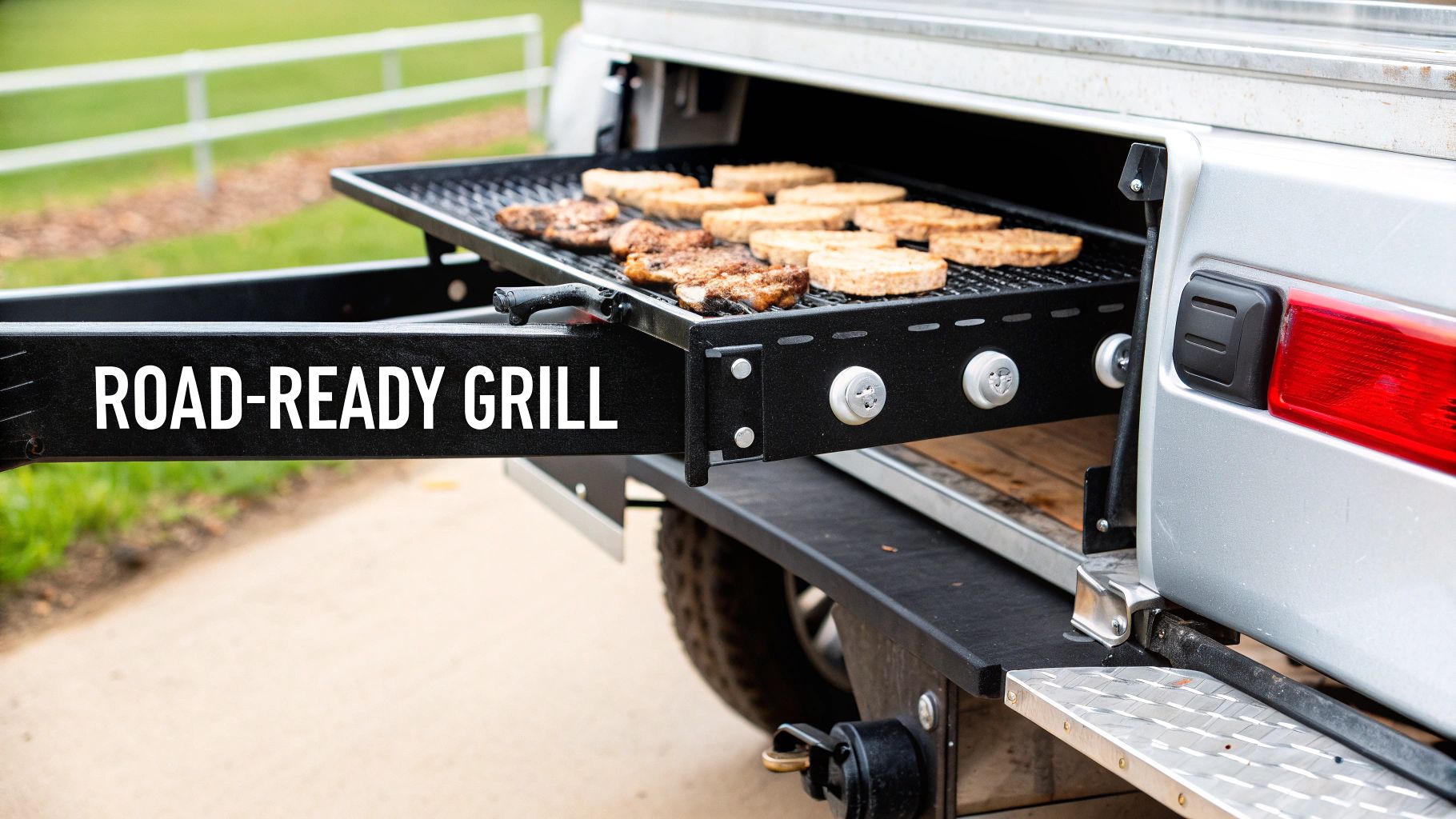
Think about it: the constant vibration and jostling of a moving truck can be brutal on equipment that isn't locked down. Connections work themselves loose, parts can shift, and what starts as a tiny rattle can quickly become a serious hazard. This is where the real work begins—turning a great piece of gear into a bulletproof part of your mobile kitchen.
Securing Your Grill Against Movement
Here’s the first and most important rule of food truck installs: nothing should ever move during transit. A grill that slides even a half-inch could sever a gas line or shear an electrical wire. That’s why bolting the unit directly to the truck’s frame or a heavily reinforced countertop isn't just a good idea, it’s a must-do.
Get yourself some heavy-duty, commercial-grade hardware—I’m talking stainless steel bolts, lock washers, and nuts. Forget about using simple screws; they’ll vibrate loose in no time. Your grill needs to be as secure as a passenger seat in a car.
The goal is zero movement. Before you take the truck out for its first spin, grab the grill with both hands and try to shove it. Hard. If you can make it budge even a little, it's not secure enough. This simple shake-down test can prevent a disaster down the road.
While you're at it, make sure the grill is perfectly level. Most commercial units have adjustable feet for this very reason. A level cooking surface is key for even cooking and proper grease drainage, even when you're parked on a street with a slight slope.
Maintaining Safe Clearances and Heat Shielding
Commercial grills throw off a tremendous amount of heat, and in the tight confines of a food truck, that heat needs to be managed properly. Fire codes are very strict about clearances, which are the minimum safe distances required between your hot equipment and any combustible surface like drywall or wood paneling.
Here's how you stay compliant and safe:
- Install heat shields: These are typically sheets of stainless steel mounted to the walls behind and next to the grill. You’ll want to leave an air gap between the shield and the wall for maximum insulation.
- Follow the manufacturer's specs: Your grill’s manual will tell you the exact clearances it needs. Health and fire inspectors know these specs and will check your setup against them. Follow the instructions to the letter.
- Keep the area clear: This might sound obvious, but never store anything flammable near the grill. That means no cardboard boxes, cleaning chemicals, or stacks of paper towels.
Cutting corners on clearances is one of the quickest ways to fail an inspection or, far worse, start a fire.
Connecting Power and Fuel Lines for the Road
Finally, you need to hook up your fuel or power lines, and these connections have to be tough enough for life on the move. Unlike in a restaurant kitchen, these lines will be subject to constant vibration.
If you have a gas grill, use a flexible, commercial-grade gas hose that's specifically rated for mobile use. Leave enough slack so it can absorb vibrations without being stretched or kinked. Once everything is connected, do a thorough leak check on every single fitting with a soap-and-water solution. If you see bubbles forming, you have a leak that needs to be fixed immediately.
For an electric grill, the key is strain relief. This means securing the power cord so that any yanking or vibration doesn't put stress on the actual connection points inside the grill. Make sure all wiring is tucked away safely, protected from both heat and physical damage. This kind of careful, detailed work during installation is what will keep your grill running safely and profitably for years to come.
Navigating Health Codes and Safety Inspections
Your food truck grill is gleaming, the menu is perfect, and you're itching to start serving. But before you can take that first order, you’ve got to face the final gatekeeper: the inspector. Failing a health or fire inspection can shut you down before you even start, turning your dream into a bureaucratic nightmare.
This is where the details really, really matter. Inspectors aren't just looking for a clean kitchen; they're hunting for specific, non-negotiable safety violations. Your entire business depends on knowing what they’re looking for before they show up with a clipboard.
And the stakes are only getting higher. The global food truck market is projected to grow from USD 4.33 billion in 2025 to USD 5.77 billion by 2029. With that kind of growth, you can bet local authorities are paying closer attention, especially when it comes to high-risk equipment like grills. Stay informed on the latest code changes to ensure you're always compliant.
What Inspectors Scrutinize Most
Think of your inspection as an open-book test. You already have all the answers—you just need to be prepared. Inspectors work off a checklist, and they almost always go for the high-risk areas first: your cooking and ventilation equipment.
A fire marshal will make a beeline for your fire suppression system. This is usually an Ansul system, and it has to be professionally installed, certified, and recently inspected. They'll check that the nozzles are aimed correctly over your grill and fryer, and they'll make sure the manual pull station is easy to get to.
Next up is ventilation. They’re going to look at your hood and the CFM (Cubic Feet per Minute) rating of your exhaust fan. Is it powerful enough for the heat and grease your grill puts out? A system that can’t keep up is a massive fire hazard and an instant red flag.
The Certification Checklist
Inspectors have their own language, and it’s all about certifications and codes. It’s not enough for your equipment to work well; it has to be officially rated for safety.
Here’s what they’ll be looking for:
- NSF Certification: Every single thing that touches food—from the grill itself to your prep counters—must be NSF (National Sanitation Foundation) certified. This mark proves it’s built for commercial use and is easy to clean properly. A residential grill is an automatic fail, no questions asked.
- Certified Gas Lines: All propane lines must be installed by a certified pro. The inspector will check every fitting and connection, looking for approved flexible hoses designed to handle the vibrations of a mobile kitchen.
- Proper Propane Storage: Your propane tanks need to live in a dedicated, ventilated cabinet that’s completely sealed off from the inside of the truck. You can't just stick them in a corner inside.
An inspector once told me, "I don't care how good your food is. If your gas line is leaking or your hood is caked in grease, you're a danger to the public." Safety always, always comes before service.
Avoiding Common and Costly Mistakes
Trust me, it’s much cheaper to learn from someone else's mistakes. I’ve seen brand-new operators fail inspections for things that were so easy to avoid. A classic one is improper clearances—not leaving enough space between the hot grill and a combustible wall. If you don't have heat shields, you're not opening.
Grease management is another huge one. A food truck is a hot, confined space, so you have to stay on top of it. Knowing how to properly prevent grease fires is non-negotiable, and that means cleaning your hood filters and grease traps religiously.
Navigating the web of local rules can be a real headache, since requirements change from one county to the next. To get a handle on what your local inspectors will be looking for, check out our guide on food truck permit requirements. Passing your inspection isn't just a box to check; it’s the foundation of a safe and successful business.
Keep Your Grill Running and Your Truck Earning
In a food truck, your grill isn't just a piece of equipment—it's the heart of your operation. When it goes down mid-service, it's not a minor hiccup; it's a direct hit to your wallet. A well-cared-for grill is a reliable money-maker. A neglected one is a breakdown waiting to happen.
Think of your maintenance schedule as a core business function, just like ordering inventory. It’s the simple, consistent care that separates a grill that lasts for years from one that dies in its first season. This isn't just about preventing that dreaded "we're closed" sign during a lunch rush; it’s about making sure your equipment is safe, efficient, and ready to perform every single day.
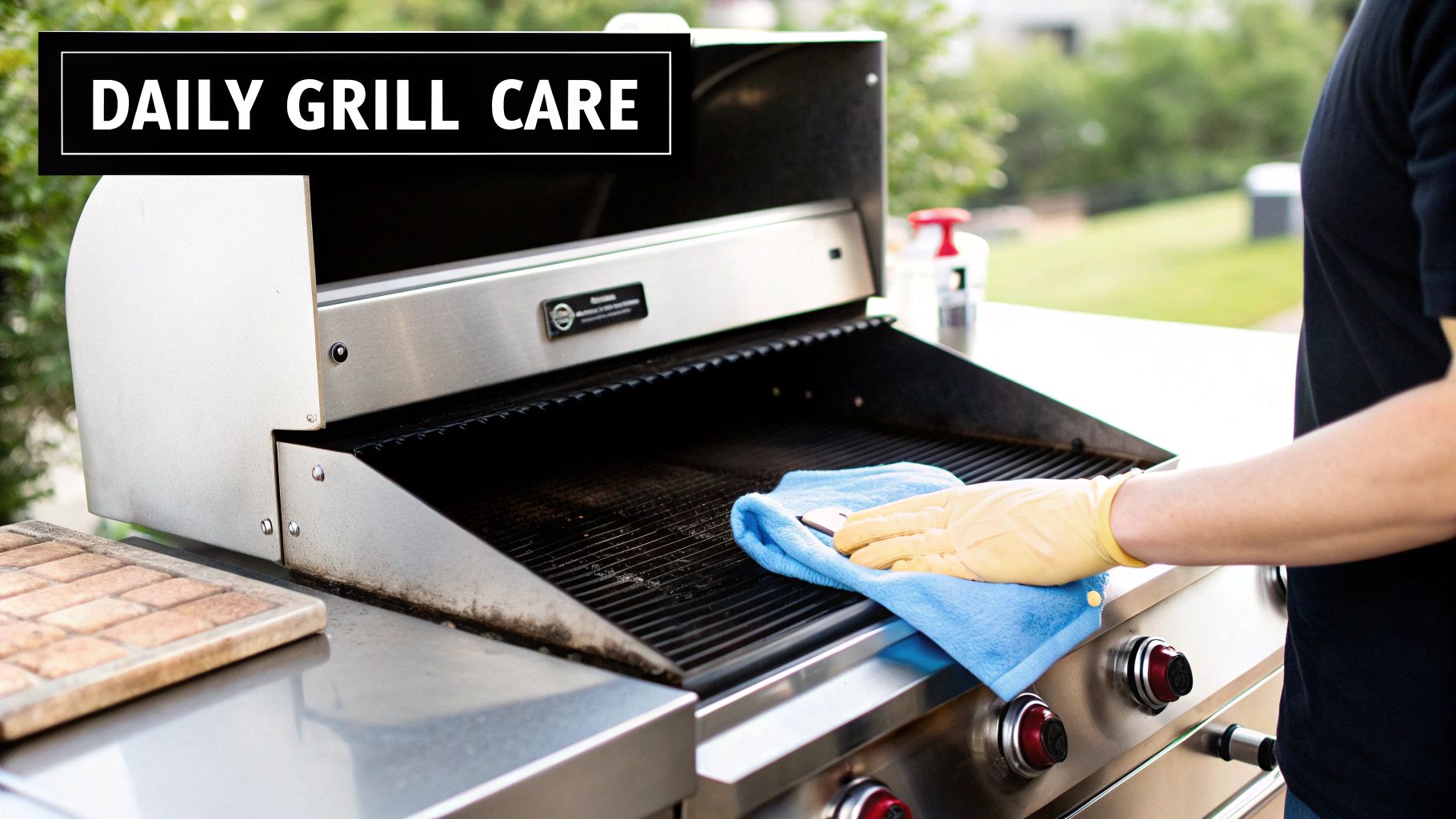
The Daily Ritual You Can't Afford to Skip
The bedrock of a healthy grill is a strict, end-of-day cleaning routine. This isn't just for the health inspector. It’s about preventing the two biggest threats in any mobile kitchen: fire and flavor contamination. Grease buildup is incredibly flammable and can turn a small flare-up into a catastrophe in seconds.
At the end of every shift—no exceptions—give your grill a proper cleaning. While it's still warm (but not dangerously hot), grab a grill brush or scraper and get all the food debris and carbon bits off the grates or flat top. Follow that up with a food-safe degreaser to wipe down all the surfaces.
And don't even think about ignoring the grease trap. A full grease trap is a massive fire hazard and a surefire way to fail an inspection. It absolutely must be emptied and cleaned every single day. This five-minute task is one of the most critical safety checks you'll perform on your truck.
Weekly and Monthly Health Checks
Daily cleaning handles the immediate grime, but your weekly and monthly checks are where you catch bigger issues before they take you offline. Think of this as your early warning system, letting you spot wear and tear before it becomes a full-blown equipment failure.
Here’s a simple checklist you can start using this week:
- Gas Hose Check (Weekly): The constant vibration from driving can be brutal on gas lines. Once a week, carefully look over every inch of your gas hoses, from the tank right to the grill. You're looking for any cracks, brittle spots, or scrapes.
- Clear the Burner Ports (Weekly): Clogged burner ports mean uneven flames, which leads to frustrating hot and cold spots on your cooking surface. Use a stiff wire brush or a port cleaning tool to clear out any gunk. A clean port gives you a consistent, even blue flame.
- Test Your Igniters (Weekly): Make sure your igniters are firing with a strong, solid spark. A weak igniter can allow dangerous gas to build up before it finally lights.
- Full System Check (Monthly): At least once a month, do a thorough inspection of all your fittings, valves, and connections. The best way to check for leaks is with a simple soap-and-water test on all gas fittings—the vibrations of the road can loosen them over time.
"Trust me, a five-minute check on a slow Tuesday is way better than a two-hour shutdown during the Saturday lunch rush. We learned that the hard way. Now, we never skip it."
Pro Tips for Peak Performance
Beyond the standard cleaning schedule, a few insider habits can seriously extend the life of your grill and improve the food you cook on it.
For anyone running a flat top, seasoning is everything. A properly seasoned griddle is naturally non-stick, which makes cooking easier and cleanup a breeze. After cleaning it, just wipe on a super-thin layer of a high-smoke-point oil (like canola) and heat the grill until the oil just starts to smoke. Let it cool, and you’ve created a protected, ready-to-cook surface.
Dealing with uneven heating is another classic food truck problem. If you've cleaned the burner ports and still have hot spots, check if the grill is level. Parking on even slightly uneven ground can throw off heat distribution. Most commercial grills have adjustable feet for exactly this reason. Taking a moment to level your grill before service can solve a surprising number of cooking consistency problems.
Got Questions About Your Food Truck Grill? We’ve Got Answers.
After you've sorted through the basics of picking, installing, and taking care of your grill, there are always those lingering questions. The kind that can make the difference between a smooth service and a major headache. Let's tackle some of the most common—and critical—questions we hear from food truck owners, whether they're just starting out or are seasoned pros. We help restaurant owners and chefs discover the answers they need.
What’s the Best Material for a Food Truck Grill?
For the body of the grill itself, there's no debate: stainless steel is the undisputed champion. It’s the industry standard for a reason. It's tough, fights off rust and corrosion, and is a breeze to clean and sanitize. In a mobile kitchen that has to pass health inspections, these aren't just nice-to-haves; they're non-negotiable.
Now, the cooking surface is where things get interesting. The right material really comes down to what you’re cooking.
- Cast Iron Grates: If you're all about getting those deep, classic sear marks on burgers and steaks, cast iron is your best friend. It holds heat like nothing else. Just know it's a bit of a high-maintenance relationship—you'll need to season it regularly to keep it non-stick and rust-free.
- Stainless Steel Grates: Looking for something easier to care for? Stainless steel is the answer. It cleans up quickly and doesn't need seasoning. The trade-off is that it doesn't retain heat quite as well as cast iron, which can mean slightly longer recovery times when you're slammed.
- Polished Steel Plate (Flat Tops): For griddles, a thick, polished steel plate is the gold standard. It gives you incredibly consistent, even heat across the entire surface. This is exactly what you need for nailing things like smash burgers, pancakes, or a perfect cheesesteak every time.
Here's the bottom line, no matter what cooktop you choose: the entire grill, from the body to the knobs, must be NSF-certified. That little sticker is your proof that the equipment is built for commercial duty and meets strict public health standards. Every health inspector will be looking for it.
How Much Does a Commercial Grill for a Food Truck Cost?
The price of a food truck grill can swing wildly, so it’s important to know what you’re getting into. And it's not just the sticker price of the grill; you have to think about the whole setup. We can help you discover exclusive deals on restaurant equipment to fit any budget.
A small, countertop griddle might only set you back $500 to $1,500. These are great for trucks with a focused menu or if you just need a secondary cooking surface.
For most trucks, the sweet spot is a standard 24-inch to 36-inch grill. These workhorses usually land somewhere between $2,000 and $5,000, depending on the brand and its features. If you need something bigger or more specialized, like a high-output charbroiler, you could easily be looking at $7,000 or more.
But remember, the grill is just the start. You also have to budget for professional installation, a commercial ventilation hood, and the mandatory fire suppression system. All told, these essential safety components can easily tack on several thousand dollars to your total investment. And don't even think about using a residential grill—it's an absolute non-starter. It won't survive commercial use and guarantees a failed inspection.
Can I Use a Charcoal Grill in a Food Truck?
We get it. The smoky flavor from a charcoal grill is incredible. But trying to use one inside an enclosed food truck is extremely difficult and almost always prohibited. It all comes down to safety and logistics.
Charcoal and wood-fired grills produce a ton of smoke and dangerous embers, creating a massive fire risk in a small, mobile space. To even attempt it legally, you'd need a highly specialized and prohibitively expensive ventilation system—way beyond what a standard food truck hood can handle. The vast majority of local fire and health departments will shut that idea down immediately.
If that authentic smoky flavor is central to your brand, you’ve still got options. You could try a smoker box on your gas grill to get a hint of that taste. A much better solution, though, is to operate a separate, tow-behind smoker. These are considered open-air cooking setups and are governed by a different set of rules, making it a far more realistic way to get that true barbecue flavor you're after.
Ready to build the heart of your mobile kitchen? At Encore Seattle Restaurant Equipment, we have the expertise and inventory to match your menu with the perfect, road-ready food truck grill. Explore our selection of new and used commercial cooking equipment to find a reliable, code-compliant solution that fits your budget. We help restaurant owners and chefs discover the latest news and exclusive deals on the restaurant equipment and supplies they need. Visit us at https://encoreseattle.com to get started.