
Food Truck Equipment Financing Guide
So, you have a killer concept for a food truck. The menu is planned, the branding is perfect, and you can already picture the long line of happy customers. But then reality hits: the cost of turning that dream into a fully-equipped, rolling kitchen.
This guide is designed to help restaurant owners and chefs discover the best ways to finance their mobile kitchens, stay informed about industry trends, and find exclusive deals on the equipment and supplies they need. This is where most aspiring food truck owners hit their first major roadblock. The price tag for the truck, ovens, fryers, and point-of-sale systems adds up fast. That's where smart financing comes in.
Funding Your Mobile Kitchen Dream
Think of food truck equipment financing as your secret ingredient for getting started. It’s not just about borrowing money; it’s a strategic move that lets you get the gear you need without wiping out your cash reserves.
Instead of sinking all your personal savings into a high-end espresso machine or a reliable generator, financing allows you to preserve that crucial capital for daily operations—things like buying ingredients, marketing your launch, and covering those inevitable unexpected costs. You get the best equipment now and pay for it over time as it generates revenue.
Turning Your Vision into Reality
This isn't a niche idea; it's how businesses are built. In the U.S., the equipment finance market is a massive $1 trillion industry. As of 2022, a staggering 79% of companies used financing to acquire the assets they needed to operate and grow. Food trucks are no exception. You can discover more about these financing trends.
A well-equipped kitchen is the heart of any food truck. Financing ensures you don't have to compromise on the quality and efficiency of your tools, directly impacting your menu, service speed, and profitability. Staying informed about equipment trends can give you a competitive edge.
Before you even start looking at loan options, it’s a good idea to know exactly what you need. Getting a handle on your equipment list will make the entire financing process smoother. You can explore food truck specific solutions to see what other mobile kitchens are using.
We've also put together a handy guide on the essential equipment for food truck kitchens to help you build out your shopping list. Once you know what you need, securing the funds to buy it becomes the next clear step to getting on the road.
Choosing Your Best Financing Path
Figuring out how to pay for your food truck equipment can feel a lot like staring at a complex menu—everything looks interesting, but you’re not sure what to order. Let's simplify it. Instead of one perfect choice, think of financing as a set of tools. The key is picking the right tool for the right job, based on where your business is today and where you want it to be tomorrow.
This isn't just about getting cash; it's about getting the right kind of cash. The right financing empowers your food truck to grow, while the wrong kind can hold you back. Staying informed about your options is the first step.
This quick decision tree can help you visualize which path might be the best starting point for you.
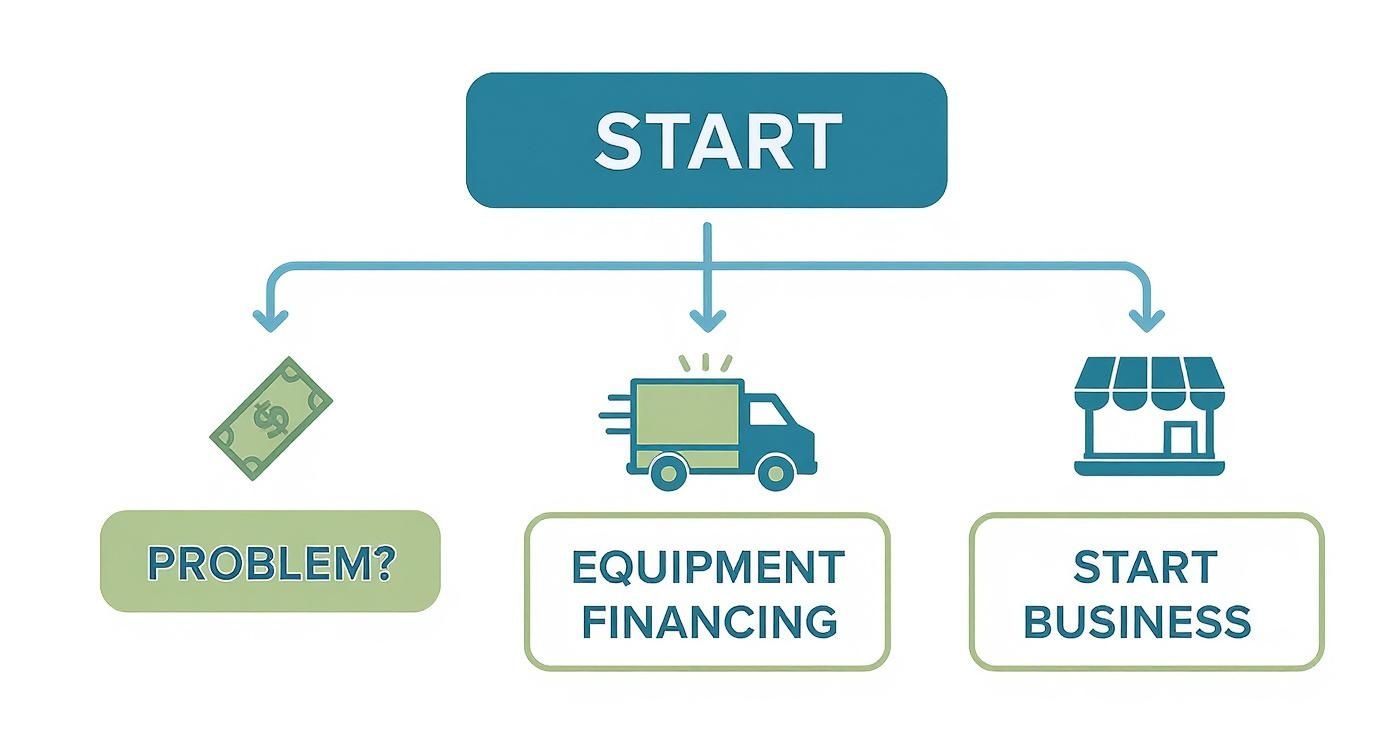
As you can see, once you've identified a need for capital, the next step is finding the equipment financing solution that fits.
Traditional Equipment Loans: The Workhorse
An equipment loan is the most straightforward option on the table. Think of it as the classic, reliable workhorse of financing. A lender gives you the money to buy a specific piece of equipment, and you pay it back with fixed monthly payments over a set period.
The beauty here is that the equipment itself usually serves as the collateral for the loan. Once you make that final payment, you own it free and clear. This is a fantastic choice for the core, long-lasting gear in your kitchen—the stuff you'll be using for years, like your commercial-grade oven, flat-top grill, or even the truck itself.
Equipment Leasing: The Smart Upgrade Path
If an equipment loan is about ownership, an equipment lease is all about access and flexibility. It lets you use the gear you need for a set amount of time with monthly payments that are often lower than a loan.
This is a brilliant strategy for equipment that evolves quickly, like a high-tech point-of-sale (POS) system or those fancy digital menu boards. Why buy something that will be outdated in two years? At the end of the lease, you usually have a few choices:
- Return the equipment and upgrade to the latest model.
- Buy the equipment you've been using at its current market value.
- Renew the lease and keep things as they are.
Leasing keeps your operation modern without the hefty upfront cost and long-term commitment of buying. To see if this path is right for you, learn more about our food truck rent-to-own options.
SBA Loans: The Heavy Hitter
SBA loans are the heavy hitters of the small business world. They aren't loans from the Small Business Administration, but rather loans from traditional banks that the SBA guarantees. This government backing makes lenders more comfortable, which often translates into better terms for you.
We're talking lower interest rates and longer repayment periods, which can make a huge difference for your cash flow. The catch? The application process is notoriously thorough and can take time. But for a qualifying startup or an expanding food truck business, the incredible terms are often well worth the effort.
Business Lines of Credit: Your Financial Safety Net
A business line of credit is your financial safety net. It's not for one specific purchase; instead, it gives you access to a pool of cash up to a pre-approved limit. You can draw from it whenever you need—for an unexpected refrigerator repair, a great deal on bulk inventory, or to cover payroll during a slow week.
You only pay interest on the money you actually use, and as you pay it back, your available credit replenishes. It’s the perfect tool for managing the unpredictable ups and downs of the food truck business.
Food trucks are often vital parts of their local food economies. You might even be able to supplement your funding by applying for programs like the USDA Local Food Promotion Grants to help your business grow.
Comparing Food Truck Financing Options at a Glance
With several paths to choose from, it can be helpful to see them side-by-side. This table breaks down the key features of each financing type to help you quickly compare and contrast, so you can stay informed about the best industry trends for your business.
| Financing Type | Best For | Ownership | Typical Term Length | Credit Impact |
|---|---|---|---|---|
| Equipment Loan | Long-lasting, essential equipment you want to own (ovens, grills, the truck). | You own it outright after the final payment. | 2–7 years | Builds business credit with on-time payments. |
| Equipment Lease | Tech-heavy or rapidly outdated gear (POS systems, digital menus). | You rent the equipment; option to buy at term end. | 2–5 years | Can build business credit; lower initial impact. |
| SBA Loan | Startups or major expansions needing favorable long-term financing. | You own the equipment purchased with loan funds. | 7–25 years | Strong positive impact due to strict underwriting. |
| Line of Credit | Managing cash flow, unexpected repairs, and inventory purchases. | Not for ownership; it's a revolving credit line. | Revolving (ongoing) | Builds credit as you borrow and repay responsibly. |
Ultimately, the best option depends on your specific goals—whether that's owning your assets for the long haul or staying nimble with the latest technology.
How to Prepare a Winning Loan Application
Think of your loan application as more than just paperwork. It's your first big pitch. You're not just asking for money; you're convincing a potential partner that your food truck is a smart bet. Lenders aren't just looking at numbers—they're looking for organized, professional entrepreneurs who have a clear, realistic plan to succeed.
A thoroughly prepared application sends a powerful message: you've done your homework. It shows you understand the market, you've crunched the numbers, and you're ready to hit the road running. Honestly, this level of preparation can be the single thing that separates a quick approval from a frustrating rejection.

Strengthen Your Financial Foundation
Before a lender even glances at your business idea, they’re going to look at your personal and business credit scores. A solid credit history is their shortcut to understanding your financial discipline. If your score isn't quite where it needs to be, now is the time to start shoring it up.
You can make a real difference with a few simple moves:
- Pay your bills on time, every time. Nothing builds a positive history like consistent, on-time payments.
- Pay down outstanding debt. Lowering the amount you owe, especially on credit cards, shows you can manage your finances effectively.
- Scrub your credit reports. Pull your reports and look for any errors. Disputing inaccuracies can sometimes give your score a surprising boost.
Taking these steps demonstrates that you're a responsible borrower, making you a much more appealing candidate for financing.
Craft a Business Plan That Tells a Story
Your business plan is the heart and soul of your application. It’s where you bring your vision to life, detailing your unique concept, who you're selling to, and exactly how you plan to make money. It needs to be professional, packed with realistic data, and compelling.
This is your chance to prove your idea isn't just a dream but a viable business. To make sure your plan really shines, check out our deep dive on how to build a great food truck business plan that will grab a lender's attention.
Your financial projections are where lenders will spend most of their time. They need to be optimistic enough to show potential but grounded enough to be believable.
Lenders need to see how they'll get their money back, and then some. Your projections should break down your startup costs, forecast your revenue based on real-world menu prices and locations, and show them exactly when you expect to break even. This is the financial story that convinces them your truck is a sound investment.
Gather Your Essential Documents
When it's time to apply, being organized is your best friend. Lenders require a specific stack of documents to verify your business's legitimacy and financial health. Having everything collected and ready to go will not only speed up the entire process but also make you look like the professional you are.
Start a folder and get these items together now:
- Personal and Business Bank Statements: Most lenders want to see the last six to twelve months to verify your cash flow.
- Personal and Business Tax Returns: Have the previous two to three years ready to go.
- Legal Business Documents: This includes your business registration, any required licenses, and permits.
- Detailed Equipment Quotes: Don't just estimate. Get official quotes for the specific pieces of equipment you plan to buy. This is also where you can find exclusive deals on restaurant equipment and supplies.
- Your Complete Business Plan: The polished, comprehensive document you've worked so hard on.
For perspective, a lender like National Funding offers loans from $5,000 to $500,000 specifically for food truck entrepreneurs. To get their best rates, they’re typically looking for owners with a credit score around 660, at least six months in business, and annual revenue topping $250,000. You can discover more insights about top food truck lenders and their requirements to see how you stack up.
Calculating the True Cost of Your Equipment
When a financing offer lands in your inbox, it's tempting to zero in on the big number—the total loan amount. But the real story, the one that impacts your business's health for years to come, is hidden in the details. The sticker price of your equipment is just the start; understanding the total cost of borrowing is what separates a smart financial move from a serious headache down the road.
To really compare apples to apples, you have to look beyond the initial loan and see how different factors will play out on your bottom line. This just means getting comfortable with a few key terms lenders throw around.
This isn't about becoming a financial wizard; it's about knowing enough to spot the best deal for your mobile kitchen and avoid costly surprises.
Decoding Your Loan Offer
Think of a loan offer like a recipe. The final dish is the total amount you’ll repay, but it’s made up of several key ingredients. You need to know what they are and how they mix together.
- Interest Rate: This is the most basic cost of borrowing money, shown as a percentage of the loan. It's a huge part of the calculation, but it definitely isn't the whole story.
- Annual Percentage Rate (APR): This is your new best friend. The APR is the most important number to compare because it includes the interest rate plus any extra lender fees (like origination costs) all rolled into one single percentage. It gives you the most honest look at the loan’s true cost.
- Origination Fees: Some lenders charge a one-time fee just for processing your loan. This is usually a percentage of the total loan, and it’s exactly why a loan with a lower interest rate might actually be more expensive once you look at the APR.
It's easy to get fixated on the monthly payment, but that can be a trap. A longer loan term always means a lower monthly payment, but you will almost always pay way more in total interest over the life of the loan.
The Impact of Loan Terms on Total Cost
Let's see how this all works in the real world. Here are a few common scenarios for a $50,000 equipment loan—a pretty typical amount for a food truck owner needing to kit out their kitchen with a new grill, refrigeration, and a solid POS system.
When you're comparing offers, always put the APR and the total interest paid side-by-side. A seemingly tiny difference in the APR can easily add up to thousands of dollars over the loan's term. Staying informed about these details helps you secure the best deal.
The table below breaks down how changing the loan term and APR affects your monthly payment and, more importantly, the total interest you'll shell out. Notice how a shorter term saves you a boatload of money in the long run, even with the higher monthly payment.
Sample Repayment Scenarios for a $50,000 Equipment Loan
This table shows just how much the interest rate and the length of your loan can change what you actually pay for your equipment.
| Loan Term | APR | Estimated Monthly Payment | Total Interest Paid |
|---|---|---|---|
| 3 Years (36 Months) | 8% | $1,567 | $6,408 |
| 3 Years (36 Months) | 12% | $1,661 | $9,788 |
| 5 Years (60 Months) | 8% | $1,014 | $10,832 |
| 5 Years (60 Months) | 12% | $1,112 | $16,733 |
See what happened there? By stretching the loan from three to five years at the same 8% APR, the total interest you pay nearly doubles, jumping from $6,408 to $10,832. That’s a massive trade-off. Lower monthly payments are tempting, but they come at the very real cost of a much higher long-term expense. This is exactly why doing the math on the true cost is a non-negotiable step in your financing journey.
Finding Local Financing in the Pacific Northwest
When you're running a food truck in the Pacific Northwest, going local for your financing can make a world of difference. While big national banks have their place, local banks, credit unions, and community lenders really get the Seattle market. They understand the summer festival rush, the dreary winter slowdowns, and the specific hurdles you'll face. This local insight often makes them a much better partner for your food truck equipment financing.
Think about it: building a relationship with a local lender means you're more than just a file number. They're invested in the community, which means they’re invested in your success. That often translates into more flexible terms and a real person to talk to when you need help.
Seattle Area Lenders and Credit Unions
Before you fill out an application with a massive, faceless bank, take a look at the players right here in our backyard. Many Seattle-based institutions have a solid history of backing small businesses.
- Regional Banks: Seek out community-focused banks with dedicated small business teams. They're typically more open to working with new ventures and understand the unique cash flow of a food business.
- Local Credit Unions: Because they're member-owned, credit unions like BECU and Verity Credit Union can often offer better interest rates and lower fees than their big-bank counterparts. They're built to serve their members, not just shareholders.
These local institutions have deep roots here. They want to see local entrepreneurs make it, and that can lead to a much smoother, more personal financing process from start to finish.
Exploring Community-Focused Financing
Sometimes, a traditional bank just isn't the right fit. Luckily, the Pacific Northwest has some incredible organizations dedicated to helping small businesses, especially those that might not tick all the boxes for a conventional loan.
Community Development Financial Institutions (CDFIs) are non-profits on a mission. They provide fair and responsible financing to build up local communities. For a food truck owner, a CDFI can be a game-changer, offering not just the cash you need but also business coaching, mentorship, and valuable connections.
Two of the best-known CDFIs in Washington are Craft3 and Business Impact NW. They specialize in funding entrepreneurs who are creating jobs and strengthening our regional economy—a perfect match for a growing food truck business.
Washington State Grants and Business Programs
Finally, don't forget to look for resources that can reduce the total amount you need to borrow. The state of Washington has several programs designed to give small businesses a boost.
A great first stop is the Washington State Small Business Development Center (SBDC). They offer free, one-on-one business advising and can help you navigate the world of grants and state-backed loans. While a straight-up grant to buy a fryer is rare, they can point you toward programs for veteran-owned businesses, job creation initiatives, or businesses in certain economic zones.
Tapping into these programs can free up your own cash for equipment. It's this kind of local knowledge and support that a generic national financing guide will never be able to provide.
Ready to Fire Up Your Kitchen? Here’s What to Do Next
You've made it through the complete guide to food truck equipment financing. We've covered everything from picking the right loan for your specific situation to pulling together an application that truly sells your vision. Hopefully, what once felt like a confusing maze of financial jargon now looks like a clear, step-by-step path forward.
With this knowledge in your back pocket, funding your dream kitchen isn't some far-off fantasy—it's a very real, achievable goal. The only thing left to do is take that first, crucial step. This is the moment where all your planning turns into action, moving your business from paper to pavement.
Partner with People Who Get the Food Truck Grind
Here at Encore Seattle, we're more than just an equipment supplier; we're your partner in the trenches. We help build businesses from the ground up, and we know the unique hustle of the food truck world because we’ve been supporting chefs and entrepreneurs in the Pacific Northwest for decades.
A brilliant culinary concept shouldn't be held back by budget. The right financing partner makes sure you don't have to cut corners on the heart of your operation: the kitchen itself. By staying informed about the latest equipment and financing deals, you empower your business to thrive.
That hands-on experience has allowed us to build solid relationships with lenders who actually specialize in the food service industry. These aren't generic banks; they're partners who understand the seasonal flows, the startup costs, and the specific needs of a mobile kitchen. They offer solutions that a typical lender just can't.
Let's Get Your Mobile Kitchen Rolling
Your journey from a great idea to a booming food truck business starts right now. We've lined up a network of financing partners who are ready to get you the capital you need, without the usual runaround. By working with us, you get direct access to lenders who are genuinely excited to invest in your vision and can help you find exclusive deals on the restaurant equipment and supplies you need.
Take the next step and explore our customized financing solutions through The Restaurant Warehouse. Let's work together to build out your mobile kitchen and turn your passion into a Seattle success story. Your hungry customers are waiting.
Got Questions About Food Truck Financing?
Even with a solid plan, you're bound to have questions when you start digging into food truck equipment financing. That's perfectly normal. This is where we tackle the common questions we hear all the time from folks just starting out and even from seasoned pros.
Think of this as a quick chat to clear up those lingering "what ifs." Getting these answers straight will help you move forward with a lot more confidence.
Can I Get Equipment Financing with Bad Credit?
Yes, you absolutely can, but your strategy will need to be a bit different. A great credit score obviously opens the door to the best interest rates and terms, but a lower score doesn't mean the door is slammed shut. It just means lenders will be looking for strength in other areas of your business.
If you're working on building your credit, you should expect lenders to:
- Ask for a bigger down payment. This lowers their risk and shows you have skin in the game.
- Offer higher interest rates to offset their perceived risk.
- Dig a lot deeper into your business plan and financial projections. They'll want to see a very clear path to profitability.
In this situation, you’ll often find that alternative lenders or merchant cash advance companies are more flexible than a traditional bank. They tend to care more about your recent sales and daily cash flow than your past credit mistakes, making them a solid option for many entrepreneurs.
Should I Finance the Truck and Kitchen Equipment Together?
This is a great strategic question, and honestly, there's no one-size-fits-all answer. You can go for a bundled loan that wraps the vehicle and all the kitchen gear into one package, or you can finance them separately. Each path has its own perks.
A bundled loan definitely makes things simpler. You'll have one application, one lender to deal with, and one monthly payment. When you’re juggling a million things to get your business off the ground, that kind of simplicity is a huge plus.
On the other hand, separate financing can sometimes save you money. You might find a fantastic rate on a commercial auto loan for the truck itself, then find a specialized equipment loan for your ovens and fridges. It takes a bit more research, but comparing rates could lead to some serious savings down the road.
My advice? Get quotes for both. Run the numbers and see which one gives you the best overall value and lower total borrowing cost before you commit.
How Long Does It Take to Get an Equipment Loan Approved?
The timeline for getting approved can be all over the map, depending on who you're working with. It really comes down to how deep the lender's approval process goes.
Here’s a rough idea of what to expect:
- Online and Alternative Lenders: These are the fastest by far. Their applications are built for speed, and you can often get a decision in 24 to 48 hours. Funds can be in your account just a few business days later.
- Traditional Banks and Credit Unions: Think of these as the slow-and-steady option. Their process is much more thorough, and it can easily take several weeks to go from application to funding.
- SBA Loans: These loans have fantastic terms, but they also have the most demanding and longest application process. It’s not unusual for an SBA loan to take a month or even longer to get finalized.
No matter which lender you choose, the best way to speed things up is to be prepared. Have your business plan, bank statements, tax returns, and equipment quotes organized and ready to go from the very beginning.
Your passion for food deserves the best equipment to make your vision a reality. At Encore Seattle, we do more than just sell equipment—we help build successful food businesses from the ground up. Through our partnership with The Restaurant Warehouse, we connect you with financing solutions designed specifically for entrepreneurs like you, helping you discover exclusive deals and stay informed on industry trends.
Let's get your kitchen fired up. Take the next step and explore our customized financing solutions through The Restaurant Warehouse to start building your mobile kitchen today.